
Since 22 July 2025 the Skilled Worker skill threshold has been RQF level 6 — degree level. The test is not what you studied but which occupation code your job sits in, and whether that code appears in the right table of Appendix Skilled Occupations. Five routes through the skill requirement now exist, and two of them are closing. Choosing the code is where applications are won or lost.

UK Work Visas
Skilled Worker Skill Level 2026: RQF 6, Occupation Codes and the Tables
What the Skill Level Test Actually Asks
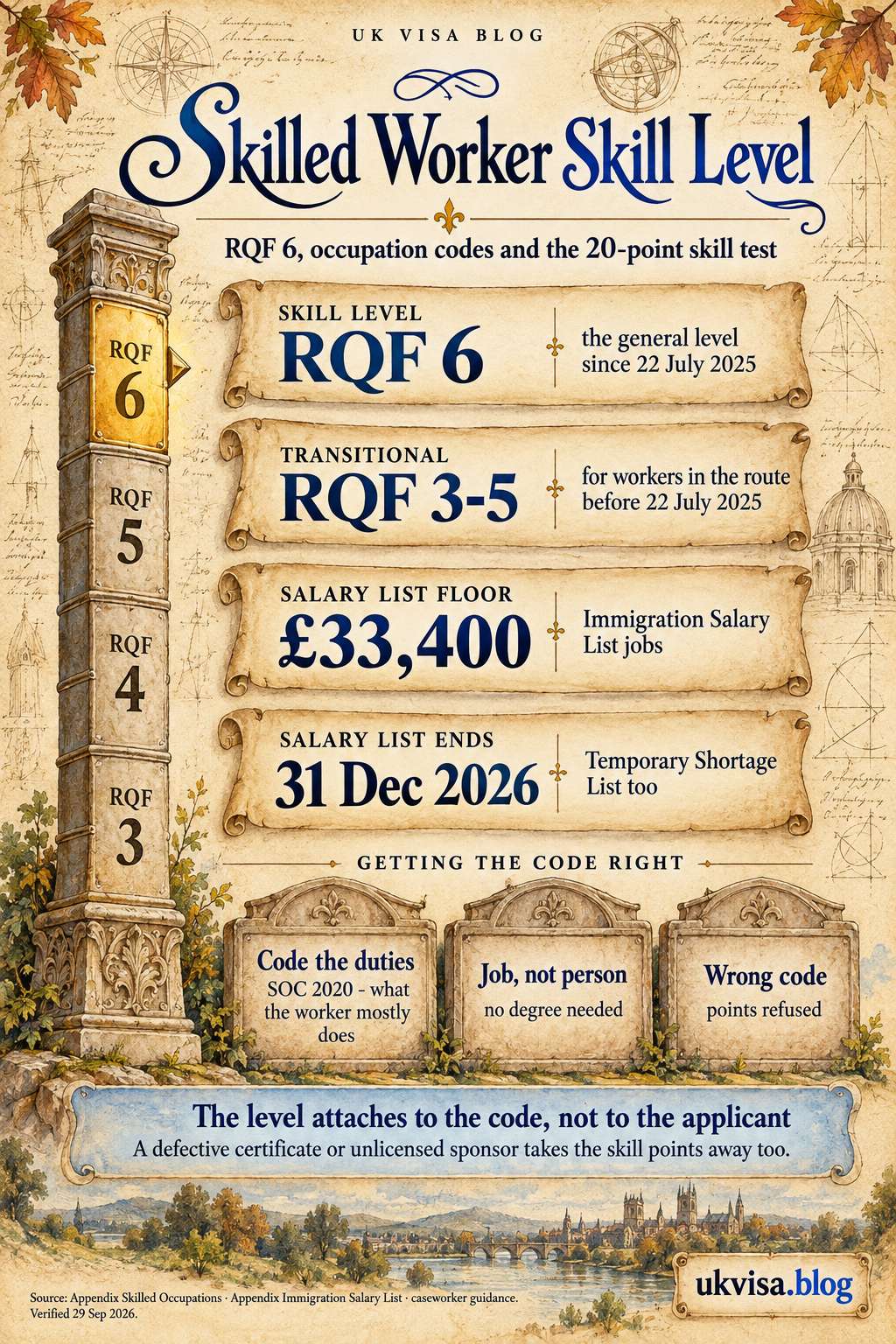
The applicant scores 20 points for a job at the appropriate skill level if the occupation code is eligible. Since 22 July 2025 that means RQF level 6, listed in Table 1, 2 or 3 of Appendix Skilled Occupations — or on the Immigration Salary List, or on the Temporary Shortage List, or covered by transitional arrangements for people already in the route. The level attaches to the job, not to the worker’s own qualifications.
RQF level 6 is bachelor’s-degree level on the UK qualifications framework, and the Home Office assigns a level to each occupation code rather than to each applicant. A candidate without a degree can be sponsored in an RQF 6 occupation, provided the duties genuinely match the code. Equally, a doctorate does not make an ineligible code eligible.
Skill level cannot be scored on its own. The caseworker guidance is explicit that these points must not be awarded unless the 20 mandatory sponsorship points are also being awarded — so a defective certificate or an unlicensed sponsor takes the skill points down with it, whatever the job.
Which Jobs Qualify
There is no shortlist worth memorising. Eligibility is decided by the code your sponsor assigns and the table it appears in, and both change between statements of changes. Rather than trust a list copied from elsewhere, check the code itself against the current Appendix Skilled Occupations on the day the certificate is assigned — that is the version a caseworker applies.
Where a professional field is concerned the codes are finer-grained than job titles suggest. In health and care, for instance, generalist and specialist medical practitioners sit in separate codes, 2211 and 2212; nursing spreads across 2231 to 2237; pharmacists are 2251, dental practitioners 2253, medical radiographers 2254 and paramedics 2255. Dentists and dental hygiene therapists sit in different codes entirely — the Health and Care Worker guide sets those out in full.
A second group is worth knowing because it carries a separate benefit: research and science codes 2111 to 2115, 2119, 2161, 2162 and 2311 are the occupations for which the Immigration Skills Charge is not payable at all — a saving on the employer side set out in our sponsorship guide.
Two practical consequences follow. First, a code that is eligible does not guarantee an affordable hire: the same code carries a going rate, and the higher of that rate and the cash threshold is what has to be paid. Second, an eligible code in one table may sit at a different rate in another, so the table matters as much as the code. Both feed directly into the salary assessment.
The Tables and What They Do
Appendix Skilled Occupations is organised into tables, and which one your code sits in determines both eligibility and the going rate. The pairs are easy to misread: Tables 1 and 2 contain identical occupation codes, as do Tables 1a and 2aa. What differs is the going rate attached to them.
How the Occupation Tables Work
| Tables | What they cover | Who can use them |
|---|---|---|
| 1, 2 and 3 | Occupations skilled to RQF level 6 | All applicants |
| 1a, 2aa and 3a | Occupations skilled to RQF level 3 to 5 | Transitional — in the route before 22 July 2025 |
| 2a | Occupations previously treated as RQF level 3 | Transitional — in the route before 4 April 2024, same sponsor |
Source: Home Office Skilled Worker caseworker guidance v20.0, 3 August 2026. Verified 22 August 2026.
Being in the route before a date means a certificate was assigned before it and a successful application was made on that certificate. The date you applied or were granted permission does not matter — only the assignment date. Continuous permission since then is also required, though a period of overstaying covered by the exceptions in Part Suitability is disregarded.
Sub-Degree Roles: What Is Left
Occupations below RQF 6 are not all gone. Two lists preserve a set of them, with different terms. The Immigration Salary List gives a lower cash threshold of £33,400 — at the full going rate, not a discounted one — and is due to expire on 31 December 2026. The Temporary Shortage List, roughly 52 occupations, preserves eligibility without any fee reduction at all.
For some occupation codes a job only counts as being on the Immigration Salary List or the Temporary Shortage List if it meets additional criteria — particular duties, experience, salary — or is based in a specific nation of the UK. The certificate of sponsorship has to confirm both that the job is on the list and that those criteria are met, and caseworkers use the “working at” address to decide which nation applies. Where a job turns out to be on the Immigration Salary List, the fee difference is refunded; there are no reduced fees for the Temporary Shortage List.
Care worker and senior care worker codes sit outside both lists on their own terms: closed to new overseas applications, but still available for extending, updating and in-country switching. Dependants are separately gated for medium-skilled roles, which is a different test from the skill points and catches people who clear the skill requirement comfortably.
Checking the Code — and Getting It Right
Use the CASCOT occupational coding tool, which the guidance names as the way to code a job against the current SOC 2020 classification. Code against the duties the worker will actually spend most of their time doing, not the job title. Where more than one code plausibly fits, sponsors should choose the closest — and where the choice is finely balanced, the guidance says sponsors should normally be given the benefit of the doubt.
That benefit disappears where the code looks chosen for advantage. Caseworkers are told to consider whether a less appropriate code was picked to make an unskilled job look skilled, to allow a lower going rate, to reach the Immigration Salary List, or to unlock PhD points. Two red flags are named: a job description that reads as a template used for other businesses in a high-risk sector, and an applicant refused before on similar grounds.
Sponsors who treat coding as an administrative field to be filled in at the end are the ones who get caught. Treat it as the first decision in the hire, made against the job description you will actually use, and keep a dated record of the going rate published on the day the certificate is assigned.
- Code the duties: the classification follows what the worker does, not what the role is called.
- Use the current classification: SOC 2020 coding changes, and the version in force at assignment is what is assessed.
- Evidence the need: caseworkers weigh whether the sponsor has shown a genuine need for the job as described.
- Match the person to the code: whether the applicant has the skills, qualifications and experience for it is part of the assessment.
- Expect to be asked: where there are concerns, the sponsor is given the chance to correct an error or explain the choice.
- Check ATAS: research roles at PhD level in sensitive subjects need a certificate, and the sponsor answers for it on the certificate of sponsorship.
A wrong code is not a technicality. It can cost the skill points, the salary points through the going rate, and — where it looks deliberate — the sponsor’s licence. It is among the most common refusal grounds, and it is the input that decides the figures in our salary threshold guide.
Skill level is one of five mandatory blocks. The rest are sponsorship, salary, English at B2 for first-time applicants under the CEFR standards, and the financial requirement. Intra-company transfers run on a separate subset of codes through the Global Business Mobility routes. The whole route is covered in our Skilled Worker guide, costs in the fee table and the health surcharge guide, faster decisions in the priority services guide, and the endgame in our Skilled Worker ILR guide.
Sources: GOV.UK the job requirements page on GOV.UK; Appendix Skilled Occupations; Appendix Immigration Salary List; and the Home Office Skilled Worker caseworker guidance version 20.0, published 3 August 2026. Figures verified 22 August 2026.
Frequently Asked
Questions about Skill Level and Occupation Codes
RQF level 6 — degree level — since 22 July 2025. The occupation code must appear in Table 1, 2 or 3 of Appendix Skilled Occupations, or on the Immigration Salary List or Temporary Shortage List, or be covered by transitional arrangements for people already in the route. The level is a property of the occupation, not of the applicant.
Not necessarily. The requirement applies to the job, so a worker without a degree can be sponsored in an RQF 6 occupation if the duties match the code. But caseworkers do consider whether the applicant has the skills, qualifications and experience the code implies, so a mismatch between the person and the role is itself a reason to question the coding.
They lost general eligibility on 22 July 2025. Some survive on the Immigration Salary List, which carries a £33,400 cash floor at the full going rate and is due to expire on 31 December 2026, and roughly 52 sit on the Temporary Shortage List, which preserves eligibility but attracts no fee reduction. Workers already in the route before the change keep transitional access to the lower tables.
Tables 1, 2 and 3 hold the RQF 6 occupations open to everyone. Tables 1a, 2aa and 3a hold RQF 3 to 5 occupations, open only to people in the route before 22 July 2025. Table 2a holds occupations previously treated as RQF 3, open to people in the route before 4 April 2024 who are applying to work for the same sponsor.
Use the CASCOT occupational coding tool against the duties the worker will actually perform, and check the result in the current Appendix Skilled Occupations. Coding changes over time, so the classification in force when the certificate is assigned is the one assessed. Where two codes both fit, choose the one containing the duties the worker will spend most time on.
Where the choice is finely balanced, sponsors are normally given the benefit of the doubt. Where a code appears chosen to make a job look more skilled, to allow a lower going rate, or to reach the Immigration Salary List or PhD points, the skill points are not awarded. Sponsors are usually asked to explain first, which is an opportunity to correct genuine errors.
Only the Immigration Salary List. Where a job turns out to be on it, caseworkers make arrangements to refund the fee difference. There are no reduced fees for jobs on the Temporary Shortage List. For some codes the job must also meet additional criteria, or be based in a particular UK nation, and the certificate of sponsorship must confirm this.
No. The guidance instructs caseworkers not to award points for a job at the appropriate skill level unless the 20 mandatory sponsorship points are also being awarded. A certificate that fails on validity, a sponsor that is not licensed or A-rated, or a vacancy found not to be genuine therefore takes the skill points with it regardless of how the job is coded.