
Most sponsored applications are decided on paper. An interview happens when a caseworker doubts something specific — that the job is real, that you will actually do it, or that a qualification is what it claims to be. Knowing which doubt you are answering is most of the preparation, because the work visa interview is a genuineness test, not a job interview.

UK Work Visas
UK Work Visa Interview 2026: What Is Tested and How It Is Decided
What the Interview Is For
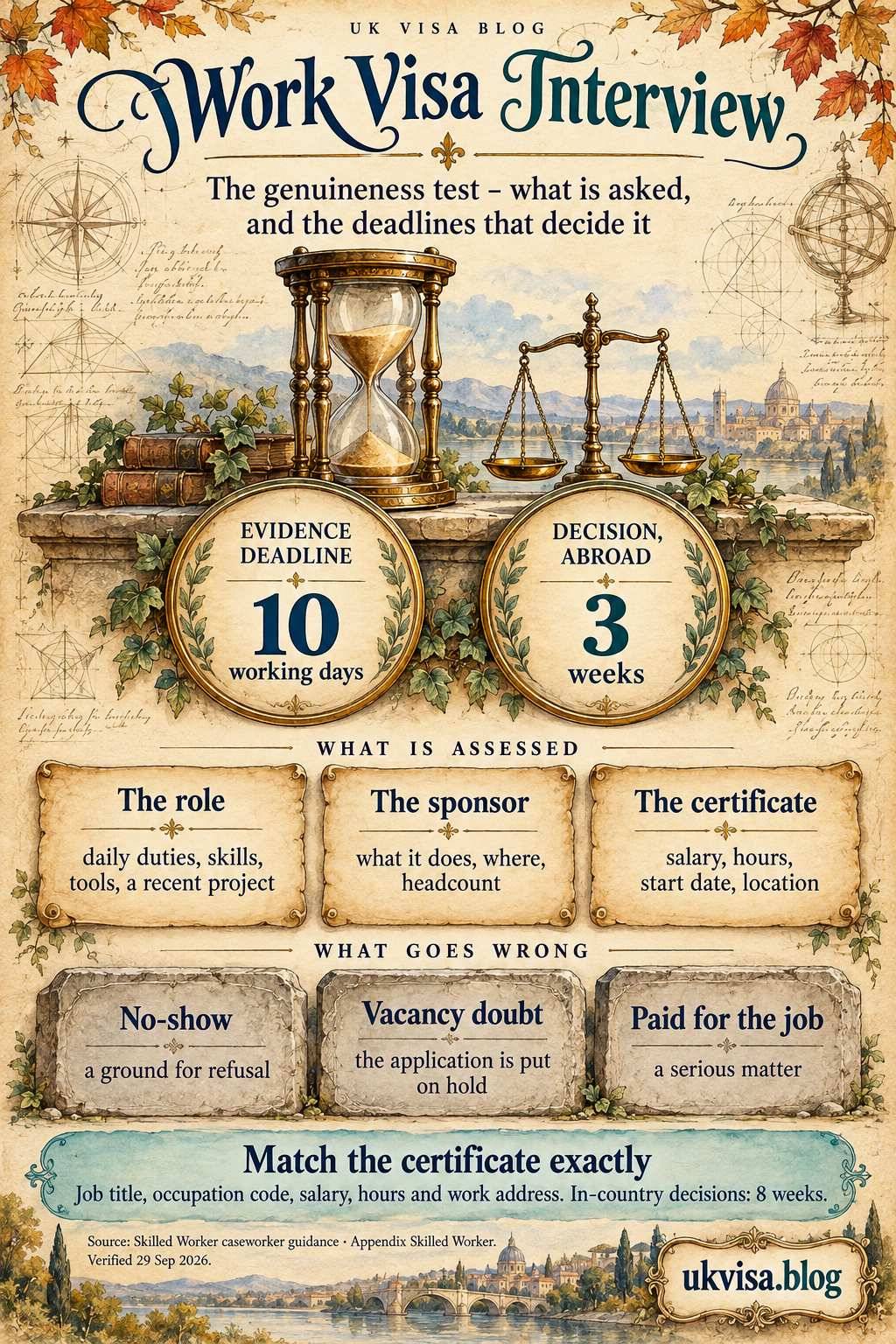
Caseworkers must be satisfied that you genuinely intend to do the job on your certificate of sponsorship, that you can do it, and that you do not intend to work outside what your permission allows. Where that is in doubt they can ask for more evidence, or require you to attend an interview. Failing to attend without a reasonable explanation is itself a ground of refusal, as is failing to supply requested documents within 10 working days.
The test is set out in the Skilled Worker caseworker guidance and it is narrow. Nobody is assessing whether you are the best candidate or whether the salary is generous. They are testing three propositions: intention, capability, and the absence of an intention to do something else. Everything asked in the room maps back to one of those.
The guidance also tells caseworkers not to reach for an interview first. They should ask only after assessing whether the application should be refused on the information already available — so an interview invitation usually means the paperwork has not settled a question, not that a refusal is already written.
Who Gets Interviewed
There is no random selection quota that applicants can plan around. Interviews cluster around three triggers, and each produces different questions.
- Doubt about you: the caseworker is not satisfied you intend to, or can, do the role described on the certificate.
- Doubt about the vacancy: concerns that the job does not exist, is a sham, or was created so someone could apply — and that you may be complicit in it.
- Doubt about a qualification: where a verification check comes back as unable to verify, the guidance directs the caseworker to request evidence and consider inviting you to interview.
- Sector risk: a job description that reads as a template used across other businesses, in a high-risk sector, is expressly named as a warning sign.
- History: a previous refusal on similar grounds is another named factor.
The vacancy trigger matters most because it can run in parallel with a compliance visit to your employer. Where that happens the application is held, and you are told it is on hold without being told why — the sponsor-side framework is in our sponsorship guide.
What You Will Be Asked
The guidance lists what a caseworker may consider when testing genuineness, and the questions follow it directly. There are five areas, and the interview rarely strays outside them.
The Assessment Areas and the Questions They Produce
| Assessment area | Typical questions |
|---|---|
| Knowledge of the role | What will you do day to day? Who will you report to? What does the team look like? |
| Relevant experience of the skills needed | Where have you done this before? What tools or systems do you use? Talk me through a recent project. |
| Knowledge of the sponsor | What does the business do? Where is it based? How many people work there? Who interviewed you? |
| How you were recruited | How did you find the vacancy? Who did you speak to? Did you pay anyone anything? |
| Any other relevant information | Salary, hours, start date and work location as stated on the certificate |
Source: Home Office Skilled Worker caseworker guidance v20.0, 3 August 2026. Verified 22 August 2026.
The recruitment question is the one applicants underestimate. Any payment made to secure sponsorship is a serious matter, and inconsistent accounts of how the job was found are among the commoner reasons applications fail.
What a Good Answer Looks Like
Detail beats polish. A caseworker is comparing what you say against the certificate of sponsorship, the job description and anything the sponsor has told them, so specifics that match those documents are what carry weight — job title, reporting line, location, hours, salary.
On the role, describe the work rather than the title: the systems you will use, the outputs you are responsible for, who you hand work to. On the employer, know what they actually do and where you will be based. On salary, give the figure on the certificate. If the two differ, that difference is the point — check it before the interview, because pay below the certificate figure is a live issue in its own right under the salary rules.
Where a question touches the occupation code, answer in duties rather than labels. Caseworkers assess whether the code matches what you will spend most of your time doing, so an answer that describes duties consistent with the code chosen resolves the concern that code selection was engineered.
How Credibility Is Judged
Credibility here means consistency between three accounts: yours, your sponsor’s, and the documents. The guidance requires caseworkers to put concerns to you in clear language and give you a chance to respond, in an interview or in writing, before deciding. That is an opportunity, not a formality — a clear explanation at that point can resolve the case.
If the caseworker concludes you were complicit in a vacancy that is not genuine, that finding goes into the refusal. The consequences run beyond the single application, because a finding of that kind sits in your immigration history and can affect later applications, including UK entry bans and the prospects of applying again.
How the Process Runs
Two mechanisms sit alongside each other. The caseworker may request additional information and evidence, which must reach the address given in the request within 10 working days — miss that and the application can be refused on the papers. Or they may require an interview, usually by video, and refuse if you do not comply without a reasonable explanation.
Where a caseworker requests additional information or evidence, the guidance requires the documents to be received at the address given in the request within 10 working days of the date the request is made — and allows the application to be refused if they are not. The clock runs from the date of the request, not from the date you read it, and posting on the tenth day is not the same as arriving on it. Check the address and the format specified, send everything asked for at once, and keep proof of delivery.
Interviews extend the timetable. Standard decisions on sponsored routes run to about three weeks from outside the UK and eight weeks inside it, and cases held for interview or for checks on the sponsor fall outside those targets — see what happens after biometrics. Interpreters are available where needed, which is separate from meeting the English language requirement itself.
Preparing Properly
There is no pass mark and no score. The caseworker is deciding whether the doubt that prompted the interview has been resolved, which means a short, consistent, specific answer does more than a long one. Preparation is document work, not rehearsal. Read your own certificate of sponsorship before anything else — job title, occupation code, salary, hours, start date, work address — because those are the facts you will be asked to confirm and the ones an inconsistency will be measured against.
- Re-read the certificate: know the code, salary, hours and location exactly as recorded.
- Re-read the job description: be able to describe the duties in your own words.
- Know the employer: what they do, where you will work, who you will report to.
- Reconstruct the recruitment: dates, names, how the role was advertised, what was paid to whom.
- Have your evidence to hand: the bundle in our document checklist, and any qualification evidence if a check was inconclusive.
- Answer only what is asked: volunteering plans that sit outside your permission creates the very doubt being tested.
Interviews are not unique to sponsored work. The same credibility logic runs through the student interview and the spouse interview, and applies across route variants including Health and Care Worker, Scale-up, Senior or Specialist Worker, UK Expansion Worker and International Sportsperson. A criminal record certificate may be required alongside, as set out in our guide, and the route itself in our Skilled Worker guide — with the endgame in our settlement guide.
Sources: Home Office Skilled Worker caseworker guidance version 20.0, published 3 August 2026; Appendix Skilled Worker; and GOV.UK Skilled Worker route page on GOV.UK guidance. Figures verified 22 August 2026.
Frequently Asked
Questions about the Work Visa Interview
No. Most sponsored applications are decided on the documents. The guidance tells caseworkers to consider an interview only after assessing whether the application should be refused on the information already available, so an invitation means a specific question is unresolved — usually about the genuineness of the job or your ability and intention to do it.
Three things: that you genuinely intend to do the role on your certificate of sponsorship, that you can do it, and that you do not intend to work outside what your permission allows. Caseworkers may weigh your knowledge of the role, your experience of the skills it needs, your knowledge of the sponsor, how you were recruited, and anything else relevant.
The application can be refused. The guidance allows a caseworker to require attendance and to refuse where you fail to comply without giving a reasonable explanation. The same applies to evidence requests: documents must reach the address given in the request within 10 working days, and failure to supply them is itself a ground for refusal.
Yes. Where a caseworker doubts the vacancy is genuine, the case can be put on hold pending a compliance visit to the sponsor. You will be told the application is on hold at the same time as the sponsor is told about the checks, but not the reasons. If the licence is then revoked, the decision must explain the genuine-vacancy concerns rather than relying only on the loss of the licence.
Because verification can be inconclusive. Where a check returns “unable to verify”, the guidance directs the caseworker to request evidence of the qualification from you and to consider inviting you to interview. A result showing the institution has no record of the qualification is treated differently — that goes to the false representations guidance rather than to an interview.
What the business does, where you will actually be working, who you will report to, and roughly how it is structured. Knowledge of the sponsor is one of the named assessment areas, and vagueness about an employer you are about to move countries for is what makes a caseworker doubt the arrangement rather than your English.
Yes. Standard sponsored decisions take about three weeks from outside the UK and eight weeks inside it, and cases held for interview, evidence requests or sponsor compliance checks sit outside those service standards. Responding quickly and completely to any request is the only part of the timetable you control.
The caseworker must put the concern to you in clear language and give you the chance to respond, in an interview or in writing, before deciding. If they still find you were complicit, that finding goes into the refusal decision and stays in your immigration history, which affects later applications well beyond the one refused.