
Self-employment is prohibited on the Student visa — no threshold, no hobby allowance, no exception for overseas clients. But the Rules do contain one precisely drafted moment when it becomes lawful, and it arrives earlier than most guides say. Getting the timing wrong turns an ambition into a breach that follows you into every later application.

UK Student Visas
Starting a Business on a UK Student Visa 2026: What the Rules Actually Permit
The Self-Employment Rule and Where It Sits
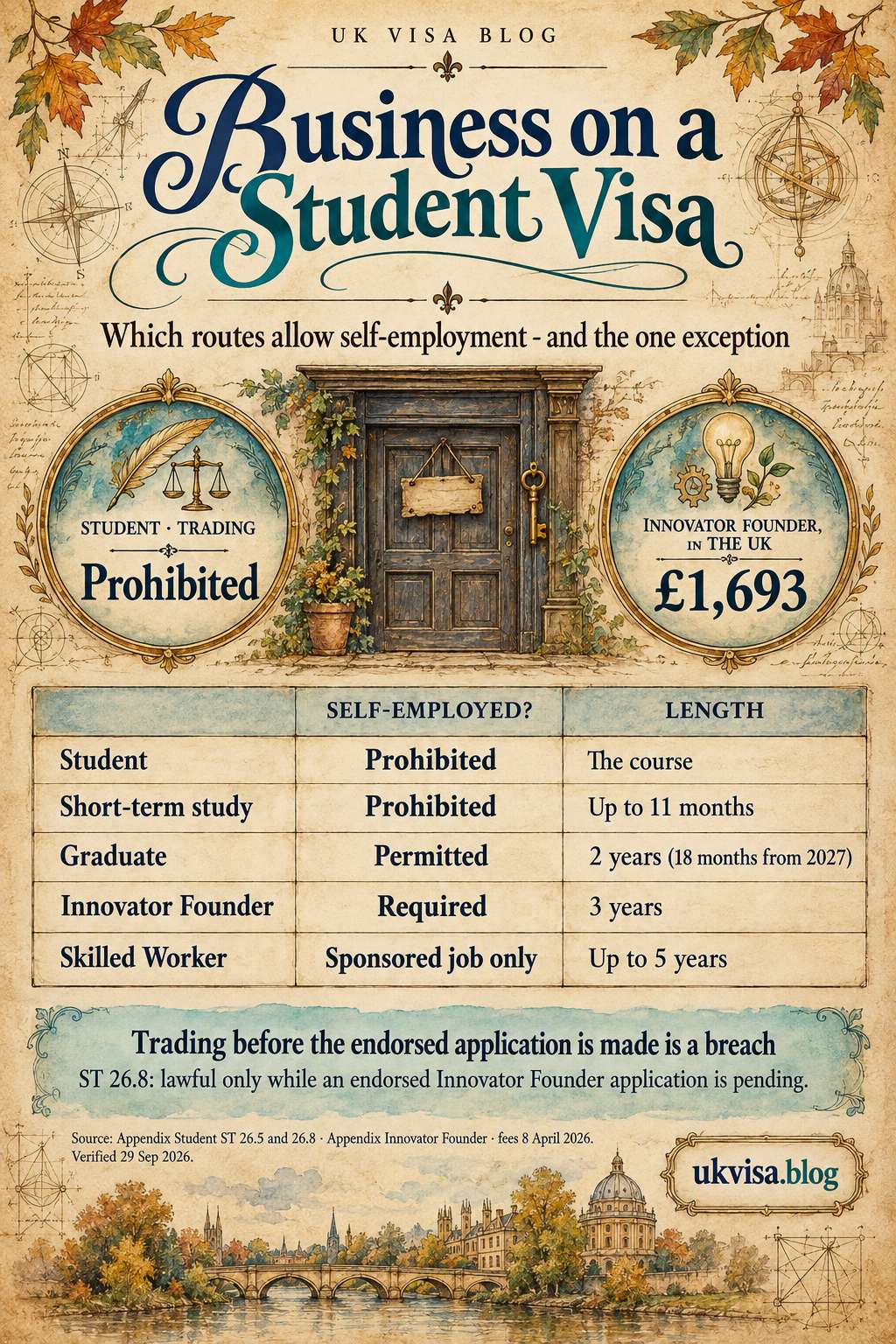
No. Paragraph ST 26.5 of Appendix Student prohibits a Student from being self-employed or engaging in business activity. There is one exception, at ST 26.8: once you have applied on the Innovator Founder route with an endorsement, having applied while holding Student permission, self-employment is permitted while that application — or an administrative review of its refusal — remains undecided. Not before.
The prohibition is a condition of your permission, sitting alongside the 20-hour cap and the ban on filling a permanent full-time vacancy. It does not vary by course level, income, or hours spent. A doctoral candidate and a foundation-year student are in exactly the same position, and the route’s wider requirements are in our Student visa requirements guide.
What Counts as Self-Employment
The test is control rather than paperwork. Where you decide what work to take, when to do it and how, you are not working under a contract of service, and that is self-employment however the arrangement is labelled. Invoicing rather than being payrolled is the usual giveaway; so is being paid by a platform as a contractor.
Location does not help either. Working remotely for a client abroad is still work performed where you are sitting, which is the UK. A dollar invoice raised from a bedroom in Manchester is UK self-employment for immigration purposes.
What Is Prohibited
Two separate prohibitions do the work: no self-employment, and no engaging in business activity. The second catches things the first might not, which is why a directorship in a trading company is a problem even where you draw nothing from it.
Common Activities and How They Fall
| Activity | Permitted? | Why |
|---|---|---|
| Part-time employed job, payrolled | Yes | Employment, within the term-time cap |
| Freelancing or consulting | No | Self-employment |
| Online shop, dropshipping, affiliate income | No | Business activity |
| Delivery and ride-hailing platforms | No | Engaged as a self-employed contractor |
| Director of a trading company | No | Business activity |
| Monetised content and sponsored posts | No | Self-employment |
| Professional sport or entertainment work | No | Separately prohibited by ST 26.5 |
| Holding shares as a personal investment | Yes | Investment, not business activity |
Source: Appendix Student ST 26.5, and the Student Sponsor Guidance work-that-is-not-allowed provisions.
Some situations genuinely sit on the line: trading securities at a scale and frequency that looks like a business rather than managing savings, or letting property in a way that amounts to running a lettings operation. The Rules do not draw the line for you, which is exactly why these are cases for advice rather than for assumption.
What a Breach Costs
Permission can be cancelled and you can be required to leave. The breach becomes adverse immigration history in every subsequent application, here and often elsewhere. Where concealment is involved it becomes a deception finding, which is a different order of problem — our guide to common refusal grounds covers how that is treated.
Undeclared trading is also visible. Companies House filings, HMRC records and platform data all sit outside your control, and a tax problem and an immigration problem tend to arrive together. Working in breach of a condition is an offence under the Immigration Act 1971.
What You Can Legitimately Do
Plenty, provided none of it amounts to trading. The distinction that matters is between building the thing and selling from it — preparation is not business activity, revenue is.
- Employed work: up to 20 hours a week in term time at degree level with a compliant sponsor, full time outside term time — see our guide to Student visa working hours.
- Assessed placements: integral to your course, capped at 33 per cent of its length, or 50 per cent at degree level with a compliant provider.
- Genuine volunteering: unpaid, for a charity, with no contractual obligations.
- Incubators and accelerators: university entrepreneurship programmes, mentoring and pitch competitions.
- Preparation: writing the business plan, market research, and pursuing an endorsement for a future application.
- Intellectual property: filing a patent or registering a trade mark, without commercialising it.
Attending events, competing for prizes and taking entrepreneurship modules are study and networking, not work. What converts any of it into a breach is the first invoice, the first paying client, or trading through a company you control.
The Innovator Founder Route
This is the route the exception points at. It requires endorsement by a Home Office-approved body that your business is innovative, viable and scalable, and there is no investment threshold — the old £50,000 requirement belonged to the closed Tier 1 (Entrepreneur) route. The route itself is covered in our Innovator Founder guide.
Switching In from Student
Appendix Innovator Founder lets a Student switch in country on one of two bases. Either you have completed the course for which your CAS was assigned, or you are studying a full-time PhD and have completed at least 24 months of it. The second limb is the one students rarely hear about, and it means a doctoral candidate need not finish to move.
You cannot switch from a Visitor, Short-term Student, Parent of a Child Student, Seasonal Worker or Domestic Worker in a Private Household permission, or from leave outside the Rules. Where a government or international scholarship agency has sponsored you in the past twelve months, written consent is required.
ST 26.8 permits self-employment only once four things are true together: you have applied on the Innovator Founder route; that application is supported by an endorsement from an endorsing body; the application was made while you held Student permission; and no decision has been made, or any administrative review of a refusal has not been finally determined. Note what is absent — the exception does not require you to have completed your course. What matters is the endorsed application being live. Trading before you submit is a breach, and so is trading after a refusal once any review is finally determined.
Timing the Endorsement
The endorsement letter has a limited life — the Innovator Founder guidance treats it as valid for three months, so obtaining one far in advance of being able to apply wastes it. Work backwards from the date you can switch rather than forwards from when the business feels ready.
Innovator Founder at a Glance
| Requirement | Detail |
|---|---|
| Fee | £1,357 from outside the UK; £1,693 to switch or extend inside it |
| Funds | £1,270, held for 28 days under Appendix Finance |
| Permission granted | 3 years, extendable |
| Settlement | After 3 years’ permission on the route, meeting the business criteria |
| What you may do | Set up one or more businesses, work for them as a director or partner |
Source: GOV.UK Innovator Founder visa page and Appendix Innovator Founder INNF 12.2 and INNF 18.1.
A Conflict Worth Taking Advice On
The published Rules set the PhD switching threshold at 24 months of completed study, while the Innovator Founder caseworker guidance has been read as pointing to 12. We flagged the same discrepancy when rewriting the Innovator Founder guide. Do not plan a switch on the shorter figure without advice: the Rules are what a refusal will cite.
Building a Business After You Graduate
The Graduate visa lifts every restriction on this page. No sponsor, no hours cap, no prohibited categories, and self-employment is permitted outright — which makes it the natural place to test whether a business works before committing to endorsement.
Where Each Route Stands on Business
| Route | Self-employment | Length |
|---|---|---|
| Student | Prohibited, except under ST 26.8 | Course plus wrapper |
| Short-term study | Prohibited | Up to 11 months |
| Graduate | Permitted | 2 years, 18 months from 1 January 2027; 3 years for a doctorate |
| Innovator Founder | Required | 3 years, extendable |
| Skilled Worker | Sponsored employment only | Up to 5 years per grant |
Source: Appendix Student, Appendix Graduate and Appendix Innovator Founder, August 2026.
The Graduate route is not itself a route to settlement and cannot be extended, though the time counts as lawful residence for long residence purposes. Most founders therefore use it to build traction and switch to Innovator Founder before it expires, starting the three-year settlement clock on a business that already works.
Two Things That Close the Door
Short-term study does not lead to the Graduate route at all, so an English language course is not a way in — our Short-term study guide sets out what that route does and does not allow. And a compliance question in your file makes everything harder: applicants flagged for a breach are likelier to face a credibility interview on any later application.
If Money Is the Pressure
Financial strain is the usual reason students drift into trading. It is the worst possible trade: the funds you evidenced at application were meant to cover this period, and a breach costs far more than the income. Our student maintenance funds guide explains what you were required to hold, and our breakdown of current UK visa charges the costs still ahead. If your family are here, note that a Student dependant faces no such restriction.
Sources: Appendix Student ST 17 and ST 26; Appendix Innovator Founder INNF 1.5A, INNF 1.5ZA, INNF 12.2 and INNF 18.1; Student and Child Student caseworker guidance, version 14.0, published for Home Office staff on 3 August 2026; Student Sponsor Guidance Document 2, version 04/2026; the what you can and cannot do page on GOV.UK and the Innovator Founder route page. Figures verified 22 August 2026.
Frequently Asked
Questions about Business on a Student Visa
No. ST 26.5 of Appendix Student prohibits being self-employed or engaging in business activity, with no threshold for income or hours. The single exception at ST 26.8 applies once you have made an endorsed Innovator Founder application while holding Student permission, and lasts while that application, or an administrative review of its refusal, is undecided.
Not under ST 26.8, which attaches the self-employment permission to having an endorsed Innovator Founder application pending, not to completing the course. Switching in country, however, does require either that you completed the course your CAS was assigned for, or that you are on a full-time PhD and have completed at least 24 months of it. The two tests are different — read both before acting.
No. Those platforms engage people as self-employed contractors, which is squarely within the prohibition, regardless of hours worked or income earned. The same applies to any arrangement where you invoice rather than being payrolled. If an employer cannot put you on their payroll, the work is not open to you on this route.
Still prohibited. Where the customer sits is irrelevant; the work is treated as done where you are physically located. E-commerce, dropshipping, affiliate income, paid content and online tutoring are all business activity or self-employment, and the fact that money arrives from abroad does not place the activity outside UK immigration control.
Take advice before you do. The prohibition covers engaging in business activity as well as self-employment, and acting as a director of a company that trades falls within it. Premature incorporation can also complicate an endorsement assessment later. Nothing stops you preparing the plan, the research and the endorsement application in the meantime.
The Innovator Founder guidance treats an endorsement letter as valid for three months, so timing matters. Securing one long before you are able to switch means securing it twice. Work backwards from the date you satisfy the switching test — course completion, or 24 months of a full-time PhD — rather than from when the business feels ready to launch.
£1,357 applying from outside the UK and £1,693 to switch or extend inside it, per person, plus the health surcharge at the standard rate. You must hold £1,270 in funds for 28 days under Appendix Finance. There is no investment requirement — the £50,000 threshold belonged to the closed Tier 1 (Entrepreneur) route and has not applied here.
Yes, without restriction: no sponsor, no hours cap and self-employment permitted. It is not itself a route to settlement and cannot be extended, though time on it counts as lawful residence for long residence purposes. Most founders use it to build traction, then switch to Innovator Founder, whose three-year clock is what leads to indefinite leave to remain.
Stop, and take advice before your next application rather than after it. A breach can lead to cancellation and removal, becomes adverse history in every later application, and where concealment is involved becomes a deception finding with a re-entry ban attached. Company filings and tax records are visible to the Home Office, so the safer course is disclosure with advice, not silence.
A Student’s dependant partner or child may take employment without an hours cap and is not subject to the student’s self-employment prohibition, though they cannot work as a professional sportsperson or access public funds. Only doctoral, research and nationally sponsored students may bring dependants in the first place, as our Student dependant guide explains.