
The Graduate visa — still widely called the PSW visa — lets you stay and work in the UK after an eligible UK degree, with no sponsor, no job offer and no salary floor. It costs £937 plus the health surcharge. The number that matters most in 2026 is a date: apply on or before 31 December 2026 and you get two years; apply after it and you get eighteen months.
UK Work Visas
UK Post Study Work Visa 2026: Fees, Duration, Eligibility and the 2027 Change
What the Graduate Visa Actually Is
The Graduate visa is an unsponsored route for people who have finished an eligible UK course. You apply from inside the UK, before your Student permission expires, once your university has told the Home Office you completed. It costs £937 plus £1,035 of health surcharge for each year. You get three years with a doctorate, two years otherwise if you apply by 31 December 2026, eighteen months after that.
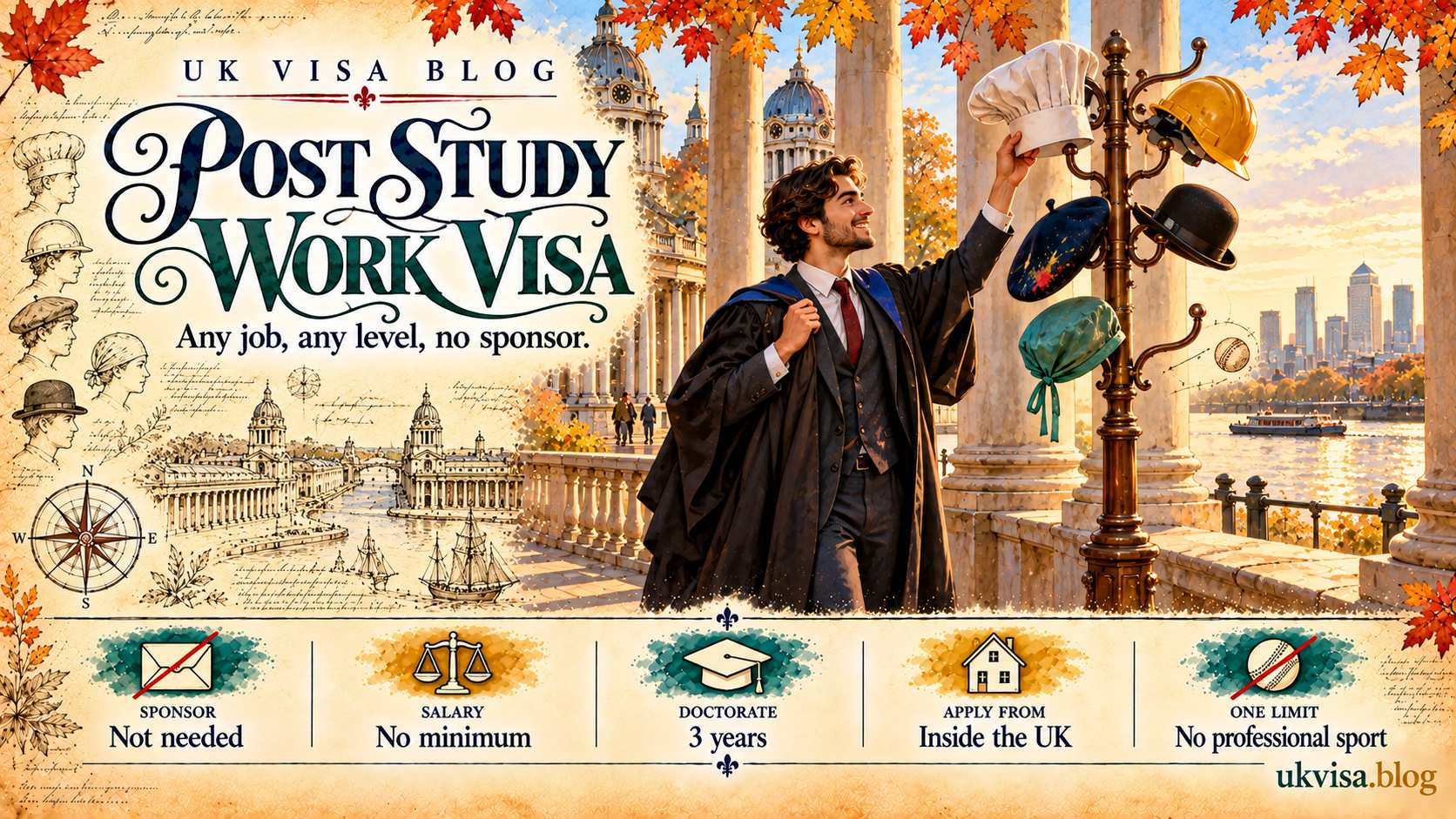
There is no certificate of sponsorship, no minimum salary and no skill level. You can work in almost any job, at any level, be self-employed, run a business, hold a directorship, or spend the whole period looking for work. That freedom is the point of the route, and it is what separates it from the hour limits that apply while you are studying.
The One Work Restriction
You cannot work as a professional sportsperson. The caseworker guidance reads that widely: playing or coaching at professional or semi-professional level, being registered to a professional or semi-professional team, or taking payment — including payment in kind — that covers most of your travel and living costs in the UK. Amateur sport is fine. Coaching a paid junior squad on the side is the sort of arrangement that is not.
What You Can Study
Study is allowed, with one carve-out: you cannot study with a Student sponsor on a course that would itself qualify for the Student route. If your course is Student-eligible, the Home Office expects you to extend your Student permission instead. Any study you do also stays subject to the Academic Technology Approval Scheme condition where the subject is a sensitive one.
Post Study Work Visa Eligibility
Four things have to be true at once: you are physically in the UK, you hold Student or Tier 4 (General) permission, you completed an eligible course with that permission, and your education provider has reported the completion to the Home Office. You do not have to wait for graduation or a certificate — the provider’s notification is the trigger, and it is worth asking them when they sent it.
- Your provider: a licensed student sponsor with a track record of compliance — shown as “Student Sponsor – Track Record” on the register.
- Your course: a UK bachelor’s degree, master’s degree, PhD or doctorate; an SRA-approved law conversion course, LPC, Solicitors Course, Diploma in Professional Legal Practice, Bar Practice Course or Bar Course; a PGCE or PGDE.
- Or a regulated-profession course: one where passing made you eligible for a job regulated by UK law or a UK public authority — your provider confirms this.
- Time in the UK: at least 12 months of a course longer than 12 months, or the whole of a shorter course.
- Scholarship consent: written approval from any government or international scholarship agency that paid your fees and living costs in the 12 months before you apply.
- Documents: passport and the CAS reference number from your Student visa application.
You Only Get This Route Once
Caseworkers check your immigration history for earlier Graduate route permission or the Doctorate Extension Scheme. If you have held either, the application is rejected as invalid — not refused on the merits, rejected. Older routes behave differently: Tier 1 (Post-study work), the International Graduate Scheme and the Future Talent Working in Scotland Scheme do not bar you, but you must complete a new eligible qualification and hold current Student permission. The old degree cannot be recycled.
If COVID Kept You Out of the UK
Study outside the UK between 24 January 2020 and 30 June 2022 counts as UK study if your permission ran longer than 12 months. For permission of 12 months or less, you qualify if you started the course before 21 June 2021 and entered on a Student visa by 27 September 2021, or started between 21 June 2021 and 30 June 2022 and entered by 30 June 2022.
Graduate Visa Fees and Costs
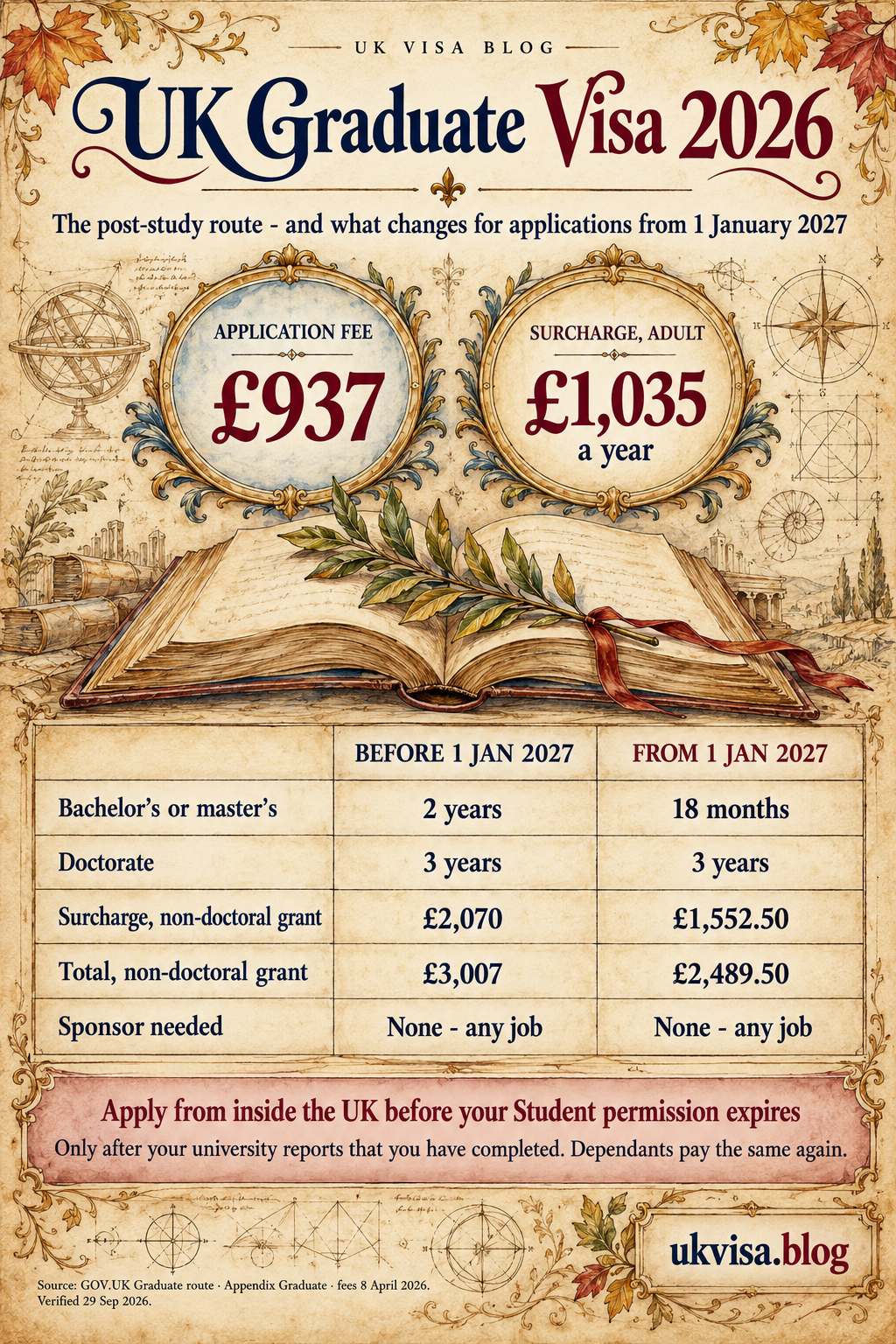
The application fee is £937. On top of that you pay the health surcharge for every year of the permission, at the full adult rate of £1,035 — not the £776 student rate you were paying before. That single change is the reason the route costs more than most graduates expect, and it is charged upfront in one payment.
What the Graduate Route Costs in 2026
| Permission granted | Health surcharge | Total with the £937 fee |
|---|---|---|
| 18 months | £1,152.50 | £2,089.50 |
| 2 years | £2,070 | £3,007 |
| 3 years, doctorate | £3,105 | £4,042 |
Source: GOV.UK, Graduate visa — how much it costs. Verified 22 August 2026.
Dependants pay the same fee and the same surcharge each, so a partner on a two-year grant adds another £3,007. For the wider picture across routes see the current fee schedule, and the maintenance figures if you are budgeting the transition from study.
The Refund Almost Nobody Claims
If you take a job in public sector healthcare after paying the surcharge, you may be able to claim a refund for the period you are working in it. And if you are a doctor, nurse or adult social care professional, GOV.UK points you at the Health and Care Worker visa instead: cheaper to apply for, with no surcharge at all — though it needs a sponsor, which the Graduate route does not.
Two Years, Three Years or Eighteen Months
A doctorate gets three years, and the 2027 change does not touch it. Every other eligible qualification gets two years if the application is made before 1 January 2027, and eighteen months if it is made on or after that date. Permission runs from the date your application is decided, not from the day you finished your course, so a slow decision does not cost you time.
The trigger is the date you submit, and the difference is six months of unsponsored work permission:
Apply on or before 31 December 2026 and a bachelor’s or master’s graduate receives two years. Apply on 1 January 2027 or later and the same graduate receives eighteen months. What counts is the date the application is made, not the date it is decided or the date you finished studying — so if your completion is confirmed in late 2026, submitting before the year end is worth six months of permission. You cannot apply before your provider reports your completion, which makes that reporting date the thing to chase.
The Graduate route cannot be extended and time on it does not count towards settlement. It is a bridge, not a destination: most people use it to find sponsored work and switch to the Skilled Worker route before it runs out, at which point the five-year settlement clock starts.
How to Apply
You apply online from inside the UK, after your provider has confirmed completion and before your Student permission expires. Identity is proved either through the UK Immigration: ID Check app or at a UKVCAS service point. A decision usually takes eight weeks, and you can stay in the UK while you wait — your Student conditions continue under section 3C, so you can keep working the hours that permission allowed.
Two Traps in the Waiting Period
First, do not leave the UK, Ireland, the Channel Islands or the Isle of Man before the decision. The application is withdrawn if you do, and by then your Student permission has usually gone. Second, applying before your provider has reported completion is one of the most common ways to lose the fee — see how sponsored and unsponsored applications get refused. UKVI may also interview where completion or the UK study requirement looks doubtful; the Student credibility interview guide is the closest preparation.
The BRP Instruction on GOV.UK
GOV.UK still tells Graduate applicants to prove their Student permission with a biometric residence permit, usable for 24 months past the printed expiry or until 31 December 2026, whichever comes first. BRPs were withdrawn at the end of 2024 and immigration status is now held in the eVisa on your UKVI account. Set the account up before you apply, and take advice if a caseworker asks for a card you no longer have.
New Rules and What Comes Next
The eighteen-month grant from 1 January 2027 is the substantive change, and it lands entirely on bachelor’s and master’s graduates. Doctoral graduates keep three years. Nothing in the announced package changes the fee, the surcharge rate or the unsponsored character of the route — it shortens the window in which you have to convert into something else.
Where Graduates Go From Here
Skilled Worker is the common exit, needing a licensed sponsor and a salary that meets one of the threshold options — £41,700 generally, or £33,400 where a new-entrant option applies. The High Potential Individual route takes graduates of listed global universities without a sponsor, the Scale-up route needs only a six-month sponsored start, and the Global Talent route runs on endorsement rather than employment.
If you are building something rather than job-hunting, the Graduate route is the only student-adjacent permission that lets you trade freely while you test it, which is why it pairs naturally with the rules on business activity during study and, once the idea is endorsable, with the Innovator Founder route.
Partners and Children
The Graduate route does not open the door to new family members. A partner or child can only stay if they were already your dependant on your Student or Tier 4 permission — the single exception being a child born in the UK during that permission or during the Graduate visa itself. Their permission ends on the same date as yours, and each of them applies and pays separately.
A partner must be a spouse or civil partner, or have been living with you in a relationship for at least two years, or be in a two-year relationship you can evidence without cohabiting. A child under 18 must live with you unless they are away in full-time education, and must not be married. The caseworker must also be satisfied there are suitable care and accommodation arrangements for any child under 18 before permission is granted.
The route that reopens family migration is switching. New dependants can join from outside the UK once you move to a sponsored route such as Skilled Worker — so a partner left behind is a reason to convert early rather than to sit out the full grant. Background on the underlying student route sits in our guide to Student visa dependants.
Short Courses Do Not Qualify
The Graduate route is only open to people who held Student or Tier 4 (General) permission. A short-term study visa does not lead to it, however long the course felt, and neither does a visitor visa used for a course. The underlying permission is checked, not the qualification alone — the framework for which sits in the Student visa requirements.
Sources: GOV.UK Graduate route page on GOV.UK guidance; Appendix Graduate of the Immigration Rules; Home Office Graduate route caseworker guidance version 6.0, published 3 August 2026; and the register of licensed student sponsors. Figures verified 22 August 2026.
Frequently Asked
Questions about the Graduate Visa
Three years for a PhD or other doctoral qualification. For every other eligible qualification it is two years if the application is made before 1 January 2027, and eighteen months if made on or after that date. Permission starts from the date of the decision. The route cannot be extended, and you can only ever hold it once.
£937 to apply, plus the health surcharge at £1,035 a year — £1,152.50 for eighteen months, £2,070 for two years, £3,105 for three. That makes £2,089.50, £3,007 or £4,042 in total. Dependants pay both again, each. If you later take a public sector healthcare job you may be able to reclaim part of the surcharge.
No. The Graduate route has its own rules in Appendix Graduate and needs no sponsor, job offer or salary. Tier 2 became the Skilled Worker route, which requires a licensed sponsor and a qualifying salary. The two are unrelated, and time on the Graduate route does not count towards settlement while Skilled Worker time does.
No. If you have previously held Graduate route permission or a Doctorate Extension Scheme grant, the application is rejected as invalid. Earlier Tier 1 (Post-study work), International Graduate Scheme or Future Talent Working in Scotland permission does not block you, but you must complete a new eligible qualification and hold current Student permission — the old degree cannot be reused.
Usually eight weeks from completing the online application, proving your identity and submitting documents. GOV.UK does not offer a paid faster-decision service on this route. You can stay and keep working under your Student conditions while you wait, through section 3C leave, but you must not travel outside the UK, Ireland, the Channel Islands or the Isle of Man before the decision.
Yes. Paid and unpaid employment, self-employment, business and professional activity are all permitted, which is the main practical gain over Student permission. The only prohibition is professional sport, read broadly to include semi-professional play or coaching, registration with a professional team, and payment in kind covering most of your UK travel and living costs.
Only if they were already your dependants on your Student or Tier 4 permission, or the child was born in the UK during that permission or during your Graduate visa. You cannot add new dependants on this route. Each applies separately and pays the £937 fee plus the full £1,035-a-year surcharge, and their permission ends when yours does.
No. Time on the Graduate route does not count towards the five-year qualifying period for indefinite leave to remain. If you switch to a sponsored route such as Skilled Worker, the qualifying period runs from that permission. Planning the switch before the Graduate grant expires is the difference between a settlement clock that has started and one that has not.