
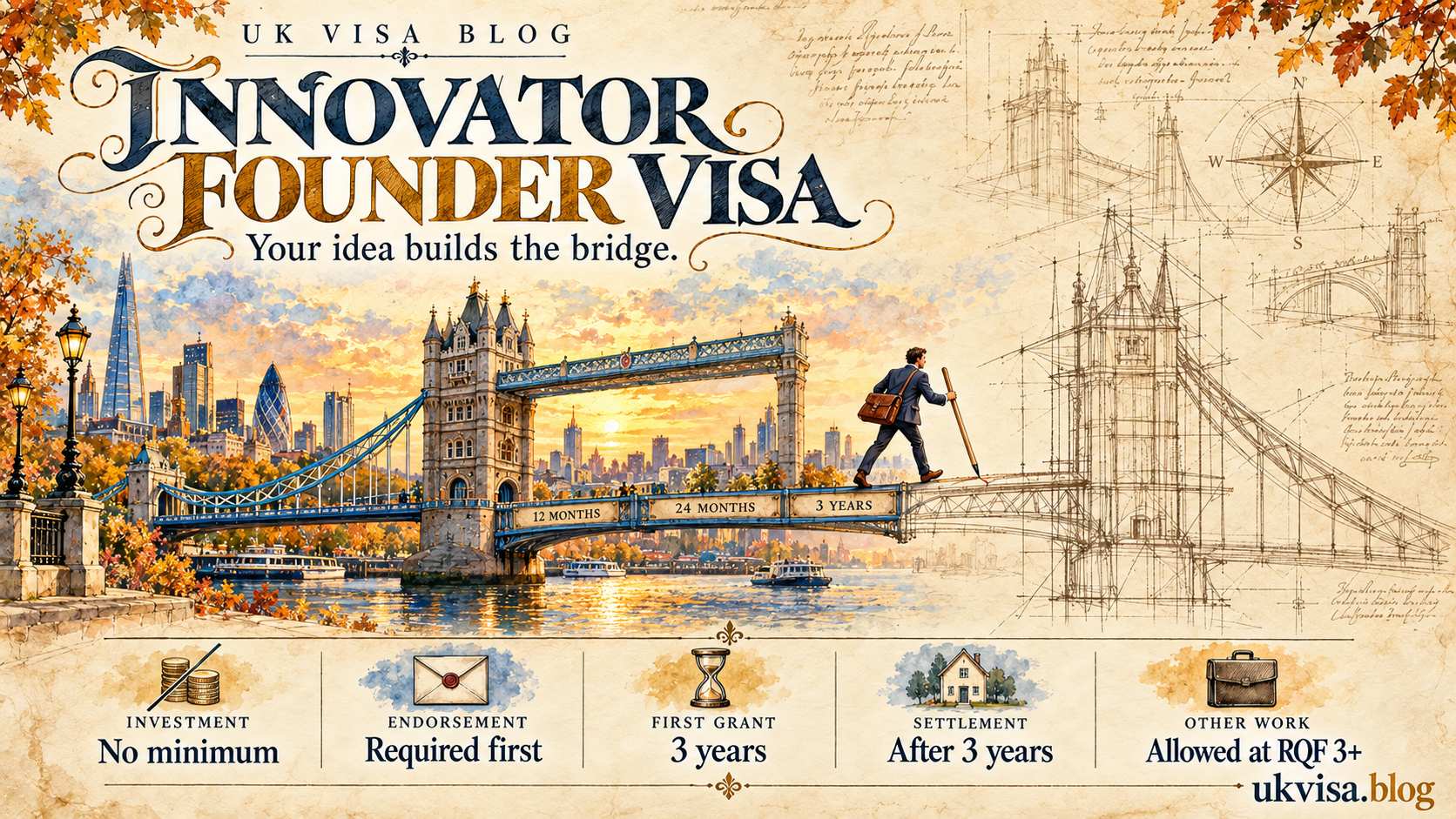
The UK Innovator Founder visa is the endorsement-based route for entrepreneurs building an innovative, viable and scalable business — with no minimum investment and settlement after just 3 years. From 8 April 2026 the fee is £1,357 outside the UK, £1,693 inside, on top of the £1,000 endorsement and two £500 contact-point meetings. Roughly 86% of applications that clear the endorsement gateway succeed at the Home Office.
UK Work Visas
UK Innovator Founder Visa 2026: Requirements, Success Rate & 3-Year ILR Pathway
What is the UK Innovator Founder Visa?
The Innovator Founder visa is the UK’s primary route for entrepreneurs establishing innovative, viable and scalable businesses. It requires endorsement from a Home Office-approved endorsing body, CEFR B2 English, £1,270 in savings and an active founding role — but no minimum investment. The grant is 3 years, extendable without limit, and Indefinite Leave to Remain is available after 3 years where the business meets 2 of 7 achievement criteria. It replaced both the Innovator and Start-up visas on 13 April 2023.
Where the Skilled Worker route runs on an employer’s Certificate of Sponsorship, this route runs on an endorsement letter: an approved body certifies the venture as innovative, viable and scalable, and the founder then applies to UKVI directly. The merger of the old Innovator (£50,000 minimum) and Start-up routes into one framework removed the fixed capital threshold entirely — the assessment moved from the applicant’s bank balance to the quality of the plan.
Founders with national-level recognition should weigh the Global Talent route; recent graduates of top-ranked universities, the High Potential Individual visa.
What Changed in 2026
Two updates frame this year. Statement of Changes HC 1333 (25 November 2025) let Student visa holders who have completed their course switch directly into the route and begin self-employment while the application is pending. And the 8 April 2026 uplift took the fees from £1,274 to £1,357 (outside the UK) and £1,590 to £1,693 (inside) — endorsement, contact-point and IHS charges were untouched.
Innovator Founder Visa Requirements 2026
The application scores 70 points — 50 for the endorsed business, 10 for English, 10 for finances — and every element is documentary:
- Age: 18 or over at the date of application.
- Endorsement: a letter from an approved endorsing body issued no more than 3 months before the application — and not withdrawn.
- The business test: new (not joining an existing trading business), innovative (different from anything else on the market), viable, and scalable with job-creation and growth potential.
- Active founder: an instrumental day-to-day role in the business — passive investors do not qualify.
- English: CEFR B2 in all four skills — approved SELT, UK degree, Ecctis-verified English-taught degree, UK school qualification, or exempt nationality.
- Maintenance: £1,270 held for 28 consecutive days — not needed after 12 months lawfully in the UK; investment funds cannot double as maintenance.
- Scholarship consent: written consent where a government or scholarship agency funded UK study in the last 12 months.
- TB certificate if applying from a listed country; certified translations for any document not in English or Welsh.
Is There a Minimum Investment Requirement?
No — and that is the route’s defining break with its ancestors. The old Innovator visa demanded £50,000; Tier 1 (Entrepreneur) demanded £200,000. Both thresholds died on 13 April 2023. What survives is a functional test: the endorsing body must be satisfied the founder holds sufficient lawful funds to start and sustain the business through the plan’s milestones — an IP-led software venture can credibly launch on £15,000, a hardware business cannot.
No investment evidence at all is needed where the business is already established and was endorsed for an earlier visa, or the founder has agreed a change of business with their endorsing body. The £50,000 figure re-enters at the far end: it is one of the seven settlement criteria measured at the 3-year ILR stage.
Innovator Founder Visa Fees from 8 April 2026
There is no sponsor, so no Certificate of Sponsorship and no Immigration Skills Charge — but the endorsing body’s charges replace them:
The Full Cost Schedule
| Fee Component | Amount from 8 April 2026 | Notes |
|---|---|---|
| Application — outside the UK | £1,357 | Per person, dependants included; up from £1,274 |
| Application — inside the UK (extend or switch) | £1,693 | Per person; up from £1,590 |
| Endorsement fee | £1,000 + VAT | Paid directly to the endorsing body |
| Contact-point meetings | £500 + VAT each | At least 2 during the grant, normally at 12 and 24 months |
| Immigration Health Surcharge | £1,035/year adult · £776/year under-18 | £3,105 for a 3-year adult grant |
| Priority / super priority | +£500 / +£1,000 | Where available at the application location |
| Settlement after 3 years | £3,226 | Per applicant; no IHS on settlement |
Source: GOV.UK Innovator Founder visa pages; Home Office immigration and nationality fees, 8 April 2026.
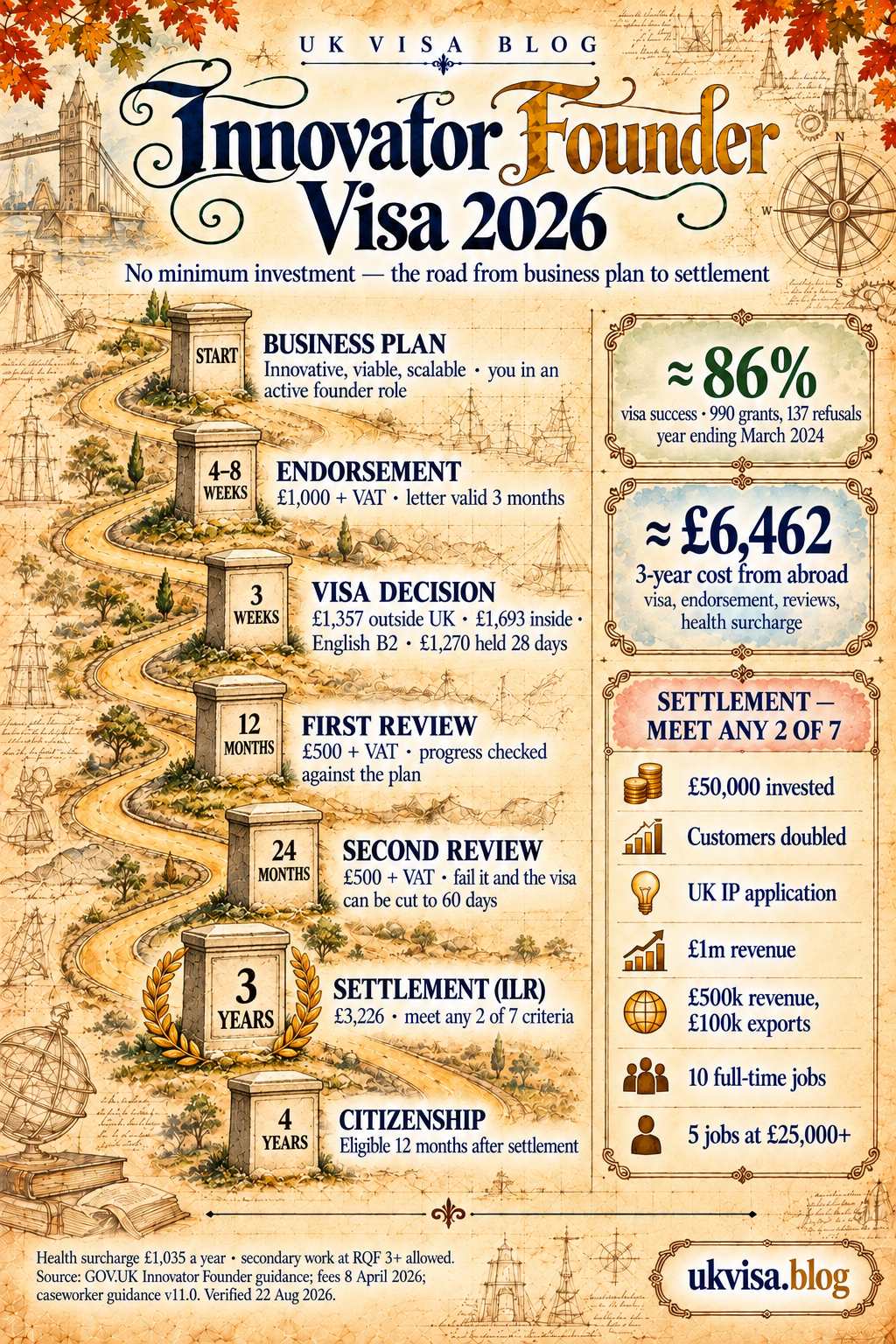
A single founder entering from abroad should budget roughly £6,462 for the 3-year cycle — visa, endorsement, two contact meetings and IHS — before VAT on the endorsing body’s charges. The IHS is the largest single line, and the wider market context sits in the UK work visa fees comparison.
Innovator Founder Visa Success Rate
Home Office statistics for the year ending March 2024 show 990 grants against 137 refusals — roughly 86% of resolved applications. The figure flatters and clarifies at once: the endorsement gateway filters most weak cases before UKVI ever sees them, with endorsement-stage approval varying from about 54% to 93% by body and sector. The predecessor Innovator route managed about 83% over its 2019–2023 life, after a bruising ~45% patch in 2020 while the market learned what “innovative, viable, scalable” meant.
Where Applications Fail
Refusals cluster around five themes: generic business plans that cannot show UK-market differentiation; thin evidence of the founder’s instrumental role; maintenance-fund documentation gaps; expired SELT certificates (2-year validity); and inconsistencies between the plan the endorsing body saw and the documents UKVI receives. The common thread is that the endorsement and the visa application are read together — they must tell the same story.
Business Ideas and the Innovation Test
The test is sector-neutral. Innovation means genuinely different from what already exists on the UK market — incremental innovation qualifies, but a copy-paste plan citing overseas competitors as proof of novelty routinely fails. Viability demands realistic, sourced financial projections; scalability demands credible plans for job creation and growth into national and international markets:
Example Concepts by Sector
| Sector | Example Concepts | Typical Initial Capital |
|---|---|---|
| HealthTech | AI diagnostics, telepsychiatry, elderly-care monitoring | £10,000 – £100,000 |
| FinTech | Payment infrastructure, AI planning tools, niche financial platforms | £15,000 – £200,000 |
| EdTech | AI tutoring, VR learning, skills-assessment SaaS | £2,000 – £40,000 |
| Green Tech | Renewables hardware, carbon tracking, sustainable packaging | £10,000 – £150,000 |
| DeepTech / R&D | Hardware prototyping, biotech, novel materials | £25,000 – £500,000 |
Source: Innovator Founder caseworker guidance v11.0 — illustrative examples of endorsable concepts. Verified 22 August 2026.
Endorsing bodies judge the plan, not the sector: named UK competitors, milestones tied to capital, and the founder’s centrality decide the outcome. Templated plans are the single leading cause of endorsement refusal.
Endorsement Process and Approved Bodies
Endorsement precedes everything. As at 2026, the GOV.UK list names three openly accessible endorsing bodies — UK Endorsing Services, Innovator International and Envestors Limited — plus the invitation-only Global Entrepreneurs Programme run by the Department for Business and Trade. The letter confirms the business test, the founder’s day-to-day role and fit-and-proper status, and is valid for exactly 3 months: the visa application must land inside that window, and an endorsement withdrawn before decision invalidates the application.
Contact-Point Meetings: The Route’s Ongoing MOT
At least two progress reviews with the endorsing body are built into every grant, normally at 12 and 24 months, at £500 + VAT each. They check the business against the endorsed plan — and they carry teeth: a failed review can end in endorsement withdrawal, which triggers curtailment of the visa, normally to 60 days. A founder who pivots should agree the change of business with the endorsing body before the meeting, not explain it afterwards.
Existing Innovator Visa Holders
The old Innovator route closed on 13 April 2023, but its holders keep three doors: extend through the legacy endorsing body that endorsed them; apply for ILR under the original Innovator settlement framework; or switch into Innovator Founder under the same-business provisions with a current endorsing body. Legacy bodies cannot endorse new ventures or new applicants — they exist only to carry their existing portfolio through.
Why Switching Is Usually Worth It
The new route permits secondary employment at RQF Level 3 or above — the old Innovator visa prohibited outside work entirely. For a founder consulting or working part-time through the bootstrapping years, that flexibility is material, and the switch costs nothing in settlement timing: both routes carry the same 3-year grant and the same 3-year ILR clock.
3-Year ILR Pathway and Settlement Criteria
Settlement after 3 years is the route’s headline — the fastest mainstream work-route path to ILR, at £3,226, and one the 2025 White Paper’s earned-settlement proposals leave specifically intact. The residence test is standard: 3 continuous years with no more than 180 days’ absence in any 12 months, plus the Life in the UK test — the B2 English proved at entry already exceeds the settlement standard.
The business test is not standard at all. A settlement endorsement letter must confirm significant achievement against the original plan, a Companies House-registered, active and trading business with the applicant as director or member in a day-to-day key role, sustainability for the next 12 months — and at least 2 of the 7 criteria:
- Investment: at least £50,000 invested and actively spent furthering the business.
- Customer growth: customers at least doubled in 3 years, and above the UK mean for comparable businesses.
- R&D: significant research and development with a UK intellectual-property application.
- Revenue: at least £1 million gross in the last full accounting year.
- Revenue with exports: at least £500,000 gross with £100,000+ from overseas sales.
- Job creation: the equivalent of 10 full-time jobs for settled workers.
- Job creation, higher-paid: 5 full-time jobs for settled workers averaging £25,000+.
The Fine Print on the Criteria
The caseworker guidance (v11.0, 4 August 2026) closes the obvious shortcuts. The same criterion cannot be counted twice — £100,000 invested is one criterion met, not two. Co-founders applying from the same venture cannot share evidence: two founders relying on job creation need 20 jobs between them. And each claimed job must have existed for 12 months at 30+ hours a week for a settled worker, compliant with minimum-wage and working-time law throughout.
From ILR to Citizenship
Naturalisation opens 12 months after settlement — roughly 4 years from first grant to British citizenship eligibility, among the fastest arcs in the system. Refused applications carry no appeal; the remedy is administrative review.
The official entry point is the GOV.UK Innovator Founder visa guide; the legal framework sits in Appendix Innovator Founder, with the current endorsing bodies list and the Innovator Founder caseworker guidance (v11.0, 4 August 2026). One discrepancy is worth flagging: GOV.UK’s switching page asks Student-route PhD candidates for 24 months of study, while the August 2026 caseworker guidance instructs staff to check 12 — applicants between those marks should take advice rather than assume the lower figure. Figures verified 22 August 2026.
Frequently Asked
Questions about the Innovator Founder visa
There is none. The old Innovator visa’s £50,000 and Tier 1 (Entrepreneur)’s £200,000 both died with the April 2023 reform. The endorsing body instead assesses whether you hold enough lawful funding to deliver the business plan — and the £50,000 figure returns only as one of the seven optional settlement criteria at the 3-year ILR stage.
About 86% of applications resolved by the Home Office in the year ending March 2024 (990 grants, 137 refusals). The real filter sits earlier: endorsement-stage approval runs from roughly 54% to 93% depending on the body and sector. Securing the endorsement letter is the hard part; the visa stage mostly confirms it.
From 8 April 2026: £1,357 outside the UK or £1,693 inside, plus £1,000 + VAT endorsement, two £500 + VAT contact-point meetings, and IHS at £1,035 per adult per year. A single 3-year applicant from abroad budgets about £6,462; settlement later costs £3,226. There are no employer-side fees because there is no sponsor.
The visa decision runs about 3 weeks from outside the UK and 8 weeks inside, with priority services where available. The endorsement stage before it typically takes 4 to 8 weeks depending on the body — so the realistic end-to-end journey from business plan to visa is 4 to 6 months.
Yes — secondary employment is allowed in roles requiring at least an RQF Level 3 (A-level equivalent) qualification, provided the endorsed business remains your main occupation. That flexibility is a key advantage over the closed Innovator route, which barred outside work entirely. Study is also permitted.
Yes — partner and children under 18, each paying the same application fee and their own IHS, with maintenance of £285/£315/£200 stacked on your £1,270. Dependants can work (except as a professional sportsperson or coach) and study; a dependant partner settles on their own 5-year track rather than the founder’s 3-year one.
The Home Office may curtail the visa, normally to 60 days, in which time you must re-secure endorsement and reapply, switch routes, or leave. Withdrawal typically follows a failed contact-point review, a business ceasing to trade, unpaid endorsing-body fees, or an unagreed change of business — which is why pivots should be cleared with the endorsing body in advance.
Yes — since HC 1333 (25 November 2025), students who have completed their course can switch in-country and even begin self-employment while the application is pending. PhD students mid-course sit in a grey zone: GOV.UK’s page says 24 months of study, the August 2026 caseworker guidance says 12 — take advice if you fall between the two.
You need 3 continuous years (180-day absence rule), the Life in the UK test, and a settlement endorsement confirming an active, trading, sustainable business in which you hold a key role — plus any 2 of the 7 achievement criteria, from £50,000 invested to 10 jobs created. Co-founders cannot share the same evidence, and no criterion counts twice. The fee is £3,226.