
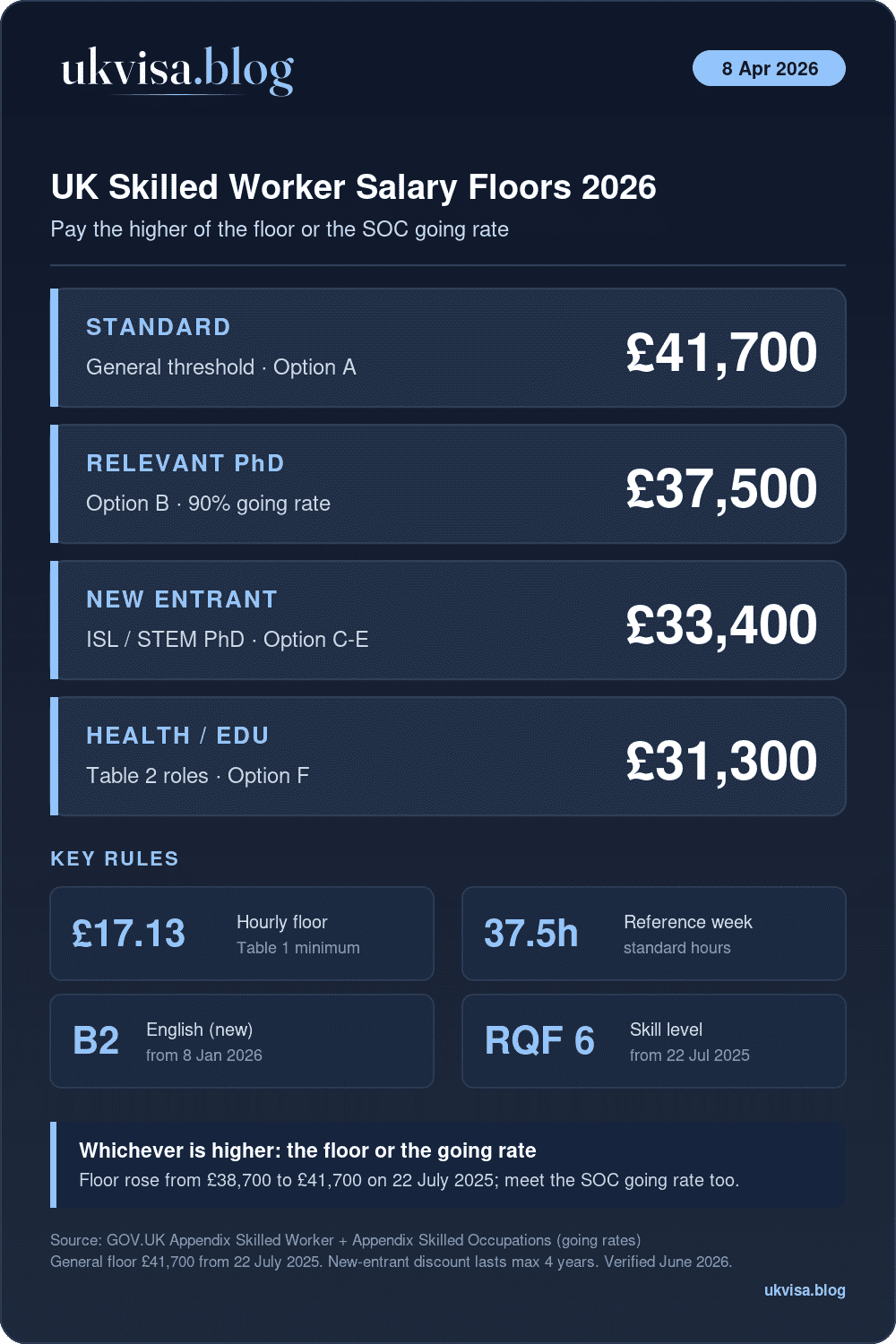
Pay on the Skilled Worker route is two tests, not one: a cash floor and the going rate for your occupation code, and you must clear the higher of them. The general floor is £41,700, but eleven salary options sit underneath it, running down to £25,000. Which one you can use depends on your occupation, your qualifications and when your certificate was assigned.

UK Work Visas
Skilled Worker Salary Threshold 2026: Options A to K and the Going Rate
The Two Tests You Have to Pass
You must be paid at least the cash threshold that applies to you and at least the going rate for your occupation code, whichever produces the higher figure. The general threshold is £41,700. Lower thresholds of £37,500, £33,400, £31,300, £28,200 and £25,000 exist, but each is tied to a specific salary option, and most of the lowest ones are reserved for health and care applicants or for people sponsored before 4 April 2024.
The dual test decides most cases. If the going rate for your code is £45,000, that is your minimum and the general floor is irrelevant. If the going rate is £26,000, you still need £41,700, because the cash floor binds. GOV.UK's own example refuses a £42,000 salary against a £45,000 going rate. Getting the code right is therefore the first salary decision — see how occupation codes and skill level are assessed.
Going Rates and How They Are Applied
Each occupation code carries a published annual going rate, set out in the going rates table for eligible occupations. Health and education roles work differently: their rates come from national pay scales rather than survey data, which is why the salary rules for those jobs sit in a separate part of the framework, shared with the Health and Care Worker visa.
Going rates are pro-rated. The caseworker guidance converts the annual rate to an hourly figure by dividing by 37.5, then multiplying by the weekly hours the sponsor states — so a role contracted for 40 hours needs more than the published figure, not the same. The cash floor is not pro-rated in the other direction: part-time work does not reduce it.
The rules also set a minimum hourly rate that has to be satisfied alongside the annual figures, and the guidance confirms it applies at settlement as well as at entry. Check the current hourly figure in Appendix Skilled Worker on the day the certificate is assigned — the going rate that counts is the one in force at assignment, not at decision.
The Salary Options, A to K
Salary is worth 20 points, and there is more than one way to score them. Options A to E are the standard set. Options F to J mirror them at lower cash figures, and option K is a separate route for listed health and education occupations. You cannot pick freely: F to J and K are gated on who you are and what you do.
Options A to E — The Standard Set
| Option | Basis | Cash minimum | Going rate |
|---|---|---|---|
| A | Salary alone | £41,700 | Full rate |
| B | Relevant PhD | £37,500 | 90% |
| C | Relevant STEM PhD | £33,400 | 80% |
| D | Job on the Immigration Salary List | £33,400 | Full rate |
| E | New entrant | £33,400 | 70% |
Source: Home Office Skilled Worker caseworker guidance v20.0, 3 August 2026. Verified 22 August 2026.
Options F to J repeat that ladder at £31,300, £28,200 and £25,000. They are not open to everyone. The guidance restricts them to applicants sponsored on the Health and Care Worker visa in occupations whose going rates are not set by national pay scales, and to people granted permission as a Skilled Worker under the pre-4-April-2024 rules who have held it continuously since, applying before 4 April 2030. Prison officers can use option F where the certificate was issued before 1 January 2028.
Options F to K — The Lower Ladder
| Option | Basis | Cash minimum | Going rate |
|---|---|---|---|
| F | Salary alone | £31,300 | Full rate |
| G | Relevant PhD | £28,200 | 90% |
| H | Relevant STEM PhD | £25,000 | 80% |
| I | Job on the Immigration Salary List | £25,000 | Full rate |
| J | New entrant | £25,000 | 70% |
| K | Listed health or education occupation | £25,000 | Full rate |
Source: Home Office Skilled Worker caseworker guidance v20.0, 3 August 2026. Verified 22 August 2026.
There is one narrow exception below option K. A nurse or midwife may be paid less than £25,000 temporarily, for up to eight months, where the conditions in the rules are met — the usual case being someone working towards professional registration.
The New Entrant Clock
New entrant rates run for a maximum of four years, and the four years include time in any Tier 2 route, on the Graduate route, or as a Skilled Worker. If granting an application would take you past four years in total, the option is not available. Anyone moving from the Graduate route into sponsored work should count the time already used before relying on the discount.
Calculating Compliant Pay
Only guaranteed basic gross pay counts. The caseworker guidance excludes other pay and benefits from the salary assessment, which rules out bonuses, commission, overtime, allowances, benefits in kind, employer pension contributions and one-off payments. Allowances are the recurring trap: they only count in the narrow transitional case described below.
- The higher of the two: cash threshold and going rate are separate tests, both must be met.
- Pro-rate the going rate: annual rate divided by 37.5, multiplied by the sponsor's stated weekly hours.
- No pro-rating of the floor: the cash threshold is the same for part-time and full-time work.
- The 48-hour cap: where the worker is sponsored for more than 48 hours a week, only the pay for the first 48 counts.
- Basic pay only: guaranteed basic gross pay, nothing else.
- Fixed at assignment: the going rate in force when the certificate is assigned is the one applied.
The guidance works the 48-hour rule through with a sponsor paying £12.50 an hour for a 60-hour week: only the first 48 hours can be considered, so the headline annual figure overstates what counts. Sponsors need to run the cash test and the going-rate test separately rather than assuming one figure satisfies both — the framework sits inside the wider sponsor duties.
Transitional Protection
Two transitional threads matter. The first is the pre-4-April-2024 cohort: if a certificate was assigned before that date and permission has been continuous since, the lower options F to J stay open until 4 April 2030. What counts is the date the certificate was assigned, not when the worker applied or was granted permission.
The second is allowances. Where a certificate was obtained on or after 24 November 2016 and the worker is extending with the same sponsor, guaranteed allowances such as London weighting can still count towards salary — but only if the application is made before 1 December 2026 and the allowance is paid for the whole period of permission. One-off bonuses never count and cannot be pro-rated.
The caseworker guidance is explicit: at settlement there is no reduction to the £41,700 or £31,300 thresholds for a relevant PhD or for new entrant status, and no reduction to the going rate for any reason. A worker who entered on option C or option E at £33,400 must be paid the full threshold and the full going rate on the day they apply for indefinite leave to remain. Where the settlement salary is below the figure on the most recent certificate, caseworkers are told to escalate the case and consider whether conditions have been breached — the full criteria are in our settlement guide.
Where Salary Applications Fail
The failures cluster tightly, and almost all of them are designed in at the certificate stage rather than discovered at decision. Occupation coding is the biggest single cause: caseworkers compare the duties described against the code chosen, and an exaggerated match is refused on skill-level grounds even where the money is right.
After that come stale going rates, pay figures that include ineligible elements, missed pro-rating, hours counted above the 48-hour cap, and discounts claimed without the evidence — a PhD option without an equivalence reference, or new entrant status without the age or immigration history to support it. The wider pattern is set out in our guide to refusal reasons, and interviews follow where a vacancy looks manufactured.
Salary is only one of the mandatory blocks. The others are sponsorship, skill level, English at B2 for first-time applicants under the CEFR standards, and the financial requirement. Multinational transfers run on a parallel but separate salary framework under the Global Business Mobility routes, and the whole picture for the main route sits in our Skilled Worker guide, with costs in the fee table and the health surcharge guide.
Sources: GOV.UK Skilled Worker route page on GOV.UK; Appendix Skilled Worker; the going rates for eligible occupations; and the Home Office Skilled Worker caseworker guidance version 20.0, published 3 August 2026. Figures verified 22 August 2026.
Frequently Asked
Questions about Skilled Worker Salary
£41,700 under the standard option, or the going rate for your occupation code if that is higher. Lower cash thresholds of £37,500, £33,400, £31,300, £28,200 and £25,000 exist, but each belongs to a specific option and most of the lowest ones are limited to health and care applicants or to workers sponsored before 4 April 2024.
Yes, through a tradeable option. A relevant PhD gives £37,500 at 90% of the going rate, a STEM PhD £33,400 at 80%, an Immigration Salary List job £33,400 at the full rate, and new entrant status £33,400 at 70%. Listed health and education occupations use £25,000 and the full pay-scale rate. Each option needs its own evidence.
Four years in total. The guidance counts time in any Tier 2 route, on the Graduate route and as a Skilled Worker towards the four years, and the option is unavailable if granting the application would take you past it. After that you need the full threshold and the full going rate, which usually means a planned salary uplift rather than a surprise at extension.
No. Only guaranteed basic gross pay is assessed, so bonuses, commission, overtime, benefits in kind, employer pension contributions and one-off payments are all excluded. The single exception is allowances such as London weighting for pre-existing Tier 2 cases extending with the same sponsor before 1 December 2026, where the allowance is guaranteed for the whole grant.
Divide the published annual rate by 37.5 to get an hourly figure, then multiply by the weekly hours your sponsor states. Longer hours therefore raise the going-rate target rather than leaving it unchanged. The cash threshold works the other way: it is not reduced for part-time work, so a half-time role still has to clear the full figure.
Where a worker is sponsored for more than 48 hours a week, only the salary for the first 48 hours counts towards the threshold. The guidance illustrates it with a 60-hour week at £12.50 an hour: the headline annual figure looks adequate but the counted figure is much lower. Sponsors should test the cash floor and the going rate separately.
No. At settlement there is no reduction to the £41,700 or £31,300 thresholds for a PhD or for new entrant status, and no reduction to the going rate for any reason. Workers who entered on a discounted option must be at the full figures on the date they apply. A salary below the certificate figure prompts caseworkers to consider whether conditions have been breached.
Their going rates come from national pay scales rather than earnings survey data, and the listed occupations use option K: £25,000 plus the full pay-scale rate for the role. A nurse or midwife may fall below £25,000 temporarily, for up to eight months, where the conditions in the rules are met — typically while working towards professional registration.