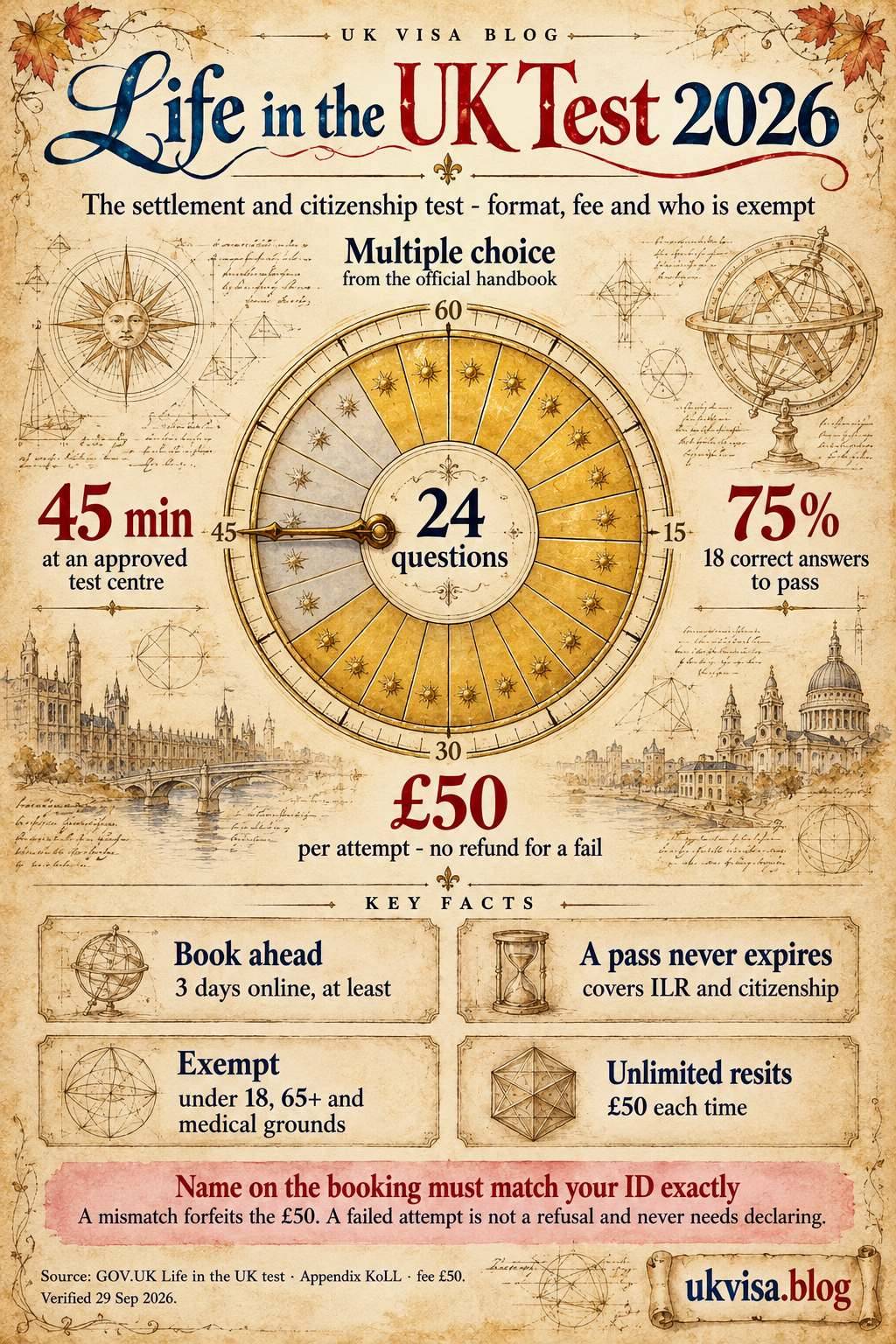
The Life in the UK test is the Knowledge of Life component of the KoLL (Knowledge of Language and Life) settlement requirement under Appendix KoLL of the Immigration Rules. It is a computer-based examination of 24 multiple-choice questions over 45 minutes, requiring 75% (18 correct) to pass, at £50 per attempt. The pass certificate is valid for life and can be used for both ILR and British citizenship applications without retaking. The test is mandatory for applicants aged 18-64 (exemptions for under-18s, 65+, and long-term medical conditions). All questions are drawn from the official handbook Life in the United Kingdom: A Guide for New Residents (3rd edition). This guide covers the test format, validity rules, topics, preparation strategies, booking process, and exemptions for 2026.
Source: Appendix KoLL (Knowledge of Language and Life) of the Immigration Rules; Home Office Life in the UK test caseworker guidance; Life in the United Kingdom: A Guide for New Residents (3rd edition, official handbook), May 2026
The substantive Life in the UK test framework is unchanged in 2026. The test fee remains £50 per attempt — the same level since the 2014 fee restructure. The format remains 24 multiple-choice questions over 45 minutes with a 75% pass mark. The official handbook continues to be the 3rd edition Life in the United Kingdom: A Guide for New Residents. HC 1691 (laid 5 March 2026) raises the English language standard for ILR from B1 to B2 from 26 March 2027 — affecting the Knowledge of Language half of KoLL, but the Knowledge of Life test framework is not amended. The pass certificate continues to be valid for life, can be used for both ILR and citizenship applications, and never needs to be retaken once obtained.
- What is the Life in the UK Test? KoLL Framework Explained
- Life in the UK Test Validity — Does It Expire?
- Life in the UK Test Format 2026 — 24 Questions in 45 Minutes
- Life in the UK Test Fee 2026 — £50 Per Attempt
- Life in the UK Test Topics — Five Handbook Chapters
- How to Pass the Life in the UK Test First Time
- How Long to Study and Prepare for the Test
- Sample Questions Across the Five Topics
- Booking Your Test — Available Dates and Test Centres
- Exemptions from the Life in the UK Test
- After You Pass — Certificate and Next Steps
- Frequently Asked Questions
Life in the UK Test 2026 — Validity, Fees, Topics, and How to Pass
The Life in the UK test — the Knowledge of Life element of the KoLL settlement requirement — is one of two mandatory knowledge requirements for Indefinite Leave to Remain (ILR) or British citizenship by naturalisation. The other element is the Knowledge of Language requirement, currently CEFR Level B1 (rising to B2 from 26 March 2027 under HC 1691). The two requirements operate independently: passing the Life in the UK test does not satisfy the English requirement, and an English certificate does not satisfy the Knowledge of Life requirement. Both must be satisfied (subject to exemption) for any qualifying ILR or citizenship application. The test was introduced in 2005 and has been administered in its current 24-question / 75% pass-mark format since 2013.
What is the Life in the UK Test? KoLL Framework Explained
The Life in the UK test is a 24-question, 45-minute, computer-based multiple-choice examination assessing applicants' knowledge of British history, culture, traditions, values, government, and society. It is the Knowledge of Life component of the KoLL settlement requirement set out in Appendix KoLL of the Immigration Rules. The test costs £50 per attempt, requires 18 correct answers out of 24 (75%) to pass, and is mandatory for ILR and British citizenship applicants aged 18 to 64. The pass certificate is valid for life and may be reused for both ILR and citizenship applications without retaking.
When Was the Life in the UK Test Introduced?
The Life in the UK test was introduced in November 2005 following the Nationality, Immigration and Asylum Act 2002 provisions for Knowledge of Life and Language. Initially required only for British citizenship applications, it was extended to ILR applications in April 2007. The current 24-question, 75% pass-mark format with the third-edition handbook has been in continuous use since 2013. The test has been delivered exclusively through Home Office-approved test centres throughout its history — there is no online or home-based version.
Life in the UK Test Validity — Does It Expire?
The Life in the UK test pass certificate is valid for life — it never expires. Once you pass, the certificate can be used for both your ILR application and any subsequent British citizenship application, without ever needing to retake. There is no validity period, no expiry date, and no requirement to refresh or renew the certificate. The pass certificate continues to be accepted even if many years pass between the test date and the application — including across changes to the handbook or test format. Applicants who passed on older (2007 or 2013) handbook editions hold valid pass certificates for current applications.
Validity Across ILR and Citizenship Applications
The lifetime validity of the Life in the UK test pass certificate is one of the few pleasingly straightforward aspects of the UK settlement framework. The same certificate covers:
- ILR application: Submit the certificate with your ILR application form (SET(M), SET(LR), SET(O)) — covers the KoLL Knowledge of Life requirement
- British citizenship application: The same certificate is reused on the Form AN — no retake required
- No time limit between test and application: A pass certificate obtained 10 years ago remains valid for an ILR or citizenship application today
- Cross-edition validity: Certificates from earlier handbook editions (2007, 2013) remain valid for current applications
- No need to update content knowledge: The pass certificate establishes the KoLL Knowledge of Life element regardless of subsequent updates
Life in the UK Test Format 2026 — 24 Questions in 45 Minutes
The Life in the UK test consists of 24 multiple-choice questions in 45 minutes, requiring 18 correct answers (75%) to pass. Each question is randomly selected from a question bank of approximately 3,000 items drawn from the official handbook. Some questions have a single correct answer; others ask the candidate to select two correct answers. The test is delivered on-screen at a Home Office-approved test centre — no paper, no online, no remote version. Results are delivered immediately: pass or fail, with no numerical score breakdown.
| Test Element | Details |
|---|---|
| Number of questions | 24 multiple-choice questions per test |
| Time allowed | 45 minutes total |
| Pass mark | 75% — 18 of 24 correct answers required |
| Test fee | £50 per attempt |
| Question format | Single-answer multiple choice (most); select-two questions also appear |
| Delivery | Computer-based at Home Office-approved test centres |
| Question source | All questions drawn from Life in the United Kingdom: A Guide for New Residents (3rd edition) |
| Result delivery | Immediate on test completion — pass / fail notification on screen |
| Certificate validity | Lifetime — never expires |
| Retake waiting period | 7 days between attempts if needed |
Life in the UK Test Fee 2026 — £50 Per Attempt
The Life in the UK test fee in 2026 is £50 per attempt, payable online when booking through the official gov.uk portal. The fee has remained at £50 since the 2014 fee restructure and was not changed in the 8 April 2026 Home Office fees revision (which raised most settlement fees including ILR from £2,885 to £3,226). The £50 covers a single test attempt — if you fail, the £50 must be paid again for each retake. There is no priority booking, no fast-track service, and no refund policy except in narrowly-defined cancellation circumstances. For the broader settlement fees context, see our UK in-country Home Office fees guide.
Life in the UK Test Topics — Five Handbook Chapters
The Life in the UK test covers the five chapters of the official handbook: (1) The values and principles of the UK; (2) What is the UK? — Geography of the four nations; (3) A long and illustrious history — From prehistoric Britain to modern times; (4) A modern, thriving society — Religion, customs, sport, arts, leisure, traditions; (5) The UK government, the law and your role — Constitution, Parliament, courts, voting, rights. Chapters 3 and 5 (history and government) provide the largest share of questions.
| Handbook Chapter | Topics Covered | Approx Share of Questions |
|---|---|---|
| 1. The Values and Principles of the UK | British values, fundamental principles, what it means to be a permanent resident or citizen | ~10% |
| 2. What is the UK? | The four nations (England, Scotland, Wales, Northern Ireland), geography, capitals, flags | ~10% |
| 3. A Long and Illustrious History | Prehistoric, Roman, Anglo-Saxon, Norman Conquest, medieval, Tudor, Stuart, Georgian, Victorian, World Wars, post-war Britain | ~35% |
| 4. A Modern, Thriving Society | Religion, customs and traditions, sport, music, art, literature, leisure activities, food, festivals | ~20% |
| 5. The UK Government, the Law and Your Role | Constitution, monarchy, Parliament, devolved governments, courts, police, voting, rights and responsibilities | ~25% |
High-Frequency Test Topics — Where Questions Concentrate
- Historical dates: Battle of Hastings (1066), Magna Carta (1215), Battle of Trafalgar (1805), Battle of Britain (1940)
- Historical figures: Henry VIII, Elizabeth I, Oliver Cromwell, William the Conqueror, Margaret Thatcher (first female PM)
- Patron saints and days: St George (England, 23 April), St Andrew (Scotland, 30 November), St David (Wales, 1 March), St Patrick (Northern Ireland, 17 March)
- UK constitution: Constitutional monarchy, Parliament (Commons + Lords), devolved governments, separation of powers
- Voting and elections: Minimum voting age (18), general election cycle (at least every 5 years), first-past-the-post system
- Legal system: Magistrates' courts, Crown Court, High Court, Court of Appeal, Supreme Court
- Traditions and festivals: Guy Fawkes Night (5 November), Remembrance Day (11 November), Pancake Day (Shrove Tuesday)
- British values: Democracy, rule of law, individual liberty, mutual respect, tolerance — the FBV (Fundamental British Values) framework
How to Pass the Life in the UK Test First Time
To pass first time: (1) read the official handbook from cover to cover — all 24 questions come from this single book; (2) take daily practice tests on free online platforms; (3) focus intensively on historical dates, monarchs, patron saints, and "firsts" (first female PM, first Parliament); (4) study consistently for 2 to 4 weeks at 1 to 2 hours per day; (5) achieve consistent practice-test scores above 80% before booking your actual test. The first-time pass rate is approximately 70%.
Proven Strategies for First-Time Success
- Read the official handbook cover-to-cover, twice: Every question comes from this single book. First reading for comprehension; second reading for memorisation of dates, names, and facts
- Take practice tests daily: Free online practice tests simulate the 24-question / 45-minute / 75% format. Aim for 5 practice tests per week in the final 2 weeks
- Focus on dates and numbers: Historical dates, voting ages, jury ages, monarch reign dates, war years — heavily tested and easily revised with flashcards
- Learn the monarchs and prime ministers: Henry VIII through Elizabeth II; Walpole through Starmer. Particular focus on "first" PMs (Walpole), reformist PMs (Gladstone, Churchill), and first female PM (Thatcher)
- Memorise the patron saints and their days: Four nations, four patron saints, four feast days — almost always tested
- Understand the UK constitutional system: Constitutional monarchy, House of Commons, House of Lords, devolution to Scottish Parliament / Welsh Senedd / Northern Ireland Assembly
- Know British traditions and festivals: Guy Fawkes Night, Bonfire Night, Burns Night, Pancake Day, May Day, Halloween, Boxing Day
- Read questions carefully: Some questions ask for two correct answers; select-two questions are partial-credit and missing one answer means missing the question entirely
- Time management: 45 minutes for 24 questions = nearly 2 minutes per question. No need to rush; review answers before submitting
How Long to Study and Prepare for the Test
Most applicants need 2 to 4 weeks of preparation at 1 to 2 hours per day. Applicants with strong existing UK knowledge may pass with 1 to 2 weeks. Applicants for whom English is a second language typically need 4 to 6 weeks. Recommended pattern: Week 1 — read Chapters 1-3 and take 2 practice tests; Week 2 — read Chapters 4-5 and focus on historical dates; Week 3 — daily practice tests targeting 80%+; Week 4 — focused revision on weak areas before booking the actual test.
| Applicant Profile | Recommended Study Duration | Daily Study Hours |
|---|---|---|
| Strong UK knowledge / native English / long UK residence | 1–2 weeks | 1 hour/day |
| Moderate UK knowledge / fluent English | 2–3 weeks | 1–2 hours/day |
| Limited UK knowledge / fluent English | 3–4 weeks | 2 hours/day |
| English as second language / limited UK exposure | 4–6 weeks | 1–2 hours/day with audio support |
Study Materials
- Official handbook (essential): Life in the United Kingdom: A Guide for New Residents — 3rd edition. Priced at approximately £12.99 for the paperback, also available as audio book and Kindle edition. The only source from which test questions are drawn
- Free online practice tests: Multiple free platforms offer practice tests in the 24-question / 45-minute format. Use daily to gauge progress
- Mobile apps: Several iOS and Android apps offer flashcards, chapter-based questions, and full practice tests for studying on the go
- Audio book: The handbook is available in audio form — useful for auditory learners or applicants studying while commuting
- Study guides (supplementary): Third-party study guides offer summaries, but should supplement rather than replace the official handbook
- YouTube tutorials: Some free YouTube series walk through each handbook chapter with explanations — useful for visual learners
Sample Questions Across the Five Topics
History (Chapter 3) Sample Questions
- Q: In which year did the Battle of Hastings take place? A: 1066
- Q: Who was the first woman Prime Minister of the United Kingdom? A: Margaret Thatcher (1979–1990)
- Q: Which king founded the Church of England by breaking from Rome? A: Henry VIII (1534)
- Q: The Battle of Trafalgar was fought in which year? A: 1805
- Q: Which document signed in 1215 limited royal power and established due process? A: Magna Carta
Government and Law (Chapter 5) Sample Questions
- Q: What is the minimum age at which you can vote in UK general elections? A: 18 years
- Q: How often must UK general elections be held? A: At least every 5 years
- Q: What is the role of the Speaker in the House of Commons? A: To chair debates and maintain order
- Q: At what age can you serve on a jury? A: 18 to 75 years
- Q: What is the highest court in the UK? A: The Supreme Court
Modern Society and Culture (Chapter 4) Sample Questions
- Q: What is celebrated on 5 November in the UK? A: Guy Fawkes Night / Bonfire Night
- Q: Who is the patron saint of England, and on which date is St George's Day? A: St George, 23 April
- Q: What food is traditionally eaten on Shrove Tuesday? A: Pancakes
- Q: On which date is St Andrew's Day (Scotland's patron saint)? A: 30 November
- Q: What is the name of the Welsh language? A: Cymraeg
Booking Your Test — Available Dates and Test Centres
Book the Life in the UK test online through the official gov.uk portal at www.gov.uk/life-in-the-uk-test. The booking flow requires creating an account, selecting a test centre by postcode, choosing an available date, and paying the £50 fee. Approximately 30 Home Office-approved test centres operate across the UK. Booking should be made at least 7 days in advance — available dates typically appear 2 to 4 weeks ahead. Bring your booking confirmation and a valid photo ID (passport, BRP, eVisa share code, or UK driving licence) on test day.
Booking Step-by-Step
- Step 1 — Access portal: Visit gov.uk/life-in-the-uk-test and select "Book the test"
- Step 2 — Account creation: Register with your full name (matching ID), date of birth, contact email, and address
- Step 3 — Find centre: Enter your UK postcode to view test centres near you ranked by distance
- Step 4 — Select date / time: Choose an available appointment from the calendar. Slots fill quickly in popular cities — book early
- Step 5 — Pay £50: Online payment by debit or credit card; no payment plans or fee waivers available
- Step 6 — Confirmation: Booking confirmation email arrives within minutes; print or save to phone for test day
What to Bring on Test Day
- Valid photo identification (one of): Current passport; Biometric Residence Permit (BRP) or eVisa share code; UK driving licence with photo
- Booking confirmation: Printed copy or accessible on phone
- Proof of address (some centres require): Recent utility bill, bank statement, or council tax bill
- Arrive 15 minutes early: Allow time for security checks, ID verification, and locker storage
- Do not bring: Phones, smart watches, notes, study materials, or any electronic device — all must be stored in lockers
Exemptions from the Life in the UK Test
Three categories of applicant are exempt: (1) applicants under 18 at the time of application; (2) applicants aged 65 or over; (3) applicants with a long-term physical or mental condition that prevents them from taking the test. Medical exemption requires a letter from a registered medical practitioner. The Home Office assesses medical exemption requests as part of the ILR or citizenship application. Exemption from the Life in the UK test does not automatically exempt the applicant from the English language requirement.
Medical Exemption Documentation
- GP or specialist letter: From a UK-registered medical practitioner, on letterhead, identifying the condition
- Explanation of impact: The letter must explain how the condition prevents the applicant from taking the test — not just that the applicant has a condition
- Long-term nature: Conditions must be long-term — short-term illnesses do not qualify; conditions must be expected to last 12 months or more
- Physical conditions: Severe visual impairment, hearing loss, motor disability preventing computer use, severe dementia
- Mental conditions: Severe cognitive impairment, severe learning disability, conditions affecting memory or comprehension to a degree that test attendance would be inappropriate
- Submission with application: Medical letter is submitted alongside the ILR / citizenship application form, not in advance
After You Pass — Certificate and Next Steps
Immediately on completing the test, you receive a pass / fail notification on screen. If you pass, you are given a pass letter on the day showing your unique reference number. The official certificate is posted to your registered address within approximately 7 days. Keep the certificate safe — it has no expiry date and must be submitted with your ILR (and later citizenship) application. Lost certificates can be replaced through the Home Office Life in the UK test helpline. If you fail, retake after a 7-day waiting period, paying £50 each time, with no limit on attempts.
Next Steps After Passing the Test
- Complete the English language requirement: Knowledge of Language is the other half of KoLL. See our CEFR framework and UKVI threshold certification guide
- Check absence records against the continuous residence rule: See our 180-day absence rule for continuous residence guide
- Submit your ILR application: You can apply up to 28 days before your qualifying residence period ends
- Family route applicants: See our Spouse / partner settlement (ILR) guide (note: spouse-specific language requirements are in our spouse visa English requirement guide)
- Skilled Worker applicants: See our Skilled Worker sponsored employment guide
- BN(O) applicants: See our BN(O) Status Holder route guide
- After ILR — moving to citizenship: See our British citizenship through naturalisation guide
- The Life in the UK test is the Knowledge of Life element of the KoLL settlement requirement under Appendix KoLL of the Immigration Rules
- Format: 24 multiple-choice questions in 45 minutes; pass mark 75% (18 correct answers)
- Fee: £50 per attempt, unchanged in the 8 April 2026 fees revision
- Certificate is valid for life — never expires; can be reused for both ILR and British citizenship applications without retaking
- Mandatory for applicants aged 18 to 64; exemptions for under-18s, 65+, and long-term medical conditions
- All questions come from the official handbook Life in the United Kingdom: A Guide for New Residents (3rd edition)
- Most applicants need 2-4 weeks of preparation at 1-2 hours per day for first-time success
- Overall first-time pass rate approximately 70%; preparation using handbook + practice tests dramatically improves success
- Retakes permitted with 7-day waiting period; no limit on number of attempts
- HC 1691 does not change the Life in the UK test framework; it raises the English language standard from 26 March 2027 (independent KoLL element)
- Booking is via gov.uk online portal; approximately 30 Home Office-approved test centres across the UK
Frequently Asked Questions About the Life in the UK Test
No — the Life in the UK test pass certificate does not expire. Once you have passed the test, the certificate is valid for life and can be used for both your ILR application and any subsequent British citizenship application without ever needing to retake. There is no validity period, no expiry date, and no requirement to refresh the certificate even if many years pass between the test and the application. Certificates from earlier handbook editions (2007, 2013) remain valid for current ILR and citizenship applications.
The Life in the UK test pass certificate is valid for life — there is no time limit. You can use the same certificate for your ILR application now and, several years later, for your British citizenship application. The certificate has no expiry date, no refresh requirement, and never needs to be retaken. This is unusual among UK immigration documents (most English language certificates expire after 2 years), making the Life in the UK test certificate uniquely durable across the settlement journey.
The Life in the UK test fee in 2026 is £50 per attempt, payable online when booking through the gov.uk portal. The £50 fee has remained unchanged since the 2014 fee restructure and was not affected by the 8 April 2026 Home Office fees revision (which raised ILR application fees from £2,885 to £3,226). The £50 covers a single test attempt — if you fail and need to retake, the £50 must be paid again for each subsequent attempt with no fee reduction or fee waiver available.
The Life in the UK test consists of 24 multiple-choice questions to be completed within 45 minutes. The pass mark is 75% — you must answer at least 18 questions correctly out of 24 to pass. Most questions have a single correct answer; some require you to select two correct answers (these are partial-credit and missing one answer means missing the question entirely). Questions are randomly selected from a question bank of approximately 3,000 items, all drawn from the official handbook Life in the United Kingdom: A Guide for New Residents (3rd edition).
Most applicants need 2 to 4 weeks of dedicated preparation at 1 to 2 hours per day. Applicants with strong existing UK knowledge may pass with 1 to 2 weeks. Applicants for whom English is a second language typically need 4 to 6 weeks. Recommended pattern: Week 1 — read handbook Chapters 1-3 and take 2 practice tests; Week 2 — read Chapters 4-5 and revise historical dates; Week 3 — daily practice tests targeting 80%+ scores; Week 4 — focused revision on weak areas before booking the actual test.
To pass first time: read the official handbook from cover to cover at least twice, take daily practice tests in the final 2 weeks, focus intensively on historical dates and figures (Battle of Hastings 1066, Henry VIII, Margaret Thatcher as first female PM), memorise the four patron saints and their days, and consistently score 80% or higher on practice tests before booking. The first-time pass rate is approximately 70% — those who prepare systematically using the handbook plus practice tests substantially exceed this average. The most common failure cause is relying on practice tests alone without reading the handbook.
Approximately 30 Home Office-approved Life in the UK test centres operate across the UK in cities including London, Birmingham, Manchester, Glasgow, Edinburgh, Cardiff, Belfast, Bristol, Liverpool, Leeds, Newcastle upon Tyne, Nottingham, Sheffield, Reading, Southampton, and others. To find centres near you, enter your UK postcode on the gov.uk booking portal — the system displays available centres ranked by distance with appointment availability. Available appointment dates typically appear 2 to 4 weeks in advance; popular centres in large cities can have longer waits during peak booking periods.
If you fail the Life in the UK test, you can retake it as many times as needed with no upper limit on attempts. You must wait at least 7 days between attempts, and each retake costs £50 paid online when booking. The Home Office does not disclose your numerical score — you receive only a pass / fail notification — so you cannot identify specific weak areas from the result itself. Use the 7-day waiting period to revisit the handbook, focus on chapters you found difficult, and take additional practice tests. Most applicants who fail the first attempt pass on the second or third attempt with proper additional preparation.
Yes — the Life in the UK test is mandatory for both ILR and British citizenship by naturalisation, unless you are exempt (under 18, aged 65 or over, or have a long-term physical or mental condition preventing test attendance). However, you only need to pass the test once. The same pass certificate covers both applications. The certificate is valid for life and can be reused for your citizenship application several years after your ILR application without needing to retake the test. This is one of the few areas of the settlement framework where a single qualification covers multiple immigration steps.
Three categories of applicant are exempt: applicants under 18 at the time of application; applicants aged 65 or over; and applicants with a long-term physical or mental condition preventing them from taking the test. Medical exemption requires a letter from a UK-registered medical practitioner identifying the condition and explaining specifically why it prevents test attendance — vague claims of "stress" or short-term illness do not qualify. The Home Office assesses medical exemption requests as part of the ILR or citizenship application. Exemption from the Life in the UK test does not automatically exempt the applicant from the English language requirement.
For the official Knowledge of Language and Life framework, see Immigration Rules Appendix KoLL. For Home Office caseworker guidance, see the knowledge of language and life caseworker guidance. To book the test, see the official Life in the UK test booking page on GOV.UK. For exemptions, see the Life in the UK test exemption guidance.