
Naturalisation has two versions. The general route needs five years’ residence and twelve months holding settlement. The spouse route needs three years and no waiting period after settlement. Both need good character, English and the Life in the UK test, and both cost £1,839 including the ceremony.

Citizenship
Naturalising as a British Citizen in 2026
What Naturalisation Is
Naturalisation is the discretionary grant of British citizenship to an adult under the British Nationality Act 1981. It is the final step after settlement, not an alternative to it, and it is discretionary — meeting every requirement creates a strong case, not an entitlement.
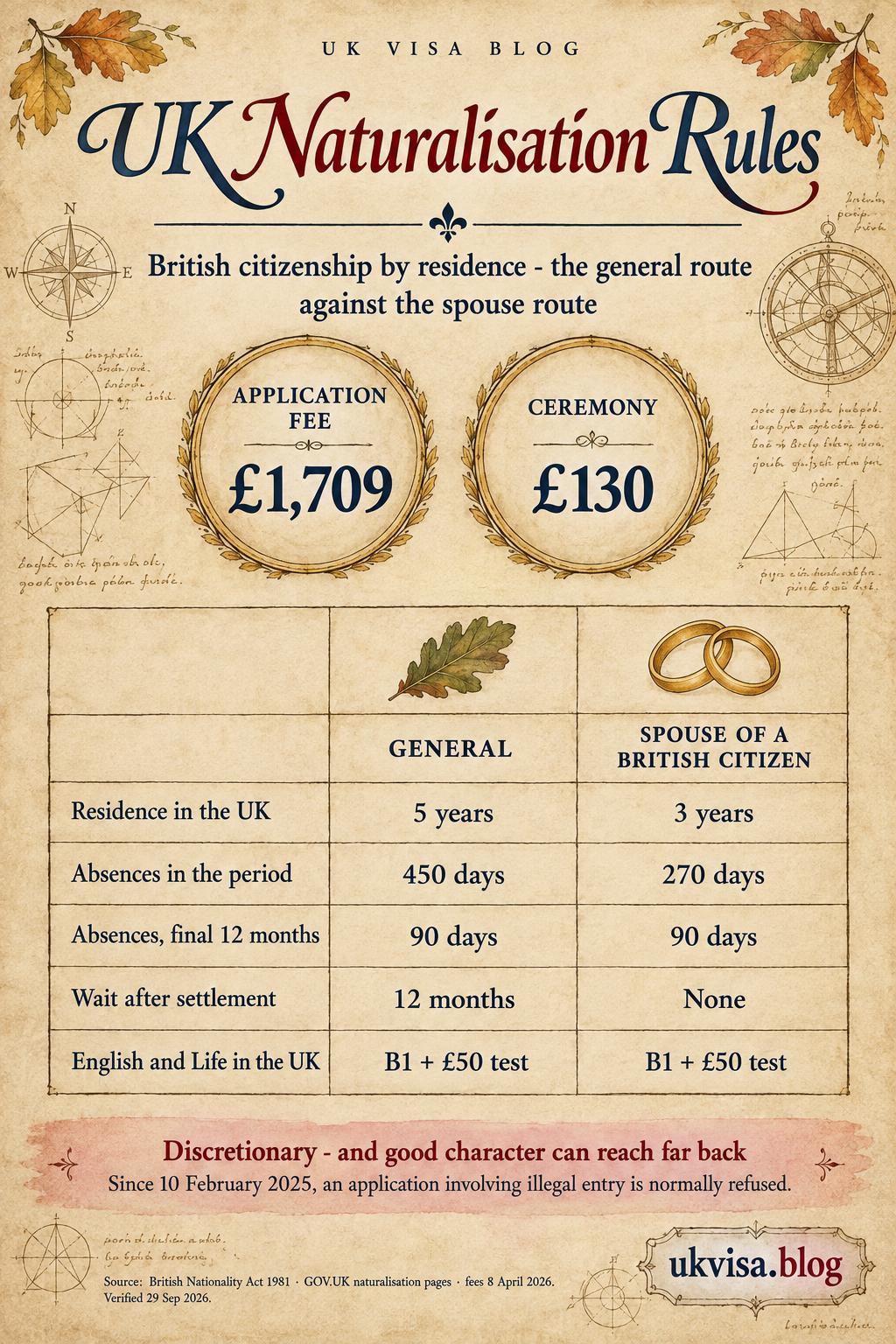
The general route needs five years in the UK, no more than 450 days absent across those five years, no more than 90 days absent in the final twelve months, and twelve months holding settlement. The spouse route needs three years, no more than 270 days absent, the same 90-day limit, and no waiting period after settlement. Both cost £1,709 plus a £130 ceremony fee.
Naturalisation and Registration Are Different
Naturalisation is for adults who qualify through residence. Registration is for people with an existing entitlement or claim — most children, and adults in defined categories. Registration as an adult costs £1,540 and as a child £1,000, against £1,709 for naturalisation, and the requirements are not the same.
The Two Routes
General Route and Spouse Route Compared
| Requirement | General route | Spouse of a British citizen |
|---|---|---|
| Residence in the UK | 5 years | 3 years |
| Maximum absences in the period | 450 days | 270 days |
| Maximum absences in the final 12 months | 90 days | 90 days |
| Wait after settlement | 12 months | None |
| Good character | Required | Required |
| English and Life in the UK | Required | Required |
| Fee including ceremony | £1,839 | £1,839 |
Source: GOV.UK naturalisation pages and the Home Office fee table, 8 April 2026. Checked 22 August 2026.
Which One Applies
The spouse route applies where you are married to or in a civil partnership with a British citizen at the date of application. It is materially easier: two fewer years, a tighter absence allowance in proportion, and — the point that saves most time — no twelve-month wait after settlement. Our page on settlement as a partner covers the step before it.
Residence and Absences
You must have been physically present in the UK exactly five years before the Home Office receives the application — or three on the spouse route. That is a single-day test on a single date, and applications are routinely refused because the applicant was abroad on it.
- The whole period: 450 days on the general route, 270 on the spouse route.
- The final year: 90 days on both routes.
- Presence on the qualifying date: you must have been in the UK five, or three, years before receipt.
- Count every trip: including short business travel and weekends abroad.
- Discretion exists: excess absences may be excused in special circumstances, but it is discretion, not entitlement.
Reconstruct the absences from passport stamps, boarding passes and calendar records before applying, not afterwards. Continuous residence for settlement uses different rules again — see our page on the continuous residence requirement.
Good Character
There is no statutory definition. The Home Office assesses criminality, immigration history, financial conduct, honesty in dealings with the department, and notoriety. It looks at the whole person, and it looks back further than most applicants expect.
Guidance changed on 10 February 2025. Applications made after that date which include illegal entry will normally be refused, regardless of when the illegal entry occurred. There is no time limit on how far back that reaches, so a journey years before a lawful grant of settlement can still defeat a citizenship application.
Criminal Convictions
Criminality thresholds in the nationality guidance are aligned with those used in the Immigration Rules, so a sentence that would be a mandatory ground for refusing permission carries corresponding weight here. Declare everything, including spent convictions, cautions and fixed penalties for anything beyond parking.
Immigration and Financial Conduct
Overstaying, working in breach of conditions, and any use of deception are all good character issues — see our pages on suitability refusal grounds, deception bans and bans on returning to the UK.
Financial conduct covers unpaid tax, undeclared self-employment income, bankruptcy and unpaid debts to public bodies including the NHS. An outstanding NHS debt above the relevant threshold is a common and unexpected obstacle. Resolve these before applying, and evidence the resolution.
English and the Life in the UK Test
Both are required and both are separate. English is at B1 unless you are exempt, and the Life in the UK test must be passed at an approved centre for £50 per attempt. Passing the test does not evidence English, and an English certificate does not evidence knowledge of life in the UK.
Exemptions apply at 65 and over, and where a long-term physical or mental condition prevents it, evidenced by a doctor’s form and original medical reports. Nationals of recognised majority English speaking countries are exempt from the English element, and a degree taught in English can also satisfy it. See our pages on English requirements and the Life in the UK test (KoLL).
GOV.UK warns that a citizenship or settlement application will be refused if you send the wrong qualifications. Check the certificate states the level required, covers the right components, and comes from a provider approved at the date you sat it.
Applying
- Confirm you qualify: the residence date, the absence totals and the twelve-month settlement point.
- Sit the tests: Life in the UK and English, unless exempt.
- Find two referees: who meet the requirements set out in the application.
- Apply online and pay: £1,709 plus the £130 ceremony fee.
- Prove identity and enrol biometrics: at an appointment or through the app.
- Attend the ceremony: within three months of the invitation.
Your status while the application is pending comes from your settlement, not from the application — see our page on the eVisa and UKVI accounts. Settlement does not lapse because a citizenship application is refused.
Referees and the Declaration
Two referees are required, and the application sets out who may act. Choosing someone ineligible is a validity problem rather than a merits one, and it is discovered late. Confirm both referees meet the stated conditions, that neither is related to you or to each other in a way the form excludes, and that both are willing to be contacted.
The declaration matters as much. You are confirming the accuracy of every answer, including the absence figures and the declarations about convictions and immigration history. An error in a total is fixable if raised; an error left standing becomes a good character question in its own right.
Fees
£1,709 to apply and £130 for the ceremony, £1,839 in total. Registration as an adult is £1,540 and as a child £1,000. The Life in the UK test is £50 per attempt and English testing is charged by the provider. See our pages on in-country fees and entry clearance fees.
No health surcharge applies to a citizenship application, and none applies to settlement either. The fee is not refunded if the application is refused, which is the strongest argument for resolving good character issues before applying rather than hoping they pass unnoticed.
How Long It Takes
Citizenship applications are among the slowest decisions the Home Office makes, and priority is available at a 30 working day target rather than the five working days offered on most visa routes. Super priority cannot be used for citizenship at all.
Where a case involves absences requiring discretion, or a good character question, expect considerably longer. Our pages on delays and settlement cover what to do while waiting.
Children
Children do not naturalise. They register, at £1,000, and the basis depends on their circumstances: born in the UK to parents who later settled, born abroad to a British parent, or registered at the Home Secretary’s discretion. Some children are British already and need only a passport rather than an application.
Check entitlement before paying. Registering a child who is already British wastes £1,000, and the reverse — assuming a child is British when they are not — produces problems at the first passport application. See our page on British citizens living abroad for the descent rules.
Why Applications Are Refused
- Absences over the limit: 450, 270 or 90 days, counted precisely.
- Not present on the qualifying date: five or three years before receipt.
- Applying too early: before twelve months of settlement on the general route.
- Good character: criminality, immigration history, unpaid tax or NHS debt, or illegal entry at any time.
- The wrong English qualification: wrong level, wrong components, or an unapproved provider.
- Non-disclosure: which is treated more seriously than the matter concealed.
There is no right of appeal against a citizenship refusal. The routes are a reconsideration request, a fresh application once the problem is resolved, or judicial review (JR) where the decision was unlawful. See our pages on administrative review (AR) and what to do after a refusal.
The Ceremony
Citizenship is not acquired on approval. You are invited to a ceremony, must attend within three months of the invitation, and become British when you take the oath or affirmation and the pledge. Missing the window without good reason can mean the approval lapses, so treat the invitation as a deadline rather than an administrative formality.
Dual Nationality
The UK permits dual nationality and does not require you to give up another citizenship. Whether you keep the other one is a question for that country’s law, and several require renunciation on acquiring a new nationality.
Check your own country’s position before the ceremony, not after. Losing a nationality unintentionally affects property rights, inheritance and the ability to travel or work there, and it is rarely reversible.
Sources: the GOV UK naturalisation pages, the good character nationality guidance, the naturalisation by discretion guidance and the British Nationality Act 1981. Figures verified 22 August 2026.
Frequently Asked
Naturalisation Questions
How long must I have lived in the UK?
Five years on the general route, or three if you are married to or in a civil partnership with a British citizen.
How many days can I have been outside the UK?
No more than 450 days across the five years, or 270 across the three years on the spouse route, and no more than 90 days in the final twelve months either way.
Do I have to wait twelve months after settlement?
On the general route, yes. If you are married to a British citizen, no — you can apply as soon as you hold indefinite leave to remain, settled status or indefinite leave to enter.
How much does it cost?
£1,839 in total: £1,709 to apply and £130 for the citizenship ceremony. The Life in the UK test is a further £50 per attempt.
Does an old illegal entry still matter?
Yes. For applications made after 10 February 2025, illegal entry will normally lead to refusal regardless of when it occurred. Take advice before applying if this affects you.
Do I need to declare spent convictions?
Yes. Declare everything, including cautions and fixed penalties beyond parking. Non-disclosure is treated more seriously than the matter concealed.
Can unpaid tax or an NHS debt refuse my application?
Financial conduct is part of good character, and unpaid tax or debt to a public body including the NHS can defeat an application. Resolve and evidence it before applying.
Can I pay for a faster decision?
Priority is available at a 30 working day target. Super priority cannot be used for citizenship applications.
Can I appeal a refusal?
No. The options are a reconsideration request, a fresh application once the problem is fixed, or judicial review where the decision was unlawful.
Will I lose my current nationality?
Not under UK law, which permits dual nationality. Whether your other country permits it is a question for its law, and some require renunciation. Check before the ceremony.