
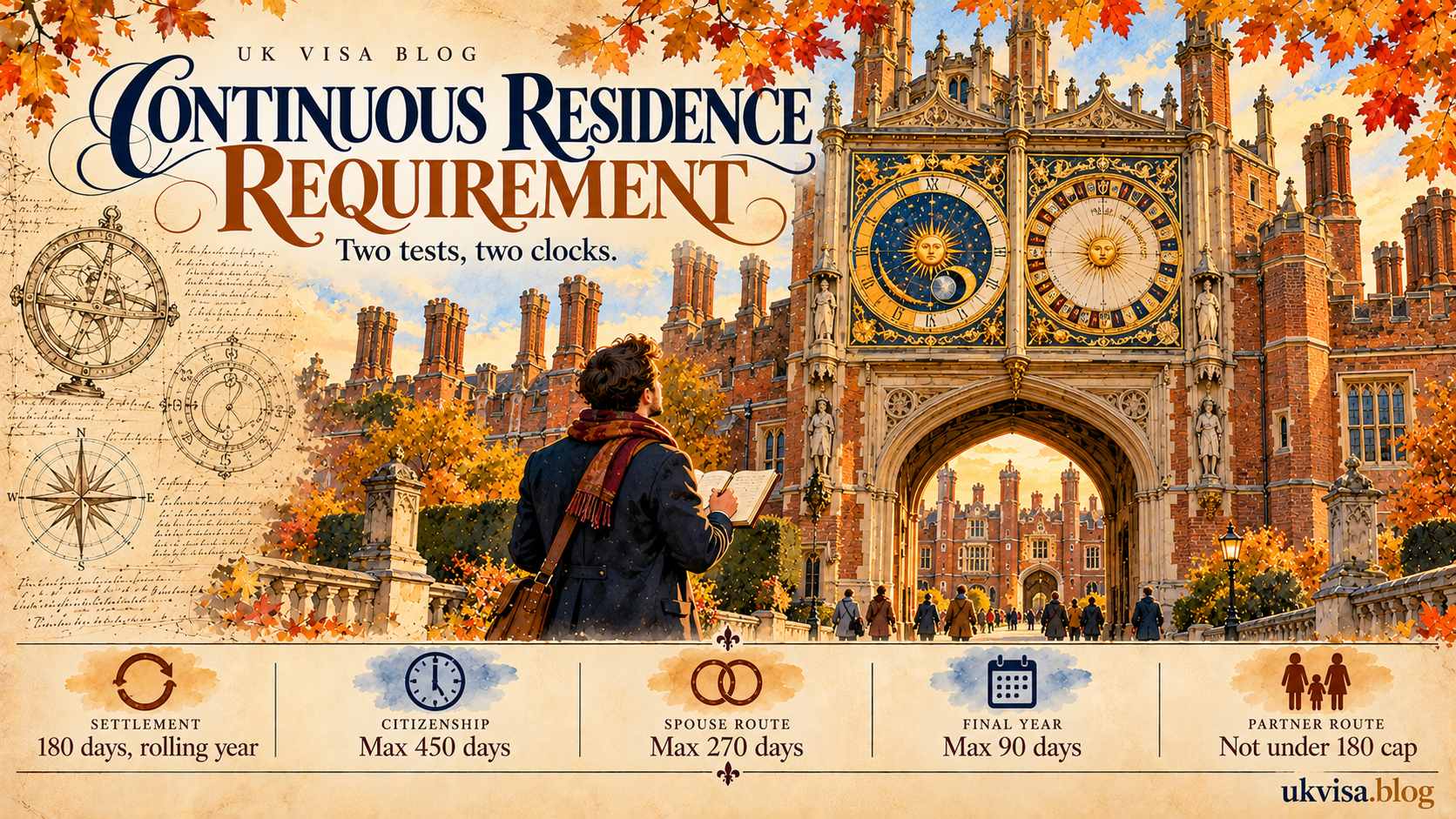
Two different absence regimes get confused constantly. Settlement uses Appendix Continuous Residence: no more than 180 days outside the UK in any rolling twelve-month period, on the routes that appendix lists. Citizenship uses its own limits — 450, 270 and 90 days. They are not the same test and they do not run together.
Continuous Residence
The UK Continuous Residence Requirement
What Continuous Residence Means
It is the requirement that your qualifying period was actually spent in the UK, with permission, and without interruptions the Rules treat as breaking it. Appendix Continuous Residence sets the test for settlement on the routes it lists. Citizenship has its own separate rules under the British Nationality Act framework.
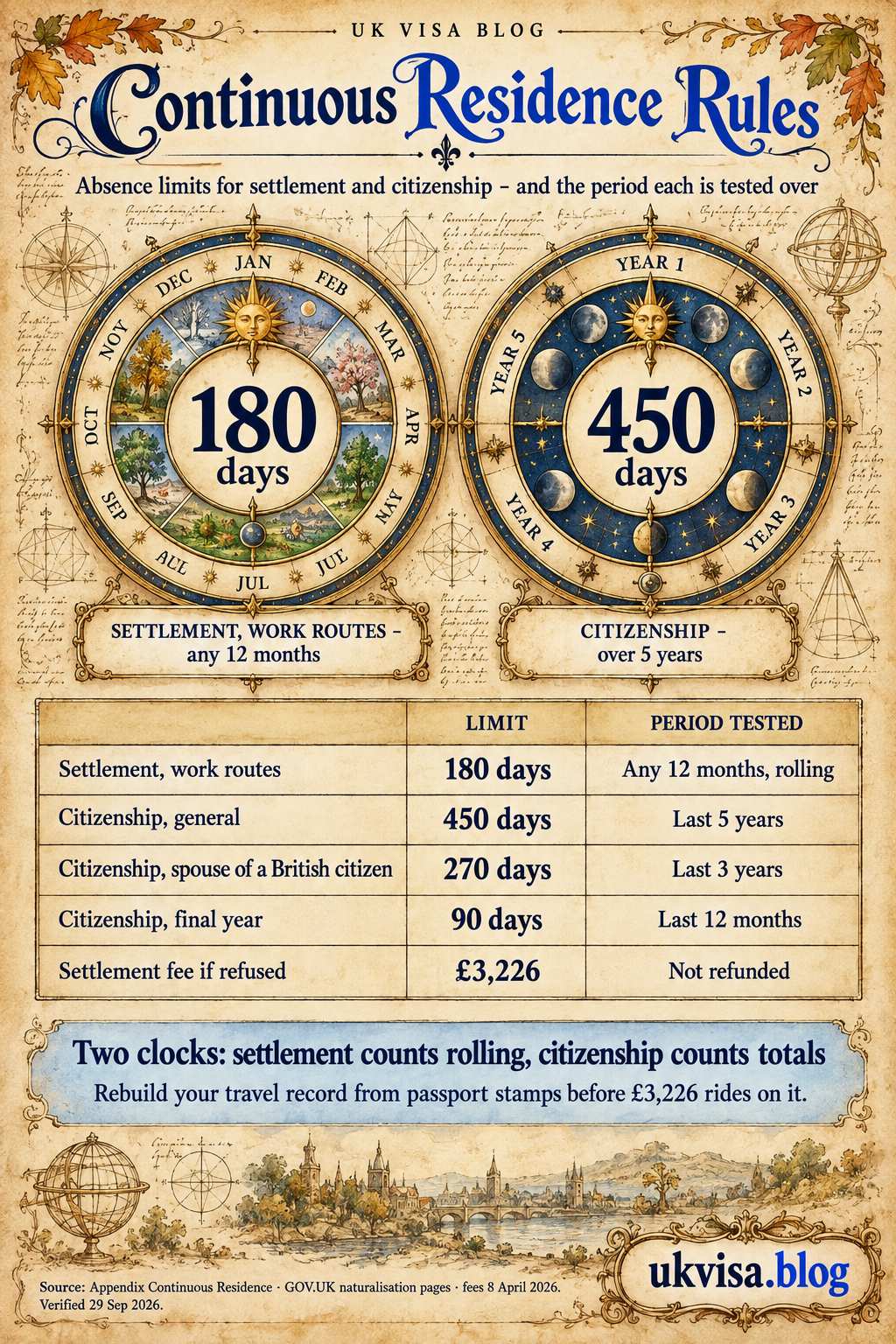
Settlement: no more than 180 days outside the UK in any rolling twelve-month period. Citizenship: no more than 450 days across five years, or 270 across three on the spouse route, and no more than 90 days in the final twelve months. Appendix Continuous Residence does not list Appendix FM, so the 180-day cap does not govern the five-year partner or parent routes.
Two Tests, Two Clocks
Meeting the settlement test does not mean meeting the citizenship one. The settlement limit is a rolling window applied throughout the qualifying period; the citizenship limits are totals across a fixed period plus a tighter cap on the final year. Someone can settle comfortably and still be a year away from naturalising because of travel that was never a problem for settlement.
The 180-Day Rule
The applicant must not have been outside the UK for more than 180 days in any twelve-month period, unless an exception applies. The window is rolling, which is the feature people misread most often — it is not measured by calendar year, and not by visa year.
Ninety days abroad in November and December, then a further hundred in January and February, is 190 days in a twelve-month window even though no calendar year exceeds 180. Every twelve-month period ending during the qualifying period is tested, not just the neat ones.
Worked Through
- Test every window: any twelve months ending within the qualifying period.
- Count whole absences: including short trips, not only long postings.
- Watch the boundaries: two moderate trips either side of a year end can combine into a breach.
- Breach restarts the clock: unless a listed exception covers the absence.
- Keep the evidence: stamps, boarding passes and tickets, contemporaneously.
The Citizenship Limits
Absence Limits Compared
| Purpose | Limit | Period tested |
|---|---|---|
| Settlement, routes under Appendix Continuous Residence | 180 days | Any rolling 12 months |
| Naturalisation, general route | 450 days | The 5 years before application |
| Naturalisation, spouse of a British citizen | 270 days | The 3 years before application |
| Naturalisation, final year | 90 days | The last 12 months |
Source: Appendix Continuous Residence and the GOV.UK naturalisation pages. Checked 22 August 2026.
The Twelve-Month Wait, and the Presence Date
On the general citizenship route you must have held settlement for twelve months before applying; spouses of British citizens do not wait at all. Separately, you must have been physically present in the UK exactly five years — or three — before the Home Office receives the application. That single-day test defeats a surprising number of otherwise sound applications.
See our page on citizenship by naturalisation for the full picture, and our page on settlement for the step before it.
Long Residence Has Its Own Character
The ten-year long residence route is governed by the same appendix, but ten years of travel is a much larger surface for a breach to hide in. Applicants who have been in the UK a decade have usually held several different permissions, changed employers, and travelled for reasons they no longer remember clearly.
Two failures dominate on that route. A gap between one permission ending and the next beginning, often years earlier and forgotten. And an absence total that nobody counted at the time. Both are fixable only by starting the reconstruction long before the application, which is the single best piece of preparation available on this route.
The Fee Makes Accuracy Worth It
Settlement costs £3,226 per person from 8 April 2026, up from £3,029, and it is not refunded on refusal. For a family of four that is £12,904 riding on an absence calculation. Against that, the cost of reconstructing the record properly — or of taking advice on a borderline total — is trivial.
Counting Your Days
Reconstruct the record rather than estimating it. Passport stamps are the primary source, but they are incomplete for travel within the Common Travel Area and for automated border crossings, so boarding passes, tickets, bank records and calendar entries all matter.
- List every trip: departure and return dates, destination and reason.
- Include short trips: weekends and business travel count.
- Use the actual dates: not the dates you meant to travel.
- Cross-check against evidence: stamps, boarding passes, card transactions.
- Keep it updated: a contemporaneous log is far more accurate than a reconstruction five years later.
- Note the reason for long absences: where an exception might apply, the reason is what evidences it.
Digital Status Does Not Log Your Travel
A UKVI account records your permission, not your movements. It will not produce an absence total for you, and neither will an eVisa. The obligation to evidence absences remains yours — see our page on the eVisa and UKVI accounts.
Excess Absences
Exceeding a limit is not automatically fatal, but the relief comes from a listed exception rather than general sympathy. On the settlement side, Appendix Continuous Residence sets out the absences that are disregarded; on the citizenship side, discretion exists but must be exercised on the facts.
The distinction matters when preparing the application. An absence that fits a listed category needs to be identified as such and evidenced. An absence that does not fit needs a candid explanation and an acceptance that discretion may not be exercised. Neither is helped by leaving the caseworker to work it out.
What Breaks Continuous Residence
- Exceeding the absence limit: without a listed exception applying.
- A period without permission: subject to limited exceptions.
- Imprisonment: which breaks residence in its own right.
- A deportation or exclusion order: in force during the period.
- Removal from the UK: however the departure was categorised.
A break generally means starting again rather than pausing. That is why a gap in permission — even a short one after a late application — is so damaging on a five or ten-year route, and why the fourteen-day overstayer exception in the suitability rules matters as much as it does.
Which Routes Appendix Continuous Residence Governs
The appendix lists them expressly: HM Armed Forces for settlement as a partner or child, Skilled Worker, Representative of an Overseas Business, Global Talent, Innovator Founder, T2 Minister of Religion, International Sportsperson, UK Ancestry, Domestic Worker in a Private Household, Temporary Work International Agreement, Scale-up, Settlement Family Life, Private Life for settlement, Hong Kong British National (Overseas), Long Residence, ECAA Settlement, and the legacy Tier 1 Entrepreneur and Investor categories.
Appendix FM is not on that list. The 180-day cap therefore does not govern the five-year partner or parent routes, though it does apply to the ten-year family life route under Appendix Settlement Family Life. Check which appendix governs your own route before counting anything — see our pages on the spouse route, Skilled Worker, Global Talent visa and the Innovator Founder visa.
Imprisonment Is Absolute
A custodial sentence during the qualifying period breaks continuous residence in its own right, independently of any absence calculation and independently of whether the sentence triggers a suitability ground. It is one of the few events with no discretionary route around it, and it restarts the clock from release.
EU Settlement Scheme
The scheme runs on its own continuity rules rather than on Appendix Continuous Residence. Its absence provisions are more generous in some respects and structured differently, and a single longer absence can be permitted for specified reasons.
Anyone holding pre-settled status and planning extended travel should check the scheme’s own provisions rather than assuming the 180-day rule applies to them. Applying the wrong test in either direction produces the wrong answer.
Planning Travel Around the Rules
The practical discipline is to count forward rather than back. Before booking anything longer than a fortnight, add it to the running total for the twelve months it falls in and check the result against the limit for your route — and, if citizenship is the eventual goal, against the 90-day cap that will apply in your final year.
Where a long absence is unavoidable, the choice is usually about timing rather than about whether to go. Moving a three-month posting from one side of a year boundary to the other can be the difference between a clean record and a restarted clock, and that decision is only available in advance.
Absences That Can Be Disregarded
- Assisting with a national or international humanitarian or environmental crisis.
- Travel disruption: caused by natural disaster, military conflict or pandemic.
- Compelling personal circumstances: including serious illness or the death of a close family member.
- Approved research activity: where the route provides for it.
- Accompanying a partner or parent in Crown service: in defined circumstances.
- Family life applicants working or studying abroad: while family life in the UK continues.
Each needs evidence of the reason, not just of the travel. A hospital record, an employer letter describing the research, a death certificate, or documentation of the disruption. Our pages on ILR processing times and delays cover what to expect once such an application is submitted, since cases turning on discretion take longer.
Sources: Appendix Continuous Residence on GOV UK, the Home Office long residence guidance, the naturalisation by discretion guidance and the statements of changes collection. Figures verified 22 August 2026.
Frequently Asked
Continuous Residence Questions
What is the 180-day rule?
No more than 180 days outside the UK in any rolling twelve-month period, on the routes Appendix Continuous Residence lists. It is not measured by calendar year.
Does it apply to the spouse route?
Appendix FM is not listed in Appendix Continuous Residence, so the 180-day cap does not govern the five-year partner or parent routes. It does apply to the ten-year family life route.
What are the citizenship limits?
450 days across five years on the general route, 270 across three on the spouse route, and no more than 90 days in the final twelve months either way.
Do short trips count?
Yes. Weekends and business travel count towards the totals. Applicants who only log long trips routinely underestimate their absences.
What happens if I exceed the limit?
Continuous residence breaks and the qualifying period generally restarts, unless a listed exception covers the absence. It is not a discretionary sliding scale.
Which absences can be disregarded?
Humanitarian or environmental crisis work, travel disruption from disaster, conflict or pandemic, compelling personal circumstances such as serious illness or a death, approved research, Crown service accompaniment, and defined family life circumstances.
Does a gap in permission break continuous residence?
Yes, subject to limited exceptions. That is why a late application matters so much on a five or ten-year route.
Does my UKVI account tell me my absence total?
No. It records permission, not movements. Reconstructing and evidencing absences remains your responsibility.
Do EU Settlement Scheme rules work the same way?
No. The scheme has its own continuity provisions, structured differently from Appendix Continuous Residence. Check the scheme’s own rules rather than applying the 180-day test.
Is the fee refunded if I am refused on absences?
No. Settlement costs £3,226 per person and is not refunded, which is why reconstructing the absence record before applying is worth the effort.
Can I settle but not qualify for citizenship?
Easily. The two tests measure different things over different periods, so travel that never troubled the settlement application can still put naturalisation out of reach for a year or more.