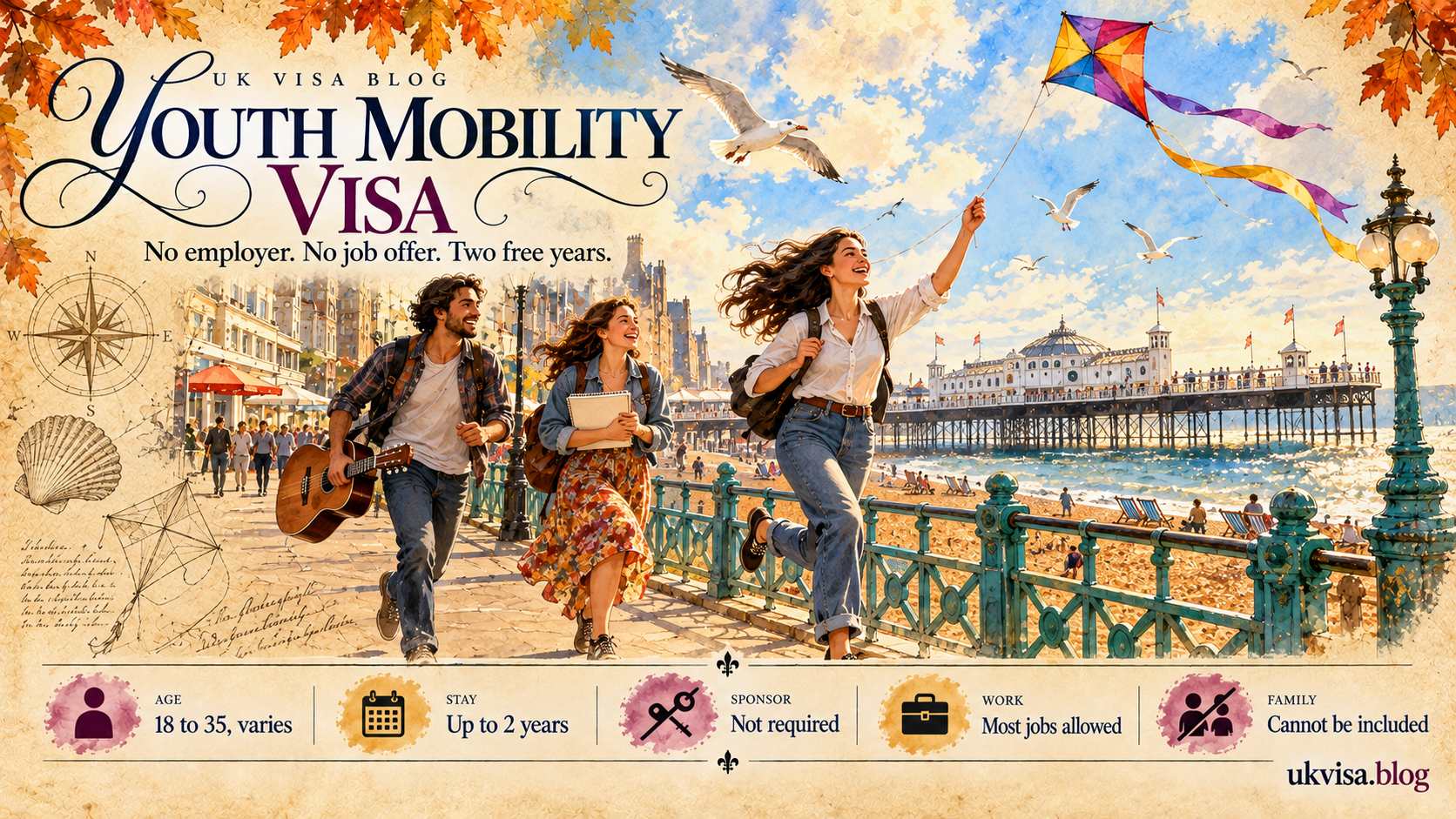
The Youth Mobility Visa UK — also known as the working holiday visa — lets young people aged 18–30 (or 18–35 for Australia, Canada, New Zealand and South Korea) from 13 eligible countries and territories live, work and study in the UK for up to 2 years, or 3 years for Australian, Canadian and New Zealand citizens. From 8 April 2026 the application fee is £340 (up from £319), and Statement of Changes HC 1691 (5 March 2026) reduced the Australia quota to 38,500 and the New Zealand quota to 8,000 places. No employer sponsorship is required, the savings test is £2,530 held for 28 consecutive days, and the visa cannot be applied for twice. The UK–EU Youth Experience Scheme is still under negotiation.
One of the most flexible UK work visas — no job offer, no employer sponsor, no Certificate of Sponsorship, and a discounted Immigration Health Surcharge of £776 per year (vs the £1,035 standard rate). Total cost for a 2-year visa from 8 April 2026 is £1,892 (£340 fee + £1,552 IHS). The downside: one chance only — the visa cannot be applied for twice, time on YMS does not count toward Indefinite Leave to Remain, and only Australian, Canadian and New Zealand citizens can extend for a third year.
- What is the Youth Mobility Visa UK?
- Eligible Countries and 2026 Quotas
- How the Youth Mobility Ballot Works
- Eligibility Requirements
- Youth Mobility Visa UK Cost from 8 April 2026
- How to Apply
- Extension to 3 Years (AU/CA/NZ Only)
- Switching to Another UK Visa
- UK–EU Youth Experience Scheme: 2026 Status
- Frequently Asked Questions
Youth Mobility Visa UK 2026: Working Holiday Visa Complete Guide
The Youth Mobility Scheme (YMS) is a reciprocal cultural-exchange route under Appendix Youth Mobility Scheme: Eligible Nationals of the Immigration Rules. It allows young people from 13 participating countries and territories to come to the UK to work, travel, study and explore the labour market without a job offer or sponsor licence — making it the most flexible work-permitting visa available. The route is administered by UKVI and runs alongside reciprocal schemes operated by partner countries (Australia's Working Holiday Maker programme, the Canadian IEC, New Zealand's Working Holiday Scheme and others).
What Is the Youth Mobility Visa UK?
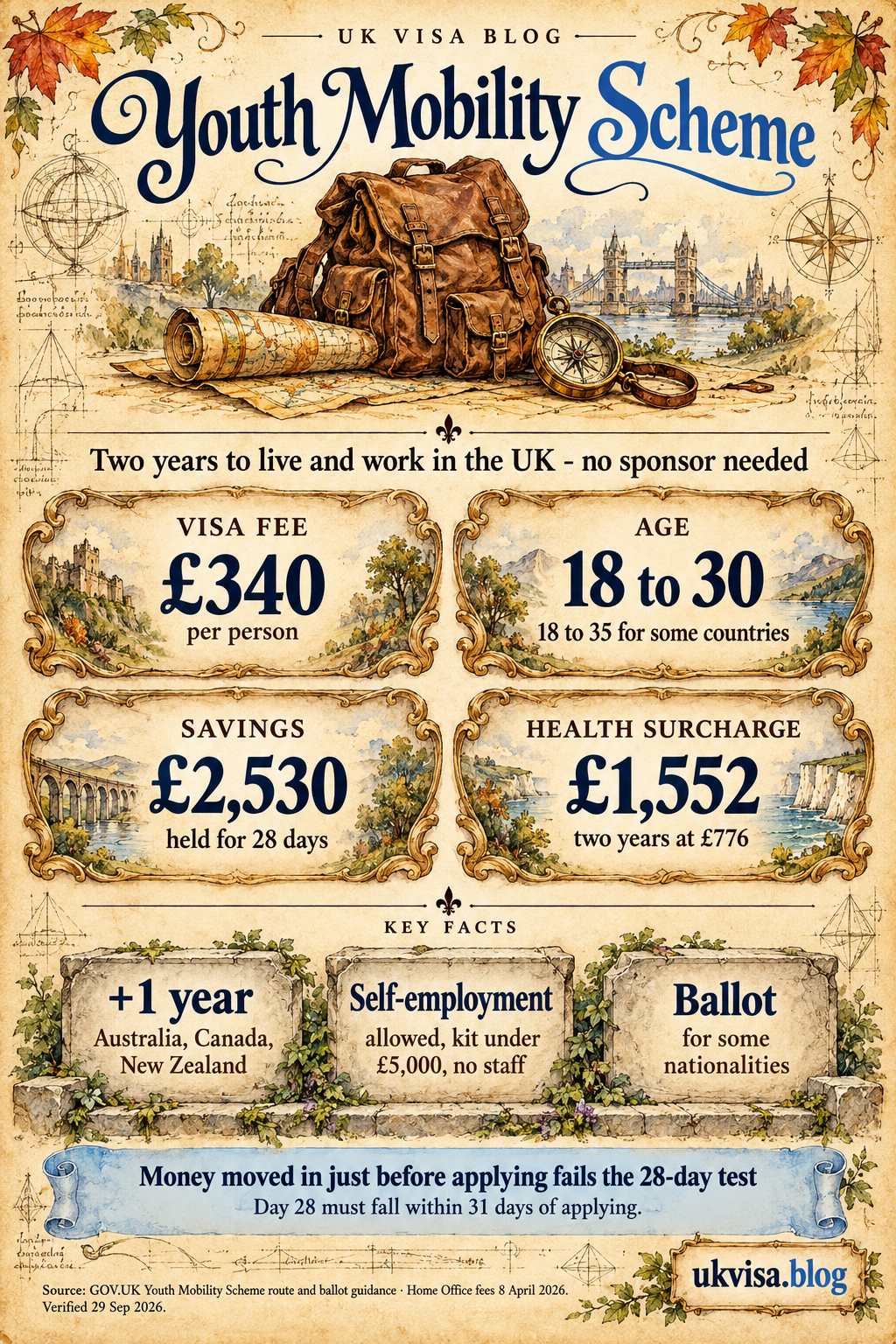
The Youth Mobility Visa UK is a 2-year work and travel visa for citizens of 13 participating countries (extendable to 3 years for Australia, Canada and New Zealand). Applicants must be aged 18–30 (or 18–35 for AU/CA/NZ/SK), hold £2,530 in savings for 28 consecutive days, have no children living with them and never have held the visa before. From 8 April 2026 the application fee is £340 plus £776/year Immigration Health Surcharge — £1,892 in total for a 2-year visa.
In contrast to most UK work visas, no employer sponsor or Certificate of Sponsorship is required. The visa holder can work in almost any role, be self-employed (with limited equipment and no employees), study, and travel freely. The most common refusal reason is failure of the £2,530 savings test — particularly where the balance dips below the threshold on any single day during the 28-day qualifying period.
What You Can Do on a Youth Mobility Visa
- Most employment — including full-time, part-time, temporary and seasonal work.
- Self-employment and small business — set up a company provided your premises are rented, your equipment is worth less than £5,000 and you have no employees.
- Study any course — privately funded, full-time or part-time; some postgraduate science and engineering courses require an Academic Technology Approval Scheme (ATAS) certificate.
- Voluntary work — unpaid voluntary positions are permitted.
- Travel freely — enter, leave and re-enter the UK at any time while the visa is valid.
What You Cannot Do
- Work as a professional sportsperson or sports coach — separate International Sportsperson visa applies.
- Access public funds — most welfare benefits are restricted under "no recourse to public funds".
- Bring dependants on your application — partners and children cannot be added; each family member must qualify for and apply for their own visa.
- Extend beyond 2 years — except citizens of Australia, Canada and New Zealand, who can extend once for a further 12 months.
- Apply a second time — the YMS is a once-in-a-lifetime visa per applicant. Having previously held leave under YMS or the older UK Working Holidaymaker Scheme is a bar to a second grant.
Eligible Countries and 2026 Quotas
Thirteen countries and territories participate: Australia, New Zealand, Canada, South Korea, Japan, Hong Kong (SAR passport), Taiwan, India (under the separate India Young Professionals Scheme), Andorra, Iceland, Monaco, San Marino and Uruguay. British Overseas citizens, British Overseas Territories citizens and British National (Overseas) citizens are also eligible with no quota. Statement of Changes HC 1691 (March 2026) reduced the Australia quota to 38,500 and New Zealand to 8,000 from 8 April 2026.
2026 Quotas by Country (from 8 April 2026)
| Country / Territory | 2026 Quota | Age Limit | Ballot Required |
|---|---|---|---|
| Australia | 38,500 (reduced from 45,000) | 18–35 | No |
| New Zealand | 8,000 (reduced from 8,500) | 18–35 | No |
| Canada | 8,000 | 18–35 | No |
| Japan | 6,000 | 18–30 | No (removed Jan 2024) |
| South Korea | 5,000 | 18–35 | No (removed Jan 2024) |
| India (Young Professionals Scheme) | 3,000 | 18–30 | Yes — separate online ballot |
| Hong Kong (SAR passport) | 1,000 | 18–30 | Yes — email ballot |
| Iceland | 1,000 | 18–30 | No |
| Monaco | 1,000 | 18–30 | No |
| San Marino | 1,000 | 18–30 | No |
| Taiwan | 1,000 | 18–30 | Yes — email ballot |
| Uruguay | 500 | 18–30 | No |
| Andorra | 100 | 18–30 | No |
| BOC / BOTC / BN(O) | No quota | 18–30 | No |
Source: Appendix Youth Mobility Scheme: Eligible Nationals; Statement of Changes HC 1691, published 5 March 2026 and in force from 8 April 2026.
Statement of Changes HC 1691 cut the Australia quota from 45,000 to 38,500 places and the New Zealand quota from 8,500 to 8,000 places. This represents the first substantive reduction in the Australia–UK YMS quota since the 2024 expansion. Australian and New Zealand applicants should expect increased competition during peak application windows and submit applications early in each quota year. All other country quotas remain unchanged.
India Young Professionals Scheme — Separate Route
Indian nationals do not apply under the standard YMS framework. The bilateral UK–India trade and migration agreement (2022) created the India Young Professionals Scheme route — branded as part of the broader Youth Mobility Scheme but with additional requirements: an RQF Level 6 degree (or 3 years' skilled work experience in an Appendix Skilled Occupations role), CEFR B1 English language proficiency, a tuberculosis test certificate, and a separate online ballot system on gov.uk (not the email ballot used by Hong Kong and Taiwan). The India YPS ballot runs twice yearly — the first 2026 ballot ran 17–19 February, with a second expected in summer 2026.
How the Youth Mobility Ballot Works
Hong Kong (SAR passport) and Taiwanese nationals must enter an email-based ballot before applying — sent to a dedicated Home Office email address with name, date of birth, passport number and mobile phone number. Ballots open twice yearly for a 48-hour window. Indian nationals use a separate online ballot via gov.uk. Japanese and South Korean nationals no longer need to enter a ballot (removed January 2024) and can apply directly at any time.
The ballot only applies where demand exceeds the annual quota for a nationality. Selection is random — there is no preference based on application timing, age, profession or sequencing. Each person can enter the ballot once per round; duplicate entries are discarded. Successful entrants receive an invitation to apply by email, and have a defined window (typically 30 days) to submit their formal visa application. Unsuccessful entrants may re-enter future ballots if they remain eligible.
2026 Hong Kong and Taiwan Ballot Dates
The first 2026 YMS ballot for Hong Kong and Taiwan opened at 00:01 Hong Kong time on Tuesday 10 February 2026 and closed at 00:01 on Thursday 12 February 2026. A second ballot is expected in summer 2026 (the 2025 summer ballot ran 22–24 July). Successful ballot entrants for the February 2026 round were notified by Friday 27 February 2026.
- Step 1: Send one email during the 48-hour ballot window to the Home Office address published on the gov.uk ballot guidance page.
- Step 2: Include your full name, date of birth, passport number and mobile phone number — the Home Office requires strict format compliance.
- Step 3: Only one entry per person is counted — duplicates are discarded automatically.
- Step 4: If selected, you'll receive an "invitation to apply" email within roughly 2 weeks.
- Step 5: Apply formally for the YMS visa within the 30-day window from the invitation.
- Step 6: Unsuccessful entrants can enter future ballots if still eligible — there is no appeals process.
Indian nationals do not use the Hong Kong / Taiwan email ballot. India operates an online ballot via gov.uk requiring full identification details, a passport photo or scan, phone number and email address. The first 2026 India ballot ran 17–19 February; a second is expected in summer 2026. If selected, the applicant has 30 days to complete the full India YPS visa application — including evidence of degree or 3 years' skilled work and a CEFR B1 English test pass.
Eligibility Requirements
Aged 18–30 at the date of application (18–35 for AU/CA/NZ/SK); citizenship of an eligible country (or BOC/BOTC/BN(O) status); £2,530 in personal savings held for 28 consecutive days within 31 days before applying; no children under 18 living with you or financially dependent on you; never previously held a YMS visa or older UK Working Holidaymaker visa. Indian applicants have additional degree and English language requirements.
- Age: 18 or over when the visa starts; 30 or under at date of application (35 for AU/CA/NZ/SK). If you turn 31 (or 36) during the visa period, you can stay until expiry.
- Nationality: Citizen of an eligible country listed in Appendix Youth Mobility Scheme: Eligible Nationals, or hold British Overseas Citizen, British Overseas Territories Citizen, or British National (Overseas) status.
- Savings (YMS 5.1): £2,530 in your personal bank account, held for 28 consecutive days ending no more than 31 days before the application date.
- No dependent children: No children under 18 living with you, and no children under 18 you are financially responsible for.
- First-time applicant: Must not have previously held leave under the YMS or the older UK Working Holidaymaker Scheme — the visa is once-per-lifetime.
- Tuberculosis test: Required where applying from a listed country with TB screening obligations.
- Ballot selection (where applicable): For Hong Kong / Taiwan / India only.
- India YPS only: RQF Level 6 degree (or 3 years' skilled work experience) + CEFR B1 English language proficiency.
- Suitability: Must not fall for refusal under the general grounds of the Immigration Rules.
The savings test under YMS 5.1 is unforgiving — your bank balance must stay at or above £2,530 every single day across the 28-day qualifying period. A single-day dip below the threshold (because of a direct debit, holiday booking or transferring funds between accounts) breaks the test and triggers refusal. The 28th day must fall within 31 days before the application date. Bank statements must be in your own name, show all transactions, and cover the full qualifying period. The £2,530 must be in cash or readily available funds — investments, shares, ISAs and pensions do not count.
Youth Mobility Visa UK Cost from 8 April 2026
From 8 April 2026 the application fee is £340 (up from £319 between 9 April 2025 and 7 April 2026). The Immigration Health Surcharge is £776 per year (a discount on the standard £1,035 rate), paid up front for the full grant period. A 2-year visa costs £1,892 total in Home Office charges (£340 fee + £1,552 IHS). Priority service (£500 uplift) and super-priority (£1,000 uplift) are available where the local Visa Application Centre offers them.
| Fee Component | Amount from 8 April 2026 | Notes |
|---|---|---|
| Visa application fee | £340 per person | Up from £319; same for extension (AU/CA/NZ only) |
| Immigration Health Surcharge — adult | £776 per year of visa | Discounted from £1,035 standard rate; up front for full grant period |
| Total 2-year visa cost | £1,892 | £340 + £1,552 (2 × £776) |
| Total 3-year cost (AU/CA/NZ) | £3,008 | £340 initial + £1,552 IHS + £340 extension + £776 third-year IHS |
| Priority service uplift | +£500 | Decision within 5 working days; availability varies by VAC |
| Super-priority service uplift | +£1,000 | Next working day decision; limited availability |
| Biometric enrolment | £19.20 (in-UK extensions) | Often waived where UK Immigration: ID Check app is used |
Source: gov.uk Youth Mobility Scheme visa fee schedule, updated 8 April 2026.
The visa fee and IHS are both non-refundable if the application is refused, but the IHS is refunded pro-rata if the visa holder leaves the UK permanently before the visa expires (or fails to enter the UK at all). For converted figures for Indian applicants see the UK visa fees in Indian Rupees guide.
The Discounted IHS Rate Explained
The Immigration Health Surcharge is charged at a discounted youth rate of £776 per year for YMS applicants — significantly lower than the £1,035 per year applied to most other UK work visas. The discount was originally introduced to reflect the temporary cultural-exchange nature of the route. See the wider discounted IHS rate of £776 page for the full breakdown of IHS rates across visa categories.
How to Apply for a Youth Mobility Visa
The YMS application is submitted online through the gov.uk Youth Mobility Scheme apply portal from outside the UK (extension applications for AU/CA/NZ are submitted from within the UK). The earliest date to apply is 6 months before the intended travel date. Successful applicants now receive an eVisa linked to their passport rather than a physical vignette or BRP. For a structured walk-through, the online visa application portal guide explains the form and document upload process.
- Step 1 (HK / Taiwan / India only): Enter the relevant ballot and wait for selection confirmation.
- Step 2: Complete the online YMS application form on gov.uk — typically takes 30–60 minutes.
- Step 3: Pay the £340 visa fee and full IHS amount (£1,552 for a 2-year visa) by debit or credit card.
- Step 4: Verify your identity — either through the UK Immigration: ID Check app (eligible passports) or by booking a biometric appointment at a Visa Application Centre.
- Step 5: Upload supporting documents — passport, bank statements showing £2,530 for 28 days, ballot confirmation (if applicable), TB certificate (if applicable), India YPS qualifications and English evidence (India only).
- Step 6: Wait for the decision — standard service is approximately 3 weeks from biometrics.
- Step 7: Create a UKVI account, link your eVisa, and travel to the UK within the validity window.
Processing Times
Standard service decisions on YMS visa applications typically take around 3 weeks from biometric enrolment. Priority service (£500 uplift) targets a decision within 5 working days. Super-priority service (£1,000 uplift) targets next-working-day decisions. Both priority services depend on availability at the applicant's local Visa Application Centre — they are not offered in every country.
Extension to 3 Years (Australia, Canada and New Zealand Only)
Only Australian, Canadian and New Zealand citizens can extend the YMS visa — by 12 months, bringing the total stay to 3 years. The extension is applied for from inside the UK before the current visa expires, costs £340 plus £776 IHS, and uses the same online form on gov.uk. Citizens of all other YMS countries cannot extend and must either leave the UK or switch to a different visa category before their 2-year permission ends.
The 3-year extension reflects bilateral mobility deals: the UK–Australia trade and migration agreement, the UK–New Zealand trade and migration deal, and the UK–Canada IEC arrangement. Apply at least 28 days before the current visa expires to avoid section 3C protection gaps. The extension cannot be applied for from outside the UK. If you turn 36 during the third year, your permission continues to expiry — the age is assessed at the date of the extension application, not throughout the visa period.
Switching to Another UK Visa
Switching to most other UK visa categories from within the UK is permitted, provided the switching rules for the target route allow it and you meet the eligibility criteria. Common YMS switching routes are:
- Switch to a Skilled Worker visa with employer sponsorship: The most common onward route. Requires a job offer from a licensed UK sponsor at RQF Level 6 paying at least £41,700 (from 22 July 2025) or the applicable lower threshold for shortage roles. The sponsor must assign a Certificate of Sponsorship — see the wider UK sponsor licence framework.
- UK Spouse visa for partners: Where you have married or formed a civil partnership with a British citizen or ILR holder, or have lived together for 2+ years in a relationship "akin to marriage".
- UK Student visa for academic courses: Where you have been offered a place on a Student-route-eligible course at a licensed sponsor.
- Global Talent, Innovator Founder, or Scale-up visa where you qualify on talent, business or sponsored fast-growth grounds.
Critically: time spent on the YMS visa does NOT count toward the 5-year continuous-residence period for ILR settlement framework applications. If you switch to Skilled Worker, the 5-year ILR clock starts from the date the Skilled Worker visa is granted, not from your YMS entry date. This is the most common misunderstanding around YMS — visa holders often assume their YMS time builds toward settlement, only to discover at the switch stage that the clock resets. Plan early if you intend to remain long-term.
UK–EU Youth Experience Scheme: 2026 Status
EU member states are not part of the Youth Mobility Scheme as of May 2026. The UK and EU agreed at the May 2025 UK–EU Summit to negotiate a reciprocal Youth Experience Scheme covering all 27 EU member states. Negotiations are ongoing; both sides are aiming to conclude an agreement around the Spring–Summer 2026 UK–EU Summit. If an agreement is reached, applications could open in 2027. Until then, EU citizens must use other routes (Skilled Worker, Student, Family) to live or work in the UK.
The December 2025 joint UK Government and European Commission announcement confirmed UK association to Erasmus+ for the 2027–28 academic year, alongside continued Youth Experience Scheme negotiations. Key open questions include whether the scheme will be capped (UK preference) or uncapped (EU preference), the duration of stay (12 months, 2 years, or longer), tuition fee status for participating students, and the IHS rate. UK Government reports indicate a capped 2-year scheme in the "tens of thousands" of places is the working assumption — but no Statement of Changes has yet been laid.
Refusal and Administrative Review
YMS visa refusals are challengeable only by way of administrative review for caseworking errors under Appendix AR of the Immigration Rules — there is no full right of appeal. The administrative review deadline is typically 28 days from receipt of the decision (refusals issued outside the UK). The review is limited to caseworking errors and cannot reconsider the underlying merits with new evidence — fresh evidence requires a fresh application. Refused applicants who simply re-apply within the same ballot round face the same evidence problem unless the underlying defect (most commonly the £2,530 savings test) has been demonstrably fixed.
- Application fee £340 from 8 April 2026 (up from £319) + £776/year IHS — total £1,892 for a 2-year visa.
- Statement of Changes HC 1691 cut the Australia quota to 38,500 places and New Zealand to 8,000 places from 8 April 2026.
- 13 participating countries + BOC/BOTC/BN(O); age 18–30 (or 18–35 for Australia, Canada, New Zealand and South Korea).
- £2,530 personal savings held for 28 consecutive days — the most common refusal reason; bank balance must not dip below threshold on any single day.
- No employer sponsorship required; can work in most jobs, be self-employed (no employees, equipment under £5,000), study, volunteer and travel.
- Hong Kong and Taiwan use an email ballot; India YPS uses a separate online ballot; Japan and South Korea no longer require a ballot.
- Extension to 3 years available only for Australian, Canadian and New Zealand citizens.
- Time on YMS does NOT count toward Indefinite Leave to Remain — the 5-year clock resets if you switch to Skilled Worker or another route.
- Once-per-lifetime visa — cannot be applied for a second time, including by previous UK Working Holidaymaker Scheme holders.
- UK–EU Youth Experience Scheme negotiations ongoing; possible agreement by mid-2026 with applications opening 2027.
For official guidance and to start your application, see the gov.uk Youth Mobility Scheme visa overview and the Appendix Youth Mobility Scheme: Eligible Nationals. The full text of the 2026 quota and fee changes sits in the Statement of Changes HC 1691 (5 March 2026). For the Hong Kong / Taiwan ballot procedure, see the dedicated gov.uk YMS Ballot Guidance.
The Youth Mobility Visa UK — also known as the working holiday visa — is a 2-year UK work and travel visa for young people aged 18–30 (or 18–35 for Australia, Canada, New Zealand and South Korea) from 13 participating countries. It does not require employer sponsorship, allows almost any kind of work and self-employment, and grants free travel in and out of the UK during the visa period. Australian, Canadian and New Zealand citizens can extend for a 12-month third year. From 8 April 2026 the application fee is £340 plus £776/year Immigration Health Surcharge.
Thirteen countries and territories participate: Australia, New Zealand, Canada, South Korea, Japan, Hong Kong (SAR passport), Taiwan, India (under the separate India Young Professionals Scheme), Andorra, Iceland, Monaco, San Marino and Uruguay. British Overseas citizens, British Overseas Territories citizens and British National (Overseas) citizens are also eligible with no quota limit. No EU member state is currently included — UK–EU Youth Experience Scheme negotiations are ongoing.
The age limit is 18–30 at the date of application for most countries (Japan, Hong Kong, Taiwan, India, Andorra, Iceland, Monaco, San Marino, Uruguay, and BOC/BOTC/BN(O) holders). Australia, Canada, New Zealand and South Korea have an extended age limit of 18–35. You must be 18 or over when the visa starts. If you turn 31 (or 36) after the visa has been issued, you can stay until the visa expires — the age is assessed at the application date, not throughout the visa period.
From 8 April 2026 the application fee is £340 per person (up from £319 between 9 April 2025 and 7 April 2026). The Immigration Health Surcharge is £776 per year at the discounted youth rate, paid up front for the full grant period. A standard 2-year visa costs £1,892 total in Home Office charges (£340 fee + £1,552 IHS). A 3-year visa for Australia, Canada or New Zealand citizens (initial + extension) costs £3,008 total. Priority service adds £500; super-priority adds £1,000 where available.
Statement of Changes HC 1691 (published 5 March 2026, in force 8 April 2026) reduced the Australia quota from 45,000 to 38,500 places and the New Zealand quota from 8,500 to 8,000 places. These are the first substantive quota cuts for Australia and New Zealand since the 2024 expansion. All other YMS country quotas remain unchanged. Australian and New Zealand applicants should expect tighter competition during peak demand windows.
Only citizens of Australia, Canada and New Zealand can extend, by 12 months — bringing the total stay to 3 years. The extension is applied for from inside the UK before the current visa expires, costs £340 plus £776 IHS, and uses the same online form on gov.uk. Citizens of all other YMS countries cannot extend and must either leave the UK or switch to a different visa category before their 2-year permission ends.
Hong Kong (SAR passport) and Taiwanese nationals must enter an email-based ballot before applying — sending one email during a 48-hour window with their name, date of birth, passport number and mobile phone number to a Home Office address published on gov.uk. Indian nationals use a separate online ballot via gov.uk under the India Young Professionals Scheme. Japanese and South Korean nationals no longer need a ballot (removed January 2024) and can apply at any time. Ballots run twice yearly. Selection is random with no appeal.
Yes, you can switch from YMS to Skilled Worker from within the UK provided you have a job offer from a licensed sponsor at RQF Level 6 paying £41,700 or above (from 22 July 2025), or the applicable lower threshold for shortage roles. Most other visa categories also accept switching from YMS — including Spouse/Partner, Student, Global Talent, Innovator Founder, and Scale-up. Important: time on YMS does NOT count toward the 5-year ILR qualifying period — the settlement clock starts from the Skilled Worker visa grant date.
No. The YMS does not permit dependants on the main applicant's visa. Partners and children cannot be added to the application. If your partner is independently eligible (citizen of a YMS country, aged 18–30 or 18–35 as appropriate, meets the savings test, never previously held YMS), they can apply for their own separate visa. Children born in the UK during the YMS holder's stay can apply as dependants under separate rules — but children must not be living with the main applicant or be financially dependent on them at the date of application.
Not yet. The UK and EU agreed in principle at the May 2025 UK–EU Summit to negotiate a reciprocal Youth Experience Scheme covering all 27 EU member states. Negotiations have continued through 2025 and into 2026 — a deal is expected around the Spring–Summer 2026 UK–EU Summit. If an agreement is reached, applications could open in 2027. Until then, EU citizens cannot apply for the YMS and must use other routes such as Skilled Worker or Student visa to live and work in the UK.
Overstaying a YMS visa is a serious immigration breach. The Home Office may remove you from the UK, impose a re-entry ban consequences for overstayers of up to 10 years depending on the circumstances of departure, and the overstay record will affect future UK visa applications and visa applications to most other countries. If you intend to remain in the UK beyond the YMS visa, file a switching application to another visa category before the YMS visa expires — section 3C of the Immigration Act 1971 automatically extends your existing leave while an in-time application is pending.