
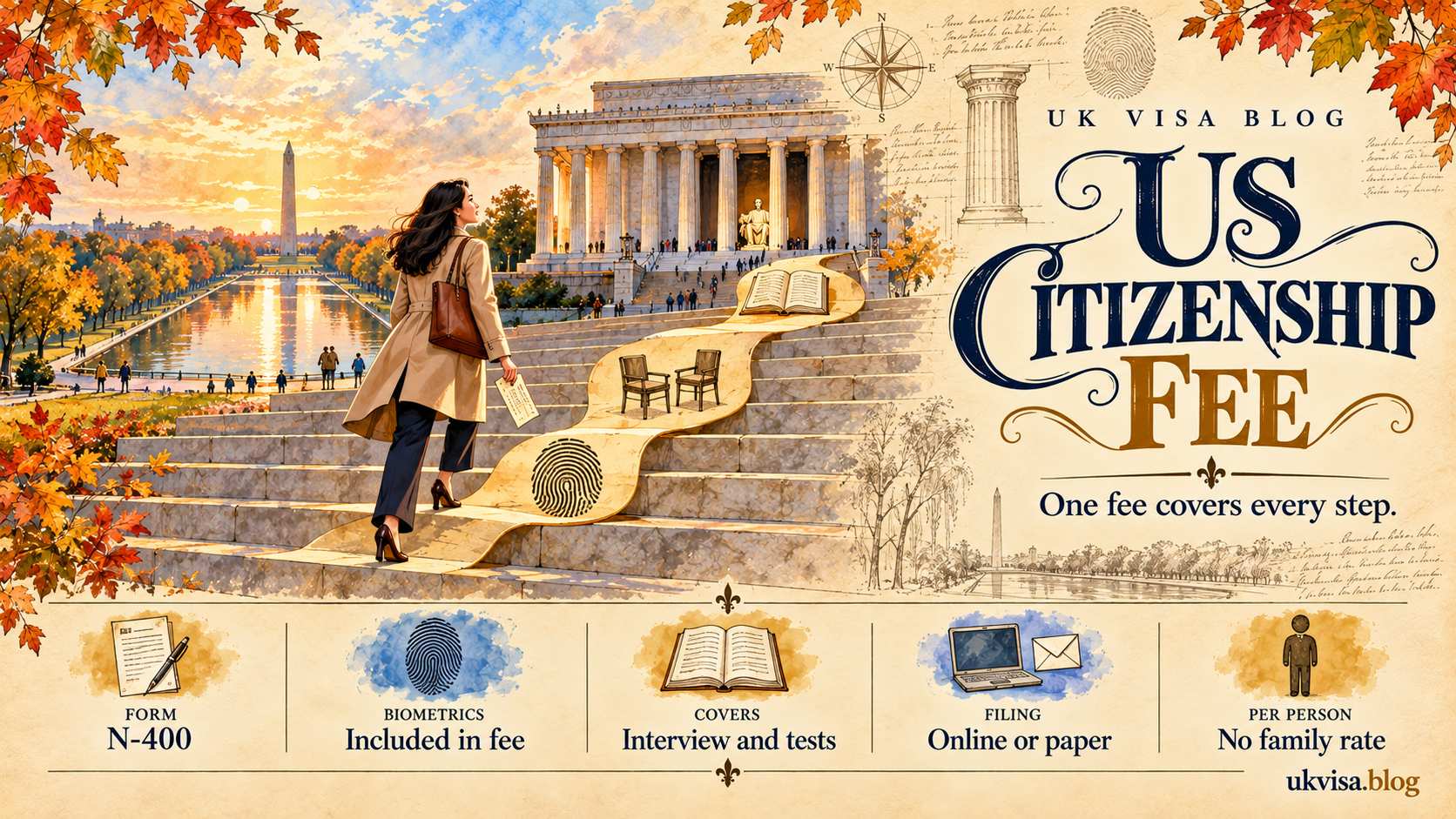
Naturalisation costs $760 on paper or $710 online, with no separate biometrics charge since the fee schedule changed on 1 April 2024. A reduced fee of $380 exists for lower-income applicants, a full waiver for some, and nothing at all for certain military applicants. This guide sets out what you pay, what you can avoid paying, and how.
US Citizenship
US Citizenship Application Fee: The Full N-400 Cost
What the N-400 Costs
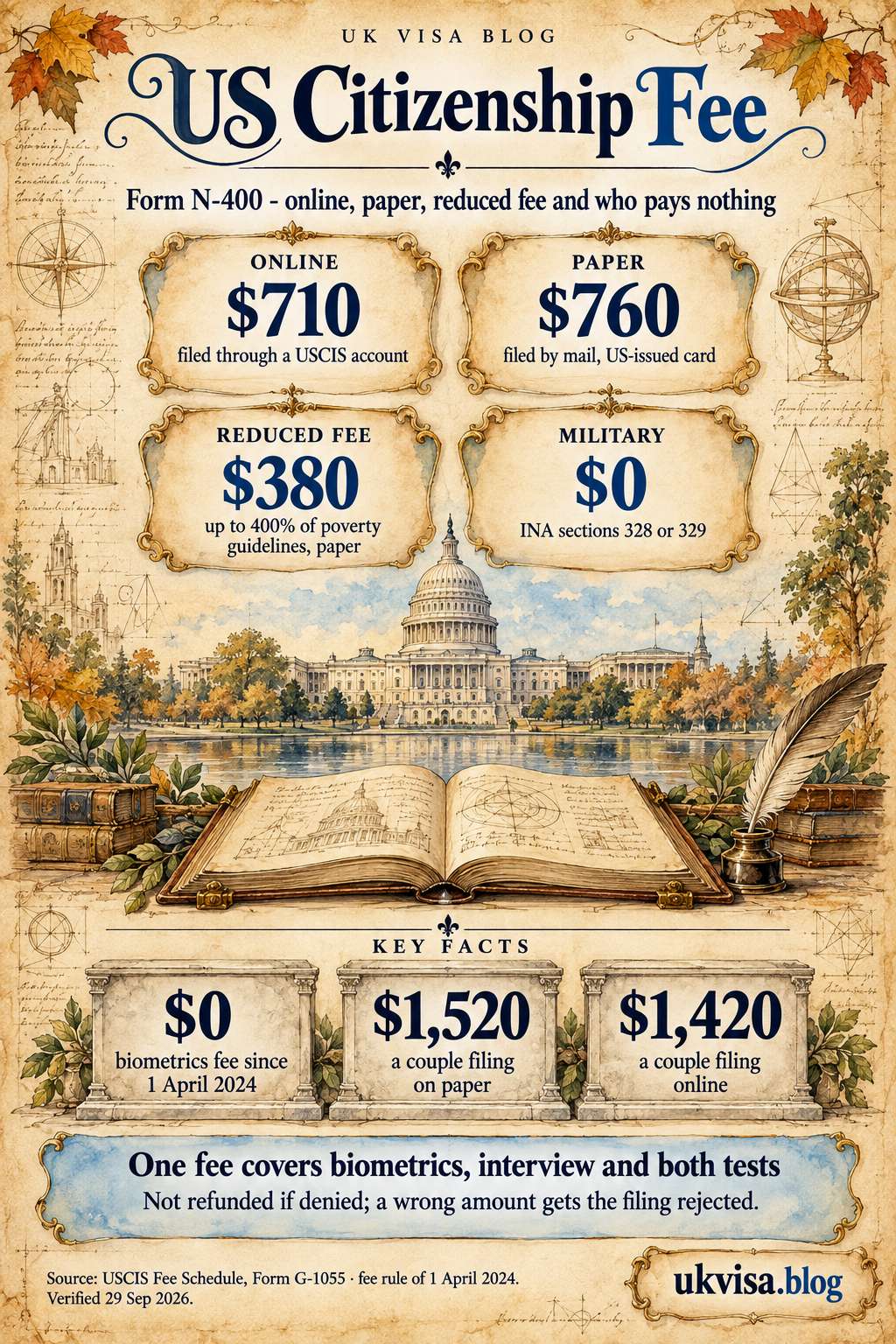
Form N-400 costs $760 filed on paper and $710 filed online, a $50 discount for using the online system. Under the fee rule effective 1 April 2024 there is no longer a separate biometric services fee, so the figure quoted is the total. A reduced fee of $380 is available where documented annual household income is not more than 400% of the Federal Poverty Guidelines.
The fee is paid once, when the application is filed. It covers the biometrics appointment, the interview and the English and civics tests. It does not cover a second application if the first is denied or withdrawn, and USCIS does not refund it where an application is unsuccessful.
Each Applicant Files Separately
There is no joint application and no family rate. A married couple naturalising together files two Form N-400s and pays twice: $1,520 on paper, or $1,420 filing both online. Each application is decided on its own facts, so one spouse being approved has no bearing on the other, and eligibility dates frequently differ between them.
Why Older Figures Are Still Circulating
Guides quoting $640 plus an $85 biometrics fee, or $595 plus $85, are describing the position before 1 April 2024. The current rule folded biometrics into the filing fee and set separate online and paper rates for the first time. If a source quotes a biometrics fee alongside the N-400 charge, it is out of date.
The Fifty Dollar Online Discount
Filing online through a USCIS account saves $50 and gives you a record of what was submitted and when. The saving is not available in every case. Anyone requesting the reduced fee must file on paper, so the choice between $710 and $380 is not a choice you can also apply the online discount to.
Reduced Fee and Fee Waivers
Two separate routes reduce what you pay, and they are not interchangeable. One halves the fee for moderate-income applicants; the other removes it entirely for those on very low incomes or receiving means-tested benefits.
The Reduced Fee of $380
Applicants whose documented annual household income is not more than 400% of the Federal Poverty Guidelines may request a reduced fee of $380 on Form I-942, with supporting documentation. The guideline figures are updated each year, so eligibility should be checked against the current ones. The request must accompany a paper N-400.
The Full Fee Waiver
Form I-912 requests a complete waiver. The 2024 fee rule codified existing waiver eligibility for low-income and vulnerable populations and expanded exemptions for certain humanitarian beneficiaries. A waiver request is decided before the application itself, and a refused request does not decide the naturalisation application, but it does delay it while the fee is paid.
Military Applicants Pay Nothing
No fee is required for applicants naturalising under sections 328 or 329 of the Immigration and Nationality Act, the provisions covering service in the US armed forces. This is an exemption rather than a waiver, so there is no separate request form and no income test to satisfy.
Older Applicants: What Changed and What Did Not
A long-standing point of confusion concerns applicants aged 75 and over, who used to pay less than everyone else. That concession has gone, but a more valuable one for older applicants remains in place.
The Age 75 Discount No Longer Exists
The reduction for applicants aged 75 and over was an exemption from the biometric services fee, not from the filing fee. Because the rule in force since 1 April 2024 abolished the separate biometrics charge for N-400 applicants, there is no longer a fee for that exemption to apply to. Applicants aged 75 and over now pay the same $760 or $710 as everyone else.
The 65/20 Concession Remains, and It Is Substantial
Applicants who are 65 or older at the time of filing and have been lawful permanent residents for at least 20 years study a specially designated list of 20 civics questions rather than the full bank. They are asked 10 of those 20 and pass on 6. They are also exempt from the English requirement and may take the civics test in their own language with an interpreter.
The Two Other Age and Residence Exemptions
Applicants aged 50 or older with 20 years as a permanent resident, and those aged 55 or older with 15 years, are exempt from the English requirement but still take the full civics test, which they may also take in their own language with an interpreter. Separately, an applicant who cannot meet either requirement because of a medical disability may be exempt from English, civics or both, on Form N-648. That form is free.
Related Fees and What Is Not Charged
Naturalisation itself carries one government fee. The related applications people confuse with it are priced separately, and USCIS publishes them together rather than in the guidance for each form.
The Other Citizenship Forms and What They Cost
USCIS sets out every charge in its fee schedule, Form G-1055. Several citizenship forms are cheaper filed online, on the same logic as the N-400, and several cost nothing in defined circumstances.
Citizenship Form Fees
| Form | Fee |
|---|---|
| N-400 Application for Naturalization | $760 paper / $710 online |
| N-600 Application for Certificate of Citizenship | $1,385 paper / $1,335 online |
| N-600K Citizenship under section 322 | $1,385 paper / $1,335 online |
| N-565 Replacement Naturalization or Citizenship Document | $555 paper / $505 online |
| N-336 Hearing on a Decision in Naturalization Proceedings | $830 paper / $780 online |
| N-470 Application to Preserve Residence for Naturalization | $420 |
| N-300 Application to File Declaration of Intention | $320 |
| N-426, N-644 and N-648 | No fee |
Source: USCIS Fee Schedule, Form G-1055, edition 05/29/26.
Where the Fee Falls Away Entirely
Military applicants under INA 328 or 329 pay nothing for the N-400, and nothing for an N-336 hearing if such an application is refused. A current or former member of the armed forces requesting their own certificate of citizenship pays nothing for the N-600, though their children do not qualify for that exemption. An N-565 is free where the certificate is wrong because of a USCIS error.
Which Civics Test You Take Depends on Your Filing Date
Applications filed on or after 20 October 2025 take the 2025 test: 20 oral questions drawn from a bank of 128, passed by answering 12 correctly and failed on 9 wrong. Applications filed before that date take the 2008 test: 10 questions from a bank of 100, passed on 6 and failed on 5. The pass mark is 60% either way, and the officer stops as soon as the outcome is settled.
You Get Two Attempts, Not One
Failing part of the English or civics test at the interview does not end the application. USCIS reschedules a second examination between 60 and 90 days later, retests only the parts you failed, and must use different test forms. Failing after two attempts means the application is denied, and not attending the re-examination counts as a failed attempt unless USCIS excuses it.
What the Fee Already Covers
The biometrics appointment, the interview and the tests are included. Applicants sometimes budget separately for these, or are asked for money for them by third parties. Anyone charging you for a USCIS appointment or a test slot is not USCIS. Legal representation, if you use it, is a genuine additional cost and is separate from the filing fee.
How to Pay
Payment method depends on how you file, and one restriction catches applicants who have banked outside the United States.
Paying by Card on a Paper Filing
Form G-1450, Authorization for Credit Card Transactions, allows a card payment with a paper filing and is placed on top of the application. USCIS charges nothing extra for paying by card. The card must be issued by a US bank, which is the point at which applicants relying on a foreign card discover the payment will not go through.
Paying Online
Filing through a USCIS online account takes payment as part of submission and applies the $710 rate. This is the simpler route for anyone eligible to use it, and it produces a receipt immediately rather than waiting for one to be posted.
USCIS rejects a Form N-400 that is not accompanied by the correct fee, that uses an incorrect payment method, or that pays more than the amount required. A rejected filing is returned rather than corrected. That costs weeks, and where an applicant is approaching a change in circumstances, or a fee increase, those weeks matter. Verify the amount against the current fee schedule on the day you file, not on the day you started preparing the application.
The Total Cost of Naturalising
For most applicants the government cost is a single figure. The table below shows what each category actually pays.
What Applicants Pay for Form N-400
| Applicant | Fee |
|---|---|
| Standard, filed online | $710 |
| Standard, filed on paper | $760 |
| Documented household income not more than 400% of the Federal Poverty Guidelines, on paper with Form I-942 | $380 |
| Approved fee waiver on Form I-912 | $0 |
| Naturalising under sections 328 or 329, military service | $0 |
| Separate biometric services fee | None since 1 April 2024 |
Source: USCIS fee rule effective 1 April 2024 and current filing fee guidance, uscis.gov.
What Sits Outside the Government Fee
Beyond the filing fee, the common costs are certified translations of foreign documents, travel to the biometrics appointment and interview, and legal advice where an application involves absences, tax questions or an earlier immigration problem. None of these is charged by USCIS, and none is compulsory, but they are the items applicants most often leave out of a budget.
Sources: the USCIS fee schedule, Form G-1055, edition 05/29/26; Policy Manual Volume 12, Part E, Chapter 2 on English and civics testing; USCIS guidance on the reduced fee request; the final rule adjusting immigration and naturalisation fees, effective 1 April 2024; Form G-1450 payment guidance; and the Form N-400 instructions.
For British readers comparing the two systems, our guide to British naturalisation and the English language requirements set out the UK position, with charges in our Home Office fee guide. US visa costs are covered in our consular fee breakdown, refusal grounds in our guide to ineligibilities, the published refusal data in our country-by-country analysis, consular practice in our interview preparation guide, and the visitor route in our B-1 and B-2 guide. Figures verified 24 August 2026.
Frequently Asked
Questions about the US citizenship application fee
$760 on paper or $710 online. There is no separate biometric services fee, because the rule effective 1 April 2024 folded it into the filing fee. A reduced fee of $380 is available where documented annual household income is not more than 400% of the Federal Poverty Guidelines, and some applicants qualify for a full waiver.
No. It was removed for N-400 applicants by the fee rule effective 1 April 2024. Any guide quoting a filing fee plus $85 for biometrics is describing the position before that date. The $760 or $710 you pay is the total government charge for the naturalisation application.
Not any more. The old concession exempted them from the separate biometrics fee, and that fee no longer exists for N-400 applicants. Applicants aged 75 and over now pay the standard $760 or $710. Older applicants may still qualify for the reduced fee or a waiver on income grounds like anyone else.
Applicants whose documented annual household income is not more than 400% of the Federal Poverty Guidelines, requesting it on Form I-942 with supporting documentation and a paper N-400. The guideline figures are updated annually. You cannot combine the reduced fee with the online filing discount, because reduced-fee requests must be filed on paper.
Yes, on Form I-912. The 2024 fee rule codified waiver eligibility for low-income and vulnerable populations and expanded exemptions for certain humanitarian beneficiaries. Separately, no fee at all is charged to applicants naturalising under sections 328 or 329 of the Immigration and Nationality Act, which cover service in the US armed forces.
No. Where you pay by card using Form G-1450, USCIS requires a card issued by a US bank. There is no extra charge for paying by card, but a foreign-issued card will not be accepted. Applicants filing from outside the United States should arrange payment before submitting rather than after a rejection.
No. USCIS does not refund the filing fee where an application is denied or withdrawn, and a fresh application means paying again. That is one reason to resolve any question about eligibility, good moral character or continuous residence before filing rather than after.
No. The biometrics appointment, the interview and the English and civics tests are covered by the filing fee, and so is the second examination if you fail part of the test first time. Anyone asking you to pay for a USCIS appointment or a test slot is not USCIS. Legal representation is a genuine separate cost if you choose to use it.
It depends on when your N-400 was filed, not when you are interviewed. Filed on or after 20 October 2025, you take the 2025 test: 20 questions from a bank of 128, passing on 12. Filed before that, the 2008 test: 10 questions from 100, passing on 6. Applicants aged 65 or older with 20 years as a permanent resident study a designated list of 20 and are asked 10.
The USCIS fee schedule, Form G-1055, currently edition 05/29/26, and the USCIS fee calculator. Check on the day you file rather than the day you started preparing. USCIS rejects a Form N-400 filed with the wrong fee, the wrong payment method, or more than the amount required, and a rejected filing is returned rather than corrected.