
The Scale-up Worker visa ties you to a sponsor for six months and then lets you go. After that you can change employer, take several jobs or work for yourself without telling the Home Office, and you can extend without a sponsor at all. The price of that freedom is a narrow set of employers, a £39,100 salary floor, and an earnings test that follows you to settlement.

UK Work Visas
Scale-up Visa UK 2026: Sponsorship, Salary and the Earnings Test
What the Scale-up Visa Is
A sponsored work route where the sponsorship lasts six months. You need a certificate of sponsorship from an approved scale-up business, a job on the eligible occupation table, and a salary of at least £39,100 or the going rate, whichever is higher. The first grant is two years. It costs £937 plus £1,035 a year of health surcharge, and it leads to settlement after five years.
The structure is unusual. For the first six months you are tied to the employer and the job on your certificate, exactly as on a sponsored route. After that you can carry on in the job, change it, stop doing it or work for yourself, and none of it needs to be reported. When the permission expires you extend on your own, with no new certificate and no employer involvement, provided you meet the earnings test.
Scale-up Visa Eligibility
Eligibility runs on the four-digit occupation code your sponsor assigns, checked against the published table of eligible occupations and going rates for this route — a narrower list than the sponsored route next door, so confirm the code before anything else, alongside how codes and skill level are assessed.
- Certificate of sponsorship: from a Home Office-approved scale-up business, for a job you will do for at least six months.
- Eligible occupation: a code on the Scale-up going rates table.
- Salary: at least £39,100 a year or the going rate for the code, whichever is higher.
- English: level B2 for a first application; B1 on an extension, with no need to prove it again.
- Money: £1,270 held in savings, unless your sponsor certifies maintenance on the certificate.
- Lawful employment: the job must comply with the minimum wage and the working time rules — failure on either is a refusal.
Switching from another visa needs B2. If you already hold this visa and are extending, B1 is the standard and no fresh proof is required — the cross-route detail sits in our CEFR levels and exemptions guide.
The £39,100 Salary Rule
You must be paid the higher of £39,100 a year and the going rate published for your occupation code. GOV.UK’s own worked example makes the trap concrete: on £39,400 against a going rate of £40,000 you fail, because clearing the general floor is not enough when the occupation rate sits above it. Only guaranteed basic gross pay counts — allowances, dividends and benefits in kind are excluded from the assessment.
The threshold that binds you later is fixed by the certificate that produced your most recent permission, not by whatever the current figure happens to be. That matters at extension and settlement, where four different rates are still live. Our going rates guide explains how the underlying occupation rates are published.
Who Can Sponsor You
Not every high-growth company can. A scale-up sponsor must have been assessed as growing by at least 20% on average in each year, measured on either employment or total turnover, in the three years before Home Office approval — or hold an endorsement from an approved body. Your employer must appear on the register of licensed sponsors with “Scale-up Worker” in the route column; a general worker licence does not carry the right.
GOV.UK is explicit on this point and almost nobody reports it: a licence to sponsor Scale-up Workers or UK Expansion Workers is valid for four years, and the business will not be able to apply for another licence to sponsor those types of worker. Ordinary worker licences continue indefinitely while the sponsor keeps meeting the conditions; these two do not. If your employer’s scale-up licence is late in its four-year life, the six-month sponsored phase has to be completed inside it — worth asking about before you accept the offer.
Employers who cannot qualify here usually sponsor on the ordinary route instead, under the framework set out in our sponsor licence guide.
Scale-up Visa Fees
The worker pays £937 to apply, whatever the length of the grant and whether the application is made inside or outside the UK, plus the health surcharge at £1,035 a year for adults. On a two-year grant that is £3,007 in total. The employer’s side is unusually light.
What the Route Costs Each Side
| Item | Amount | Paid by |
|---|---|---|
| Application fee | £937 per person | Worker |
| Health surcharge, adult | £1,035 a year | Worker |
| Health surcharge, under 18 | £776 a year | Worker |
| Money to show | £1,270 | Worker, or certified by sponsor |
| Certificate of sponsorship | £525 | Sponsor |
| Immigration Skills Charge | Not payable on this route | — |
Source: GOV.UK Scale-up Worker visa and UK visa sponsorship for employers, 8 April 2026 fee schedule. Verified 22 August 2026.
The skills charge is the real saving. GOV.UK applies it only when a certificate is assigned on the Skilled Worker or Senior or Specialist Worker routes, so a scale-up sponsor avoids £1,320 a year for a medium or large business, or £480 for a small or charitable one. Wider comparisons sit in the work-route fee table, with the levy itself explained in our health surcharge guide.
How to Apply
Apply online, up to three months before the start date on your certificate. Decisions usually take three weeks from outside the UK and eight weeks inside it — see what happens after biometrics. Your sponsor can cover the maintenance requirement by completing the “sponsor certifies maintenance” section of the certificate, which removes the need to evidence £1,270 of savings.
The Six-Month Sponsored Phase
During the first six months you cannot change employer without applying to update your visa. Moving to a different eligible job with the same employer is fine and needs no application. After the six months you can continue, change or stop the job without telling the Home Office, and you can be self-employed — the permission itself does not change, only what it allows.
Two things survive the cliff. Your permission still bars public funds and professional sport. And the earnings clock keeps running: what you are paid through PAYE across the whole grant, not just the sponsored part, is what the extension and settlement tests measure. Keeping payslips and bank statements from month one is the practical consequence.
Scale-up Against Skilled Worker
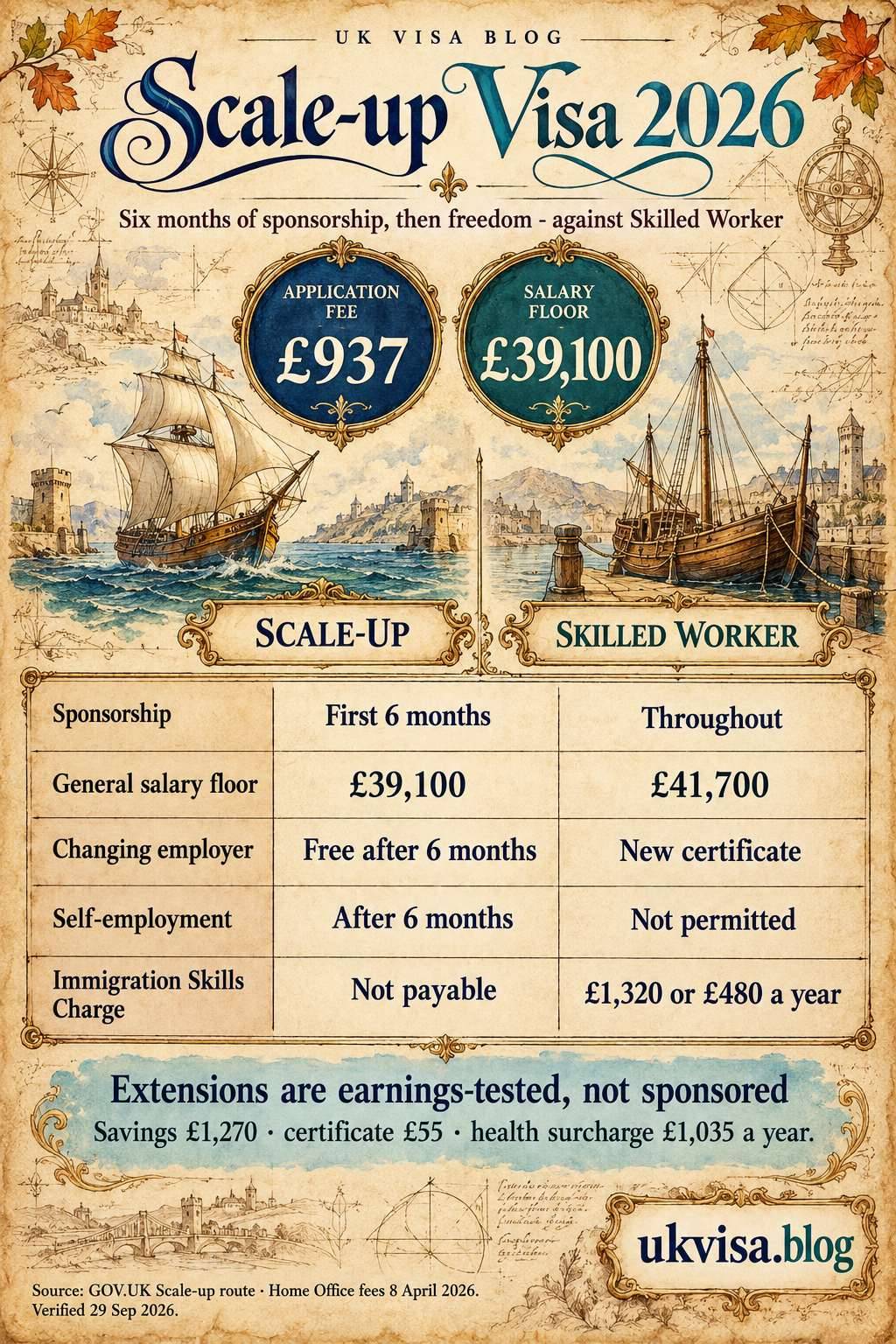
Both routes lead to settlement in five years and both run on occupation codes and going rates. The choice usually comes down to whether the employer can offer a scale-up certificate at all — and if it can, the route is cheaper for them and looser for you.
The Two Routes Side by Side
| Feature | Scale-up Worker | Skilled Worker |
|---|---|---|
| Sponsorship | First 6 months only | Throughout, including extensions |
| General salary floor | £39,100 | £41,700 |
| Changing employer | Free after 6 months | New certificate and application |
| Self-employment | Permitted after 6 months | Not permitted |
| Application fee | £937, any duration | £819 to £1,865 by duration and location |
| Immigration Skills Charge | Not payable | £1,320 or £480 a year |
| Extending | No sponsor needed, earnings tested | New certificate from a sponsor |
Source: GOV.UK Scale-up Worker and Skilled Worker visa pages, 8 April 2026 fee schedule. Verified 22 August 2026.
If sponsorship is not available at all, the High Potential Individual route gives recent graduates of listed universities unsponsored permission without any of this; where it is available, the Skilled Worker route remains the broader option on occupations.
Extension and Settlement
You can extend if you worked the job on your certificate for at least six months and met the earnings requirement during at least half of your most recent permission. No new certificate is needed and your employer is not involved. Which figure you have to have earned depends on when the certificate behind your current permission was assigned.
Which Earnings Threshold Applies to You
| Certificate assigned | PAYE earnings equivalent to |
|---|---|
| On or after 22 July 2025 | £39,100 a year |
| 4 April 2024 to 21 July 2025 | £36,300 a year |
| 12 April 2023 to 3 April 2024 | £34,600 a year |
| On or before 11 April 2023 | £33,000 a year |
Source: Home Office Scale-up Worker caseworker guidance v11.0, 3 August 2026. Verified 22 August 2026.
Only PAYE earnings count. Dividends, allowances and payments in kind are excluded, and where two jobs overlap you cannot count both for the same month. Statutory maternity, paternity, neonatal, shared parental, adoption and sick leave are treated as periods paid at the required level, provided the job met the threshold when the leave began.
At the Settlement Stage
Settlement needs five years of continuous residence, which may combine Scale-up time with Skilled Worker, Global Talent, Innovator, T2 Minister of Religion, International Sportsperson, Representative of an Overseas Business and the old Tier 1 categories. On the date of application you must be in PAYE employment at your applicable threshold, and you must have earned at that level for at least 24 of the previous 36 months.
One point is regularly reported wrongly: there is no English requirement at settlement on this route, because the caseworker guidance treats it as already met by the earlier Scale-up application. You do need the Life in the UK test, and the absence rules in the settlement framework apply as usual — the parallel sponsored-route criteria are set out in our Skilled Worker settlement guide.
Sources: GOV.UK Scale-up Worker route page on GOV.UK; Scale-up going rates for eligible occupations; the employer sponsorship pages on GOV.UK; and the Home Office Scale-up Worker caseworker guidance version 11.0, published 3 August 2026. Figures verified 22 August 2026.
Frequently Asked
Questions about the Scale-up Visa
Six months. During that period you cannot change employer without applying to update your visa, though you can move to a different eligible job with the same employer without applying. After six months you can continue, change or stop the job, or become self-employed, with nothing to report to the Home Office and no new certificate of sponsorship.
The higher of £39,100 a year and the going rate for your occupation code. Clearing £39,100 alone is not enough: GOV.UK’s own example refuses a £39,400 salary where the going rate is £40,000. Only guaranteed basic gross pay counts towards the figure — allowances, dividends and benefits in kind are left out of the assessment.
£937 to apply, the same inside or outside the UK and whatever the length of the grant, plus the health surcharge at £1,035 a year for an adult and £776 for a child. A two-year grant costs £3,007 in total. Each dependant pays the same again. Your sponsor pays £525 for the certificate of sponsorship and no skills charge.
No. The charge applies when a certificate is assigned on the Skilled Worker or Senior or Specialist Worker routes, and Scale-up is neither. A medium or large sponsor therefore avoids £1,320 a year, and a small or charitable one £480 a year, for each worker sponsored. The £525 certificate fee still applies.
Yes. Extension needs no certificate and no employer involvement. You must have worked the job on your original certificate for at least six months, and have met the earnings requirement during at least half of your most recent permission — £39,100 a year where that certificate was assigned on or after 22 July 2025, with lower figures for older certificates.
B2 for a first application and for switching from another visa. If you already hold this visa and are extending, the level is B1 and you do not have to prove it again. At settlement there is no English requirement at all on this route — the caseworker guidance treats it as satisfied by your earlier Scale-up application.
Five years of continuous residence, which can combine Scale-up time with Skilled Worker, Global Talent, Innovator, T2 Minister of Religion, International Sportsperson, Representative of an Overseas Business or old Tier 1 permission. You must be in PAYE employment at your applicable threshold on the date of application, have earned at that level for 24 of the previous 36 months, and pass the Life in the UK test.
Businesses assessed as growing by at least 20% on average each year, on employment or total turnover, across the three years before Home Office approval — or endorsed by an approved body. The employer must show “Scale-up Worker” in the route column of the register of licensed sponsors. Note that a scale-up licence lasts four years and cannot be replaced with another one.