
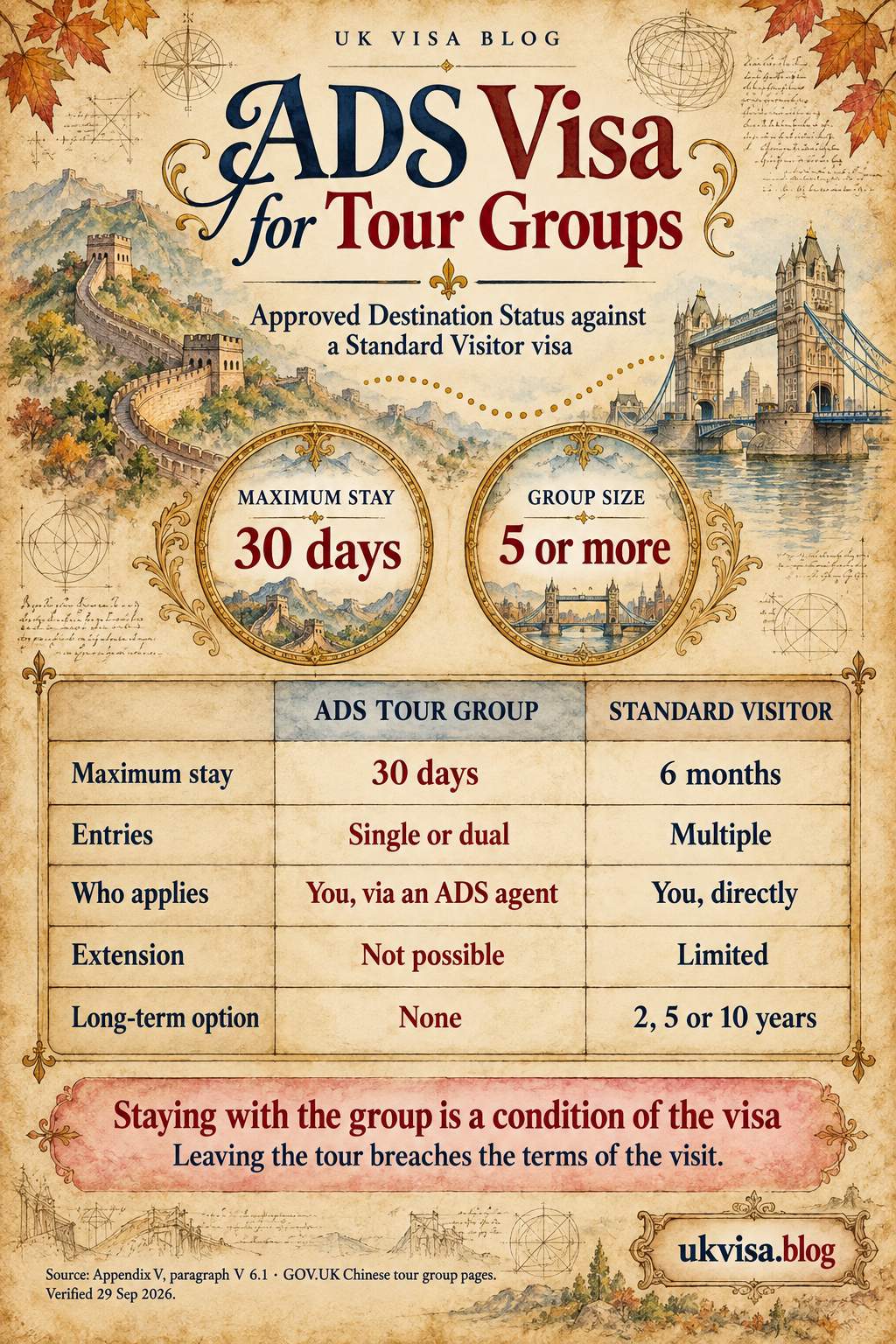
The Approved Destination Status agreement lets Chinese citizens visit the UK as part of an organised tour group. It is a group product: you apply through a licensed Chinese operator, travel with a group of at least five, stay with that group throughout, and leave within thirty days. It cannot be extended.

Tour Groups
The ADS Tour Group Route for Chinese Visitors
What the Approved Destination Status Scheme Is
ADS is an agreement between the UK and China that allows Chinese nationals to enter the UK with an approved tour group. It sits in Appendix V of the Immigration Rules at paragraph V 6.1, and it works differently from every other visit route because the unit of application is the group rather than the individual.
An ADS visa allows up to thirty days in the UK as part of a tour group of at least five people, organised by an ADS licensed Chinese tour operator. You must enter with the group and stay with it for the whole visit. The visa cannot be extended, and it is normally issued for a single entry rather than multiple.
Why the Scheme Exists
Approved destination status agreements are bilateral arrangements that permit organised leisure travel from China to a named country. For the UK the practical effect is a streamlined group process handled by licensed operators on both sides, with the operator carrying responsibility for the itinerary and for the group travelling and returning together.
Who Qualifies
- Chinese citizenship: the agreement applies to Chinese nationals.
- A licensed operator: the tour must be organised by an ADS licensed Chinese tour operator.
- A group of at least five: you must enter the country as part of that group.
- Stay with the group: for the whole of the visit, not just on arrival.
- Leave when the visa expires: there is no extension and no switching.
What ADS Visitors Must Not Do
The ordinary visitor prohibitions apply in full. No work of any kind, no study beyond what the visitor rules allow, no access to public funds, and no medical treatment other than the narrow permitted cases. The ADS-specific condition on top of those is the group one: separating from the tour breaches the basis on which the visa was issued.
Documents to Give Your Agent
- Your current travel document or passport: valid for the trip.
- Your previous passports or travel documents: to evidence travel history.
- Evidence of current employment or studies: the tie showing you will return.
That list is short because the operator carries the itinerary and accommodation evidence for the group. It does not mean the individual assessment disappears — employment or study evidence is what answers the question of whether you will leave at the end of the visit.
How the Group Application Works
You complete the visit application form online, then your agent arranges a single appointment at a visa application centre in China for the whole tour group. That appointment usually takes place at least three weeks before departure, and includes fingerprints and a photograph.
The Sequence
- Book with a licensed operator: the tour must be an ADS tour, not any package holiday.
- Complete the online form: the standard visit application, selecting the ADS route.
- Hand documents to your agent: passports, previous passports, employment or study evidence.
- Attend the group appointment: arranged by the agent, usually three or more weeks ahead.
- Give biometrics: fingerprints and photograph at the centre.
- Collect the decision through the agent: along with the rest of the group.
Because the operator submits and pays for the group together, an individual traveller cannot easily separate their application from it. A change of plan close to departure — a family emergency, a work commitment — is handled through the operator, not by contacting the visa centre directly.
Children Travelling With the Group
A child on a tour is still a child visitor, and the additional requirements for children apply. Where a child is not travelling with a parent or guardian, evidence of the relationship and of parental consent to the travel and the arrangements is expected, along with details of who is responsible for their care during the trip. A child is also not expected to hold funds in their own name; access to a parent’s or a third party’s funds meets that requirement.
Fee and Processing
You pay the visa fee directly to your travel agent, who pays for the whole group. GOV.UK’s ADS route page does not publish a separate figure for this visa, so check the current amount with your operator or through the Home Office fee tool before booking rather than relying on a figure quoted in a brochure.
On timing, the group appointment is normally arranged at least three weeks before departure, which is the practical planning window. Priority and super priority services exist for visit applications generally, but on an ADS tour the operator’s schedule governs, and paying to accelerate one member of a group achieves little.
Single Entry, and When It Is Dual
Most visit visas permit multiple entries. ADS visas are the standing exception. Guidance directs that the endorsement is issued for a maximum of thirty days and marked single or dual. In most cases it is single. A dual entry visa is issued where the tour itinerary involves onward travel to Europe and then a planned return to the UK.
There is one procedural consequence worth knowing. Issuing a single-entry visit visa normally requires an Entry Clearance Manager’s authority — but ADS visas are expressly excluded from that requirement, because single entry is the norm for the route rather than a restriction imposed on an individual.
What You Can Do on the Tour
Tourism and leisure activities, as for any visitor: sightseeing, visiting attractions, shopping, attending events. The permitted activities appendix governs, exactly as it does for a standard visit, and our page on activities permitted to visitors lists them.
If a Group Member Leaves the Tour
Staying with the group is a condition of qualifying, so leaving it puts the traveller outside the basis of their permission. That is a change of circumstances or of purpose, which are discretionary grounds for cancelling permission — our page on visa cancellation and the suitability rules sets out how those grounds work.
The consequences reach further than one traveller. A record of group members separating affects the operator, and an immigration history containing a breach of conditions affects every later application that person makes, on any route.
Arrival Is Still an Individual Decision
A visa permits travel; permission to enter is granted by a Border Force officer on arrival, and that is assessed person by person even where the group arrives together. Refusals at the border are recorded against set codes: A1 for insufficient funds for the proposed visit, A2 where the officer is not satisfied the traveller is a genuine visitor, A4 for unsatisfactory study arrangements, and E4 for lacking the required entry clearance.
For a tour group traveller the practical protection is consistency. Know the itinerary, the hotels and the return date, and be able to say what the trip is. Where an officer has residual doubts, guidance requires them to record the traveller’s stated intentions in full, and that record follows the person into every later application.
ADS or a Standard Visitor Visa?
The Two Routes Compared
| Feature | ADS tour group | Standard Visitor |
|---|---|---|
| Maximum stay | 30 days | 6 months per entry |
| Entries | Single, or dual where the itinerary requires | Normally multiple |
| Travel | With a group of at least 5, throughout | Independent |
| Who applies | Through a licensed Chinese operator | You, directly |
| Extension | Not possible | Limited, to complete 6 months |
| Long-term option | None | 2, 5 or 10 years |
| Itinerary | Fixed by the operator | Yours to choose |
Source: Appendix V of the Immigration Rules and GOV.UK route guidance, checked 22 August 2026.
Which One Fits
ADS suits a packaged leisure trip where the itinerary is the point. A standard visit suits anyone travelling independently, visiting family, combining business with leisure, staying longer than a month, or wanting to return repeatedly — the two, five and ten-year options exist only on that route.
A previous compliant ADS trip is useful travel history for a later independent application. Our pages on UK visas for Chinese citizens and on visitor fees cover the alternatives, and our supporting documents guide what an independent application needs.
What an Independent Application Needs Instead
Applying alone means meeting the genuine visitor test in your own right: that you will leave at the end of the visit, will not live here through repeated visits, are coming for a permitted purpose, will do nothing prohibited, and have sufficient funds for the whole trip without working or drawing public funds.
On money, there is no set figure. A caseworker weighs income and savings against ongoing commitments at home — rent or mortgage, and anyone supported financially — and asks whether the remainder covers the trip and is reasonable spending for that person. Funds must sit in an institution permitted under Appendix Finance, and recent unexplained deposits invite checks on their origin.
Where a relative or employer is paying, that support must be declared. It counts only where the relationship is genuine, the supporter is not in breach of immigration laws when the decision is made or when you enter, and they can fund your stay as well as their own household. Undeclared support that you cannot show is genuinely your own money is left out of the assessment entirely.
No Route Onwards From an ADS Visa
You cannot extend an ADS visa and you cannot switch out of it — see our pages on extending a visit visa and switching from a visit visa. Anyone intending to study, work or join family in the UK applies on the correct route from China, before travelling.
Sources: the GOV UK Chinese tour group pages, Appendix V of the Immigration Rules, the permitted activities appendix, and the Home Office visit caseworker guidance version 17.0 published 25 February 2026. Verified 22 August 2026.
Frequently Asked
ADS Tour Group Questions
What is the Chinese tour group visa?
It is the visa issued under the Approved Destination Status agreement between the UK and China, allowing Chinese citizens to visit the UK for up to thirty days as part of an organised tour group.
How much does the ADS visa cost?
You pay the fee to your travel agent, who pays for the whole group. GOV.UK’s route page does not publish a separate figure, so confirm the current amount with your operator before booking.
How long can I stay?
Up to thirty days. The endorsement is issued for a maximum of that period and cannot be extended. You must leave when it expires.
How many people make a tour group?
At least five. You must enter the UK as part of the group and stay with it for the whole visit.
Can I leave the group to visit relatives?
No. Staying with the group is a condition of the route. Separating from it puts you outside the basis of your permission and risks cancellation and a damaged immigration record.
Is the ADS visa multiple entry?
Usually single entry. A dual entry visa is issued where the tour itinerary involves onward travel to Europe followed by a planned return to the UK.
Can I apply for an ADS visa on my own?
No. The tour must be organised by an ADS licensed Chinese tour operator, and the agent arranges the group appointment at the visa application centre.
How far in advance should we apply?
The group appointment usually happens at least three weeks before departure, so the operator will collect documents well before that. Build in more time where passports need renewing.
Do Chinese citizens need a visa to visit the UK?
Yes. Chinese nationals need entry clearance for a visit, whether through the ADS scheme or as a standard visitor applying independently.
Can an ADS visit lead to a longer visa later?
Not directly, but a compliant trip is useful travel history for a later standard visit application, including the two, five and ten-year options that ADS does not offer.
Sources: GOV.UK, Standard Visitor visa; Immigration Rules Appendix V: Visitor; and the Home Office fee table of 8 April 2026. Figures verified 22 August 2026.