
Supporting documents win applications by answering the specific question a caseworker has to decide. GOV.UK is blunt about the limit: submitting the documents on its own list does not guarantee success. It also publishes a list of documents that are less useful as evidence — and most refused bundles are heavy with those.
Evidence
UK Visa Supporting Documents: What Actually Helps
Your Application Reference
Every application carries a reference — a GWF number on older applications, a unique application number on newer ones, and a VAF form number on some paper routes. It appears in your online account, on the submission confirmation email, on the payment receipt and on the appointment confirmation.
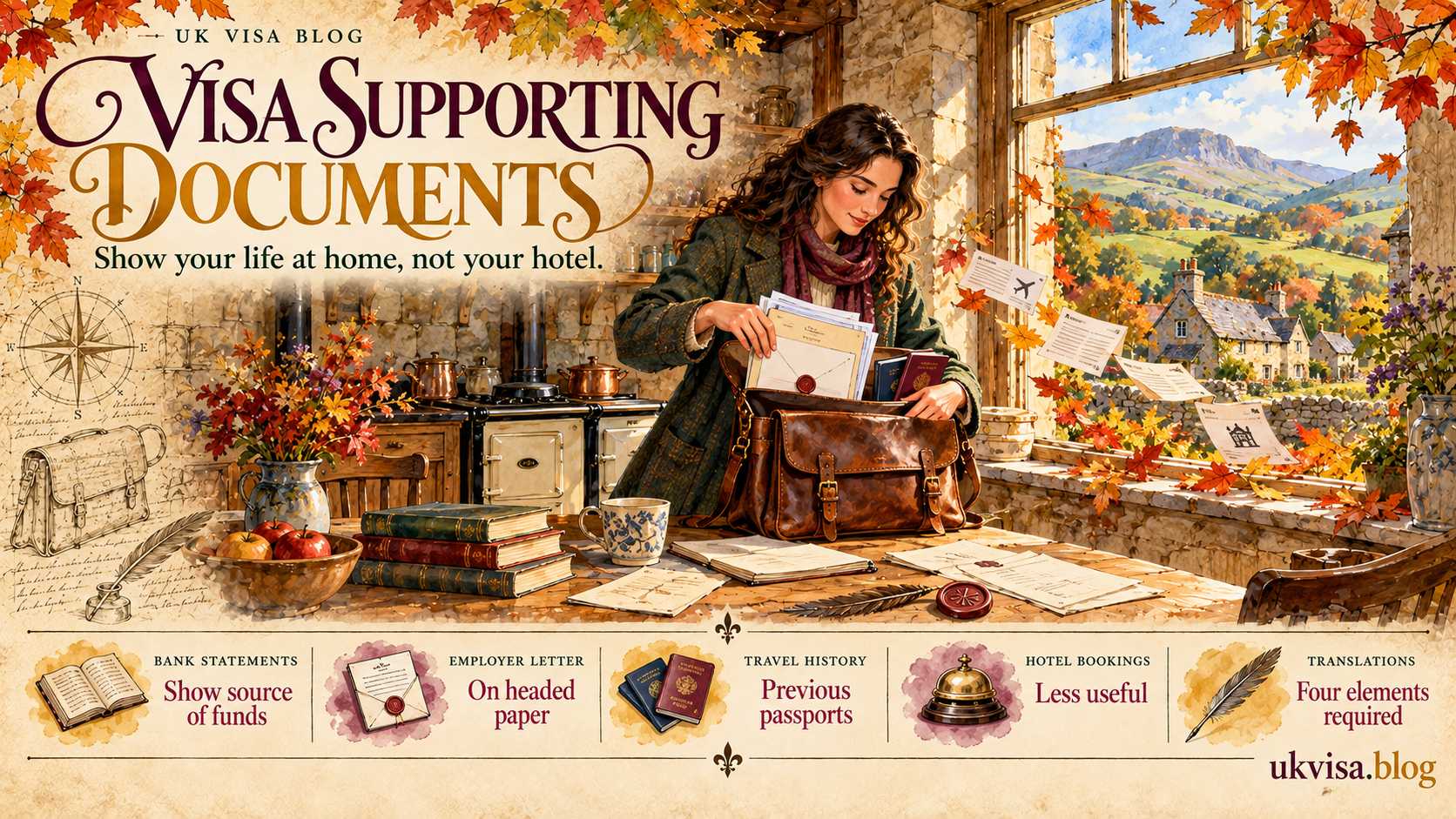
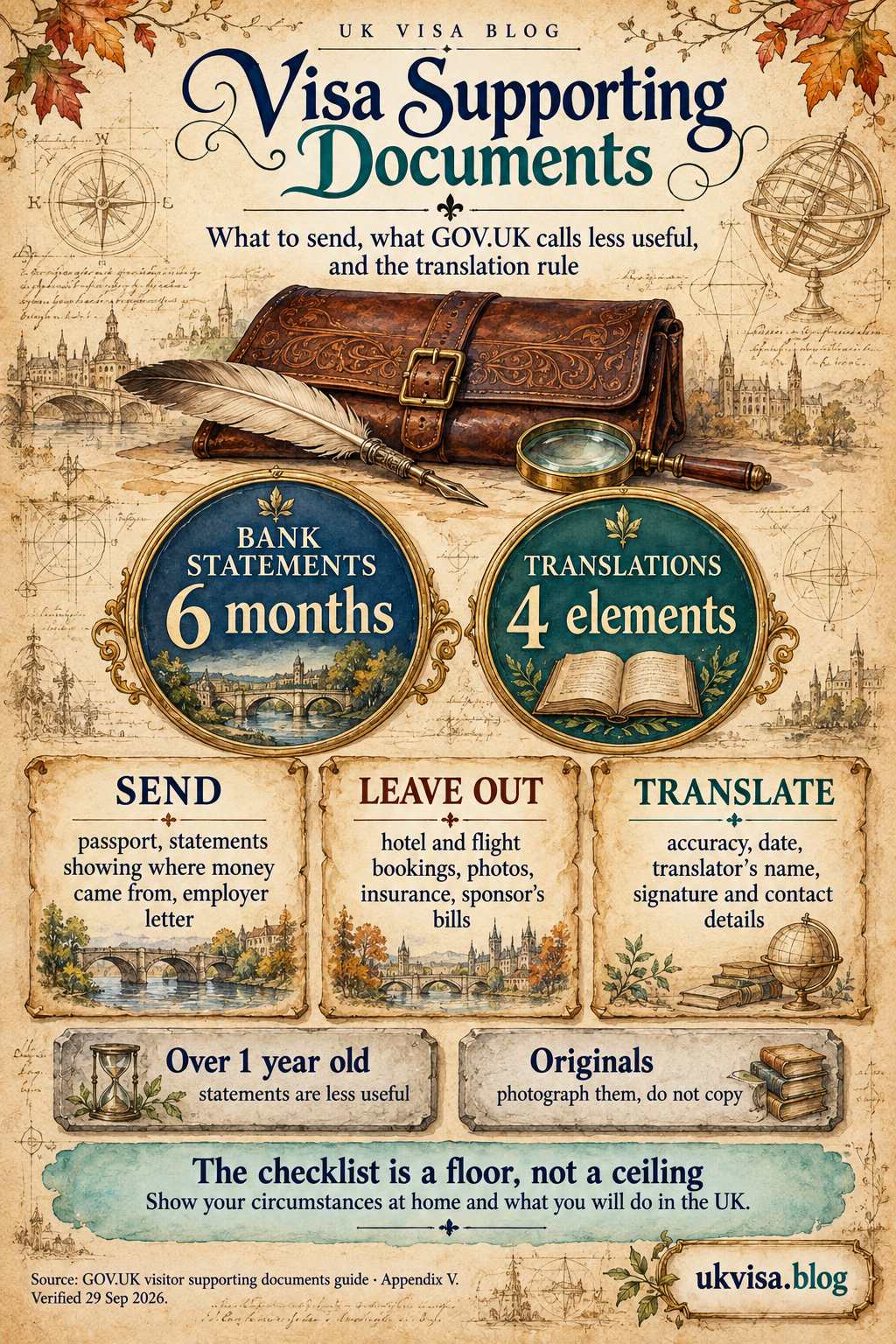
Send documents that show your circumstances at home and what you will do in the UK: passport, bank statements showing the origin of funds, an employer or education letter on headed paper, previous passports showing travel history, and proof of legal residence where you are not applying in your own country. Leave out hotel bookings, flight bookings, photographs, travel insurance and the sponsor’s utility bills — GOV.UK lists all of those as less useful.
The Reference Is Not Your Visa Number
The application reference identifies the application. The visa number appears on the vignette after a grant and identifies the permission. They are different things, and quoting the wrong one in correspondence means your message cannot be matched to your file.
The Checklist You Are Given
The online application generates a checklist tailored to the answers you gave. It is not a downloadable form and there is no universal PDF version, which is why checklists circulating online rarely match what you are actually asked for. Work from the one your own application produces.
Treat it as a floor rather than a ceiling. GOV.UK describes its own document list as not exhaustive and recommends providing information about your circumstances at home and details of the activity you will do in the UK. The checklist tells you what is mandatory; the rest is your case.
Proof That You Have Applied
- The submission confirmation email: with the application reference.
- The payment receipt: showing the fee and any health surcharge.
- The appointment confirmation: from the visa application centre.
- The document upload confirmation: where you uploaded rather than attended.
- Your online account: which shows the application status.
Employers, universities and landlords sometimes ask for this while a decision is pending. None of it proves you hold permission — it proves an application exists. Our page on the eVisa and UKVI accounts covers proving status once a decision is made.
“Proof of Application” on the VFS Upload Portal
On the VFS and TLScontact portals, “proof of application” is an upload category, and the file it wants is the checklist PDF generated when you submitted on GOV.UK — the one carrying your GWF or UAN reference. Download it from the final screen or the confirmation email and upload that document, not a screenshot of the payment page.
The “coversheet.outofcountry” File Explained
That checklist arrives with a machine name such as coversheet.outofcountry.visit-visa-ooc-standard.supportingdocuments — the route written into the filename. It is not an error and does not need renaming: it is your cover sheet, listing what you said you would provide, and it belongs at the front of your bundle or in the checklist slot of the upload portal.
The Core Documents
Travel and Identity
A valid passport or other travel document is required with every application and when you travel. Some passport holders need alternative evidence of identity and nationality. Previous passports are worth sending because they evidence travel history, which is one of the strongest indicators available to a caseworker.
Where you are applying outside your own country, or your right to reside is not shown in your passport, provide confirmation of legal residence. Its absence is a common and entirely avoidable gap.
Financial Evidence
GOV.UK asks for documents that clearly show you have access to funds: bank statements detailing the origin of the funds held, building society books showing the same, and proof of earnings such as an employer letter confirming start date, salary, role and company contact details.
Personal and Family Status
Birth and marriage certificates where a relationship is relevant, and evidence of dependants. Where a child is applying, evidence of the relationship to a parent or guardian, a copy of a parent’s passport photo page, and consent to the travel and the arrangements — see our page on child visitors.
Bank Statements
The requirement is not a balance. It is that the statements show the origin of the funds. A stable pattern of income and spending over six months tells the caseworker where the money came from; a single large deposit does the opposite and invites checks.
GOV.UK lists bank statements or letters issued more than one year before the date of application among documents that are less useful as evidence, along with credit card statements and photocopies of bank cards. Send recent statements from the account the funds actually sit in.
Uploading Documents
- Photograph originals, not copies: GOV.UK says digital images should be taken of original documents wherever possible.
- Name files clearly: so the caseworker can see what each one is without opening it.
- One document per file: rather than a single scan of everything.
- Check legibility: an unreadable statement is an absent statement.
- Do not duplicate for a family: you do not need multiple copies of the same document when applying as a family or group at the same time.
Evidencing That You Will Leave
This is the hardest requirement to document because it is about intention. What answers it is commitments that continue in your absence and require your return: employment with approved leave dates, a business you run, property you own or rent, dependants who remain, studies that resume, care responsibilities.
Assurances carry nothing. A checkable fact carries a great deal — approved leave ending on a named date, a term starting the week after, a lease running past your return. Our pages on the standard visitor route and refusal grounds cover how this is assessed.
Employment and Study Evidence
- Employed: a letter on company headed paper detailing your role, salary and length of employment.
- Studying: a letter from your education provider on headed paper confirming enrolment and leave of absence.
- Self-employed: business registration documents or recent invoices confirming ongoing self-employment.
- Attending an event or meeting: letters from the inviting or sending organisation, and whether any costs are met.
Business visitors should read our business visit page for what the invitation must establish. Where someone else funds the trip, see our page on sponsoring a visitor.
Accommodation
Where you are staying with a host, their letter and their evidence of the property carry the weight — a tenancy agreement or mortgage statement, with the address matching your application exactly. Discrepancies between what an applicant says and what a sponsor says are a recognised reason to doubt an application.
On family and settlement routes, accommodation is a formal requirement with its own tests — see our page on accommodation requirements on the spouse route. On visit routes it is evidential rather than prescriptive.
Translations
Any document not in English or Welsh must come with a full translation the Home Office can independently verify. Each translation must carry confirmation from the translator that it is accurate, the date of translation, the translator’s full name and signature, and their contact details.
All four elements are required. A translation missing the translator’s contact details is not verifiable, and a document that cannot be verified is treated as absent. This is one of the most common avoidable failures in an otherwise sound bundle.
Route-Specific Requirements
Some routes require specified mandatory evidence rather than general supporting documents. Study routes need a confirmation of acceptance and evidence of funds and English — see our student route page.
Family routes need relationship, financial and accommodation evidence in prescribed formats — see our spouse route page and our spouse documents guide. Settlement adds the Life in the UK test and continuous residence evidence — see our page on settlement.
Mandatory Evidence Is Different From Supporting Evidence
The Rules require specified evidence for certain types of visitor and certain activities — private medical treatment, organ donation, academics staying beyond six months, doctors sitting professional assessments, permitted paid engagements. Those are conditions of eligibility, not documents you choose to send.
Everything else is supporting evidence, judged on whether it answers the question the caseworker has to decide. The practical test before adding anything to a bundle is simple: which finding does this document prevent? If the answer is none, it is padding — and padding lengthens the read without strengthening the case.
What to Leave Out
- Bank statements or letters: issued more than one year before the application.
- Credit card statements and photocopies of bank cards.
- Driving licences, evidence of car ownership, business cards.
- Educational certificates: not listed as required for your visa.
- Personal photographs and notarial certificates.
- Hotel bookings, and flight bookings unless transiting.
- Travel insurance and certificates for leisure activities such as sports trophies.
- The sponsor’s utility bills and council tax bills.
Sending them does not cause a refusal, but it buries the documents that matter and, in the case of flight and hotel bookings, encourages applicants to spend money before a decision. GOV.UK warns expressly that submitting documents does not guarantee success and that this should be borne in mind before making bookings.
If the Application Is Refused
Read the notice for the paragraph and the finding, then match each finding to a document. Most document-based refusals are evidential rather than character findings, which means a fresh application with the right evidence is faster than review — see our pages on administrative review (AR) and refusal grounds.
Where you were asked for further documents during the application and missed the deadline, that is a different problem and a harder one. Answer any request exactly, by the date given, quoting the reference — see our pages on delays and processing after biometrics.
Sources: the GOV UK guide to supporting documents for visitors, updated 25 February 2026, Appendix V of the Immigration Rules and the GOV UK application pages. Figures verified 22 August 2026.
Frequently Asked
Supporting Document Questions
Is there an official downloadable checklist?
No. The checklist is generated by your own application from the answers you gave. Lists circulating online rarely match what you are actually asked for.
How many months of bank statements should I send?
Enough to show the origin of the funds — six months is the usual working answer. Statements issued more than a year before the application are listed as less useful.
Should I book flights and hotels before applying?
No. Both are listed among documents that are less useful as evidence, and GOV.UK warns that submitting documents does not guarantee success — a reason to be careful about bookings.
Do photographs of my family help?
Personal photographs are on the less useful list. Relationship evidence is better carried by certificates, correspondence over time and consistent accounts from both sides.
What must a translation include?
Confirmation from the translator that it is accurate, the date of translation, the translator’s full name and signature, and their contact details. All four are required.
Can my family share one set of documents?
Yes. You do not need to provide multiple copies of the same documents where you apply as a family or group at the same time.
Should I photograph the original or a copy?
The original, wherever possible. GOV.UK asks for digital images of original documents rather than of copies.
Does sending more documents improve my chances?
No. It buries the ones that answer the caseworker’s question. Send what evidences your circumstances at home and your activity in the UK, and leave the rest out.
What if I am applying outside my own country?
Provide confirmation of your legal residence there, unless your right to reside is already shown in your passport. Its absence is a frequent and avoidable gap.
Do I need a long-term visa bundle to be any different?
The documents are the same, but the evidence of a continuing reason to travel matters more. See our page on two, five and ten-year visit visas.
Should I pay for a document-checking service?
Services sold at visa application centres check that files are legible and complete. They do not assess whether your evidence answers the rules, and they carry no weight with a caseworker. See our page on what centre add-ons actually buy.
Does providing everything on the list guarantee a visa?
No, and GOV.UK says so directly. The documents support an assessment; they do not decide it.