
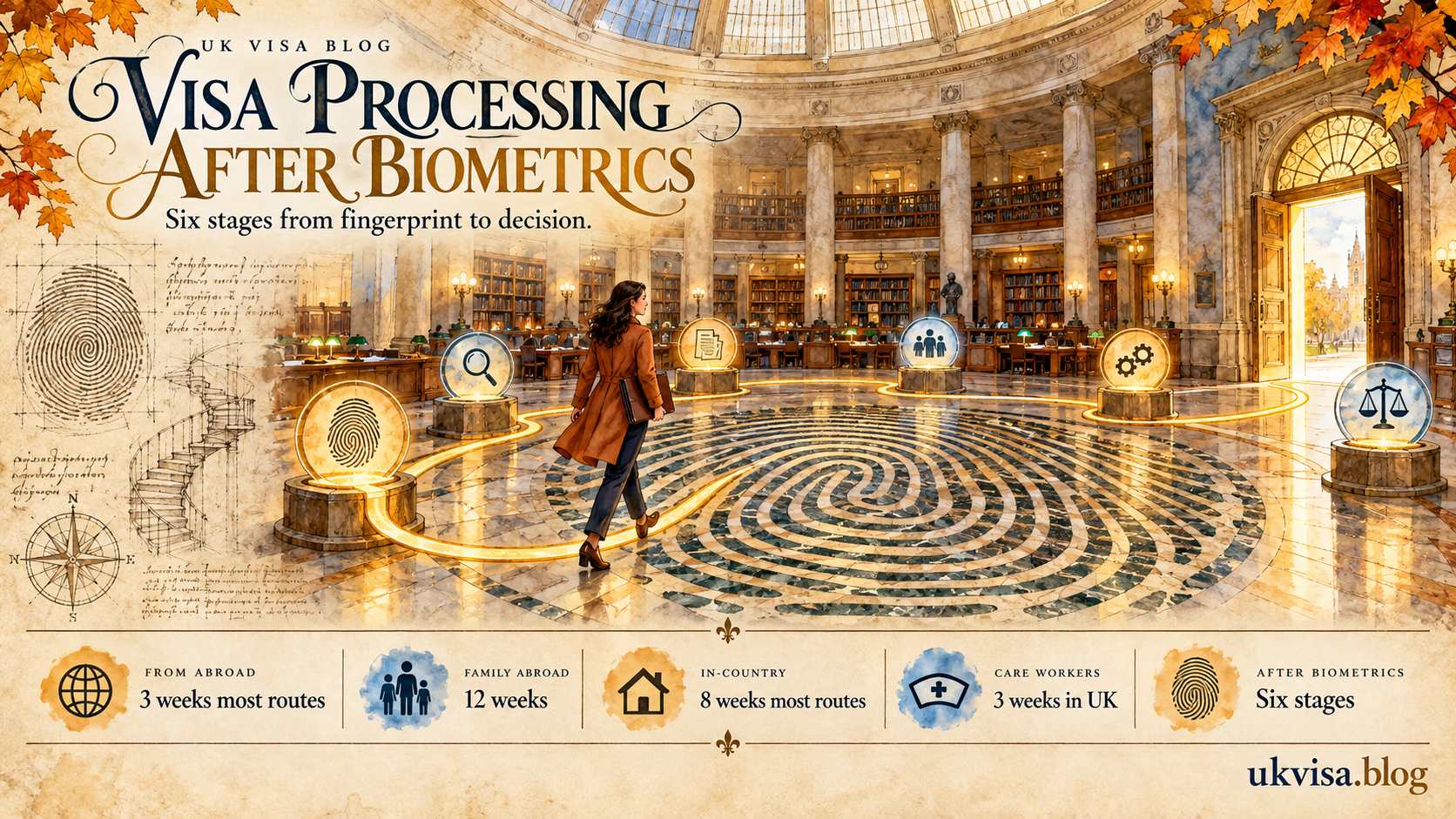
The clock most people care about starts at biometrics, not at submission. From that point the published waiting times apply: three weeks for visit, study and work applications made abroad, twelve weeks for family and settlement, and eight weeks for most applications made inside the UK.
Processing Times
How Long a UK Visa Takes After Biometrics
What Happens Once You Have Given Biometrics
Giving fingerprints and a photograph completes the application. Until that point nothing is queued for a decision, which is why counting from the day you paid online overstates the wait. The published time runs from the appointment.
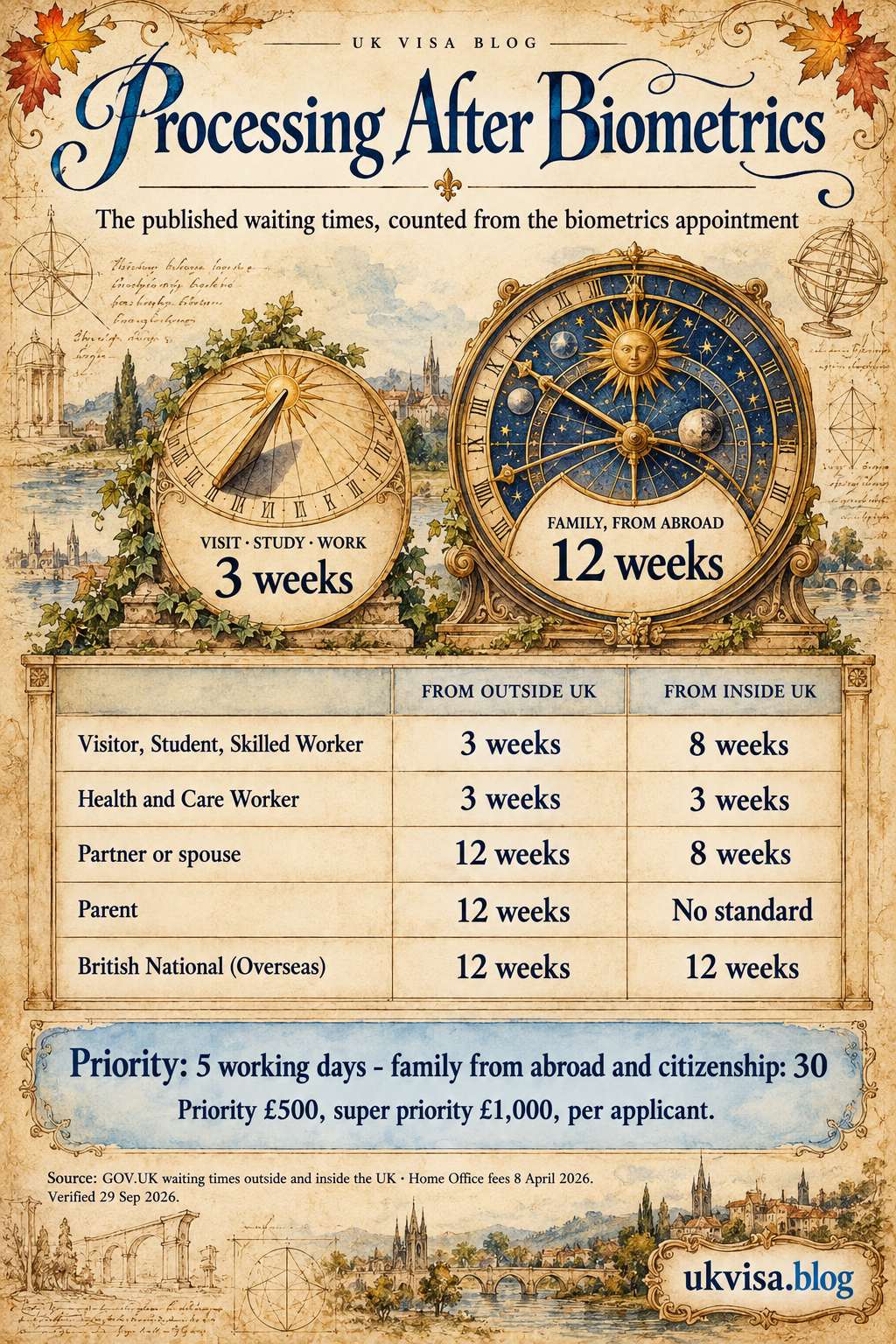
From outside the UK: 3 weeks for visit, study and work; 12 weeks for partner, parent, child, adult dependent relative and BN(O). From inside the UK: 8 weeks for most routes, 3 weeks for Health and Care Worker and Start-up, and 12 months for some family applications made on a private life or parent basis. Priority costs £500 abroad and £1,000 for super priority in the UK.
The Sequence After the Appointment
- Identity confirmed: biometrics enrolled or checked through the app.
- Documents received: uploaded, scanned at the centre, or posted.
- Allocation: the file joins the queue for a decision hub.
- Consideration: the caseworker assesses the route requirements and suitability.
- Checks, where needed: verification, an interview, or a referral for specialist consideration.
- Decision and notification: the notice served, and documents returned or collected.
What to Take to the Appointment
- Your passport: the one named in the application, and any previous passports if asked for.
- The appointment confirmation: printed or on screen, with the application reference.
- Documents not already uploaded: in the order the checklist lists them.
- Certified translations: for anything not in English or Welsh.
- Payment for optional services: scanning, courier return and priority where bought at the centre.
Whether the centre keeps your passport varies by country and by service. Where it does, you cannot travel until it is returned, which matters more than most applicants expect — a passport held for twelve weeks on a family application rules out travel for a season, not a fortnight.
Appointment or App
Some applicants prove identity through the UK Immigration ID Check app rather than at a service point. Super priority works with either. Using the app, the next working day target runs from the point you finish uploading your documents; at a service point it runs from the appointment. Either way, uploads finished at a weekend or on a bank holiday move the target to two working days.
Applications Made Outside the UK
Published Waiting Times From Abroad
| Route | Standard time |
|---|---|
| Standard Visitor, Marriage Visitor, transit, Chinese tour group | 3 weeks |
| Student, Child Student, short-term English study | 3 weeks |
| Skilled Worker, Health and Care Worker, temporary work | 3 weeks |
| Partner or spouse | 12 weeks |
| Parent, child, adult dependent relative | 12 weeks |
| British National (Overseas) | 12 weeks |
Source: GOV.UK visa decision waiting times, applications outside the UK. Checked 22 August 2026.
Student, Spouse and Skilled Worker Timings
The route decides the clock. A student or Skilled Worker application from abroad runs to the three-week standard after biometrics; a spouse or partner application runs to twelve weeks; an in-country extension runs to eight. In every case the published target counts from the day you attend the appointment or verify identity in the app — not from the day you paid.
Visit applications are covered on our pages on the standard visitor route, marriage visitors and the ADS tour group route. Study is covered on our pages on the student route and short-term study.
Work routes share the three-week target — see our pages on Skilled Worker, Health and Care Worker, Global Talent, the Innovator Founder route, High Potential Individual, UK Ancestry and temporary work.
Family applications are the slow category. Twelve weeks is the target for partners, parents, children and adult dependent relatives, and the same applies to the BN(O) route. See our spouse route page and our page on the parent of a British child route.
Applications Made Inside the UK
Published Waiting Times In Country
| Route | Standard time |
|---|---|
| Most work visas | 8 weeks |
| Health and Care Worker | 3 weeks |
| Start-up | 3 weeks |
| Student and Child Student | 8 weeks |
| Partner or spouse, meeting the income and English requirements | 8 weeks |
| Partner on a private life basis | 12 months |
| Parent | 12 months |
| Child, adult dependent relative | 8 weeks |
| British National (Overseas) | 12 weeks |
| Most other applications | 8 weeks |
Source: GOV.UK visa decision waiting times, applications inside the UK. Checked 22 August 2026.
The two twelve-month entries are the ones to plan around. A partner application made on a private life basis, and a parent application in country, are published at a year — an order of magnitude longer than the equivalent application meeting the standard requirements.
Section 3C Keeps You Lawful Meanwhile
Where a valid in-country application is made before your existing permission expires, your leave continues on the same conditions while the decision is pending. That is what makes a long wait survivable. See our page on 3C leave, and our pages on ILR processing times, settlement and extension times.
Priority and Super Priority
Priority costs £500 per applicant and targets five working days for most visa and settlement applications. On family visa applications made from outside the UK, and on citizenship applications, the priority target is 30 working days. Super priority costs £1,000 per applicant and targets the end of the next working day. It cannot be used for citizenship applications.
Both services buy queue position, not certainty. Where a case needs document verification, an interview or specialist consideration, it leaves the fast queue and reverts to standard handling — and the fee is not refunded, because the service was provided. Neither improves the quality of the decision.
Availability varies by country and route and is withdrawn during peak demand. Check what is offered at your own visa application centre before building a timetable around it — see our page on priority services and on fees.
Weeks Means Working Weeks
Published times are expressed in weeks but worked in working days. An application biometrically enrolled immediately before a run of public holidays waits through them. Counting three weeks from a Friday before a bank holiday weekend gives a different real date from counting it from a Tuesday.
The practical approach is to add margin rather than to plan to the target. Anything with a fixed date behind it — a course start, a job, a wedding, a tenancy — should be built on the assumption that the published time is a floor rather than a ceiling. GOV.UK allows most applications to be made up to three months before travel, and using that window is cheaper than paying for priority later.
Settlement Applications Made Overseas
The priority service works differently on family routes. For family visa applications made from outside the UK, and for citizenship applications, the priority target is 30 working days rather than five. The £500 fee is the same, so it is worth knowing what you are buying: a shorter wait than twelve weeks, not a decision inside a fortnight.
What Actually Slows a Case Down
- Documents sent for verification: bank statements, employer letters, qualifications.
- Inconsistencies: figures or dates differing across the form, the evidence and a sponsor letter.
- A request for further evidence: which pauses the case until you answer it.
- An interview: arranged where credibility or the relationship is in question.
- A complex immigration history: previous refusals, removals or breaches.
- Demand: GOV.UK names increased visa demand as a reason applications take longer.
Where the published time will not be met you are usually contacted, though not always. Our pages on visa delays and on exceptionally complex issues explain what those messages mean.
What You Can Do at Submission
Most of the levers are pulled before the appointment, not after. Consistent figures, documents in the required format, certified translations, and a clear explanation of anything unusual all reduce the chance of a verification detour. Our supporting documents guide and application form walkthrough cover the detail.
If You Are Asked for More Documents
A request for further evidence stops the clock on your case until it is answered. Send exactly what was asked for, quoting the application reference, by the deadline given. Sending a rebuilt bundle invites new questions and lengthens the check; missing the deadline turns a solvable gap into a refusal.
Do not confuse that request with a delay notification. A delay email asks for nothing and needs no reply — it simply records that the published time will not be met. Applicants who answer a delay email with unsolicited documents add work to their own file for no benefit.
When Chasing Is Reasonable
Not before the published time has passed, because the case is not late yet and the enquiry generates nothing but a templated reply. Once the time has passed with no decision and no notification, or where something material has changed — a passport expiring, a serious illness, a new fixed date — contact becomes worthwhile.
Keep any evidence of what the delay is costing as it happens. A deferred course, a withdrawn offer, a rearranged wedding: each is far easier to evidence at the time than to reconstruct months later, and each matters if the delay eventually becomes extreme enough to need a legal remedy.
Checking Where Your Application Is
GOV.UK publishes current waiting times by route and by country, and that is the authoritative reference — forum reports of faster or slower decisions describe individual cases, not the queue. Your own application account shows status changes, and the registered email receives any request or notification.
Keep that email and phone number working throughout. A request for documents that goes unanswered becomes a refusal, and a notice sent electronically is treated as served on the day it was sent. Once permission is granted, our page on the eVisa and UKVI accounts covers what you do next.
If the answer is a refusal, our pages on the administrative review route and what to do after a refusal set out the options and the deadlines that apply to each.
Sources: GOV UK waiting times for applications outside the UK, for applications inside the UK, and the GOV UK processing time checker. Figures verified 22 August 2026.
Frequently Asked
Processing Time Questions
When does the clock start?
At your biometrics appointment, once identity is proved and documents provided. Counting from the day you submitted online overstates the wait.
How long does a visit visa take?
Three weeks from outside the UK. In-country visitor applications are published at eight weeks, but visitors rarely apply in country.
Why do family applications take twelve weeks?
They involve more evidence and more assessment — the relationship, the financial requirement, accommodation and English. Twelve weeks is the published target from abroad.
Which in-country routes are published at twelve months?
Partner applications made on a private life basis and parent applications. Both are an order of magnitude slower than the eight-week standard.
Can I use super priority with the ID Check app?
Yes. The timing is the same either way: a decision by the end of the next working day, counted from your appointment or from finishing your document upload, and two working days where that falls at a weekend or on a bank holiday.
Is a decision within three weeks guaranteed?
No. It is a published waiting time, not a promise. Verification, interviews and demand all push individual cases beyond it.
Will I be told if my application is running late?
Usually. GOV.UK says you will be contacted within the current processing times if the application will take longer, though notification practice varies.
Can I travel while an in-country application is pending?
Leaving generally ends an in-country application and the section 3C leave protecting your status. Take advice before making plans.
Does paying for priority improve my chances?
No. It changes when a caseworker opens your file, not what they find in it. Money is better spent on the evidence.
Do dependants get decided at the same time as the main applicant?
Usually, where the applications are linked and submitted together with the same biometrics dates. Where one member’s case needs extra checks, the others can be held with it.
Does the health surcharge affect how long it takes?
No, but an unpaid or incorrectly calculated surcharge can make an application invalid, which does. See our page on the health surcharge.
Where do I check the current times?
On the GOV.UK waiting times pages for applications inside and outside the UK, and the processing time checker. Those are updated; forum reports are not.