A UK visa delay typically arrives as one of three UKVI templated emails: the NSF (Not Straightforward) email saying the application cannot be decided within standard processing times; the "we are unable to make a decision on your application within published visa processing times" notification (the most common phrasing); or the more specific "this is because your application raises exceptionally complex issues" email for the most case-complex applications. Receiving any of these does not mean refusal — they signal that UKVI needs more time for verification, security checks, document authentication, sponsor or relationship verification, or operational reasons. This guide explains what each email means, the typical timeline around the NSF notification, why your case may be flagged, and the practical steps to take while waiting in 2026.

~20–30%Apps That Go NSF
15 / 30 daysNSF Email Trigger Point (Non-Set / Set)
12–24 weeksTypical NSF Decision Window
7–12%Priority Visas That Still Get Delayed

Source: Home Office published service standards; UKVI customer service correspondence templates, May 2026

What's Current in 2026 — UK Visa Delay Landscape

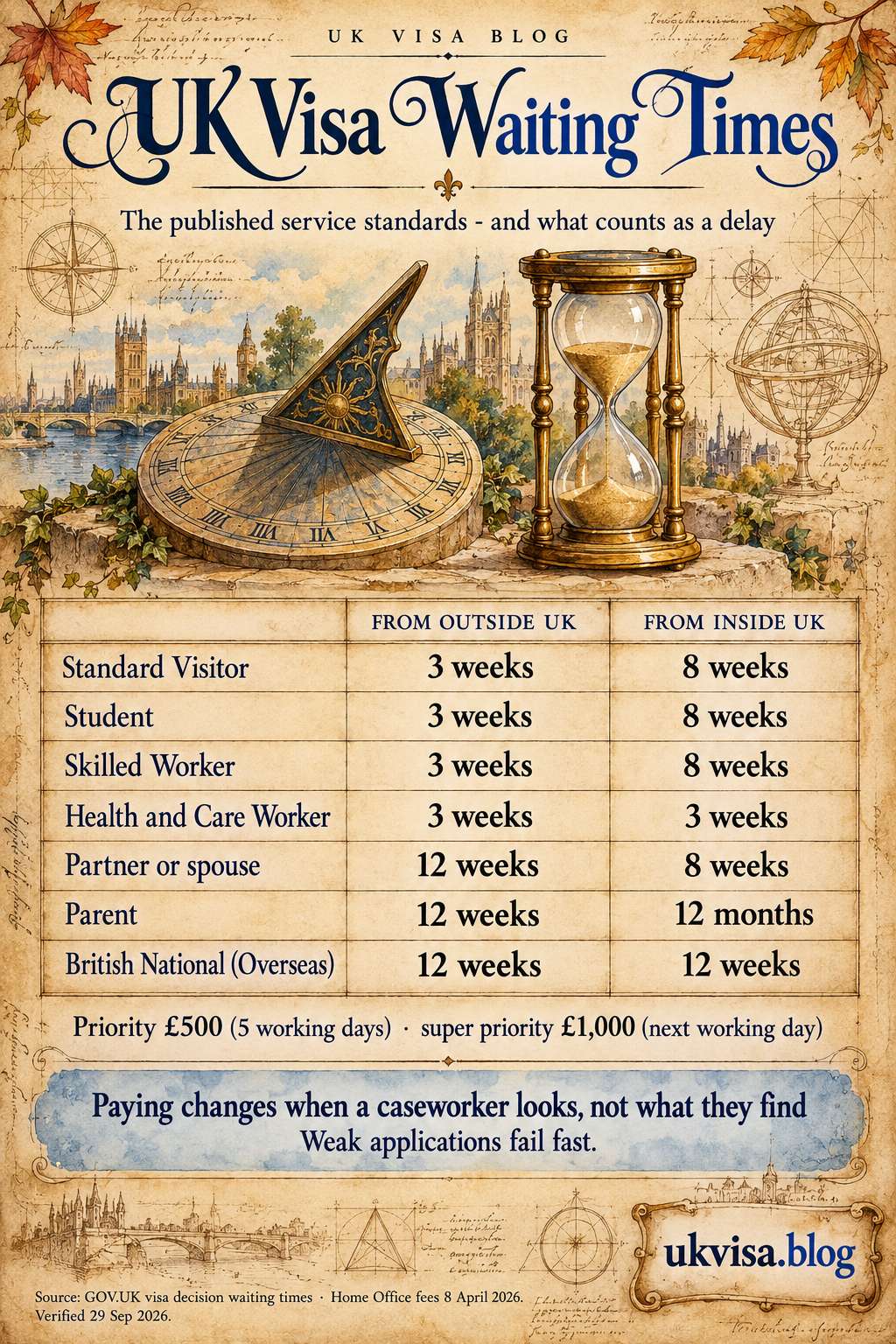
UKVI continues to issue three templated delay emails by case complexity: the NSF "Not Straightforward" notification (most common), the broader "unable to make a decision within published times" notification, and the case-specific "exceptionally complex issues" notification (most serious). Standard targets remain 3 weeks (out-of-country non-settlement), 12 weeks (settlement), 8 weeks (in-country extensions), and 6 months (ILR). Priority at £500 (5-working-day target) and Super Priority at £1,000 (next-working-day target) were unchanged in the 8 April 2026 fee revision — but neither exempts an application from NSF. Administrative review has lengthened during 2025–2026: overseas now 6 to 12 months, in-country 8 to 12 weeks.

Understanding UK Visa Delays and UKVI NSF Notifications in 2026

UKVI issues a templated email when an application is flagged for consideration outside the standard service window. The email often signals the complexity: operational NSF (highest volume), "unable to make a decision" (broader service standard breach), or "exceptionally complex issues" (highest-tier review). Most delays end in approval, not refusal, but the wait — typically 12 to 24 weeks beyond the original target — is stressful where travel, course start dates, or job offers are time-sensitive. Knowing which email you received, your route's target, and the waiting strategy is the foundation of managing a delay. See our sibling pillar on standard processing target timelines.

What is an NSF (Not Straightforward) Email from UKVI?

Quick Answer

An NSF (Not Straightforward) email from UKVI tells you your visa application requires additional review and will not be decided within standard customer service targets. It is the most common of UKVI's three templated delay emails. Receiving it does not mean refusal — the classification is about processing time, not outcome. It simply removes your application from the published service standard while UKVI completes additional checks. NSF decisions typically arrive within 12 to 24 weeks of the notification, with no guaranteed timeline.

NSF (Not Straightforward): A UKVI classification applied to applications requiring additional review beyond standard processing — typically for document verification, security or background checks, adverse immigration history, suspected deception, sponsor verification, or operational reasons such as high volumes or technical constraints. NSF classification removes the application from the published service standard. There is no statutory timeframe for an NSF decision, though most cases resolve within 12 to 24 weeks of the NSF email.

The Standard NSF Email Text — Verbatim

The NSF email follows a consistent template across out-of-country and in-country applications. The exact wording received by most applicants reads:

Sample UKVI NSF Email (Verbatim Template) "Thank you for applying for a UK visa. Your visa application has been received and is under consideration. We aim to process non-settlement applications within 15 working days. Unfortunately, the processing of your application has not been straightforward, and we will be unable to decide your application within our customer service targets. We are continuing to work on your application and aim to make a decision as soon as possible. Please do not attend the visa application centre until you have been advised that your application has been decided."

Settlement applicants receive a near-identical version with the service standard updated to "12 weeks" rather than 15 working days. The closing line — "please do not attend the visa application centre" — is the key practical instruction: your passport remains with UKVI until the decision is made. The email comes from a no-reply address; do not attempt to respond. If UKVI requires additional information, you will receive a separate, specific request via the UKVI Account or email address registered on your application.

"We Are Unable to Make a Decision" — The Most Common Templated UKVI Email

Quick Answer

The phrase "we are unable to make a decision on your application within published visa processing times" appears in UKVI's broader delay template. It is functionally similar to the NSF email but worded differently, and is most often used for settlement and in-country applications. It confirms your application is still under active consideration but the published service target will not be met. Like the NSF notification, it does not predict outcome — applications regularly gain approval after it. The accompanying text points to gov.uk processing times and confirms UKVI is continuing to work on the case.

The longer templated UKVI message that contains this phrase typically reads in full:

Full Template of the "Unable to Make a Decision" UKVI Email "This message is to tell you that we are still processing your visa application. We aim to make a decision on your application within our published visa processing times. We are unable to make a decision on your application within published visa processing times. For up-to-date information on processing times, visit www.gov.uk/guidance/visa-decision-waiting-times-applications-inside-the-uk or www.gov.uk/guidance/visa-decision-waiting-times-applications-outside-the-uk depending on your application type. You do not need to take any action. UKVI will contact you again when a decision has been made or if any further information is required."

The "unable to make a decision" email is the broader service standard breach notification — it covers any application where UKVI has missed the published target but has not yet reached the higher-tier "exceptionally complex" classification. The instruction is consistent across both NSF and this notification: do not contact UKVI; do not visit the visa application centre; wait for the decision or any specific request for further information. Practical recovery options if the delay extends well beyond reasonable expectations are covered in our guide to reapplication and refusal recovery options.

"Exceptionally Complex Issues" Email — The Most Serious NSF Tier

Quick Answer

A small subset of NSF cases receives a more specific email beginning "this is because your application raises exceptionally complex issues, and we require further time to consider your case thoroughly and reach a decision". This is the most serious tier — typically reserved for complex suitability concerns, significant adverse immigration history, multifaceted sponsor or relationship verification, or cases escalated to senior caseworkers or specialist teams. Decisions often take 6 to 12 months or longer. For the full mechanics — triggers, timelines, and case examples — see our guide on the Tier 3 exceptionally complex issues email.

The three UKVI templated delay emails form a tiered escalation pattern:

Templated EmailSeverity TierTypical Decision Window
NSF "Not Straightforward"Tier 1 — most common12 to 24 weeks from NSF email
"Unable to make a decision within published times"Tier 1 / Tier 2 — service standard breach12 to 24 weeks from notification
"Exceptionally complex issues"Tier 3 — highest complexity6 to 12+ months

When You Receive the NSF Email by Visa Type

UKVI typically issues the NSF email shortly after the published service standard for your application type has been missed. This means the timing of the NSF notification correlates directly with your visa category — out-of-country visitor and student applications receive the NSF email much sooner than ILR or settlement applications:

Application TypeStandard Service TargetNSF Email Typically Arrives
Non-settlement out-of-country (visit, student, work)3 weeks (15 working days)After 15 working days
Settlement out-of-country (spouse, family)12 weeksAfter 30 working days, often 8–12 weeks
In-country extensions (FLR(M), FLR(FP), Skilled Worker extension)8 weeksAfter 8 weeks
ILR processing delay timeline6 monthsAfter 6 months
Priority Service (£500, 5-working-day target)5 working daysVariable; often after 10 working days
Super Priority Service (£1,000, next-working-day target)1 working day (UKVCAS only)Variable; can be 1–2 weeks if complex

Why Your UK Visa Is Delayed — Common Reasons for NSF Classification

Quick Answer

UK visa delays and NSF classification most commonly result from: (1) incomplete or inaccurate form details; (2) document verification with third parties (banks, universities, employers); (3) security and background checks; (4) adverse immigration history; (5) criminal convictions requiring suitability assessment; (6) an interview requirement; (7) sponsor verification; (8) suspected deception triggering fraud investigation; or (9) UKVI operational factors (peak volumes, staffing, technical outages). NSF can also stem from genuine complexity — multiple visa stages, dual nationality issues, or unusual evidence patterns requiring specialist review.

Application-Side Causes (Most Common NSF Triggers)

  • Incomplete or inaccurate information: Missing details or factual inconsistencies in the online UK visa application trigger correspondence to clarify
  • Document verification: Educational certificates, bank statements, employer letters, and accommodation documents may be cross-checked with issuing authorities — particularly for higher-fraud-risk jurisdictions (full evidential framework in our required paperwork guide)
  • Security and background checks: Enhanced screening triggered by nationality, residence history, employment in sensitive sectors, or counter-terrorism flag review
  • Adverse immigration history: Previous Part Suitability grounds refusals, overstays, or re-entry ban history triggers additional scrutiny on every subsequent application
  • Criminal convictions: Applicants with police certificates showing convictions require suitability assessment under Part Suitability of the Immigration Rules
  • Interview requirement: Some applications require an in-person or remote credibility interview — common for Student visas from higher-risk jurisdictions, and for spouse visa interview verification where relationship genuineness is questioned
  • Sponsor verification: Checking visitor visa sponsor details, sponsor licence status for work routes, or CAS authenticity for student routes
  • Suspected deception: Any indicator of false statement, forged document, or fraudulent intent triggers escalated review and potentially the 10-year deception ban framework

UK Spouse Visa Delay — Common Reasons

UK Spouse and partner visa applications experience disproportionately high NSF rates due to the credibility-heavy nature of relationship assessment. Common spouse-route NSF triggers include relationship verification (genuine and subsisting test), complex financial evidence for self-employment or savings-based applications, joint cohabitation evidence for unmarried partners, and centralised settlement processing creating queue effects. Spouse visa NSF cases routinely take 12 to 18 weeks beyond the standard 12-week service target.

UKVI Operational Causes

Not all delays originate in your application — UKVI internal factors regularly trigger NSF classification:

  • High application volumes: Peak periods — August to October for Student visas, October to January for visitor visas — create processing backlogs
  • Staffing capacity: Reduced caseworker availability at decision-making hubs affects throughput
  • Technical and system outages: UKVI infrastructure disruptions can temporarily halt processing across regions
  • Specialist team referrals: Cases referred to specialist enrichment teams (such as the Delhi or Mumbai enrichment teams handling Indian applications, or counter-terror review for certain profiles) extend timelines
  • Policy changes: New Immigration Rules or fee changes (such as the 8 April 2026 fee revision) create transitional processing delays

UKVI Service Standards and NSF Decision Windows 2026

Understanding UKVI's customer service targets — and the typical extension when an application is classified NSF — helps set realistic expectations, particularly for slower routes such as indefinite leave to remain:

Application TypeStandard TargetNSF Decision Window
Non-settlement out-of-country (visit, student, work)3 weeks (15 working days)12 weeks typically; some up to 24 weeks
Settlement out-of-country (spouse, family)12 weeks12 to 24 weeks; some longer
In-country extensions (FLR variants)8 weeksVariable, no service standard guarantee
ILR / SET(M) / SET(O) / SET(LR)6 monthsVariable, no guarantee; many run 8–12 months
Priority Service5 working daysCan still be delayed if NSF triggers
Super Priority ServiceNext working dayCan still be delayed if NSF triggers
UKVI Customer Service Target: The published timeframe within which UKVI aims to process applications classified as "straightforward". Service targets are guidelines, not statutory obligations — applications classified NSF fall outside these targets entirely. Recent processing data suggests NSF rates have risen from approximately 15% pre-2023 to 20–30% in 2026 across most categories, driven by enhanced security checks, increased application volumes, and policy transition periods.

Can Priority Visa Applications Be Delayed?

Quick Answer

Yes — Priority (£500) or Super Priority (£1,000) does not exempt your application from NSF classification. Roughly 7–10% of Priority and 8–12% of Super Priority applications run beyond their advertised targets. Priority puts you at the front of the queue, but if NSF complexities arise — security check, document verification, suspected deception — the extra scrutiny applies regardless of the fee paid. The priority fees are not refunded if the application is then delayed. For the full framework, see our UK Priority and Super Priority guide.

The most common scenarios where priority service is delayed include enhanced security checks triggered after biometric capture, document verification with third parties, sponsor licence validation (for sponsored work routes), and centralised settlement processing referrals. Where a priority application is moved to NSF, the priority "queue jumper" status is effectively lost — the application then sits with other NSF cases awaiting specialist review.

When UKVI Sends Emails — Working Days and Hours

Quick Answer

UKVI operates Monday to Friday during standard UK office hours (09:00 to 17:30 UK time) — automated decision emails and templated NSF notifications are typically sent during working hours. UKVI does not send visa decision emails on weekends or UK public holidays. However, automated UKVI Account status updates and biometric receipt confirmations may arrive outside working hours from automated systems. The "working days" referenced in service standards exclude weekends and English bank holidays — applications submitted on a Friday at 17:30 are typically processed from the following Monday morning.

UKVI's typical email-sending pattern follows the UK working week. Decision emails and NSF notifications arrive during UK office hours, with peak email volumes typically between 09:00 and 16:00 UK time. Some applicants report decision emails arriving between 16:30 and 18:00 UK time as caseworkers complete their end-of-day decisions. Weekend or holiday-time emails from UKVI are almost always automated system notifications (account confirmation, biometric receipt) rather than caseworker decisions.

UKVI Public Holidays Excluded from Working Days

English bank holidays excluded from UKVI service-standard working-day calculations include: New Year's Day, Good Friday, Easter Monday, Early May Bank Holiday, Spring Bank Holiday, Summer Bank Holiday, Christmas Day, and Boxing Day. Where one of these falls on a weekend, the next Monday becomes the substitute bank holiday and is also excluded. Local holidays in Scotland, Wales, and Northern Ireland do not affect UKVI service-standard calculations, which apply only to English bank holidays.

What to Do If Your UK Visa Is Delayed — Practical Steps

Quick Checklist: What to Do During a UK Visa Delay
  • Check your email daily — including spam, junk, and promotions folders — for any UKVI correspondence
  • Respond promptly and completely to any UKVI request for additional information or documents (typically within 14 calendar days unless otherwise stated)
  • Do NOT contact UKVI while your application is within published processing times — premature contact will not accelerate the case
  • Do NOT attend the visa application centre or attempt to retrieve your passport until UKVI confirms decision
  • Do NOT book flights, accommodation, course start, employment start, or wedding dates based on assumed visa outcome
  • Keep copies of all documents submitted with the application — including the application reference number and biometric receipt
  • Track your UKVI Account for status changes — biometric received → application under consideration → decision made
  • For sponsored applications (Skilled Worker, Student), keep your sponsor informed of NSF status; some sponsors can liaise with UKVI on behalf of the applicant
  • Consider professional immigration advice for cases where delay exceeds 6 months without communication
  • If delay relates to financial or course-start hardship, escalation routes via MP correspondence or pre-action protocol may be appropriate

When to Contact UKVI About Your Delayed Application

Quick Answer

Contact UKVI only if your application has exceeded the published processing time AND you have received no communication (no NSF email, no "unable to make a decision" message, no exceptionally complex issues notification). That means after 15 working days (out-of-country non-settlement), 12 weeks (settlement), 8 weeks (in-country extensions), or 6 months (ILR). Premature contact during normal processing only triggers automated responses and adds to UKVI's backlog. If you have received any NSF notification, UKVI is already aware — contacting them again will not speed up the decision.

Approved Contact Routes If Service Standard Breached

  • UKVI international enquiry service: For out-of-country applications — a paid enquiry service with per-email and per-minute telephone charges (check current rates on the GOV.UK 'Contact UKVI' page)
  • UKVI domestic enquiry service: For in-country applications — telephone and email enquiry routes with similar charges
  • MP correspondence: Your UK Member of Parliament can raise the case with the Home Office on your behalf — typically appropriate after 6+ months of delay with no progress
  • Pre-Action Protocol letter (judicial review): Final escalation route where delay has caused significant detriment and UKVI has not responded to standard enquiry escalation — typically requires solicitor input via the judicial review pre-action process
  • Where refusal becomes likely: Familiarise yourself with the common refusal grounds and whether administrative review or reapplication is the appropriate next step — full recovery framework at our refusal-recovery guide linked above
Critical: Do Not Make Travel or Commitment Plans During Delay After receiving an NSF notification, "unable to make a decision" message, or "exceptionally complex issues" email, avoid booking flights, accommodation, course enrolment, employment start dates, or other date-sensitive commitments based on an assumed visa outcome. Wait until UKVI confirms the decision in writing and the application centre has notified you that your passport is ready for collection. Many applicants have lost significant deposits or experienced employment offer revocations by acting on optimistic assumptions during NSF delays.
Key Takeaways: UK Visa Delays and NSF Notifications 2026
  • An NSF (Not Straightforward) email is the most common UKVI delay notification — it does NOT predict refusal
  • "We are unable to make a decision within published times" is functionally similar — broader service standard breach
  • "Exceptionally complex issues" is the most serious tier — 6 to 12+ months decision window typical
  • NSF email typically arrives shortly after the published service standard is missed (15 days non-settlement, 30 days settlement)
  • Approximately 20–30% of applications now experience some form of NSF or service-standard breach in 2026
  • Priority service (£500) and Super Priority (£1,000) do NOT exempt applications from NSF classification
  • UKVI sends emails Monday to Friday during UK office hours; weekends and English bank holidays excluded from working-day counts
  • Do not contact UKVI while within published service standards or after receiving any NSF notification
  • Respond promptly to any UKVI request for additional documents — typically within 14 calendar days
  • Avoid booking travel, accommodation, course dates, or employment based on assumed visa outcome during NSF delay
Frequently Asked Questions About UK Visa Delays and NSF Notifications
What is an NSF email from UKVI?

An NSF (Not Straightforward) email tells you your visa application requires additional review and cannot be decided within standard customer service targets. It is the most common of UKVI's three templated delay emails — alongside the "unable to make a decision" message and the more serious "exceptionally complex issues" notification. Receiving it does not mean refusal — the classification is about processing time, not outcome. It is automatically generated when caseworkers identify factors requiring investigation, such as document verification, security checks, suspected deception, sponsor verification, or operational backlogs within UKVI.

What does "we are unable to make a decision on your application within published visa processing times" mean?

This UKVI templated message confirms your application is classified complex or non-straightforward, and the published service standard for your visa type will not be met. Your case stays under active consideration, but expect an extended wait with no guaranteed timeline. It is functionally equivalent to the NSF notification — both signal a service standard breach — and does not indicate approval or refusal. Most applications receiving it are ultimately approved after UKVI completes the checks, though some are refused where suitability concerns or evidential gaps emerge during review.

How long after receiving the NSF email should I expect a decision?

There is no guaranteed timeline for NSF applications. For non-settlement out-of-country visas, decisions typically arrive within 12 weeks of the notification, some up to 24 weeks. For settlement visas, within 12 to 24 weeks, some extending to 6 months. For ILR, NSF cases routinely take 8 to 12 months. The timeframe depends on case complexity, the checks required (document verification usually resolves faster than counter-terror security checks), and UKVI capacity. Cases receiving the "exceptionally complex issues" notification typically take longer still — 6 to 12 months or more.

Why is my UK visa taking longer than 15 working days?

Your UK visa may exceed 15 working days for many reasons: incomplete or inaccurate form details; document verification with banks, universities, or employers; security and background checks for certain nationalities or profiles; adverse immigration history (refusals, overstays, deportations); criminal convictions requiring suitability assessment; an interview requirement; high application volumes during peak periods; UKVI staffing capacity; or technical outages. If your case is classified NSF, it falls outside the 15-day service standard entirely. Most applicants then receive the NSF email shortly after day 15, confirming the breach with no specific decision date.

Does receiving an NSF email mean my UK visa will be refused?

No — an NSF (Not Straightforward) email does not predict refusal. The classification relates solely to processing time, not outcome. Most NSF applications are ultimately approved once UKVI completes the checks and is satisfied the Immigration Rules are met. However, NSF cases have a slightly higher refusal rate than straightforward ones — see our UK visa approval and refusal rates — because the complications that triggered NSF (suspected deception, adverse history, suitability concerns) sometimes confirm Immigration Rules failures during review. If a refusal follows, full recovery options are in our refusal recovery framework.

Can my priority visa application be delayed?

Yes — even Priority (£500, 5-working-day target) and Super Priority (£1,000, next-working-day target) applications can be delayed. Roughly 7–10% of Priority and 8–12% of Super Priority applications run beyond their advertised targets. If flagged NSF during the priority queue — typically from security checks, document verification, or suspected deception — the extra scrutiny applies regardless of the fee paid. Critically, the priority fees are not refunded if the application is then delayed. The most common cause is enhanced security checks triggered after biometric capture.

When does UKVI send emails — what time and which days?

UKVI operates Monday to Friday during UK office hours (09:00 to 17:30 UK time). Caseworker decision emails and NSF notifications are typically sent during these hours, peaking between 09:00 and 16:00. UKVI does not send visa decision emails on weekends or English bank holidays. However, automated system emails — UKVI Account confirmation, biometric receipt, or fee payment receipt — may arrive any time including weekends. The "working days" in service standard calculations exclude weekends and English bank holidays (New Year's Day, Good Friday, Easter Monday, Early May, Spring, Summer, Christmas Day, Boxing Day).

What should I do if my UK visa application is delayed?

If your UK visa application is delayed: check your email daily (including spam) for UKVI correspondence; respond promptly to any request for documents (typically within 14 calendar days); do not contact UKVI while within published processing times; do not visit the visa application centre or retrieve your passport; avoid booking flights, accommodation, course dates, or employment on an assumed outcome; keep copies of all submitted documents and your reference number; for sponsored applications, keep your sponsor informed. Where delay exceeds 6 months without communication, consider professional advice and possible MP or Pre-Action Protocol escalation.

When should I contact UKVI about my delayed visa application?

Contact UKVI only if your application has exceeded the published processing time AND you have received no communication — after 15 working days (out-of-country non-settlement), 12 weeks (settlement), 8 weeks (in-country extensions), or 6 months (ILR). Contacting them within normal service standards only triggers automated responses. If you have received any NSF or "unable to make a decision" message, UKVI is already aware — more contact will not accelerate it. Approved routes when standards are breached include the UKVI international enquiry service (paid), the domestic enquiry service, and — after 6+ months without progress — your UK Member of Parliament.

Does UKVI send visa decision emails on weekends?

No — UKVI does not send caseworker-generated visa decision emails on weekends or English bank holidays. UKVI Decision Making Centres operate Monday to Friday during UK office hours (09:00 to 17:30 UK time). However, automated system notifications — such as UKVI Account confirmation, biometric receipt, or fee payment receipt — may arrive at any time including weekends. If you receive a UKVI email on a Saturday, Sunday, or bank holiday, it is almost certainly an automated system notification rather than a decision communication. Decision emails arrive during the following working day's office hours.

For the latest UKVI service standards and published decision waiting times by visa category, see the official Home Office guidance at visa decision waiting times for in-country applications and visa decision waiting times for out-of-country applications. To contact UKVI through approved channels, visit the GOV.UK contact UKVI inside or outside the UK page. For the broader Immigration Rules suitability framework relevant to NSF triggers, see Immigration Rules Part Suitability.