
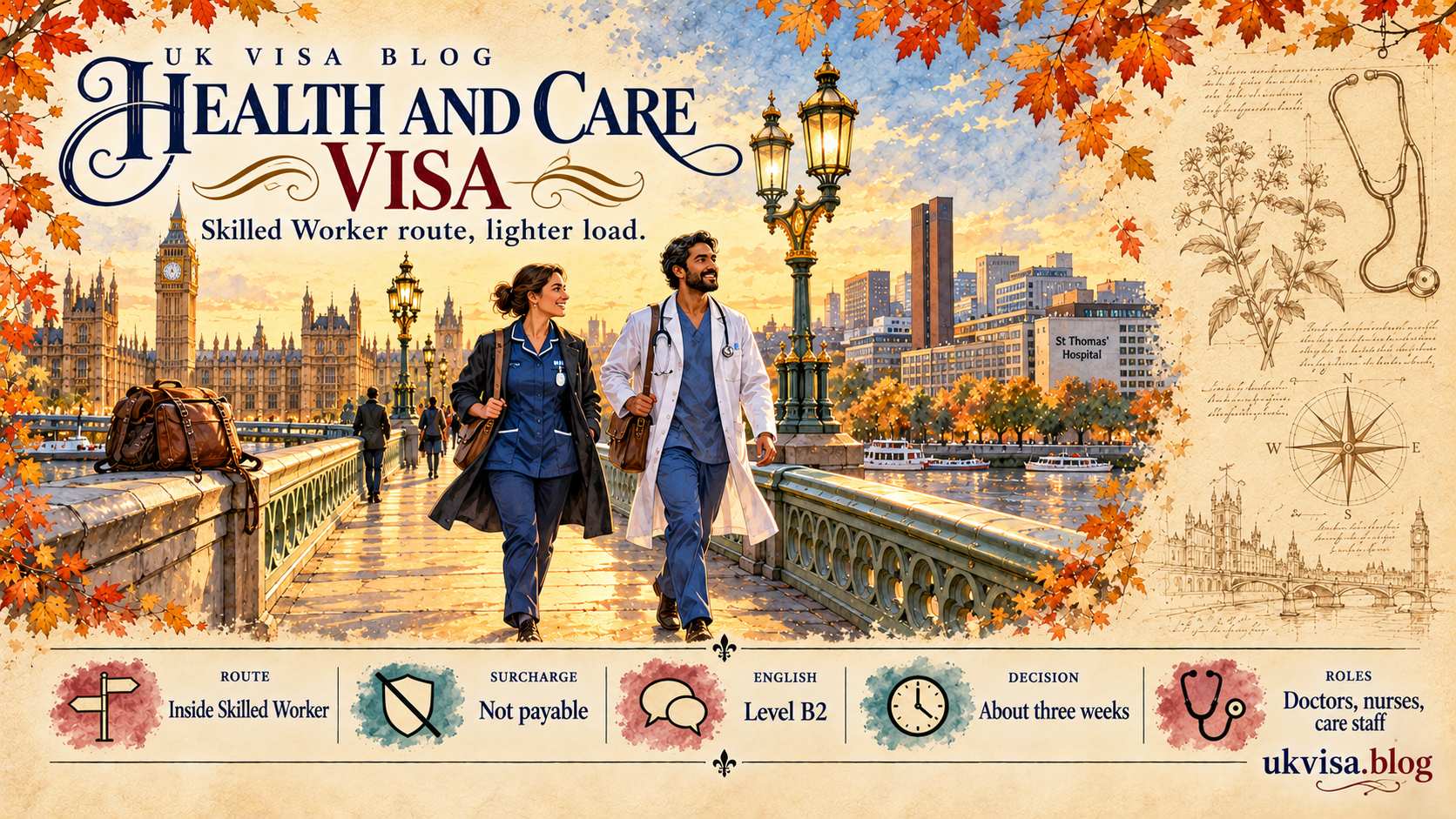
The Health and Care Worker visa is the Skilled Worker route at a discount: £324 or £628 to apply, no Immigration Health Surcharge, and a £25,000 general salary floor rather than £41,700. Legally it is not a lighter route — the sponsorship, English and settlement rules are Skilled Worker rules. Two things catch people out: which salary floor actually applies, and one charge that is not waived at all.
UK Work Visas
Health and Care Visa UK 2026: Requirements, Fees, English and Settlement
What Is the Health and Care Worker Visa?
It is a concession inside the Skilled Worker route for sponsored doctors, nurses, allied health professionals and adult social care staff in eligible occupation codes. You pay £324 for permission of three years or less, £628 for longer, inside or outside the UK, and neither you nor your family pays the Immigration Health Surcharge. The general salary floor is £25,000 or the going rate, whichever is higher. Decisions take about three weeks.
Everything else is the Skilled Worker route. You complete the Skilled Worker form and answer “yes” when asked whether you are applying as a Health and Care Worker, and caseworkers decide the case under the Skilled Worker guidance — same points table, same suitability rules, same settlement clock as the route it sits inside.
Who Can Sponsor You
Your offer must come from the NHS, an organisation providing medical services to the NHS, or an adult social care provider. The employer needs a sponsor licence — £611 for small businesses and charities, £1,682 for medium and large organisations, roughly eight weeks to process — under the regime that sets out what a licence commits an employer to.
The Care Quality Commission Condition
Care workers (6135) and senior care workers (6136) in England need a CQC-registered sponsor. The caseworker guidance adds two points the public page omits: the sponsor must be actively carrying out regulated activities and not be dormant on the register, and any English work location triggers the condition — someone based mainly in Scotland but working partly in England is caught. Care workers sponsored before 11 March 2024 are exempt only when extending with the same employer.
The Agency Supply Trap
Your sponsor must hold full responsibility for the duties, functions and outputs of your job. You must not be hired out to a third party to fill its vacancy or do an ongoing routine role for it; contract work has to be a time-bound project with a real end date. That rules out the agency model of staffing rotas at homes the licence-holder does not run — one of the commoner reasons sponsored applications fail.
Health and Care Worker Visa Eligibility Requirements
Five things have to line up: a valid certificate of sponsorship, an eligible occupation code, the salary rule for that code, English, and maintenance funds shown in your document bundle. The job must also comply with the national minimum wage and the Working Time Regulations — failure on either is a refusal regardless of salary.
- Certificate of sponsorship: used within three months of assignment; entry-clearance cases need a Defined CoS for that specific job and salary.
- Eligible occupation code: one of the codes below, with a job description that genuinely matches it.
- Salary: £25,000 plus the national pay scale rate, or £31,300 for the ten codes outside those scales.
- English: B2 for first-time applicants; B1 if you held this visa before 8 January 2026 and are extending.
- Maintenance: £1,270 held for 28 days in a row, day 28 within 31 days of applying — unless you have been in the UK on a valid visa for 12 months, or your employer completes the “sponsor certifies maintenance” field under Additional data on the certificate.
- Certificates: a tuberculosis test if you are applying from a listed country, and a criminal record certificate for most codes from outside the UK.
Partners and Children
Dependants need £285 for a partner, £315 for a first child and £200 for each additional child, on the same 28-day basis. Two date gates decide whether they can come at all. Sponsored as a care worker, dependants are only possible if you have been continuously employed in that role on a Health and Care Worker or Skilled Worker visa since before 11 March 2024. For other medium-skilled codes the date is 22 July 2025.
Narrow exceptions survive both gates: a child born in the UK, a sole surviving parent, or a child whose other parent is sponsored in the same category. Switching in as a care worker is harshest — your family cannot switch with you at all.
Criminal Record Certificates
Applying from outside the UK you need overseas police certificates unless your code is 2113, 2114, 3111 or 6132. GOV.UK frames the scope by age: under 28, any country you spent 12 months or more in since turning 18; 28 or over, any country stayed in over the last 10 years.
The caseworker guidance states it once, for everyone: any country you were present in for 12 months or more, continuously or in total, in the 10 years before the application, while aged 18 or over. The over-28 wording on GOV.UK drops that 12-month qualifier, so take advice before deciding a certificate is unnecessary.
Eligible Occupation Codes in 2026
Eligibility runs on the four-digit occupation code your employer assigns, not your job title, and the same code drives your going rate. Titles in one area of practice can sit in different codes — dentists and dental hygiene therapists are the standard example — so check how codes and skill level are assessed first.
Codes Open to New Health and Care Worker Applications
| Code | Occupation |
|---|---|
| 1171 | Health services and public health managers and directors |
| 1232 | Residential, day and domiciliary care managers and proprietors |
| 2113 | Biochemists and biomedical scientists |
| 2114 | Physical scientists |
| 2211 | Generalist medical practitioners |
| 2212 | Specialist medical practitioners |
| 2221 | Physiotherapists |
| 2222 | Occupational therapists |
| 2223 | Speech and language therapists |
| 2224 | Psychotherapists and cognitive behaviour therapists |
| 2225 | Clinical psychologists |
| 2226 | Other psychologists |
| 2229 | Therapy professionals not elsewhere classified |
| 2231 | Midwifery nurses |
| 2232 | Registered community nurses |
| 2233 | Registered specialist nurses |
| 2234 | Registered nurse practitioners |
| 2235 | Registered mental health nurses |
| 2236 | Registered children’s nurses |
| 2237 | Other registered nursing professionals |
| 2251 | Pharmacists |
| 2252 | Optometrists |
| 2253 | Dental practitioners |
| 2254 | Medical radiographers |
| 2255 | Paramedics |
| 2256 | Podiatrists |
| 2259 | Other health professionals not elsewhere classified |
| 2461 | Social workers |
| 3111 | Laboratory technicians |
| 3212 | Pharmaceutical technicians |
| 6131 | Nursing auxiliaries and assistants |
Source: GOV.UK, Health and Care Worker visa — your job. Verified 22 August 2026.
Codes You Can Only Extend, Update or Switch Into
Care worker (6135) and senior care worker (6136) are closed to new overseas applications but still open for extending, updating and in-country switching — switching needs three months’ legal employment with the sponsor first. Six further codes work the same way for anyone holding a certificate from before 22 July 2025 with continuous permission since: 1231, 3211, 3213, 3219, 6132 and 6133.
English Language Requirement
First-time applicants must prove English at CEFR level B2 in reading, writing, speaking and listening. If you held this visa before 8 January 2026 and are extending or updating, the standard is B1 and you do not have to prove it again. Switching from a Skilled Worker visa needs no fresh proof. Switching from any other visa means B2.
You can prove it with a UK school qualification begun under 18 (GCSE, A level, Scottish National Qualification level 4 or 5, Scottish Higher or Advanced Higher in English), a UK-awarded degree taught in English, or an overseas degree with an Ecctis assessment. Otherwise, sit an approved Secure English Language Test.
Nationals of a listed group of countries and territories are exempt outright, among them Australia, Canada, Jamaica, Malta, New Zealand, Trinidad and Tobago and the USA. Doctors, dentists, nurses and midwives are exempt if they have passed an English assessment their regulator accepts. Our guide covers CEFR levels, tests and exemptions across routes.
What “IELTS 5.5” Actually Means
The Immigration Rules set the requirement in CEFR terms, not as an IELTS band score, and band equivalences are published by the test providers rather than the Home Office. So book the UKVI version of whichever test you choose — the ordinary academic version is not a SELT — and check that provider’s own CEFR mapping before booking, rather than a figure quoted second-hand.
Salary Thresholds in 2026
This is where the route is most often described wrongly. The general Health and Care floor is £25,000, not £31,300. Most eligible jobs take their going rate from national pay scales, and you must clear both £25,000 and the pay scale rate for your role and band. The £31,300 figure belongs to a minority of codes outside those scales.
The Ten Codes That Use £31,300
Codes 1171, 1231, 1232, 2113, 2114, 3111, 3211, 3212, 6135 and 6136 need at least £31,300, or the lower going rate, whichever is higher. The caseworker guidance explains the split: these lower thresholds exist for Health and Care applicants whose occupation does not use national pay scales, and for pre-April-2024 Skilled Workers under transitional arrangements running to 4 April 2030.
When You Can Be Paid Less
Within those ten codes, four discounts reduce the going rate, each with its own cash minimum — none available if the job is on the immigration salary list. Our going rates guide explains how the rates are published.
Which Salary Rule Applies to You
| Your situation | Cash minimum | Rate you must also meet |
|---|---|---|
| Most eligible health and care jobs | £25,000 | National pay scale rate |
| One of the ten listed codes | £31,300 | Lower going rate for the code |
| Job on the immigration salary list | £25,000 | Full going rate, no discount |
| Under 26, studying, recent graduate or in training | £25,000 | 70% of the lower going rate |
| Relevant STEM PhD | £25,000 | 80% of the lower going rate |
| Relevant non-STEM PhD | £28,200 | 90% of the lower going rate |
| Postdoctoral role in code 2113 or 2114 | £25,000 | 70% of the lower going rate |
Source: GOV.UK, Health and Care Worker visa — different salary requirements. Verified 22 August 2026.
The two 70% discounts carry a cost that is easy to miss: your total time in the UK cannot exceed four years if you use them, counting earlier Tier 2 (General) time. For anyone planning a five-year run to settlement, the new-entrant rate can put the settlement date out of reach. Note too that the cash floor is never pro-rated for part-time work, while going rates are — and where you are sponsored for more than 48 hours a week, only the first 48 count.
Fees and What You Actually Pay
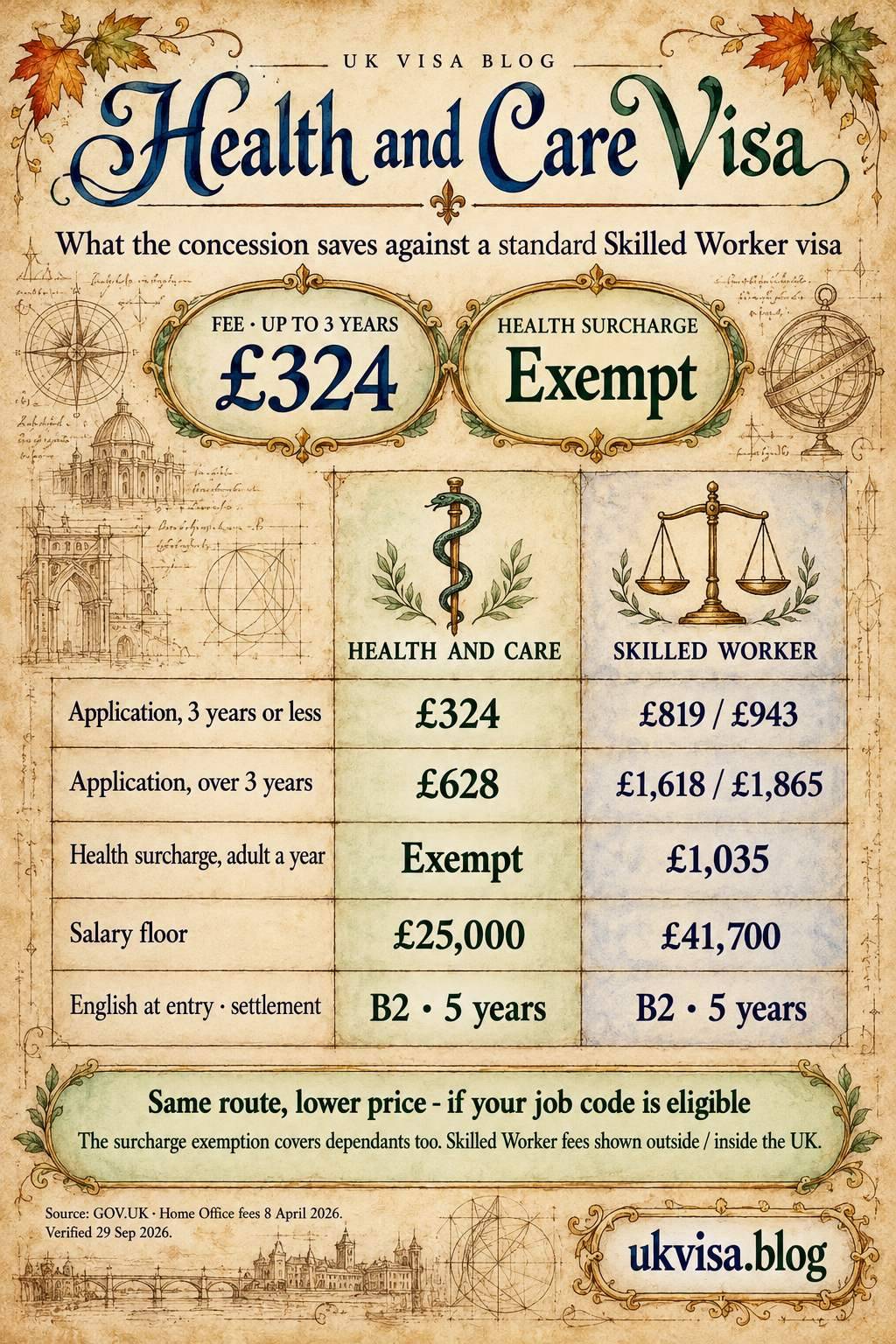
The fee is £324 for permission of three years or less and £628 for longer, per person, the same inside and outside the UK. Dependants pay the same rates. The gap against the standard route widens once the health surcharge is added.
Health and Care Costs Against the Standard Route
| Item | Health and Care Worker | Skilled Worker |
|---|---|---|
| Application, 3 years or less | £324 | £819 outside, £943 inside |
| Application, more than 3 years | £628 | £1,618 outside, £1,865 inside |
| Health surcharge, adult | Exempt | £1,035 a year |
| Health surcharge, under 18 | Exempt | £776 a year |
Source: GOV.UK Health and Care Worker and Skilled Worker visa pages, 8 April 2026 fee schedule. Verified 22 August 2026.
On a five-year grant that is £628 against £1,618 plus £5,175 of surcharge. The exemption covers your partner and children, and NHS treatment is free from the day the visa starts, with the usual charges for prescriptions, dental treatment and eye tests. See how the surcharge works elsewhere and the full fee table.
One widely repeated claim about this route does not survive checking, and it falls on the employer rather than you:
There is no Health and Care exemption from the Immigration Skills Charge. Exemptions run by occupation code — 2111 to 2115, 2119, 2161, 2162 and 2311 — plus entry clearance under six months, student switchers and certificate overlaps. Of the health and care codes only 2113 and 2114 appear. Sponsoring a nurse, doctor or care worker costs £1,320 for the first 12 months and £660 per additional six months, or £480 and £240 if small or charitable — up to £6,600 over five years.
Processing Times
Decisions usually arrive within three weeks whether you apply from outside the UK, extend, update or switch; dependants inside the UK wait about eight. Priority costs £500 and targets five working days, super priority £1,000 and the next working day — but in-country super priority needs a UKVCAS appointment and is not available through the ID Check app. See what happens after biometrics and paid faster-decision services.
Cases can be paused while the Home Office checks your sponsor, or held for a genuineness interview — see our credibility interview questions. If you applied inside the UK, leaving the UK, Ireland, the Channel Islands or the Isle of Man before the decision withdraws the application.
The Settlement Pathway
Five years of continuous residence on this route or the Skilled Worker route leads to settling permanently in the UK, and the £3,226 fee is the whole cost. The 2025 White Paper proposes a ten-year earned-settlement period; the consultation closed on 12 February 2026 and the response is still pending, so the five-year rule stands.
- Five years’ residence: on this route, Skilled Worker or a qualifying predecessor.
- Absences: no more than 180 days outside the UK in any rolling 12 months.
- Salary at application: still meeting the threshold and going rate for your code.
- Knowledge of life: a pass in the Life in the UK test.
- English: B1 now, rising to B2 from 26 March 2027 under HC 1691.
- Sponsorship: still sponsored by a licensed employer in a qualifying role.
The full mechanics, including good character and continuous employment, are in our guide to the settlement criteria.
If Your Sponsor Loses Their Licence
Your certificate is cancelled and permission is cut to 60 days, or whatever is left if less — find a new sponsor inside that window or leave. The same applies if the employer does not renew, or a new owner does not apply within 28 days of a takeover. If you were involved in the reasons, permission is withdrawn immediately.
Sources: GOV.UK Health and Care Worker route page on GOV.UK and Skilled Worker route page on GOV.UK pages; Appendix Skilled Occupations; Skilled Worker caseworker guidance v20.0, 3 August 2026; and if your sponsor loses their licence. Figures verified 22 August 2026.
Frequently Asked
Questions about the Health and Care Worker Visa
B2 for a first application, in all four skills. B1 if you held this visa before 8 January 2026 and are extending or updating, with no fresh proof needed. The rule is set in CEFR levels, not IELTS bands — equivalences come from each provider, so check theirs and book the UKVI version. Nurses and doctors with a regulator-accepted assessment are exempt.
Not from overseas. Codes 6135 and 6136 remain available for extending, updating and switching inside the UK, and switching needs three months’ legal employment with the sponsor first. In England the sponsor must be CQC-registered and actively carrying out regulated activities, unless you were sponsored before 11 March 2024 and are extending with the same employer.
Both, depending on your code. Most eligible jobs use national pay scales: the floor is £25,000 and you must also be paid the pay scale rate. Ten codes sit outside those scales — 1171, 1231, 1232, 2113, 2114, 3111, 3211, 3212, 6135 and 6136 — and need £31,300 or the lower going rate, whichever is higher.
£324 for permission of three years or less, £628 for longer, per person, the same inside or outside the UK. No Immigration Health Surcharge is payable by you or your dependants. You also need £1,270 of maintenance funds unless your sponsor certifies it. Priority adds £500, super priority £1,000.
No. There is no Health and Care exemption. The charge is waived only for codes 2111 to 2115, 2119, 2161, 2162 and 2311, for entry clearance under six months, for student switchers and where certificates overlap. Sponsoring a nurse, doctor or care worker costs £1,320 for the first year and £660 per further six months, or £480 and £240 for small and charitable sponsors.
Usually yes, with £285 for a partner, £315 for a first child and £200 for each additional child. Two exceptions bite: care workers need continuous employment in the role since before 11 March 2024, other medium-skilled codes since before 22 July 2025. Anyone switching in as a care worker cannot bring dependants at all.
Yes, up to 20 hours a week alongside your sponsored job, if the second role is in a higher-skilled eligible code, on the immigration salary list, or in the same sector and at the same level as your main job. Overtime and NHS bank shifts are unlimited. Anything over 20 hours needs a new certificate of sponsorship and an application to update your visa.
Five years of continuous residence on Health and Care Worker or Skilled Worker permission, no more than 180 days outside the UK in any rolling 12 months, the Life in the UK test, English at B1 rising to B2 from 26 March 2027 under HC 1691, and continuing sponsorship in a qualifying role. The ILR fee is £3,226; no surcharge is payable on settlement.