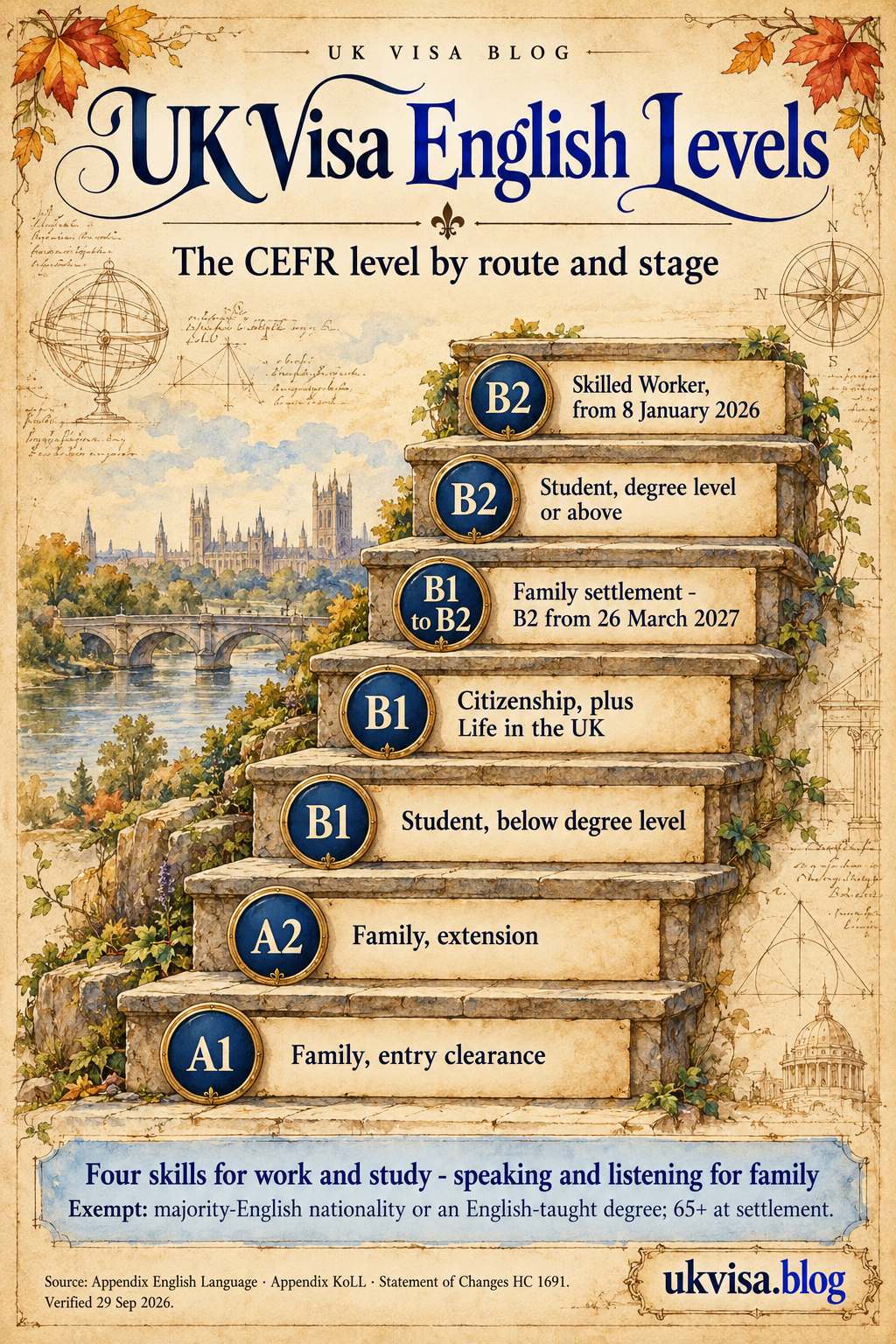
UK visa English language requirements set out the CEFR level you must demonstrate at each stage of the immigration journey, from initial visa entry through to settlement and citizenship. Most work and settlement routes require CEFR Level B1 in 2026, while Student visas at degree level require B2, initial spouse visas require A1, and healthcare professional regulators (NMC, GMC) require C1. Critically, Statement of Changes HC 1691 (laid 5 March 2026) raises the ILR settlement standard from B1 to B2 across most settlement routes from 26 March 2027 — affecting Skilled Worker, Family, Long Residence, and other settlement applicants. This guide covers the complete CEFR framework, what "UKVI CEFR threshold met" means on your SELT certificate, approved Secure English Language Tests (SELTs) for 2026, route-by-route requirements, the upcoming B2 settlement standard, and the eight exemption categories under Appendix English Language.
Source: Appendix English Language; HC 1691 Statement of Changes (5 March 2026); SELT provider published fees, May 2026
The Home Office laid Statement of Changes HC 1691 on 5 March 2026, raising the English language requirement for Indefinite Leave to Remain from B1 to B2 (Upper Intermediate / Vantage level) across most settlement routes — including Skilled Worker → ILR, Spouse / Partner → ILR, Long Residence, Global Talent → ILR, and BN(O) → ILR. The change takes effect for ILR applications submitted on or after 26 March 2027. Applications made before that date continue to be assessed at B1. The eight exemption categories under Appendix English Language continue to apply, including the majority English-speaking country exemption, the English-taught degree exemption, and the age 65+ and under-18 exemptions. Strategic timing now matters significantly — applicants currently at B1 level whose ILR eligibility ripens close to 26 March 2027 should consider whether to apply before or after the cut-off based on their English readiness.
- CEFR Levels Explained for UK Visas
- What "UKVI CEFR Threshold Met" Means on Your SELT Certificate
- English Requirements by Visa Route
- Skilled Worker and Health & Care Worker English (B1)
- Student Visa English Requirements (B2)
- Family Route — Spouse, Partner, Fiancé English Progression
- ILR English Requirement (B1 Until 25 March 2027 / B2 From 26 March 2027)
- British Citizenship English Requirement
- English Language Exemptions Under Appendix English Language
- Approved SELT Tests and Providers 2026
- If Your Visa Is Refused on English Grounds
- Frequently Asked Questions
UK Visa English Language Requirements 2026
UK Visas and Immigration uses the Common European Framework of Reference for Languages (CEFR) to set English proficiency standards across all visa routes. The framework is codified in the Immigration Rules at Appendix English Language, which lists approved Secure English Language Tests (SELTs), required CEFR levels by route, and the eight exemption categories. Failing to provide acceptable English language evidence is a frequent refusal ground — particularly where applicants take tests at non-approved centres or fail to obtain the "UKVI CEFR threshold met" certification statement essential for UK visa purposes.
CEFR Levels Explained for UK Visa Applications
CEFR levels for UK visas range from A1 (Breakthrough — basic phrases) through A2 (Waystage — routine situations), B1 (Threshold — main points of standard speech), B2 (Vantage — complex topics fluently), C1 (Effective Operational — sophisticated expression), to C2 (Mastery — near-native). UK visa requirements use levels A1 through C1 depending on route. From 26 March 2027, settlement applications require B2 (previously B1).
| CEFR Level | Description | IELTS Equivalent | Primary UK Visa Use |
|---|---|---|---|
| A1 (Breakthrough) | Basic phrases, introduce yourself, simple personal questions | 2.0–3.0 | Initial spouse and partner visa |
| A2 (Waystage) | Routine tasks, simple descriptions of background and immediate environment | 3.0–3.5 | Spouse and partner visa extension (FLR(M)) |
| B1 (Threshold) | Main points of clear standard speech, deal with most travel situations | 4.0–5.0 | Skilled Worker, Health and Care Worker, current settlement standard until 25 March 2027 |
| B2 (Vantage) | Complex texts, interact with fluency, technical discussion in own field | 5.5–6.5 | Student visa (degree level); settlement applications from 26 March 2027 (HC 1691) |
| C1 (Effective Operational) | Express ideas fluently and spontaneously, sophisticated language | 7.0–8.0 | NMC / GMC professional registration, postgraduate Student visas at certain institutions |
| C2 (Mastery) | Understand everything heard or read, near-native expression | 8.5–9.0 | Exceeds all UKVI requirements; rarely required directly |
What "UKVI CEFR Threshold Met" Means on Your SELT Certificate
"UKVI CEFR threshold met" is the certification statement printed on Secure English Language Test (SELT) certificates that confirms your performance satisfies the minimum CEFR level for UK visa purposes. It appears alongside each CEFR level you achieved or exceeded. For example, a B2 score will show "UKVI CEFR threshold met" at A1, A2, B1, and B2 — meaning the same certificate can be used for any UK visa requiring any of those levels. Without this exact certification statement, UKVI will not accept your test results — even if your numerical score appears sufficient.
How the Threshold Statement Appears on Your Certificate
When you take an approved SELT at a UKVI-approved centre, your results document will explicitly state "UKVI CEFR threshold met" at each level you achieved or exceeded. The cascading nature of the certification is critical — passing at a higher level than required means the same certificate can be reused throughout your immigration journey:
- UKVI CEFR threshold met at A1: Qualifies for initial spouse, partner, fiancé, and parent visa applications
- UKVI CEFR threshold met at A2: Qualifies for spouse and partner visa extensions (FLR(M))
- UKVI CEFR threshold met at B1: Qualifies for Skilled Worker, Health and Care Worker, current settlement standard, naturalisation
- UKVI CEFR threshold met at B2: Qualifies for Student visas at degree level, and (from 26 March 2027) all settlement applications under HC 1691
- UKVI CEFR threshold met at C1: Qualifies for NMC and GMC professional registration, postgraduate Student visas
- UKVI CEFR threshold met at C2: Exceeds all UK visa English requirements
Strategic Use of CEFR Threshold Certification
If you pass at a level higher than your immediate visa stage requires (for example, achieving B2 when only A1 is needed for an initial spouse visa), you can reuse the same certificate at every subsequent stage — extension, settlement, and naturalisation — even after the standard 2-year validity period expires, as long as the certificate was used in a previously successful visa application and has not been formally withdrawn by the test provider. This single-test strategy can save £300–£500 over a 5-year settlement route. With the B2 settlement standard taking effect on 26 March 2027 under HC 1691, applicants currently choosing test levels for any visa stage should strongly consider taking the B2 test now to future-proof the entire route.
UK Visa English Requirements by Route 2026
English requirements vary by route: Skilled Worker and Health and Care Worker visas require B1 in all four skills (reading, writing, speaking, listening); Student visas at degree level require B2 in all four skills; initial Spouse and partner visas require A1 in speaking and listening only; ILR settlement currently requires B1 in speaking and listening (rising to B2 from 26 March 2027); British citizenship requires the same English level as ILR plus the Life in the UK Test; Standard Visitor visas have no English language requirement.
| Visa Route | CEFR Level 2026 | Skills Tested | Common Approved Tests |
|---|---|---|---|
| Skilled Worker sponsored employment | B1 | R, W, S, L (all four) | IELTS for UKVI General, PTE Academic UKVI, Trinity ISE I |
| Health and Care Worker | B1 (plus C1 for clinical registration) | R, W, S, L | IELTS for UKVI General, PTE Academic UKVI, IELTS Academic UKVI (NMC/GMC) |
| UK Student route applications | B2 (degree); B1 (below degree) | R, W, S, L | IELTS Academic UKVI, PTE Academic UKVI |
| Spouse / partner visa (initial) | A1 | S, L only | IELTS Life Skills A1, Trinity GESE Grade 2 |
| Spouse / partner extension (FLR(M)) | A2 | S, L only | IELTS Life Skills A2, Trinity GESE Grade 3 |
| ILR / settlement (before 26 Mar 2027) | B1 | S, L only | IELTS Life Skills B1, Trinity GESE Grade 5 |
| ILR / settlement (from 26 Mar 2027 — HC 1691) | B2 | S, L only | IELTS for UKVI B2, Trinity GESE Grade 6 or 7, PTE Academic UKVI |
| British citizenship (naturalisation) | Same as ILR at time of grant | S, L only | SELT plus Life in the UK settlement test |
| UK Standard Visitor visa | None | — | Not required |
R = Reading, W = Writing, S = Speaking, L = Listening
Skilled Worker and Health and Care Worker English Requirements
Skilled Worker and Health and Care Worker visa applicants must demonstrate CEFR Level B1 in all four skills — reading, writing, speaking, and listening. The minimum IELTS for UKVI score is 4.0 in each component, or equivalent on PTE Academic UKVI (minimum 43 each component) or Trinity ISE I (pass all four components). Healthcare professionals seeking clinical registration with the NMC or GMC face additional, higher requirements (typically C1 / IELTS 7.0+) imposed by the professional regulators, separate from the visa English requirement.
Minimum IELTS Score for UK Work Visa
- IELTS for UKVI (General Training): Minimum 4.0 in each component (R, W, S, L) for B1 threshold
- PTE Academic UKVI: Minimum 43 in each component for B1
- Trinity College London ISE I: Pass in all four components
- LanguageCert International ESOL SELT B1: Pass grade
- PSI Skills for English UKVI B1: Pass in all four skills
Healthcare Professional Registration — NMC and GMC C1 Standard
While the Health and Care Worker visa itself requires B1 like the standard Skilled Worker route, healthcare professionals seeking clinical registration must meet separate, higher language standards imposed by the professional regulators independent of UKVI:
- Nursing and Midwifery Council (NMC): IELTS Academic 7.0 overall, minimum 6.5 in writing and 7.0 in reading, speaking, listening; or OET grade B in each subtest
- General Medical Council (GMC): IELTS Academic 7.5 overall, minimum 7.0 in each component; or OET grade B in each subtest
- Health and Care Professions Council (HCPC): Varies by profession; typically 7.0 IELTS or OET grade B
- General Dental Council (GDC): IELTS Academic 7.0 overall
For the wider Health and Care Worker route framework including salary thresholds, sponsor requirements, and dependant provisions, see our dedicated Health and Care Worker route guide. Note that from 26 March 2027 under HC 1691, when these applicants reach ILR, they will need to meet the B2 settlement standard separately from any earlier work-route B1 evidence.
Student Visa English Requirements — B2 for Degree Level
UK Student visa applicants at degree level (undergraduate, postgraduate, or above) must demonstrate CEFR Level B2 in all four skills. Students applying for below-degree courses (foundation, English-language courses) require B1. UK Higher Education Institutions with track-record sponsor status can assess English proficiency themselves — applicants can submit a CAS confirming the institution has independently verified English ability, without taking a separate SELT. This is the most common pathway for international students at UK universities.
Student Visa English Methods
- SELT route: IELTS for UKVI Academic (minimum 5.5 in each component for B2) or PTE Academic UKVI (minimum 51 each component)
- HEI self-assessment: UK universities with track-record sponsor status can confirm English on the CAS — no separate SELT needed
- Pre-sessional English progression: Below-B2 applicants can join university-affiliated pre-sessional English courses meeting the requirement
- Native speaker exemption: Nationals of majority English-speaking countries (see exemptions section)
- English-taught degree exemption: Prior UK or overseas degree taught in English (Ecctis verification for overseas qualifications)
Full Student route framework including CAS rules, sponsor licence requirements, and the Confirmation of Acceptance for Studies framework is covered in our dedicated Student route guide linked in the requirements table above.
Family Route — Spouse, Partner, and Fiancé English Progression
Family route English requirements progress from A1 initial entry → A2 extension → B1 settlement (B2 from 26 March 2027). Only speaking and listening skills are tested (no reading or writing). The same A1, A2, B1 standards apply to spouses, civil partners, unmarried partners, and fiancé(e)s. For the full route-specific framework including all SELT options, exemption details, fees, and strategic timing around the B2 March 2027 cut-off, see our dedicated spouse visa English language requirement guide.
| Family Route Stage | CEFR Level 2026 | Common Approved Tests |
|---|---|---|
| Initial entry (UK Spouse / Partner / Fiancé visa) | A1 (Speaking, Listening) | IELTS Life Skills A1, Trinity GESE Grade 2 |
| UK Spouse visa renewal — FLR(M) at 2.5 years | A2 (Speaking, Listening) | IELTS Life Skills A2, Trinity GESE Grade 3 |
| Spouse / partner settlement (ILR) — before 26 Mar 2027 | B1 (Speaking, Listening) | IELTS Life Skills B1, Trinity GESE Grade 5 |
| Spouse / partner settlement (ILR) — from 26 Mar 2027 | B2 (Speaking, Listening) | IELTS for UKVI B2, Trinity GESE Grade 6 or 7, PTE Academic UKVI |
Children under 18 on the family route are exempt from the English language requirement regardless of route stage. Adult dependants on work routes (e.g. children of Skilled Worker holders) are also exempt from English requirements during the initial visa and any extensions — but they must meet the B1 / B2 settlement standard when they apply for ILR. This is identical to the main applicant's settlement requirement.
ILR English Requirement — B1 Until 25 March 2027 / B2 From 26 March 2027
Indefinite Leave to Remain currently requires CEFR Level B1 in speaking and listening — for applications submitted up to and including 25 March 2027. For ILR applications submitted on or after 26 March 2027, the requirement rises to B2 under Statement of Changes HC 1691 laid on 5 March 2026. The B2 standard applies across most settlement routes including Skilled Worker → ILR, Health and Care Worker → ILR, Spouse / Partner → ILR, Long Residence, Global Talent → ILR, and BN(O) → ILR. The date that matters is the date the online ILR application is submitted and the fee paid — not the date the qualifying residence period ends.
Why HC 1691 Matters and Who Is Affected
The B2 settlement uplift announced in HC 1691 represents a meaningful jump in language expectations — B2 ("Vantage") is approximately one full CEFR level above B1 ("Threshold"). At B2, applicants must understand the main ideas of complex text on both concrete and abstract topics, including technical discussions in their own field, and interact with native speakers with a degree of fluency and spontaneity that makes regular conversation possible without strain. The change affects:
- Skilled Worker route applicants: 5-year qualifying period completing on or after 26 March 2027
- Spouse and partner route applicants: 5-year qualifying period completing on or after 26 March 2027
- Long Residence applicants: 10-year qualifying period completing on or after 26 March 2027
- Global Talent and Innovator Founder: Settlement applications on or after 26 March 2027
- BN(O) route holders: 5-year qualifying period completing on or after 26 March 2027
- Existing B2 / C1 / C2 certificate holders: Unaffected — certificate continues to qualify
- Exemption holders: All eight Appendix English Language exemption categories continue to apply
ILR English — Speaking and Listening Only
Both the current B1 and the new B2 ILR standards test only speaking and listening — not reading or writing. This is consistent with the practical-communication focus of family and settlement routes. Applicants who already passed at B2 or higher during an earlier work or study route (e.g. Skilled Worker IELTS for UKVI B1 at entry, Student visa IELTS Academic UKVI B2 at entry) can reuse those certificates for ILR — even where validity has expired — provided they were used in a previously successful UK visa application and have not been withdrawn. Full settlement framework including the 5-year qualifying residence rule, absences cap (180 days per rolling 12-month period), and the £3,226 application fee is in our UK long-term settlement guide.
British Citizenship English Requirement
British citizenship by naturalisation requires the same CEFR English level as ILR at the time of application — currently B1 speaking and listening, rising to B2 from 26 March 2027. Naturalisation applicants must also pass the Life in the UK Test (24 questions, 75% pass mark, £50 fee). Most ILR applicants who already passed an English test at B1 or higher can reuse that certificate for citizenship, provided it has not been withdrawn. The naturalisation application fee from 8 April 2026 is £1,709 plus £130 mandatory ceremony fee = £1,839 total.
Citizenship-stage English is typically the easiest part of the process for most applicants because the certificate from ILR carries over directly — the same B1 (or B2 from March 2027) speaking and listening SELT, or the same exemption, qualifies for both stages. For the complete naturalisation procedure including good character requirements, residence calculations, and the citizenship ceremony, see our British citizenship through naturalisation guide.
English Language Exemptions Under Appendix English Language
Eight exemption categories under Appendix English Language allow applicants to bypass the English test requirement: (1) nationals of majority English-speaking countries; (2) holders of degrees taught in English (Ecctis verification for overseas qualifications); (3) applicants aged 65 or over; (4) applicants under 18; (5) those with a long-term physical or mental condition preventing them from meeting the requirement; (6) exceptional / compassionate circumstances at Home Office discretion; (7) prior visa application where English was already met at the required level; (8) certain visa categories with no English requirement (e.g. Standard Visitor). All exemptions continue to apply under the B2 standard from 26 March 2027.
Majority English-Speaking Country Exemption
Nationals of the following majority English-speaking countries are automatically exempt from the English test requirement at all UK visa stages — only the passport need be provided as evidence:
- Americas: Antigua and Barbuda, The Bahamas, Barbados, Belize, Canada, Dominica, Grenada, Guyana, Jamaica, St Kitts and Nevis, St Lucia, St Vincent and the Grenadines, Trinidad and Tobago, USA
- Europe: Republic of Ireland, Malta
- Oceania: Australia, New Zealand
Academic Qualification Exemption — Degrees Taught in English
Applicants holding a degree (UK bachelor's level or higher) taught or researched in English are exempt:
- UK degrees: Provide the original degree certificate — no Ecctis verification needed
- Overseas degrees from a majority English-speaking country: Provide certificate plus Ecctis statement of comparability (£49.50)
- Overseas degrees from other countries (taught in English): Provide certificate plus Ecctis visa and nationality statement confirming both equivalency to UK bachelor's standard AND that the degree was taught in English (£140–£175)
- Where Ecctis is used: Apply at the official Ecctis (formerly UK NARIC) verification service
Other Exemption Categories
- Age 65 or over: Automatic exemption at the date of application
- Under 18: Children and minors are exempt across all routes
- Medical exemption: Long-term physical or mental condition preventing the applicant from meeting the requirement — requires detailed medical evidence from a UK or country-of-residence medical professional; see also the UK medical visa context for related visa routes
- Exceptional circumstances: Compelling or compassionate circumstances at Home Office discretion (rarely granted)
- Previously satisfied requirement: Where a previous successful UK visa application included a SELT at the required level — that certificate can be reused even after validity expires, provided it has not been withdrawn
- No-requirement visa categories: Standard Visitor, certain T5 Temporary Worker routes, and several short-term routes have no English requirement at all
Approved SELT Tests and Providers for UK Visas 2026
Only Secure English Language Tests (SELTs) from UKVI-approved providers, taken at approved SELT centres, are accepted for UK visa applications. The same provider often offers both standard tests and UKVI-specific SELT versions — only the SELT version produces the essential "UKVI CEFR threshold met" certification statement. Taking the wrong version of the test is one of the most expensive mistakes in the UK visa process — the test fee is non-refundable, and you will need to retake at the correct SELT centre. The full list of currently-approved SELT providers and centres is maintained at the official UKVI approved English language test providers list.
| Provider | SELT Product Name | CEFR Levels | Typical Fee (2026) |
|---|---|---|---|
| IELTS SELT Consortium | IELTS for UKVI Academic / General Training | B1, B2, C1, C2 (4 skills) | £240–£250 |
| IELTS SELT Consortium | IELTS Life Skills | A1, A2, B1 (Speaking, Listening only) | £150–£170 |
| Trinity College London | GESE (Graded Examinations in Spoken English) | A1 (Grade 2) through C2 (Grade 12) | £150–£170 |
| Trinity College London | ISE (Integrated Skills in English) | A2, B1, B2, C1, C2 (4 skills) | £180–£230 |
| LanguageCert | International ESOL SELT / Academic SELT / General SELT | A1, A2, B1, B2, C1, C2 | £150–£200 |
| PSI Services (UK) Ltd | Skills for English UKVI | A1, A2, B1, B2, C1 | £150–£180 |
| Pearson | PTE Academic UKVI | A2, B1, B2, C1, C2 (4 skills) | £200–£250 |
The critical importance of using only approved SELT centres was underscored by the ETS TOEIC test investigation, where thousands of international students faced visa revocations after the Home Office concluded widespread fraud at certain centres. The TOEIC test itself was removed from the SELT list in 2014; ongoing litigation has clarified the standard of proof required for fraud allegations and the right to administrative review and appeal for affected applicants.
If Your Visa Is Refused on English Language Grounds
If your visa is refused because UKVI rejected your English language evidence, the refusal notice and grounds explanation will set out the exact ground — typically that the test centre was not approved, the test version was not a SELT, the test was outside the 2-year validity, the certificate was not authenticated, or the CEFR level achieved was below the required threshold. Recovery options include retaking a SELT at an approved centre and reapplying, requesting administrative review of the refusal if a caseworker error occurred (no new evidence accepted at AR), or — for human rights / family route refusals — pursuing a First-tier Tribunal appeal where the refusal engages Article 8.
- Wrong test centre (not SELT-approved): Retake at a SELT centre and reapply — administrative review will not succeed if the test centre was demonstrably non-approved
- Wrong test version (e.g. standard IELTS instead of IELTS for UKVI): Retake the correct SELT version and reapply
- Test out of validity (over 2 years old at decision date): Take a new test and reapply — unless the test was used in a previous successful application
- CEFR level below threshold: Retake at the correct level and reapply
- Caseworker error (genuine SELT but incorrectly assessed): Apply for administrative review within 14 days (UK) / 28 days (overseas) — £80 fee, refunded if successful
- Spouse / family route refusal engaging Article 8: Consider First-tier Tribunal appeal on human rights grounds
- UK visa English requirements use CEFR levels A1 through C1 depending on route, with C2 exceeding all standards
- HC 1691 (laid 5 March 2026) raises the settlement standard from B1 to B2 from 26 March 2027 across most ILR routes
- "UKVI CEFR threshold met" certification appears only on SELT-centre certificates — standard IELTS Academic or General is not accepted
- Skilled Worker and Health and Care Worker visas require B1 in all four skills (R, W, S, L)
- Student visas at degree level require B2; below-degree courses require B1
- Family route progresses A1 → A2 → B1 (B2 from 26 March 2027) in speaking and listening only
- Eight exemption categories under Appendix English Language continue to apply under the B2 settlement uplift
- NMC, GMC, HCPC, and GDC impose separate higher language standards (typically C1) for clinical registration — independent of the visa English requirement
- SELT fees range from £150–£250; test certificates are valid 2 years but can be reused if used in a successful prior application
- Strategic timing: applicants currently at B1 with ILR eligibility ripening close to 26 March 2027 should consider whether to apply before or after the cut-off
Frequently Asked Questions About UK Visa English Requirements
"UKVI CEFR threshold met" is the mandatory certification statement printed on Secure English Language Test (SELT) certificates confirming that your test performance satisfies the minimum CEFR level required for UK visa applications. It appears at every CEFR level you achieved or exceeded — so a B2 score will show "UKVI CEFR threshold met" at A1, A2, B1, and B2 all on the same certificate. Without this exact certification statement, UKVI will not accept your test results, even if your numerical score appears sufficient. This is why tests must be taken at SELT-approved centres rather than standard IELTS or Pearson centres.
Statement of Changes HC 1691, laid on 5 March 2026, raises the English language requirement for Indefinite Leave to Remain from CEFR Level B1 to B2 with effect from 26 March 2027. The change applies across most settlement routes — Skilled Worker, Health and Care Worker, Spouse / Partner, Long Residence, Global Talent, Innovator Founder, and BN(O). Applications submitted before 26 March 2027 continue to be assessed at B1; applications on or after that date require B2 unless an exemption applies. The date that matters is the date the ILR application is submitted, not the date the qualifying residence period completes.
Yes, CEFR B1 remains the minimum English requirement for Skilled Worker visa applications in 2026 — applicants must demonstrate B1 proficiency in all four skills (reading, writing, speaking, and listening). The minimum IELTS for UKVI score is 4.0 in each component, or equivalent on PTE Academic UKVI (43 each component) or Trinity ISE I (pass all four). The initial work visa requirement of B1 has not changed under HC 1691 — only the settlement (ILR) standard rises to B2 from 26 March 2027 for the same applicants.
For the Skilled Worker and Health and Care Worker routes, the minimum IELTS score is IELTS for UKVI (General Training) at 4.0 in each component — reading, writing, speaking, and listening — which corresponds to CEFR Level B1. You must take IELTS for UKVI (not standard IELTS) at a UKVI-approved SELT centre. Healthcare professionals seeking NMC or GMC clinical registration face additional higher requirements (typically IELTS Academic 7.0+) imposed by the professional regulators separately from the visa English requirement.
ILR (Indefinite Leave to Remain) currently requires CEFR Level B1 in speaking and listening for applications submitted up to and including 25 March 2027. From 26 March 2027 onwards, the requirement rises to B2 under Statement of Changes HC 1691. You can meet the current B1 requirement through IELTS Life Skills B1, Trinity GESE Grade 5, or equivalent approved SELTs. The B2 standard from 26 March 2027 will require IELTS for UKVI B2, Trinity GESE Grade 6 or 7, PTE Academic UKVI B2, or LanguageCert SELT B2 — note that IELTS Life Skills does not currently offer B2.
Eight exemption categories under Appendix English Language allow applicants to bypass the English test: nationals of majority English-speaking countries (USA, Canada, Australia, New Zealand, Ireland, Malta, plus 15 Caribbean countries); holders of degrees taught in English (with Ecctis verification for overseas qualifications); applicants aged 65 or over; applicants under 18; those with a long-term physical or mental condition preventing them from meeting the requirement; exceptional / compassionate circumstances at Home Office discretion; prior visa applications where English was already met at the required level; and certain no-requirement visa categories such as Standard Visitor.
UKVI accepts Secure English Language Tests (SELTs) from seven approved providers: IELTS for UKVI Academic and General Training, IELTS Life Skills, Trinity College GESE and ISE, LanguageCert International ESOL SELT (Academic and General), PSI Skills for English UKVI, and Pearson PTE Academic UKVI. The test must be taken at a UKVI-approved SELT centre — results from regular IELTS or PTE test centres are not accepted, even if the score appears sufficient. The defining feature of an accepted result is the "UKVI CEFR threshold met" certification statement on the official results document.
English test results are valid for 2 years from the test date when first used. After 2 years, results expire and cannot be used for a new visa application unless they were previously accepted in a successful UK visa application — in which case they can be reused indefinitely for subsequent applications (extensions, ILR, citizenship) on the same immigration journey, even after the 2-year window, as long as the certificate has not been formally withdrawn by the test provider. This is the basis of the "pass once, use throughout" strategy at higher CEFR levels.
Yes — if your degree is at UK bachelor's level or higher and was taught or researched in English, you may be exempt from taking a SELT. For UK degrees, provide the original degree certificate. For overseas degrees from a majority English-speaking country, you need an Ecctis statement of comparability (£49.50). For overseas degrees from any other country, you need an Ecctis visa and nationality statement (£140–£175) confirming both that the qualification is equivalent to a UK bachelor's degree and that it was taught in English. The exemption applies across all UK visa stages including initial entry, extensions, ILR, and naturalisation.
If your UK visa is refused because UKVI rejected the English language evidence, the refusal letter will set out the exact ground — wrong test centre (not SELT-approved), wrong test version (e.g. standard IELTS instead of IELTS for UKVI), test out of validity, CEFR level below threshold, or certificate authenticity issues. Recovery options include: retaking the correct SELT at an approved centre and reapplying (the most common path); requesting administrative review within 14 days (UK) or 28 days (overseas) if a caseworker error caused the refusal (no new evidence at AR); or — for family route refusals engaging Article 8 — pursuing a First-tier Tribunal appeal where appeal rights exist.
For the formal Immigration Rules framework governing English requirements, see the official Immigration Rules Appendix English Language. For the HC 1691 Statement of Changes confirming the B2 settlement uplift from 26 March 2027, see the Statements of Changes to the Immigration Rules archive. Practical guidance on knowledge-of-English for visa applicants is available at the GOV.UK English language requirements for UK visa applications page.