
The spouse visa financial requirement is £29,000 a year, or £88,500 in cash savings. It is the single most common ground of refusal, and almost never because the sponsor earns too little. People are refused because the specified evidence in Appendix FM-SE does not prove what they actually earn.
UK Family Visas
Spouse Visa UK Financial Requirements Overview 2026
UK Spouse Visa Income Threshold 2026
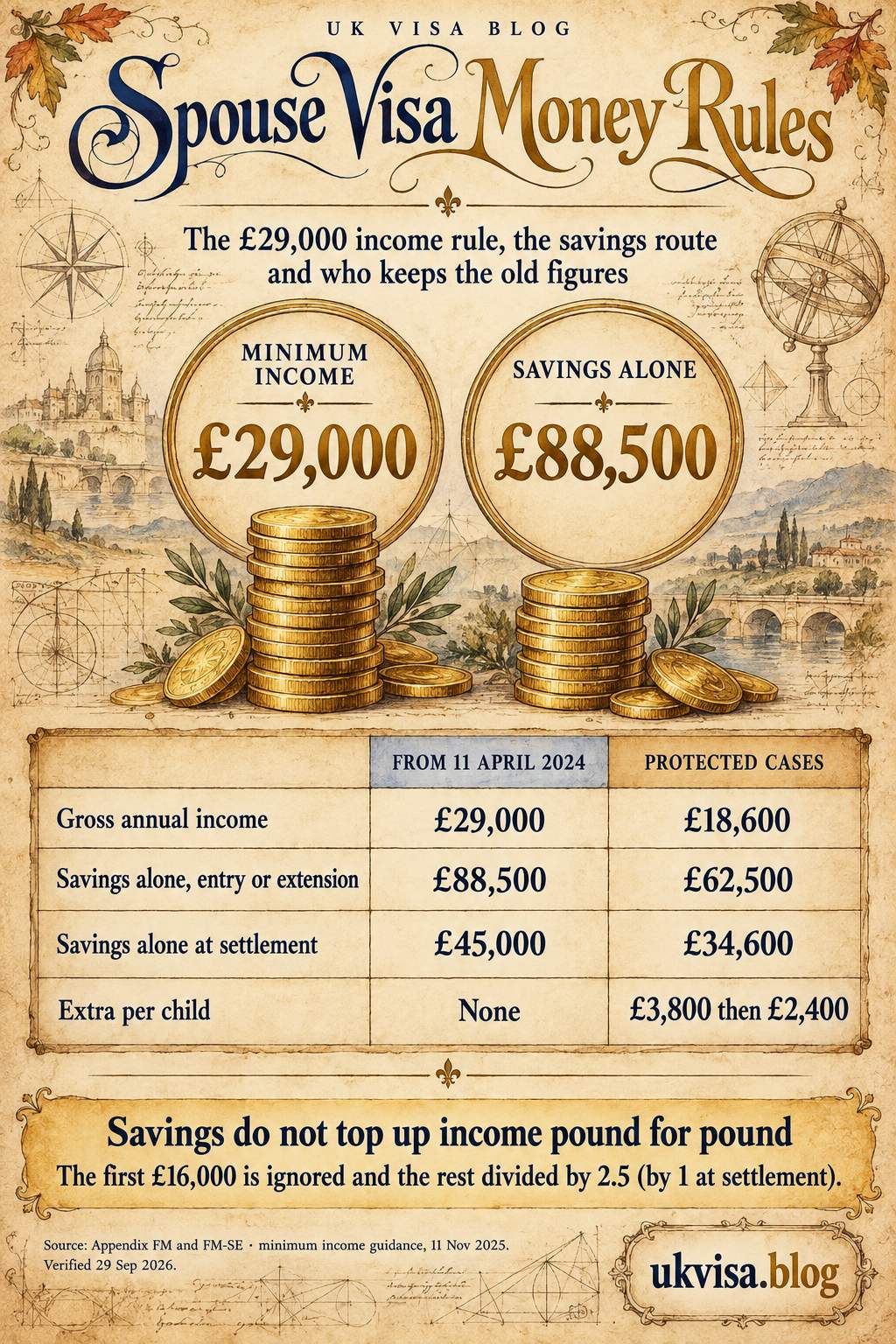
The minimum income requirement is £29,000 gross a year, in force since 11 April 2024 and unchanged for 2026. Savings alone must reach £88,500 at entry clearance and extension, held for six unbroken months. The announced rises to £34,500 and £38,700 were paused after the Migration Advisory Committee reported in June 2025. Children add nothing to the £29,000 figure.
The requirement exists so that couples can support themselves without means-tested public funds. It applies to spouse, unmarried partner and fiancé(e) applications alike, and it is set out in Appendix FM with the evidence rules in Appendix FM-SE. For relationship, English and accommodation, see our UK Spouse visa requirements pillar.
Which Threshold Applies to You
| Application | Income threshold | Savings alone |
|---|---|---|
| First applied before 11 April 2024, same partner | £18,600 | £62,500 |
| Applied on or after 11 April 2024 | £29,000 | £88,500 |
| Sponsor on a qualifying disability or carer benefit | Adequate maintenance | Not applicable |
Source: Appendix FM; Home Office minimum income guidance version 13.0, 11 November 2025.
Is the £29,000 Gross or Net?
Gross — the figure before income tax, National Insurance and pension contributions. If the contract says £29,000, the threshold is met whatever the take-home pay. The Home Office works in gross figures across every income category, and a sponsor who quotes net pay on the form creates a discrepancy that has to be explained.
Transitional Protection and Its Ceiling
Anyone whose first partner application predates 11 April 2024 keeps £18,600 for later applications with the same partner, provided there is no break in permission. The Home Office minimum income guidance adds £3,800 for a first child and £2,400 for each further child — then caps the total at £29,000.
Those child amounts belong to transitional cases only. On the current threshold the figure is a flat £29,000 however many children are included, so a protected sponsor with three children and an unprotected sponsor with none face the same number.
Future Increases Remain Paused
The previous government announced rises to £34,500 and then £38,700, aligning the family route with Skilled Worker salaries. The Migration Advisory Committee was asked to review and reported in June 2025. It declined to name a single figure, set out a range and rejected the idea that family migration should track work-route thresholds. Nothing has been implemented since.
The Savings Formula and the 2.5 Multiplier
Savings do not plug a shortfall pound for pound. The first £16,000 is disregarded entirely, and what remains is divided by 2.5 to convert it into an annual income equivalent. Working backwards, the savings you need are £16,000 plus two and a half times the gap.
- No income at all: gap £29,000 — savings needed £16,000 + £72,500 = £88,500.
- Sponsor earns £24,000: gap £5,000 — savings needed £16,000 + £12,500 = £28,500.
- Sponsor earns £20,000: gap £9,000 — savings needed £16,000 + £22,500 = £38,500.
- Sponsor earns £27,000: gap £2,000 — savings needed £16,000 + £5,000 = £21,000.
- Transitional £18,600, no income: savings needed £16,000 + £46,500 = £62,500.
Why 2.5
The multiplier is not arbitrary. It reflects the 30-month grant of permission that follows the application, so the savings have to cover two and a half years of the income the rules assume a couple needs. The £16,000 floor sits underneath as a buffer the Home Office does not count at all.
Savings Go Much Further at Settlement
This is the point most guides miss. At the settlement stage there is no further grant of limited permission to fund, so the guidance directs that the whole of the amount above £16,000 is added to income rather than divided by 2.5. Savings alone at settlement therefore need to reach £45,000, not £88,500.
That halves the barrier at the final stage for couples relying on capital rather than salary. It also means a family who cannot reach £88,500 for the extension may still clear the requirement at Spouse visa ILR on the same money. Plan the five years around it.
What Counts as Cash Savings
Money must be in the name of the applicant, the sponsor, or both jointly. Funds in a third party’s name never count, however firmly they are promised. Accounts must be with a regulated institution and the money withdrawable on demand, so notice accounts and locked-in products fail.
Proceeds from selling a property or an investment can be used where the asset belonged to the applicant or sponsor and the sale is fully evidenced through to the money arriving. Gifts and inheritance are permitted, with the source declared. Borrowed money is excluded, and cryptocurrency only counts once converted to sterling in a qualifying account.
The required amount has to be held for six unbroken months. A single day below the figure — a car bought and refunded, money briefly moved between accounts — breaks the period and the six months start again. Check every day of every statement before you apply, not just the opening and closing balances.
Acceptable Income Sources: Categories A to G
Appendix FM-SE sorts income into seven lettered categories. Each carries its own qualifying period and its own list of documents, and only those documents will do. Most applications sit in Category A or D; the trouble starts when income comes from more than one place.
The Seven Income Categories
| Category | Qualifying period | Core evidence |
|---|---|---|
| A — salaried, same employer six months or more | 6 months | Payslips, matching bank statements, employer letter |
| B — salaried under six months, or variable pay | 12 months | Current annualised salary plus 12 months of gross income |
| C — non-employment income | 12 months | Tenancy or dividend documents plus bank statements |
| D — cash savings | 6 months unbroken | £88,500 and six months of statements |
| E — pension | In payment 28 days | Pension statement and bank credits |
| F — self-employment, last full financial year | 1 year | SA302, tax return, accounts, accountant’s letter |
| G — self-employment, average of two years | 2 years | Two years of the same evidence |
Source: Appendix FM-SE; Home Office minimum income guidance version 13.0.
Which Combinations Are Allowed
Savings combine with salaried income, non-employment income and pension. They do not combine with self-employment. A self-employed sponsor must reach the threshold from Category F or G alone, or by adding salaried, pension or non-employment income — never by topping up with capital in the bank.
Whose income counts also shifts with the stage. On an entry clearance application only the sponsor’s income is admissible, however much the applicant earns abroad. On an in-country application the applicant’s UK earnings count too, provided they hold permission to work — the main reason the UK Spouse visa extension is easier to fund than the first application.
Self-Employment: Gross Taxable Profit, Not Net
Categories F and G run on gross taxable profit before deductions, not the net profit that appears at the bottom of a set of accounts. Using the wrong line is a routine cause of refusal, and the margin matters — a sponsor scraping past £29,000 on paper has nothing to absorb a caseworker reading the figures differently.
The evidence list is long: SA302, the full tax return, business accounts, an accountant’s letter on headed paper, business and personal bank statements, and a VAT certificate where turnover exceeds £90,000. Directors of limited companies drawing salary and dividends use the same categories for company income.
Exemptions from the Financial Requirement
Sponsors receiving certain disability and carer benefits are exempt from the threshold altogether. The exemption attaches to the benefit, not to the level of income, so a sponsor earning nothing at all can still qualify. Adequate maintenance replaces the £29,000 test.
- Disability payments: Disability Living Allowance, Personal Independence Payment, Adult Disability Payment in Scotland, Attendance Allowance, Severe Disablement Allowance.
- Carer payments: Carer’s Allowance and Carer Support Payment in Scotland.
- Injury and service awards: Industrial Injuries Disablement Benefit, Armed Forces Independence Payment, Guaranteed Income Payment, Constant Attendance Allowance, Mobility Supplement, war disablement pension, police injury pension.
The Adequate Maintenance Test
Adequate maintenance asks a different question: after housing costs and council tax, does the household have at least the weekly equivalent of Income Support for a couple, plus the rate for each child. Benefits, savings and earnings all count towards it, which is why it is usually a much lower bar than £29,000.
It is not, however, an absence of a test. You still have to build the budget, evidence every award letter and show the accommodation is adequate. Exempt applications are refused for thin arithmetic as readily as ordinary ones are refused for thin payslips.
Bank Statement Requirements
Bank statements do more work than any other document in the file, because they are what corroborates everything else. They have to cover the full qualifying period, show the salary landing in the amounts the payslips claim, and be recent. Our UK Spouse visa document checklist sets the rest of the bundle out.
- Identity: the account holder’s name as it appears on the application, with account number and sort code, or IBAN for a foreign account.
- Provenance: the bank’s name and logo on every page, and every page present.
- Currency: dated no earlier than 28 days before the date of application.
- Coverage: six unbroken months for Categories A and D, twelve for B and C, with no gaps.
- Corroboration: salary deposits that match the payslips in amount and date, with the payer identifiable.
- Balances: opening and closing balances visible, and for savings the required sum held throughout.
Electronic and Self-Printed Statements
Digital statements are accepted where they carry the bank’s logo, your name, the account details and the full transaction history. Where a bank issues nothing else, ask for a covering letter on letterhead confirming the statements are genuine. Foreign currency accounts need conversion at the OANDA rate for the date of application, shown as a separate calculation.
The Mistakes That Cost Applications
Three months of payslips supplied where six are required. Statements that stop more than 28 days before the application. Payslip and statement figures that differ because of an expense reimbursement. Overtime counted that does not recur across the whole period. A savings balance that dips once. Pages missing from a multi-page statement.
None of these is dishonesty and none is a shortfall. Each simply leaves a caseworker unable to reconcile the figures from the papers alone, and a caseworker who cannot reconcile them refuses. If it fails anyway, our guides to UK Spouse visa refusal reasons and how to appeal the refusal set out what follows.
If You Cannot Meet the Requirement
Waiting is often the cheapest answer — six months in a better-paid job, or six months of building the savings figure. Where that is impossible, the 10-year family route exists for applicants who can show refusal would be unjustifiably harsh, and the exemption route opens if the sponsor’s health changes. The same threshold applies on the UK Fiancé visa, and a query about the money can pull a case into a UK Spouse visa interview.
Sources: the partner financial requirement pages on GOV.UK; Appendix FM of the Immigration Rules and Appendix FM-SE; and Home Office guidance on the minimum income requirement, version 13.0 of 11 November 2025. Lifetime costs across the route sit in our complete Home Office fees guide. Figures verified 22 August 2026.
Frequently Asked
Questions about Spouse Visa Financial Requirements
£29,000 gross annual income, applying to every application made on or after 11 April 2024. Sponsors whose first partner application predates that date keep £18,600 for later applications with the same partner, provided permission has been continuous. The threshold is unchanged for 2026; the announced rises to £34,500 and £38,700 were paused after the Migration Advisory Committee reported in June 2025.
Before tax. The figure is gross annual income, ahead of income tax, National Insurance and pension contributions. A contract showing £29,000 meets the threshold whatever the take-home pay. The Home Office uses gross figures consistently across all seven income categories in Appendix FM-SE, so quote the gross salary on the form and let the payslips corroborate it.
Required savings are £16,000 plus two and a half times the income shortfall. Savings alone against £29,000 therefore mean £88,500. The first £16,000 is disregarded and the remainder is divided by 2.5 to reflect the 30-month grant that follows. The money must sit in an accessible account in the applicant’s or sponsor’s name for six unbroken months.
No. At settlement there is no further period of limited permission to fund, so the whole amount above £16,000 counts as income rather than being divided by 2.5. Savings alone need to reach £45,000 against a £29,000 requirement — roughly half what the earlier stages demand. Couples relying on capital should plan the five years with that drop in mind.
Yes. Sponsors receiving Personal Independence Payment, Disability Living Allowance, Attendance Allowance, Carer’s Allowance, Armed Forces Independence Payment, a war disablement pension or several related awards are exempt from the threshold entirely. Adequate maintenance applies instead: household income after housing costs and council tax must reach the Income Support equivalent for the family. It is a lower bar, not an absent one.
Savings combine with salaried income, non-employment income and pension, but never with self-employment under Category F or G. Work out the gap between annual income and £29,000, then apply the formula. A sponsor on £24,000 has a £5,000 gap and needs £28,500 in savings. Self-employed sponsors must reach the threshold without capital in the bank.
Six consecutive months for Category A salaried employment and for Category D cash savings; twelve months for Category B and Category C. Every statement must carry your name, account details and the bank’s logo on each page, show all transactions unredacted, and be dated no earlier than 28 days before the date of application.
Yes, for anyone whose first spouse, partner or fiancé(e) application predates 11 April 2024 and who continues applying with the same partner without a break in permission. Savings alone under that threshold are £62,500. Child amounts of £3,800 and £2,400 apply within transitional cases, capped at £29,000 in total. Any break in leave moves you onto the current threshold.
Only from inside the UK. On an entry clearance application the sponsor’s income alone is admissible, and overseas earnings count for nothing. On an extension or a switch the applicant’s UK employment income can be added, provided they hold permission to work. Two modest salaries frequently clear £29,000 where a single one did not.