
The UK Spouse Visa lets the husband, wife or civil partner of a British or settled person live, work and study in the UK. It costs £2,064 from abroad, needs a sponsor earning £29,000 or savings of £88,500, and leads to settlement in five years. Most refusals turn on paperwork, not on whether the marriage is real.

UK Family Visas
Understanding UK Spouse Visa Requirements and Guidance 2026
What Are the UK Spouse Visa Requirements?
You must be married to or in a civil partnership with a British, Irish or settled person, both be 18 or over, and show the relationship is genuine and subsisting. Your sponsor must earn £29,000 a year or hold £88,500 in cash savings. You need English at A1, and accommodation that is not overcrowded. Entry clearance costs £2,064 and is granted for 33 months.
The rules sit in Appendix FM of the Immigration Rules, and both sides of the couple have to satisfy them. Marriage to a British citizen confers no right of entry on its own. The visa is a permission you apply and pay for, and it can be refused.
Six requirements have to be met together. Failing any one of them is fatal to the application, however strong the rest of the file looks:
- Relationship: legally married or in a civil partnership recognised under UK law, and living together permanently or intending to.
- Sponsor status: British or Irish citizen, indefinite leave to remain, EU settled status, or refugee and humanitarian protection status.
- Financial: £29,000 gross annual income, £88,500 in cash savings, or a permitted combination of the two.
- English: A1 speaking and listening for the first application, rising to A2 at extension and B1 at settlement.
- Accommodation: somewhere adequate and not statutorily overcrowded under the Housing Act 1985.
- Age: both applicant and sponsor 18 or over on the date of application.
Relationship Requirement
Your relationship with your UK-based partner must be genuine and subsisting. Married couples prove it with the certificate plus evidence of a shared life. Unmarried partners need two years in a relationship akin to marriage before applying. If you are engaged but not yet married, the UK Fiancé visa route comes first.
How Caseworkers Weigh Your Evidence
The relationship caseworker guidance (version 7.0) sorts evidence into three tiers. Strong evidence is official and verifiable — a joint tenancy, a mortgage, council tax. Acceptable evidence is third-party but unverified, such as separate utility bills at the same address. Weak evidence is photographs, letters from friends and personal statements.
Enough strong evidence settles the question on its own. Weak evidence never does, whatever its volume. The guidance also tells caseworkers not to demand several documents covering the same period, so a thick file of duplicates adds nothing. Build for range across the relationship, not depth in one month.
English Language Requirement
The A1 English test for spouse visa applications is met by an approved Secure English Language Test, a degree taught in English, or nationality of a majority English-speaking country. The level rises with each stage: A1 first, A2 at extension, B1 at settlement alongside the Life in the UK test.
Accommodation Requirement
You need adequate accommodation that you own, rent or occupy with permission, and that will not be statutorily overcrowded once you move in. Rented property needs the landlord’s consent. Rooms in a family home usually need an independent housing inspection report to prove the space works.
How to Apply for a UK Spouse Visa
Applications are made online through the family visa pages on GOV.UK, followed by biometrics and document upload. Which form you use, what you pay and how long you are granted all turn on whether you are outside the UK or already in it. See the UK Spouse visa documents guide for the evidential standard each document has to meet.
Entry Clearance vs Leave to Remain
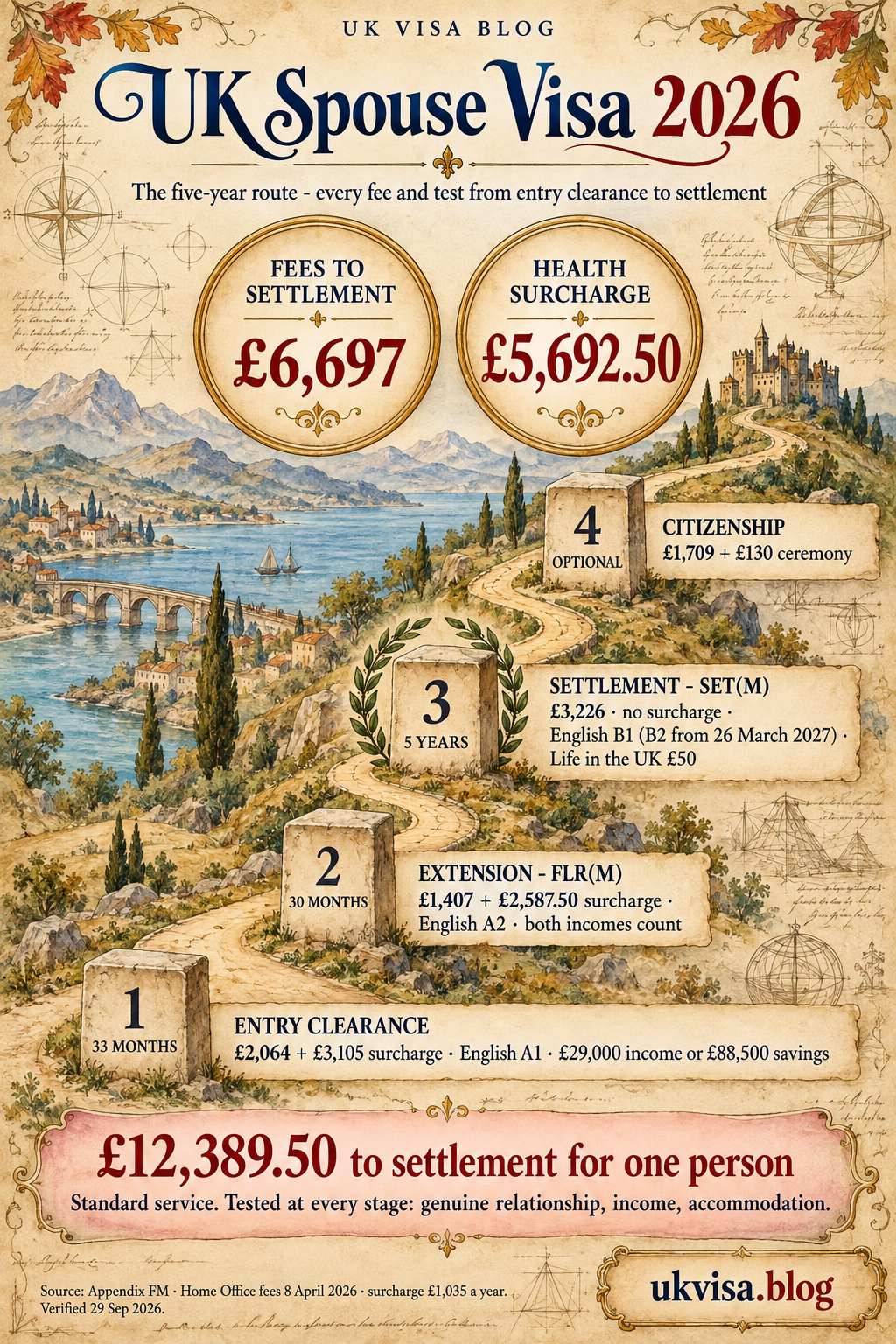
Entry clearance is for applicants abroad. The fee is £2,064 and the grant is 33 months. Leave to remain is for people already in the UK on a visa granted for more than six months who want to switch. That fee is £1,407 and the grant is 30 months. Visitors cannot normally switch from inside the UK.
UK Spouse Visa Fees from 8 April 2026
| Charge | Amount | Notes |
|---|---|---|
| Entry clearance (outside the UK) | £2,064 | Was £1,938 |
| Leave to remain (inside the UK) | £1,407 | Was £1,321 |
| FLR(M) extension | £1,407 | Same as in-country initial |
| SET(M) settlement | £3,226 | Was £3,029 |
| Immigration Health Surcharge | £1,035 a year | £776 a year for a child |
| Priority service | £500 | Faster decision where offered |
| Super priority service | £1,000 | In-country, not on the adult dependent relative route |
Source: Home Office immigration and nationality fees, 8 April 2026.
The surcharge is paid upfront for the whole grant and rounded in half-year blocks, so a 33-month grant is charged as three years and a 30-month grant as two and a half. Full rates for dependants and every other line sit in our Home Office fees guide.
Total Home Office Cost of the Five-Year Route
| Stage | Fee | Surcharge |
|---|---|---|
| Entry clearance, 33 months | £2,064 | £3,105 |
| FLR(M) extension, 30 months | £1,407 | £2,587.50 |
| SET(M) settlement | £3,226 | Not payable |
| Total to settlement | £6,697 | £5,692.50 |
Source: 8 April 2026 fee table; surcharge at £1,035 a year.
That is £12,389.50 for one adult applicant reaching settlement, before English tests, the Life in the UK test at £50, translations or advice. Children carry their own fee and their own surcharge at the lower rate.
Processing Times
Entry clearance decisions usually take around 12 weeks from biometrics; in-country applications around eight. Priority targets five working days and super priority the next working day, where either is offered. Self-employment, combined income categories and requests for further information all push cases past the standard processing time.
Citizenship Comes Sooner for Spouses Than People Expect
Most settled migrants must hold indefinite leave for 12 months before naturalising. Spouses of British citizens do not. The citizenship-by-marriage page on GOV.UK requires three years’ residence and settled status at the date of application, with no minimum holding period. If your sponsor is British, you can apply the moment settlement is granted.
The Spouse Visa Financial Requirement Explained
The spouse visa financial threshold is £29,000 gross a year, in force since 11 April 2024. The Migration Advisory Committee reported in June 2025 and the figure was left alone; the announced rises to £34,500 and £38,700 were paused and have not taken effect. It remains £29,000 for all new applications in 2026.
How to Meet the £29,000 Requirement
Income is proved through the lettered categories in Appendix FM-SE, and each one dictates exactly which documents will do. Salaried sponsors in the same job for six months use Category A. Everyone else falls into a category with a longer evidential list and a longer look-back period.
Income Categories and What They Require
| Category | Covers | Core evidence |
|---|---|---|
| A | Six months or more with the same employer | Six months of payslips, matching bank statements, employer letter |
| B | Under six months, or variable pay | 12 months of payslips plus current annualised salary |
| C | Non-employment income | Rent, dividends and investment income over 12 months |
| D | Cash savings | £88,500 held six months in an accessible account |
| E | Pension | Pension statements and bank credits |
| F | Self-employment, last full financial year | SA302, tax return, accounts, accountant’s letter |
| G | Self-employment, average of two years | Two years of the same evidence |
Source: Appendix FM-SE; Home Office minimum income guidance version 13.0.
The Savings Formula
Savings do not fill a shortfall pound for pound. Take the gap, multiply it by 2.5, then add £16,000. A sponsor on £24,000 is £5,000 short, so needs £16,000 plus £12,500 — £28,500, held for six consecutive months and immediately accessible. Savings cannot be combined with self-employed income under Category F or G.
Transitional Protection and the Cap Nobody Mentions
Anyone whose first partner application predates 11 April 2024 stays on £18,600 for later applications with the same partner. The Home Office minimum income guidance (version 13.0, 11 November 2025) adds child amounts of £3,800 for the first child and £2,400 for each further child — but caps the total at £29,000.
Those child amounts belong to the transitional threshold alone. Applications made on or after 11 April 2024 face a flat £29,000 no matter how many children are included, which is why a large family on the new threshold can be better off than a small one on the old.
Adequate Maintenance — the Benefit Exemption
Sponsors receiving Carer’s Allowance, Personal Independence Payment, Disability Living Allowance, Attendance Allowance, Armed Forces Independence Payment or a war disablement pension are exempt from the threshold entirely. The adequate maintenance test replaces it: household income after housing costs and council tax must leave the family above Income Support levels.
Five-Year Route vs Ten-Year Route
Meeting every requirement in Appendix FM puts you on the five-year route. Applicants granted permission on Article 8 grounds because they cannot meet one of them go onto the 10-year family route instead — the same family life, twice the wait and twice the fees.
Comparing the Two Routes to Settlement
| Feature | Five-year route | Ten-year route |
|---|---|---|
| Grants of permission | Two (33 then 30 months) | Four (30 months each) |
| Financial requirement | £29,000, or transitional £18,600 | Exceptions possible on Article 8 grounds |
| Time to settlement | Five years | Ten years |
| Applications to settlement | Three | Five |
Source: Appendix FM and Appendix Settlement Family Life.
You can move onto the five-year route once you satisfy every standard requirement, but the clock restarts. Time already served on the ten-year route does not count towards the five-year qualifying period, so the switch only pays off early in the journey.
Extension and Settlement
After the first grant expires you apply on form FLR(M) to extend for a further 30 months. You must still meet the financial requirement, show the relationship continues and pass A2 English. Our spouse visa extension guide covers the timing and the evidence in full, and the FLR(M) form guide covers the form itself.
What Changes at the Extension Stage
One thing gets easier. From inside the UK the applicant’s own earnings count towards the threshold alongside the sponsor’s, which is not permitted on an entry clearance application from abroad. Two modest salaries frequently clear £29,000 where one did not.
One thing gets harder, and it is a matter of dates rather than money:
An application made while your current permission is still valid extends that permission automatically under section 3C until a decision is made. Let it lapse first and you are an overstayer — exposed to removal, to re-entry bans, and to a suitability problem in every future application. You can apply at any time before it expires — there is no earliest date; the 28-day rule simply caps how much unused permission carries over to the new grant.
From Spouse Visa to Settlement
Five years on the partner route qualifies you for UK settlement on form SET(M). You need B1 English, the Life in the UK citizenship test and continuing eligibility under Appendix FM. Our UK Spouse visa ILR guide walks the stage through, and the SET(M) form guide covers the application itself.
The settlement caseworker guidance (version 4.0, 29 July 2025) records a useful discretion: where an applicant falls short, a caseworker may vary the settlement application into one for further leave rather than refuse it outright, granting another 30 months to put things right.
Absences on the Partner Route
The partner route carries no 180-day absence cap of the kind that governs work visas. The continuous UK residence rule still bites in a different way: long or frequent absences invite the question whether the UK is really your home and whether the relationship is genuine and subsisting. Keep time abroad explicable and documented.
Common Refusal Reasons — and What Follows
Refusals cluster in a small number of places, and almost all of them are evidential rather than substantive. Applicants who comfortably meet the rules are refused because the documents cannot prove it in the specified form. Our guide to why spouse visas are refused takes each in turn.
- Relationship evidence: thin, one-sided, or all from the same short period.
- Financial evidence: the right income proved with the wrong documents, or categories combined in a way the rules do not allow.
- Savings history: funds held under six months, or a large unexplained deposit shortly before applying.
- Self-employment: net profit used instead of gross taxable profit, or the wrong financial year.
- English test: expired certificate, wrong level, or a provider that is not approved.
- Accommodation: a property that would be overcrowded once the family moves in.
- Immigration history: earlier overstaying, refusals or deception, undeclared.
What a Refusal Actually Gives You
A partner application under Appendix FM is a human rights claim, so refusing it is a refusal of a human rights claim — one of the three decisions carrying a statutory right of appeal to the First-tier Tribunal under section 82 of the Nationality, Immigration and Asylum Act 2002. That right exists whether you applied from inside or outside the UK.
The choice is between appealing and reapplying. Appeal where the caseworker misapplied the rules to documents you actually sent. Reapply where the file was incomplete, because a tribunal cannot cure evidence you never provided. Our spouse visa appeal process guide sets out grounds, timing and cost.
If You Are Called for Interview
Interviews are the exception, not the rule, and are triggered by inconsistency rather than suspicion of the marriage itself. Both partners may be questioned separately and the answers compared. Our UK Spouse visa interview guide covers the ground that is actually tested.
Sources: the family visa pages and the fee table on GOV.UK; Appendix FM and Appendix FM-SE of the Immigration Rules; Home Office guidance on the minimum income requirement, version 13.0 of 11 November 2025; relationship with a partner, version 7.0; and settlement — family and private life, version 4.0 of 29 July 2025. Right-to-work checks are made against your eVisa via your UKVI online account. Figures verified 22 August 2026.
Frequently Asked
Questions about the UK Spouse Visa
£29,000 gross a year, unchanged since 11 April 2024. The Migration Advisory Committee reported in June 2025 and the threshold stayed put; the announced rises to £34,500 and £38,700 were paused. If income alone falls short you can use £88,500 in cash savings, or combine the two. Anyone whose first partner application predates 11 April 2024 keeps the £18,600 threshold for later applications with the same partner.
From 8 April 2026 the fee is £2,064 from outside the UK and £1,407 from inside it. The Immigration Health Surcharge adds £1,035 a year for an adult and £776 for a child, paid upfront for the whole grant — £3,105 for a 33-month entry clearance grant. Priority costs £500 and super priority £1,000 where offered. Settlement later costs £3,226.
Not on applications made on or after 11 April 2024. The threshold is a flat £29,000 however many children are included. The child amounts of £3,800 for a first child and £2,400 for each further child apply only under the transitional £18,600 threshold, and even then the total is capped at £29,000.
About 12 weeks from biometrics for entry clearance and about eight weeks in-country. Priority targets five working days and super priority the next working day where either service is available. Self-employed sponsors, combined income categories and any request for further documents routinely take longer than the published service standard.
Yes, without restriction. You can take any job, be self-employed, run a business and study. Employers check the right to work against your eVisa in your UKVI account rather than a biometric residence permit. You cannot claim public funds such as Universal Credit, Housing Benefit or tax credits while the no-recourse condition applies.
Apply on form FLR(M) at any time before your current permission expires — there is no earliest date, though only up to 28 days of unused permission carries over to the new grant. The fee is £1,407 plus £2,587.50 of surcharge for the 30-month grant. You must still meet the financial requirement, show the relationship continues and pass A2 English. From inside the UK your own earnings count towards the threshold alongside your sponsor’s.
The five-year route is for applicants who meet every requirement in Appendix FM, and takes two grants of permission before settlement. The ten-year route is for people granted permission on Article 8 grounds when they cannot meet one of them, and takes four. You can move to the five-year route once you qualify, but the five-year clock starts afresh.
Yes. A partner application under Appendix FM is a human rights claim, and refusing a human rights claim carries a right of appeal to the First-tier Tribunal under section 82 of the Nationality, Immigration and Asylum Act 2002. That applies to entry clearance refusals as well as in-country ones. Whether appealing beats reapplying depends on why the case failed.
If your sponsor is a British citizen, as soon as you hold settlement — there is no 12-month waiting period for spouses, unlike other routes. You need three years’ residence in the UK before the date of application and must meet the good character and residence rules. Naturalisation costs £1,709 plus a £130 ceremony fee.