
Most of the UK visit application form is mechanical. Four or five free-text fields do the real work, and they are where applications are lost — the purpose of the visit, what you plan to spend, who is helping to pay, and your previous immigration history. This page covers what those questions are actually testing.

Application Form
Filling In the UK Visit Visa Application Form in 2026
What the Form Is Actually For
The form is the caseworker’s primary evidence. Your documents corroborate it; they do not replace it. The burden of proof sits on you to show you meet the rules, and the standard applied is the balance of probabilities — more likely than not. A vague answer is not neutral, it is an unmet burden.
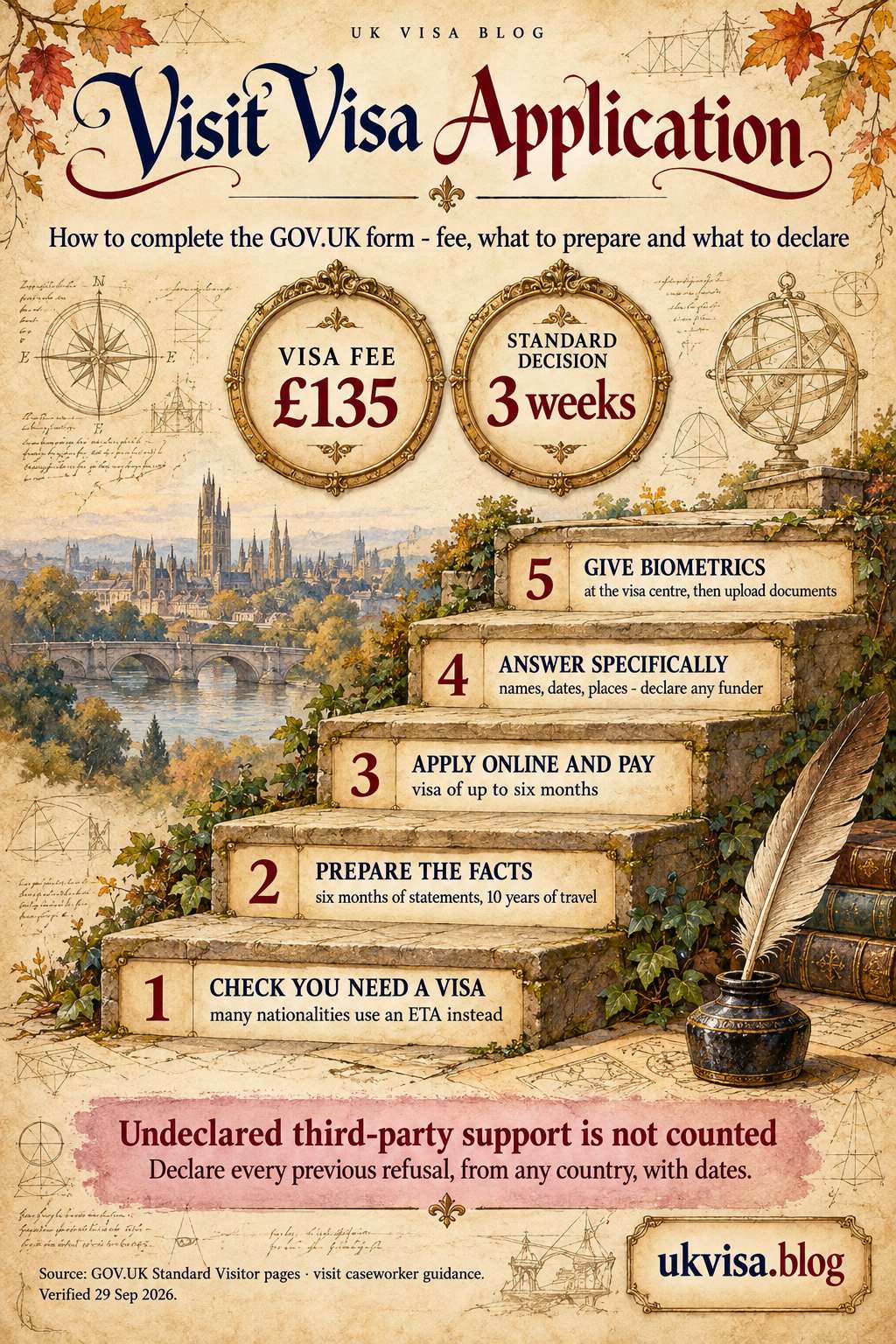
Apply online through the GOV.UK visit route, pay £135 for a visa of up to six months from 8 April 2026, then book biometrics at a visa application centre. Answer the free-text fields specifically and consistently with your documents. Declare any third-party funding — undeclared support is excluded from the assessment entirely.
Before You Open the Form
- Passport: number, issue and expiry dates, and your travel history for the last ten years.
- Financial documents: six months of statements, so your figures match rather than approximate.
- Employment details: employer name, address, your start date and salary.
- Previous applications: every UK application, including refusals, and applications to other countries.
- Sponsor details: full name, address, status and relationship, where someone is helping.
The application starts on the GOV UK apply page. Check first whether you need a visa at all: many nationalities now travel on an Electronic Travel Authorisation instead, which costs £20 and is a different process.
The Purpose of Your Visit
Guidance requires that you can explain your main reason for coming at three separate points: when you apply, when you arrive, and if you later apply to extend. The same answer must hold up each time. You may do several permitted activities on one trip, but there should be a main one you can state plainly.
What a Weak Answer Looks Like
“Tourism” on its own tells the caseworker nothing. “To visit my sister” without naming her, the dates or where she lives is barely better. The answer should carry names, dates, places and a reason those dates exist — a graduation, a wedding, a school holiday, a conference. Specificity is what a caseworker can check.
Keep It Inside the Permitted Activities
Describe only things a visitor may do. Attending meetings, negotiating, sightseeing, visiting family, a short course, an academic exchange — all permitted. Working for a UK employer, providing services to clients here, or doing unpaid work for a business are not. Our page on what visitors may and may not do lists the boundaries.
The Money Questions
There is no set level of funds. A caseworker looks at your income and savings, subtracts your ongoing commitments at home — rent or mortgage, and anyone you support financially — and asks whether what remains covers the likely cost of the trip and is reasonable in light of your circumstances.
Realistic Spending Figures to Quote
| Trip length | Staying with family | Hotel or rented |
|---|---|---|
| 1 week | £300 to £500 | £900 to £1,400 |
| 2 weeks | £500 to £900 | £1,700 to £2,600 |
| 1 month | £900 to £1,600 | £3,200 to £5,000 |
| 3 months | £2,400 to £4,000 | £8,500 and upwards |
Indicative living costs only; the Home Office sets no minimum for visitors. Checked 22 August 2026.
Quote a figure you can fund and would plausibly spend. Naming £5,000 for a fortnight with relatives invites the question of where the money came from. Naming £200 for a month in London reads as someone who intends to work. The monthly outgoings question is the counterpart: it is testing whether the trip is affordable alongside your existing commitments.
Where statements show sufficient funds but the money has not been held for long, guidance permits further checks into where it came from. Funds must also sit in a financial institution permitted under Appendix Finance. A lump sum arriving days before the application, with no declared source, is a common refusal trigger.
The Questions That Catch People Out
Is Anyone Paying Towards Your Visit?
Answer yes if anyone is contributing anything — flights, accommodation, spending money. Support that is not declared, where you cannot then show the money in your account is genuinely yours, is excluded from the assessment altogether. The person supporting you must be lawfully in the UK; support from someone in breach of immigration law is disregarded in full.
Why Are They Helping to Pay?
State the relationship and the reason in one sentence: a parent funding a graduation trip, an employer funding a conference, a sibling funding a family visit. The caseworker is assessing whether the relationship is genuine and whether the supporter can afford it while supporting their own household. They may check how you met and how often you are in contact.
Previous Applications
Declare every one, including refusals from any country, and give the dates and reference numbers where you have them. Refusals are recoverable; concealment is not. Where a previous application by you, your sponsor or an immediate family member involved deception, that is a named reason for doubting the whole application. Our page on applying again after a refusal covers how to frame the history.
The Final Free-Text Field
Use it when there is something a caseworker would otherwise misread — a gap in employment, an unusual deposit, a previous refusal, a name difference across documents, or a stay abroad that looks like residence. Do not use it to restate the form. Two or three short paragraphs answering the obvious questions is the right length.
Sample Answers
These are structures rather than text to copy. Swap in your own facts, and make sure every figure and date matches your documents and any invitation letter exactly.
Main purpose of visit:
I am visiting my [relationship], [name], who lives at [town]. I will arrive on [date] and return on [date] to resume my work as [role] at [employer]. The visit is timed around [specific event or reason]. During the trip I plan to [two or three specific activities].
Who is paying:
My [relationship], [name], will pay for my accommodation and living costs while I am in the UK, estimated at [amount]. I am funding my own return flight and personal spending from my savings. [Name] is a [British citizen / holder of leave valid until date] and has provided a letter, payslips and bank statements with this application.
Additional information:
My account shows a deposit of [amount] on [date]. This was [the sale of my vehicle / an annual bonus from my employer / a gift from my parents], and I have enclosed [document] confirming it.
My previous application on [date] was refused because [reason given]. Since then [what has changed], evidenced by [document].
I remain employed at [employer] and have [number] years of service. My [property / dependants / caring responsibilities] remain in [country] and I will return on [date].
Working Through the Sections
- Travel information: dates, purpose and how long you intend to stay — the credibility anchor for everything else.
- Personal and passport: exact match with the passport, including transliterated spellings and any former names.
- Family details: where your close relatives live. Several in the UK and few at home is a recognised doubt factor.
- Employment and income: the tie that pulls you home, and the source of your funds.
- Accommodation: the full UK address you will stay at, matching your host’s letter.
- Travel history: ten years of travel to the UK and other countries, plus any refusals or removals.
- Other history: convictions, immigration breaches, and the war crimes and extremism declarations.
- Declaration: confirming the information is true. Sign it only once every figure matches your documents.
Two sections repay extra care. Travel history is cross-checked against Home Office records, so an omitted refusal surfaces. And the accommodation address must match what your host has written, because discrepancies between what an applicant says and what a sponsor says are named in guidance as a reason to doubt a visit.
No English Language Test for Visitors
Visitors are not subject to an English language requirement, and no test certificate is needed for a standard visit. That is a feature of work, study and family routes, set out on our page covering English requirements by route. Interviews, where they happen, are conducted through an interpreter if required.
After You Submit
You book and attend a biometrics appointment at a visa application centre, uploading documents before or at the appointment. Send what supports the application — see our supporting documents guide and the GOV UK document guide. Hotel bookings, flight bookings, photographs and travel insurance are listed there as less useful evidence.
Timing and Priority
Standard visit decisions target around three weeks from biometrics. Priority costs £500 for a five working day target; super priority £1,000 for the next working day. See our pages on priority services, what happens after biometrics and chasing a delayed decision. Full costs sit on our visitor fee page.
If the Answer Is No
Visit refusals carry no general right of appeal. Administrative review is not available for visit visas either, so the realistic route is a fresh application answering the refusal notice point by point. Our pages on reading the refusal letter, the common grounds and success rates set out what usually changes an outcome.
Sources: the GOV UK standard visitor pages, the Home Office visit caseworker guidance version 17.0 published 25 February 2026, and the GOV UK guide to supporting documents updated 25 February 2026. Figures verified 22 August 2026.
Frequently Asked
Application Form Questions
How much money should I say I plan to spend?
A figure you can evidence and would plausibly spend on the trip you describe. There is no minimum. Your income and savings, less your commitments at home, must cover it.
What should I write for the purpose of my visit?
Name the main reason with specifics: who you are visiting, where, on what dates, and why those dates. You may list other permitted activities, but there should be one main purpose you can repeat consistently at the border.
Do I have to declare that my brother is paying for my flight?
Yes. Any third-party contribution must be declared. Undeclared support that you cannot show is genuinely your own money is excluded from the assessment entirely.
Should I declare a refusal from another country?
Yes. The question asks about applications to any country. A declared refusal you can explain is far less damaging than an undeclared one that surfaces later.
Do I need to book flights before applying?
No, and you should not. Flight and hotel bookings are listed by GOV.UK among documents that are less useful as evidence. Describe your intended dates on the form instead.
Is there an English test for a visit visa?
No. Visitors face no English language requirement. That applies to work, study and family routes.
Can I edit the form after submitting?
No. Once submitted and paid, corrections have to be made by contacting the visa application centre or explaining in a covering document at your appointment. Check every figure before you sign the declaration.
How long does the form take to complete?
Around an hour of typing, but the preparation matters more. Assemble your statements, employment details and travel history first so the answers match the evidence rather than your memory.
What if I make an honest mistake on a date?
Correct it at the earliest opportunity and explain it in the additional information field or a covering note. A minor inconsistency explained is ordinary; the same inconsistency left unexplained is treated as a credibility point.
Can I apply for a longer visa on the same form?
Yes. The same application lets you select two, five or ten years. Fees are £506, £903 and £1,128 respectively — see our comparison of the long-term visit options.