
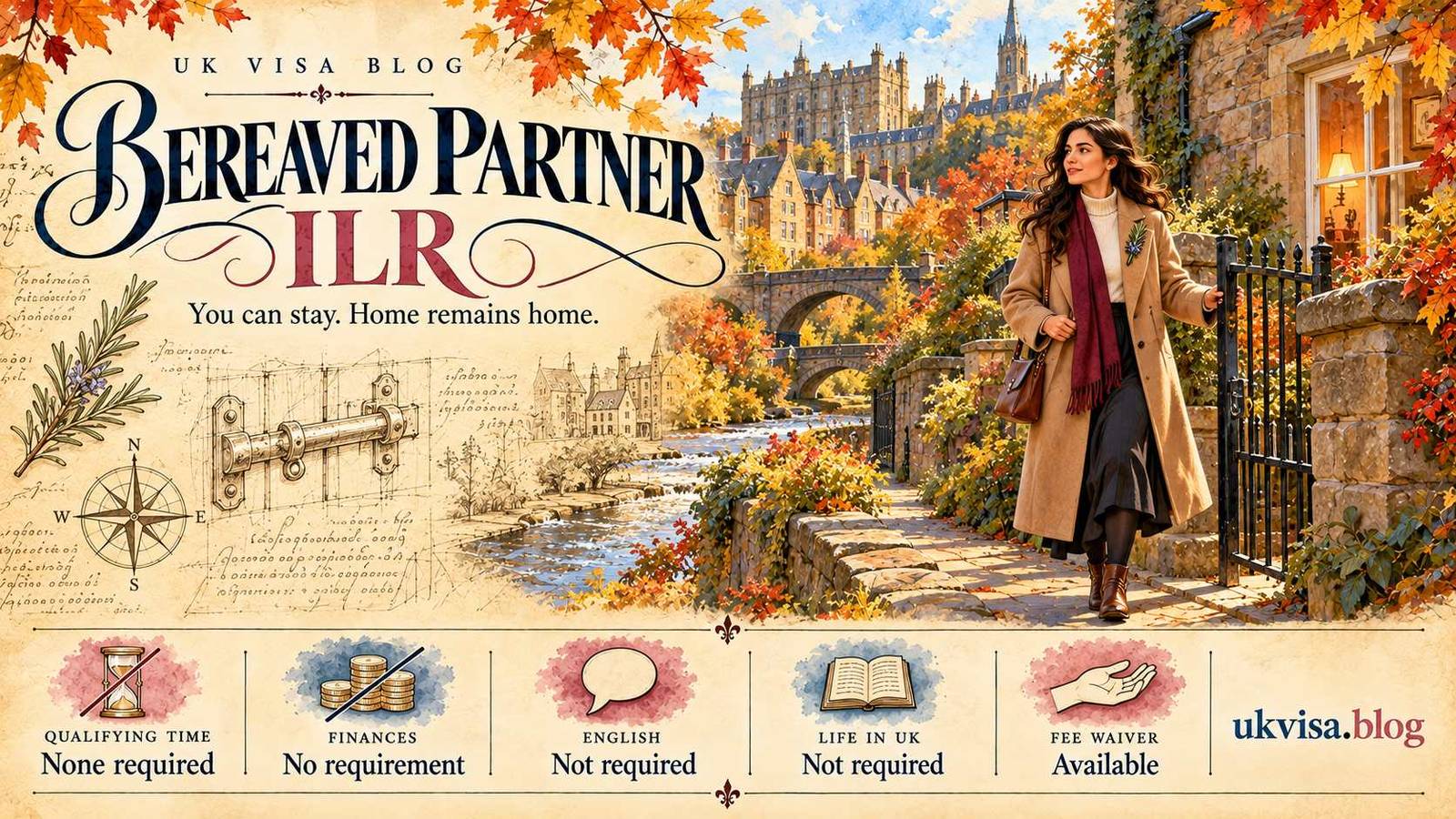
Bereaved partner settlement gives indefinite leave to someone whose British or settled partner has died. There is no qualifying period, no financial requirement, no English test and no Life in the UK test — and you can apply even if your own permission has already expired.
UK Family Visas
UK Bereavement Visa: Bereaved Partner ILR Guidance 2026
What Is Bereaved Partner ILR?
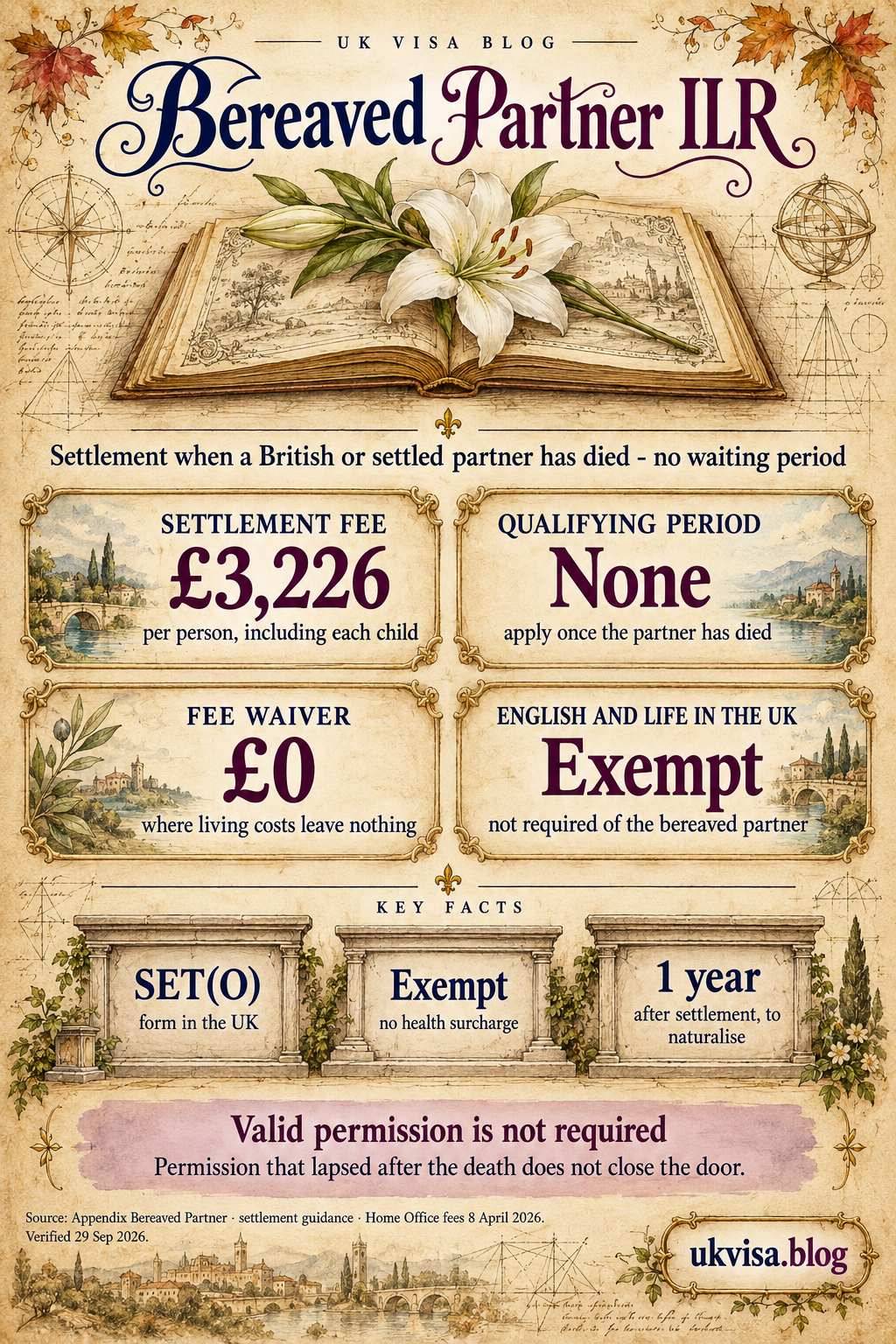
Settlement for a person whose partner has died, where that person’s last grant of permission was as a partner under Appendix FM or an equivalent route. There is no minimum qualifying period, no financial requirement, and neither the English language nor the Life in the UK requirement applies to the bereaved partner. The fee is £3,226, and a waiver is available.
The route exists because it would be unjust to require someone to leave the UK solely because the relationship their permission rested on has ended in death. It grants ILR directly, rather than requiring the person to find another category or restart the clock.
Where the Rules Now Sit
Appendix Bereaved Partner was introduced on 31 January 2024, consolidating provisions that had previously sat inside Appendix FM as section BPILR. It runs from paragraph BP 1.1 to BP 12.2 and covers both the bereaved partner and any dependent children. Since 11 November 2025 the common Part Suitability provisions apply to it.
You Do Not Need Valid Permission to Apply
This is the route’s most important feature and the one most often missed. What matters is that your last grant of permission was as a qualifying partner — not that it is still current. Permission that lapsed after the death does not close the door, which recognises that immigration paperwork is rarely the first priority in bereavement.
Who Qualifies
Two eligibility questions and a suitability one. The partner you held permission as the partner of must have died, and the relationship must have been genuine and subsisting immediately before the death. Beyond that, the application must not fall for refusal under Part Suitability.
Which Permission Qualifies
| Last grant of permission | Eligible |
|---|---|
| Spouse or civil partner under Appendix FM | Yes |
| Unmarried partner under Appendix FM | Yes |
| Partner under Part 8 of the Immigration Rules | Yes |
| Partner under Appendix HM Armed Forces | Yes, and an application can be made from overseas |
| Previously granted as a bereaved partner | Yes |
| Fiancé(e) or proposed civil partner | No |
| Dependant of a worker or student | No — different rules apply |
Source: Appendix Bereaved Partner of the Immigration Rules.
What the Relationship Evidence Must Show
A narrower question than an ordinary partner application asks. You are not proving a continuing relationship — you are proving it was genuine and subsisting immediately before the death. Evidence therefore focuses on the period up to that point rather than on the years around it.
- Death certificate: the official certificate confirming the death.
- Relationship document: the marriage or civil partnership certificate, where there is one.
- Shared life: joint tenancy, utility bills or correspondence to a shared address covering the period before the death.
- Financial: joint accounts or shared commitments.
- Personal: photographs, and statements from family, friends or professionals who knew you as a couple.
- Identity: your current passport or travel document.
Dependent Children
Children can settle alongside the bereaved parent under paragraphs BP 7.1 to BP 10.2. They must have held permission as a dependant of the deceased partner, have been under 18 when that permission was granted, and intend to live with the bereaved parent. They can be included in the parent’s application or apply separately.
One asymmetry matters here. The bereaved partner is exempt from the language and knowledge requirements; a dependent child aged 18 or over is not. They must meet English at B1 — B2 for applications made on or after 26 March 2027 — and pass the Life in the UK test (KoLL), and show adequate maintenance and accommodation without public funds.
How to Apply
Online, through the settlement application appropriate to your circumstances. The form depends on where you are and what permission you last held rather than on the bereavement itself.
Which Form Applies
| Circumstances | Form |
|---|---|
| Most bereaved partners, in the UK | SET(O) |
| Armed Forces partners, in the UK | SET(AF) |
| Children applying separately | SET(F) |
| Armed Forces partners, from overseas | VAF(AF) |
Source: Appendix Bereaved Partner, validity requirements.
Complete the form, pay the fee or request a waiver, attend a biometrics appointment, and upload the death certificate and relationship evidence. The decision arrives in your UKVI account as an eVisa. Decisions on this route commonly take several months, and no priority service is offered — our guide to ILR processing times covers the comparison across settlement routes.
Fee and Fee Waiver
The settlement fee is £3,226 per person from 8 April 2026, up from £3,029, and it applies to each dependent child as well as the main applicant. No Immigration Health Surcharge is payable, because settlement applications are exempt.
Bereaved partner settlement is one of the very few settlement categories where a fee waiver is available. Requiring a recently widowed person without means to find £3,226 would defeat the compassionate purpose entirely. You must evidence that you cannot pay after essential living costs — housing, food, heating, children’s needs — are met. Request it as part of the application, not after a refusal for non-payment.
Costs from 8 April 2026
| Item | Amount |
|---|---|
| Main applicant | £3,226 |
| Each dependent child | £3,226 |
| With an approved fee waiver | Nil |
| Health surcharge | Not payable on settlement applications |
| Priority and super priority | Not available on this route |
Source: Home Office immigration and nationality fees, 8 April 2026.
Wider settlement and citizenship costs sit in our Home Office fees guide.
If the Application Is Refused
The route is compassionate but not automatic. Paragraph BP 11.2 requires refusal where the requirements are not met, and the tightening of the suitability framework in November 2025 gives caseworkers a wider basis on which to refuse on character grounds.
- Wrong prior permission: the last grant was as a fiancé(e), or as a dependant on a work or study route.
- Relationship not established: insufficient evidence that it was genuine and subsisting immediately before the death.
- Partner’s status unclear: the deceased’s British, settled or qualifying status not evidenced.
- Suitability: criminality or immigration breaches engaging Part Suitability.
- Incomplete application: missing documents or an unanswered section.
The refusal letter states the remedy. Administrative review is available where the decision is one listed as eligible for it; where the application raised a human rights claim, an appeal to the First-tier Tribunal may be open instead — see our immigration appeal guide. The grounds here differ from ordinary spouse visa refusal grounds, because the question is the relationship at the date of death rather than ongoing maintenance.
Where Bereavement Is Not the Only Issue
Two other routes sit close to this one, and the right choice is not always obvious. Where the relationship had already broken down because of domestic abuse before the death, settlement under the domestic abuse provisions may be the stronger claim, because it turns on the abuse rather than on the relationship subsisting at the date of death.
Where the deceased was not British or settled — a partner with limited permission on a work or study route, for instance — Appendix Bereaved Partner does not apply at all, and any claim rests on Article 8 outside the rules. Identify which of the three you are in before paying a fee, because the evidence each needs is different and the fee is not refunded.
After Settlement Is Granted
You hold indefinite leave with the same rights as any other settled person: no time limit, no work restriction, access to public funds, and the ability to sponsor family members on the relevant routes. Our guide to the partner route to settlement covers the ordinary path for comparison.
Citizenship
Naturalisation becomes available twelve months after settlement is granted. The exemption from that wait belongs to spouses of British citizens applying under section 6(2), which no longer applies once the British partner has died — so the twelve months run here. See our British citizenship requirements guide.
Keeping the Status
Settlement lapses after more than two continuous years outside the UK. For someone who may want to spend extended periods with family abroad after a bereavement, that is a real constraint, and it is one reason to think about citizenship rather than assume settlement is permanent in every sense. Time here also matters for continuous residence in any later application.
Sources: Appendix Bereaved Partner of the Immigration Rules; Home Office guidance on settlement, family and private life, version 4.0 of 29 July 2025; and the fee table of 8 April 2026. The underlying partner route is covered in our UK spouse visa guide. Figures verified 22 August 2026.
Frequently Asked
Questions about Bereaved Partner ILR
Settlement for someone whose British or settled partner has died, where their last grant of permission was as that person’s partner. There is no qualifying period, no financial requirement, and neither the English language nor the Life in the UK requirement applies to the bereaved partner. It is governed by Appendix Bereaved Partner, introduced on 31 January 2024.
You can apply for settlement straight away. There is no waiting period and no requirement to have completed any part of the five years. Apply on form SET(O) with the death certificate and evidence that the relationship was genuine and subsisting immediately before the death. A fee waiver is available if you cannot afford the fee.
Yes. What the rules require is that your last grant of permission was as a qualifying partner, not that it is still current. Permission that lapsed after the death does not defeat the application — a deliberate feature of the route, recognising that immigration paperwork is rarely the first priority during bereavement.
£3,226 per person from 8 April 2026, up from £3,029, including each dependent child. No Immigration Health Surcharge is payable because settlement applications are exempt. A fee waiver is available where you cannot pay after essential living costs, and this is one of very few settlement routes where a waiver applies at all.
No. Neither the English language requirement nor the Life in the UK requirement applies to the bereaved partner. They do apply to a dependent child aged 18 or over applying alongside you: B1 English, rising to B2 for applications made on or after 26 March 2027, plus a pass in the Life in the UK test unless exempt.
Fiancé(e)s and proposed civil partners, because that permission is not held as a partner. Dependants of workers and students are also outside the route, since different rules govern those categories. Qualifying permission includes spouse, civil partner and unmarried partner under Appendix FM, partners under Part 8, and partners under Appendix HM Armed Forces.
Commonly several months from the biometrics appointment, and there is no priority or super priority service on this route to shorten it. Cases needing additional verification take longer. Because there is no requirement to hold valid permission, a lapsed visa during the wait does not prejudice the application.
Yes, under paragraphs BP 7.1 to BP 10.2, where the child held permission as a dependant of the deceased partner, was under 18 when that permission was granted, and will live with the bereaved parent. They can be added to your application or apply separately on form SET(F), and each pays the full fee unless a waiver applies.
Twelve months after settlement is granted, subject to the residence and good character requirements. The exemption from that wait applies to spouses of British citizens applying on the basis of that marriage, which is no longer available once the British partner has died — so the ordinary twelve-month period runs on this route.