
The UK Student visa financial requirement is worth 10 of your 70 points, and it is the one most applications fail. You must show outstanding course fees plus £1,529 a month in London or £1,171 outside, capped at nine months, held for 28 unbroken days. The traps are the round-up rule, the offset limit, and how the health surcharge is actually calculated.

UK Student Visas
UK Student Visa Financial Requirements 2026: Funds, Evidence and the 28-Day Rule
How Much Bank Balance Is Required for a UK Student Visa?
Add your outstanding course fees to your living costs. Living costs are £1,529 a month in London or £1,171 outside, for a maximum of nine months — £13,761 and £10,539 respectively. A London student with £10,000 of unpaid fees must show £23,761. The money has to sit in a qualifying account for 28 consecutive days ending no more than 31 days before you apply.
The requirement sits at ST 12 of Appendix Student, with the evidence rules in Appendix Finance. It is a single calculation with two halves: what you still owe your sponsor, and what the Home Office assumes you will spend living here. Both come off your CAS or your bank statements — nothing is estimated by the caseworker.
Maintenance Funds by Location
| Where you study | Per month | Nine-month maximum |
|---|---|---|
| In London | £1,529 | £13,761 |
| Outside London | £1,171 | £10,539 |
Source: Appendix Student ST 12; GOV.UK Student visa money page.
Three Worked Examples
London, tuition £15,000 with £5,000 already paid: £10,000 outstanding plus £13,761 living costs equals £23,761. Outside London, tuition £12,000 with £6,000 paid: £6,000 plus £10,539 equals £16,539. Same London case again, but with a £1,200 accommodation deposit paid to the university: £10,000 plus £13,761 minus £1,200 equals £22,561.
What Counts as Course Fees
Applying from overseas, or from inside the UK with less than a year’s permission, you must cover the fees for one academic year — or the whole course where it runs under a year. The amount comes from the CAS, which also records anything already paid. Where a payment post-dates the CAS, produce the sponsor’s receipt; the caseworker is directed to look for exactly that.
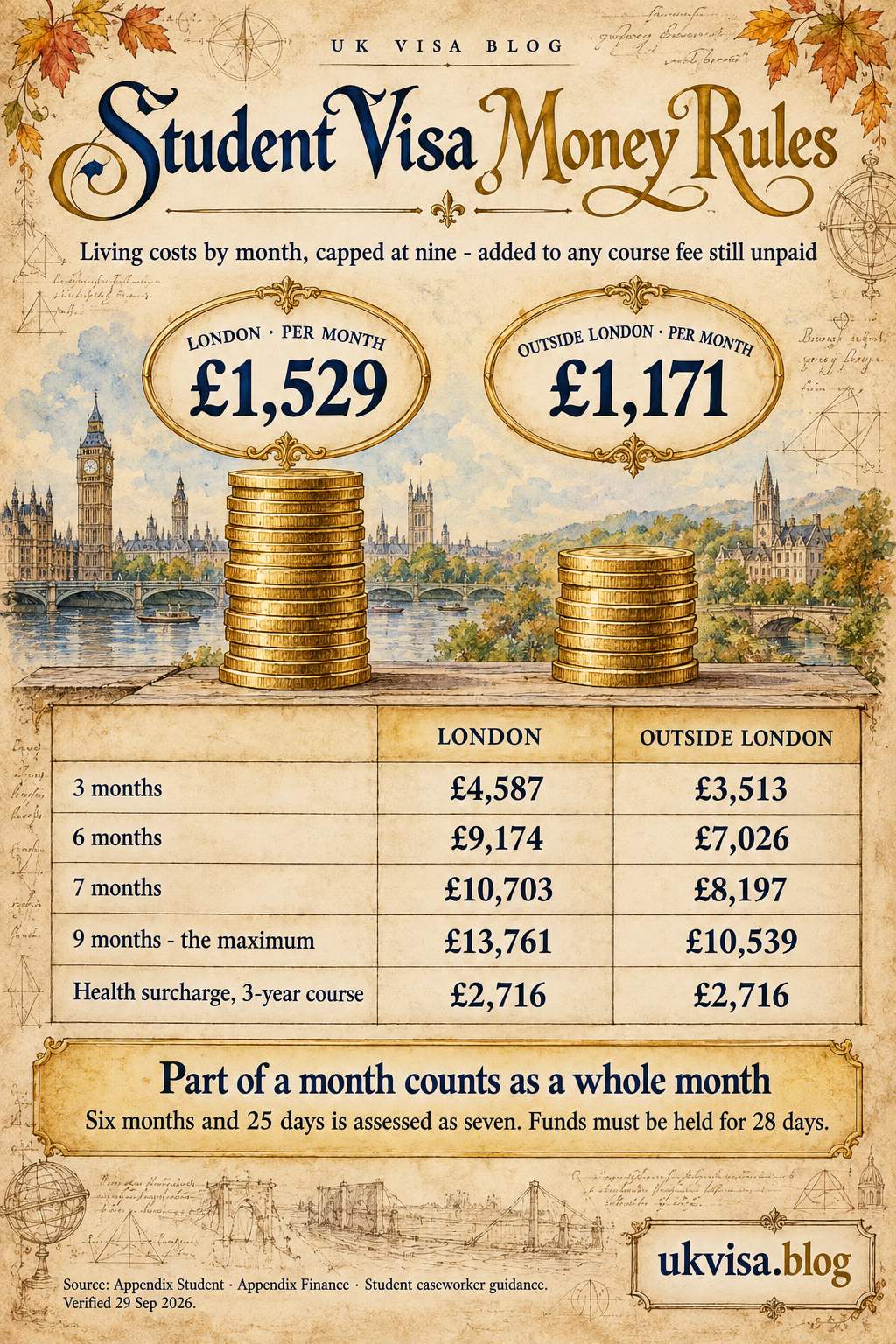
Living Costs and the Nine-Month Cap
Nine months is a ceiling, not a standard. A three-year degree still asks for nine months of living costs; a five-month course asks for five. What surprises people is how the months are counted when a course does not divide neatly.
UKVI Living Costs: London and Outside London
The UKVI living-cost figures for 2026 are £1,529 a month for study in London and £1,171 a month outside London, each capped at nine months — a maximum of £13,761 or £10,539 on top of unpaid course fees. These are the amounts the caseworker checks, not an estimate of what living in the UK costs; a cheaper city does not lower the figure, and an expensive one does not raise it.
The Round-Up Rule
Part of a month counts as a whole month. The Student and Child Student guidance gives the worked example itself: a course of six months and 25 days is assessed as seven months. Outside London that is £8,197 rather than £7,026 — a difference of £1,171 that applicants routinely miss because they calculate from the course length rather than rounding first.
Living Costs by Course Length
| Months counted | London | Outside London |
|---|---|---|
| 3 months | £4,587 | £3,513 |
| 6 months | £9,174 | £7,026 |
| 7 months | £10,703 | £8,197 |
| 9 months (maximum) | £13,761 | £10,539 |
Source: calculated from the ST 12 monthly rates; part-months round up to a full month.
London Is Decided by Your Main Study Site
The higher rate follows the campus, not your postcode. London means the City of London and the 32 boroughs, and the guidance tells caseworkers to settle borderline cases by putting the institution’s postcode into the Royal Mail postcode finder. Living in London while studying in Hertfordshire does not buy you the London allowance, and the reverse is equally unforgiving.
Who Does Not Have to Show the Money
Two groups score the 10 points automatically: applicants who have held valid UK permission for at least 12 months at the date of application, and Student Union sabbatical officers. That is the whole list. Postgraduate doctors and dentists on foundation programmes are not exempt, despite still appearing on many guidance sites: the provisions that carried that exemption were removed from Appendix Student on 9 April 2025.
Bank Statement Requirements and the 28-Day Rule
The 28-day rule is where most financial refusals happen, and almost always for a mechanical reason rather than a shortage of money. Read it as two separate tests that both have to pass.
How the 28 and 31 Days Interact
First: the required funds must be present on every day of a 28-day consecutive period. Second: that period must end no more than 31 days before the date of application, and Appendix Finance adds that the most recently dated piece of financial evidence must itself fall inside that 31-day window. GOV.UK’s own example takes it to the limit — apply on 1 January and a 28-day period ending 1 December still qualifies.
The failure mode is not usually the dates. It is a single day inside the window when the balance dropped:
The balance must not fall below the required total on any day of the 28. A rent payment, a card settlement, a transfer out and back the same week — each of these ends that period and starts a new one, and the application is assessed on what the statements show, not on what you meant. Move the money in, calculate the total including the round-up rule, and then do not touch the account until you have applied. If a dip has already happened, waiting is cheaper than a refusal: a refused application is a disclosable refusal on every future form.
Which Accounts Qualify
Funds may sit in any personal current, deposit, savings or investment account, and in a pension account provided the money can be withdrawn immediately. The institution must be regulated in its own country, must keep electronic records, and must be verifiable by the decision maker. The single working test is immediate access without penalty.
What does not count is defined by that same test rather than by a list of product names: overdraft facilities are expressly excluded, and so are shares, bonds, credit balances and any pension or instrument the money cannot be withdrawn from at once. A fixed deposit is fine if you can break it today; it is not if you cannot.
- Your name: exactly as it appears on the passport used for the application.
- The account: account number and the name of the financial institution.
- Every day of the window: a continuous transaction history across the full 28 days, not just opening and closing balances.
- The balance: a figure at or above the required total on each of those days.
- Dating: the 28-day period ending within 31 days of the application date.
When the 28 Days Does Not Apply
Three sources of money escape the holding period entirely: a student loan, an award from an official financial sponsor, and money coming from your own student sponsor — a bursary, for instance. In each case the evidence is the letter or the CAS entry rather than a run of statements, which is why loan-funded applicants are rarely caught by this rule at all.
Proof of Funds: Parents, Sponsors and Loans
The money does not have to be yours, but the list of whose it may be is short and the evidence for each source is prescribed. Getting the category right matters more than the amount of paperwork you send.
Using a Parent’s or Guardian’s Account
Appendix Finance permits funds held in the name of a parent or legal guardian. You must evidence the relationship and provide their written consent to your using the money. No other relative qualifies — a grandparent, sibling, aunt or family friend cannot hold the funds, however willing. Where a caseworker is unsure about a third party, the guidance tells them to ask rather than refuse, and to assess evidence fairly and proportionately.
Official Financial Sponsorship
An official financial sponsor is defined, not judged case by case. It means His Majesty’s Government, your own national government, the British Council, or any international organisation, international company, university or independent school. A private domestic company that fits none of those descriptions is not an official financial sponsor, whatever it puts in writing.
Student Loans
The loan must come from a government, a government-sponsored student loan company, or a regulated academic loan scheme. The letter must be dated no more than six months before the date of application, and must confirm that no condition attaches to releasing the money other than your studying in the UK. Personal loans and unregulated lenders are not accepted.
- Your own account: statements covering the 28-day period, at a regulated institution with electronic records.
- Parent or legal guardian: their statements, proof of the relationship, and their written consent.
- Official financial sponsor: the award letter, or the sponsorship recorded on your CAS.
- Student loan: the loan letter, dated within six months, confirming amount and unconditional release.
- Sponsor bursary: the entry on the CAS — no 28-day holding required.
Differential Evidence
Nationals listed at ST 22 of Appendix Student are not usually asked to file financial documents with the application. The funds must still exist: the guidance states plainly that UKVI reserves the right to request evidence, and that where a Student’s dependant fails to provide requested funds documents the caseworker must refuse. Travelling under differentiation is a paperwork concession, not a lower standard.
Money You Cannot Rely On
You cannot count future UK earnings, even though most students may work — the test is what you hold before you arrive. Nor can you rely on a business you run or plan to start here, since self-employment is prohibited on this route. Our guides to Student visa working hours and starting a business on a Student visa set out both limits.
Immigration Health Surcharge for Students
The surcharge is separate from the funds you evidence — it is money you actually pay, upfront, when you submit. Students, their dependants and under-18 applicants all pay the discounted rate of £776 a year rather than the standard £1,035, and our health surcharge guide covers how it is collected.
Health Surcharge at the Student Rate
| Permission granted | Charge |
|---|---|
| 6 months or less, applying inside the UK | £388 |
| More than 6 months, up to 1 year | £776 |
| 1 year 4 months (typical taught master’s) | £1,164 |
| 2 years | £1,552 |
| 3 years | £2,328 |
| 3 years 4 months (typical undergraduate) | £2,716 |
Source: GOV.UK healthcare surcharge rates, student rate £776 per year.
How Part-Years Are Actually Charged
This is where published guides get it wrong. A remainder of six months or less is charged at half a year, £388 — not rounded up to a full year. So a one-year master’s granted 16 months of permission pays £776 for the year plus £388 for the four-month wrapper: £1,164, not £1,552. A remainder of more than six months but under a year costs a full £776. And applying from outside the UK for six months or less, you pay no surcharge at all.
What It Buys, and Refunds
The surcharge covers NHS care on the same basis as a resident, including GP appointments, hospital treatment and emergency care. Prescriptions, dental treatment and eye tests still carry the usual charges. Where permission is granted for less time than you paid for, or refused, a refund follows — the refunds page on GOV.UK sets out who qualifies.
Where the Money Question Goes Next
With the funds in order, the rest of the application follows the pattern in our Student visa requirements guide, and the full fee picture sits in our breakdown of current UK visa charges. Dependants each need their own funds — £845 a month in London, £680 outside, capped at nine months — as our Student dependant guide explains.
Anyone called to a credibility interview should expect questions about who funded the account and why the balance moved when it did. Shorter English courses run on the Short-term study route, which has its own money rules, and the Graduate route carries no financial requirement at all.
Sources: Appendix Student ST 12 and ST 22; Appendix Finance FIN 5, FIN 7, FIN 8 and FIN 9; Student and Child Student caseworker guidance, version 14.0, published for Home Office staff on 3 August 2026; GOV.UK Student route money page and healthcare surcharge rates. Figures verified 22 August 2026.
Frequently Asked
Questions about Student Visa Finances
Outstanding course fees from your CAS plus living costs of £1,529 a month in London or £1,171 outside, for up to nine months — £13,761 and £10,539 at the cap. Fees already paid to your sponsor come off the total, as does an accommodation deposit paid to the sponsor, up to £1,529. The whole amount must be held for 28 consecutive days ending within 31 days of the application date.
The required funds must be present on every day of a 28-day consecutive period, and that period must end no more than 31 days before you apply. A single day on which the balance falls below the total ends the period and starts a new one. Student loans, official financial sponsorship and a bursary from your own student sponsor are evidenced by letter instead and are not held to the 28 days.
Yes. Appendix Finance allows funds held by a parent or legal guardian, provided you evidence the relationship and supply their written consent to your using the money. No other relative qualifies — grandparents, siblings, aunts, uncles and family friends cannot hold the funds on your behalf. Their statements must satisfy the same 28-day and 31-day tests as your own would.
Any personal current, deposit, savings or investment account, and a pension account where the money can be withdrawn immediately, at an institution regulated in its own country that keeps electronic records. Overdraft facilities are expressly excluded, as are shares, bonds, credit balances and anything you cannot withdraw at once without penalty. Immediate access is the test, not the name of the product.
Two. You score the 10 points automatically if you have held valid UK permission for at least 12 months at the date of application, or if you are applying as a Student Union sabbatical officer. Postgraduate doctors and dentists on foundation programmes are not exempt — those provisions, and the exemption that went with them, were removed from Appendix Student on 9 April 2025. Differentiated nationals are excused from filing the evidence up front but must still hold the funds.
£776 a year, the discounted rate that also covers student dependants and under-18 applicants, against £1,035 on most other routes. A remainder of six months or less is charged at £388, and a remainder longer than six months costs a full £776. No surcharge is payable at all where you apply from outside the UK for six months or less. It is paid in full when you submit.
No. That claim is common and wrong. A 12-month course typically attracts 16 months of permission, and the surcharge on that is £776 for the year plus £388 for the four-month remainder — £1,164 in total. Only a remainder of more than six months triggers another full year. Check the arithmetic before budgeting from a figure you read elsewhere.
Yes, up to a maximum of £1,529, and only where the payment went to your student sponsor for accommodation the sponsor provides. Payments to private landlords or third-party halls are not deductible. The amount is taken from the CAS, or from a receipt issued by the sponsor. Boarding students at a residential independent school are treated differently and the maximum does not apply to them.
It counts as seven months. Any part of a month rounds up to a full one — the caseworker guidance uses a course of six months and 25 days as its own example, assessed as seven. Outside London that is £8,197 rather than £7,026 in living costs. Round up before you calculate, not after, or you will be short by exactly one month’s allowance.