
Most Student applicants are never interviewed. But where a caseworker doubts you are a genuine student, the credibility interview is not optional for them either: the guidance says they must not refuse on that ground without interviewing you first. Knowing what they are told to assess — and what they are told to ignore — changes how you prepare.

UK Student Visas
UK Student Visa Interview 2026: Questions, Criteria and the Genuine Student Rule
What the UKVI Credibility Interview Is
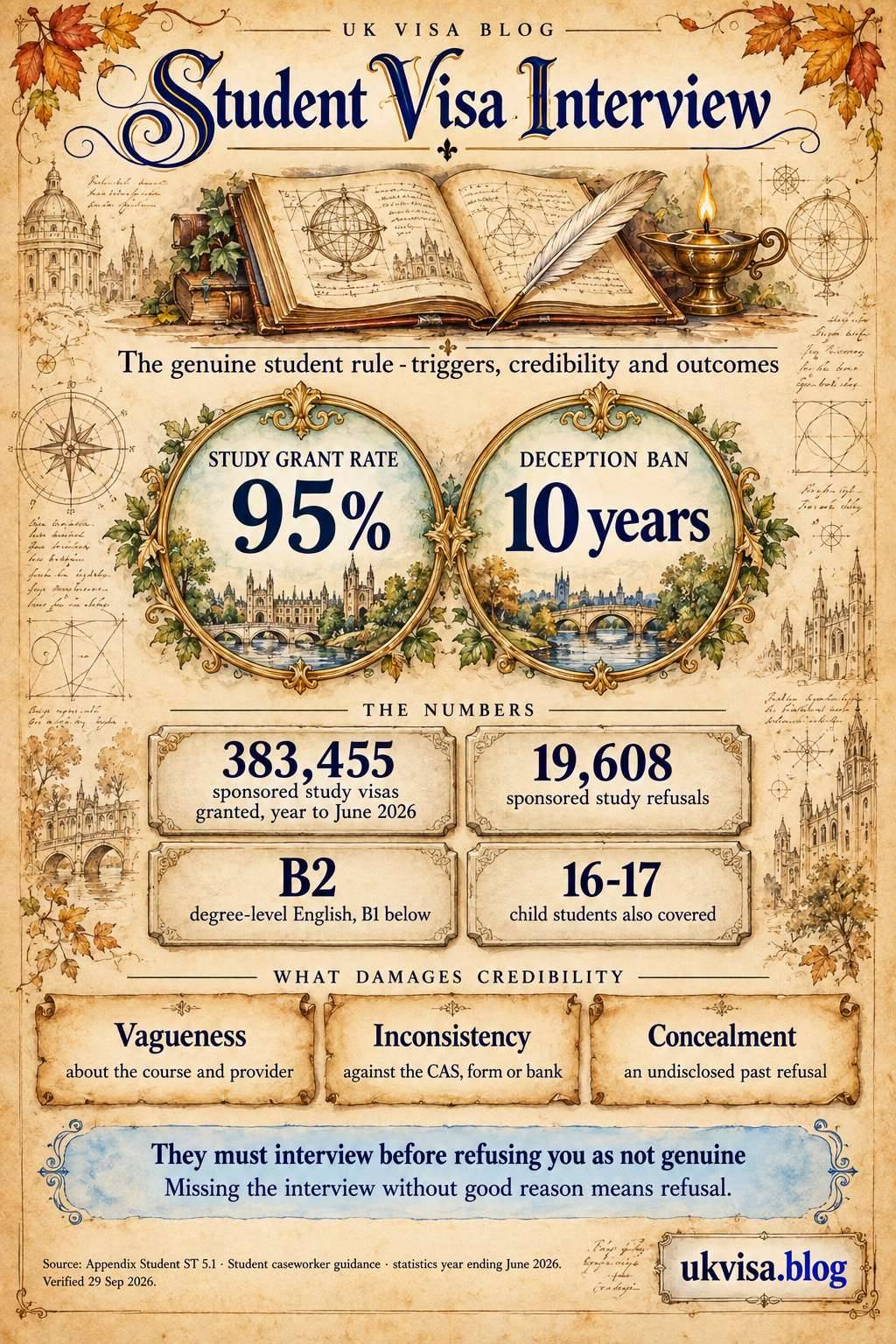
A credibility interview tests one thing: whether, on the balance of probabilities, you are a genuine student. It is not compulsory and most applications never trigger one. Where a caseworker intends to refuse under ST 5.1, the guidance requires them to interview you first, with only two narrow exceptions. Failing to attend without an acceptable reason means refusal.
The genuine student requirement is a single line in the Rules — ST 5.1 of Appendix Student says the applicant must be a genuine student. Everything that gives it shape comes from the Student and Child Student caseworker guidance, which is why the interview feels less like a document check and more like a conversation about your reasoning.
It applies to Student applicants and to Child Student applicants aged 16 or 17. For that younger group the guidance adds a restraint: the use of the rule must be proportionate and targeted at cases where there is evidence of risk. The wider points framework behind the application is in our Student visa requirements guide.
The Standard Is the Balance of Probabilities
A caseworker must be satisfied on the balance of probabilities — a civil standard, not a criminal one. It cuts both ways: they need no proof, but they must explain themselves. Where a refusal rests on credibility, the guidance requires them to set out the allegations, reasoning and argument behind it.
Is an Interview Compulsory?
No. Interviews are selected, not universal, and an invitation is not a verdict. It usually means one part of the picture needs clarifying rather than that a refusal is coming.
What Tends to Trigger One
No trigger list is published, but the credibility factors show what draws attention: contradictions between documents, a long break since you last studied, a course that does not follow from your background, an unclear source of funds, an institution or agent the Home Office has concerns about, and previous refusals.
The guidance states plainly that a caseworker must not refuse on genuineness grounds without interviewing the applicant. There are two exceptions: where the application was previously refused on the same ground with no change in material circumstances and no new evidence, and where a significant number of identical or very similar applications have been made, a sample has been interviewed, and the facts mean the applicant could not refute the finding. If you were refused as not genuine and never interviewed, and neither exception applies, that is a point to raise on reviewing the refusal.
And What Happens If You Do Not Attend
Failure to attend without a reasonable explanation is itself a refusal ground, under paragraph SUI 14.1(a) of Part Suitability. An interview can only be rearranged where you give adequate reasons and the interview team is reasonably satisfied by them. Check your email, including the spam folder, from the day you apply.
Interview Questions and How to Answer Them
Questions cluster around five areas: your immigration history, your education and study plan, your money, your knowledge of the course and provider, and what you intend to do afterwards. The examples below are patterns, not scripts — a memorised answer is worse than an imperfect one.
Immigration History
Expect to be asked where you have travelled, what visas you have held, and whether any application anywhere has been refused. Answer the refusal question directly, name the country and the year, say what the stated reason was and what has changed since. The Home Office can see far more than applicants assume, and a concealed refusal converts a credibility problem into a deception finding.
That distinction matters enormously. A refusal for weak evidence is survivable; a finding of deception under Part Suitability can carry a re-entry ban of up to ten years. Nothing you might gain by omitting an old refusal is worth that trade.
Course and Provider
You should be able to say what the course covers, how it is structured, how long it runs, and why this provider rather than another. Anchor the answer in specifics you actually know — named modules, the assessment pattern, a placement year, a particular research group. Vagueness here is the most common finding in credibility refusals, because it is the easiest thing to test.
Money
Say who is paying, where the money came from, and what it has to cover. If a parent is funding you, be able to explain their income and why the balance appeared when it did. A sudden large deposit with no story behind it invites exactly the question you do not want. The thresholds themselves are in our Student visa financial requirements guide, and the wider fee picture in our breakdown of current UK visa charges.
On part-time work, the honest answer is usually the best one: that you may work within the limit for experience, but your funding does not depend on it. Our guide to Student visa working hours sets out what the limit actually is, which is worth knowing before you are asked.
Dependants
If a partner or child is coming with you, expect questions about what they will do and how they are funded. The guidance is explicit that a caseworker must look carefully at genuineness where a main reason for the application is the employment, education or healthcare benefits available to a dependant. Who may bring family at all is covered in our Student dependant guide.
Afterwards
Give a plan rather than an aspiration: the kind of role, the sector, whether you intend to use the Graduate route first, and how the qualification connects to what follows. Wanting to work in the UK afterwards is lawful and does not count against you — the guidance treats intending to comply with your conditions, including extending or switching where that is lawful, as part of credibility.
Building a business is the one plan needing care, since self-employment is prohibited on this route. Our guide to starting a business on a Student visa explains the lawful sequence.
What Caseworkers Are Told to Assess
The guidance sets out seven categories of credibility factor, with worked examples under each, and says openly that the list is not exhaustive. Knowing the headings is more useful than memorising questions, because the questions vary and the headings do not.
The Seven Credibility Factors
| Factor | What is examined |
|---|---|
| Immigration history | Previous applications and refusals here and elsewhere, time spent abroad and why, compliance with earlier conditions |
| Education history and study plans | The gap since you last studied, commitment, academic progression, your rationale and research into the course, provider and living arrangements |
| Personal and financial circumstances | Economic position, a credible source of funds, how the money was acquired, distance from campus to accommodation, monthly expenditure |
| Qualification, provider and agents | Whether the institution is under investigation or of concern, and whether the Home Office has concerns about the agent handling the application |
| English language ability | Whether spoken ability appears to fall short of the level claimed |
| Role of dependants | Whether benefits available to a dependant are a main reason for the application |
| Pull factors | Whether the choice of the UK turned on institutional reputation, or on how easy it is to work during or after the course |
Source: Student and Child Student caseworker guidance, version 14.0, 3 August 2026.
Pull Factors Are Not What Most Guides Say
Published advice routinely describes pull factors as family already in the UK. The guidance defines them differently: a pull factor is something known to influence the choice of the UK as a destination, and it gives two examples — the reputation of British institutions compared with other countries, and the ease of working during or after the course. The first is a perfectly good reason to come; the second is the one that invites follow-up questions.
What They Are Told Not to Do
Two limits are worth knowing. A caseworker must not refuse you because of what you do or do not know about the place you will be living — the guidance names bus routes and local geography specifically. And where something you said can be read more than one way, they must justify the reading they chose rather than simply adopting the worst one.
English ability can be weighed as a credibility factor, but a refusal resting on it has to be justified in the letter. There is also a direction that often goes unquoted: caseworkers must take account of the fact that you are making a considerable investment to obtain a UK qualification.
Career Logic Carries Real Weight
A course that does not follow from your background is not fatal, but it needs an account. Moving from a commerce degree and three years in finance to an MBA explains itself; moving to an unrelated field without a stated reason does not. Say what changed and why this course serves it. Language levels themselves — B2 at degree level, B1 below — are covered in our guide to how English is proved for UK visas.
How the Interview Runs, and What Follows
The mechanics differ depending on where you applied from, and the authorisation trail is more formal than most applicants realise.
Applying from Inside the UK
A caseworker completes an interview referral, which their manager must authorise, and sends it to the interview administration team to schedule. That team writes to invite you. If the interviewer finds you credible, the case returns to the caseworker to finish. If the caseworker then still doubts you, they cannot simply refuse — the case must be escalated to a senior caseworker for a refusal to be considered.
Applying from Outside the UK
An Entry Clearance Officer must refer the case to an Entry Clearance Manager to authorise using the genuine student rule, and the manager must take risk factors into account in doing so. Where the officer is then satisfied and the other route requirements are met, they must grant, recording that an interview took place.
Format
The guidance says interviews may be arranged and conducted in various ways depending on where you are and when you are available. It names a telephone interview, where the caseworker rings and asks whether you are able to answer questions there and then — you can say no — and contact by email or telephone to arrange an interview at a set time and place. No fixed duration is published.
If the Decision Goes Against You
A credibility refusal has to do more work than most. The guidance requires the letter to cover the information obtained at interview, to explain the reasons fully, and to reflect the interview transcript accurately — precisely because it will matter if you seek administrative review. Refusals on this basis are described in the guidance itself as subjective, which is why a detailed letter is required to support one.
One outcome is worse than a credibility refusal. If you admit at interview or elsewhere that fraudulent information formed part of the application, the caseworker must refuse under paragraph SUI 10.1 of Part Suitability — the deception ground, with the ban that follows it.
Preparing Properly
Preparation is not rehearsal. What is being tested is whether your account holds together under questions you have not seen, so the work is in knowing your own application rather than in polishing sentences.
- Your CAS: course title, level, dates, fees and anything already paid — the caseworker is reading it as you speak.
- The course itself: modules, structure, assessment, length, and why this provider.
- Your funding: whose money, where it came from, and what it covers.
- Your immigration history: every application and every refusal, with dates and stated reasons.
- Your plan afterwards: the role, the sector, and how the qualification gets you there.
- The practicalities: a quiet line if the interview is by phone, and your documents to hand.
- Memorised scripts: rehearsed phrasing invites probing, and it collapses on the second follow-up.
- Inconsistency: any answer that contradicts your CAS, your application or your bank evidence.
- Vagueness about the course: the single most testable weakness in any application.
- Undisclosed refusals: concealment turns a survivable problem into a deception finding.
- Answering through an agent: heavy reliance on an agent’s account of your own plans reads as weak commitment.
- Volunteering more than was asked: every extra fact is a new thing to reconcile.
Interviews on other routes turn on different things — employer and role on the work visa interview, the relationship on the spouse visa interview, and travel intent and home ties on the visitor visa interview. Courses of six months or less use the Short-term study route instead, which is assessed differently.
Sources: Appendix Student ST 5.1 and Part Suitability paragraphs SUI 10.1 and SUI 14.1; Student and Child Student caseworker guidance, version 14.0, published for Home Office staff on 3 August 2026, sections on the genuine student rule, credibility factors and interviews; the Student route page on GOV.UK; UK Visas and Immigration. Figures verified 22 August 2026.
Frequently Asked
Questions about the Student Visa Interview
No. Most applications are decided without one. Caseworkers select cases where credibility needs testing, and the guidance requires the genuine student rule to be applied proportionately, particularly for applicants aged 16 or 17, where its use must be targeted at cases showing evidence of risk. An invitation means something needs clarifying, not that a refusal has been decided.
Only in two situations. The guidance says a caseworker must not refuse on genuineness grounds without interviewing, unless the application was previously refused on that ground with no change in material circumstances and no new evidence, or unless a large number of near-identical applications have been made, a sample interviewed, and the facts mean you could not refute the finding. Outside those, the interview comes first.
The balance of probabilities. The caseworker must be satisfied it is more likely than not that you are a genuine student, considering everything in the application and anything said at interview. Where they refuse, they must set out the allegations, the reasoning and the argument, and where a statement of yours could be read in more than one way, they must justify the reading they adopted.
No duration is published. The guidance says interviews may be arranged in various ways depending on where you are and when you are available, and names a telephone interview — where the caseworker rings and asks whether you can answer questions then — and contact by email or phone to arrange a set time and place. If you are called unexpectedly and cannot speak properly, say so rather than proceeding.
If the interviewer records that you failed to attend with no reason or an unacceptable one, the caseworker must refuse. Rearranging is only possible where you give adequate reasons and the interview team is reasonably satisfied by them, so contact them as soon as you know, with evidence. Refusal on this basis is under paragraph SUI 14.1(a) of Part Suitability.
Yes, and there is no upside in doing otherwise. Immigration history is the first credibility factor, and a refusal you explain is a much smaller problem than one that surfaces later. If you admit at interview or elsewhere that fraudulent information was part of an application, the caseworker must refuse under paragraph SUI 10.1 — the deception ground, which can carry a re-entry ban of up to ten years.
No. The guidance tells caseworkers not to refuse an applicant based on knowledge of the location where they will study, naming bus routes and local geography as examples. What they can properly test is your rationale for, and research into, the course, the sponsoring institution and your living arrangements — which is a question about your reasoning, not about local trivia.
Yes, and spoken ability is one of the credibility factors the guidance lists. Where a caseworker has concerns that ability falls short of the level claimed, they may weigh it — but any refusal resting on it has to be justified in the letter. A noticeable gap between spoken English and a submitted test score is the pattern that draws attention.
No timescale is published for the interview itself, and the interview is only one input. From outside the UK the caseworker grants where satisfied and the other requirements are met; from inside, a credible interview returns the file to the caseworker to complete, and a refusal after a credible interview must be escalated to a senior caseworker. Standard route processing times still apply to the decision.
It must cover the information obtained at interview, explain the reasons fully, and accurately reflect the interview transcript. The guidance is candid that credibility refusals are subjective and require a detailed letter to support them, precisely because that documentation matters in any administrative review. A thin or inaccurate letter is itself something to raise.