
A visa can be taken away before you travel, at the border, or while you are living in the UK. The Immigration Rules now handle all three under Part Suitability, using SUI paragraph numbers. Knowing which paragraph your letter cites tells you whether the decision was mandatory or discretionary — and what, if anything, can be done.

Cancellation
Visa Cancellation Under the Part Suitability Rules
Cancellation, Curtailment and Revocation
The three words describe the same outcome at different moments. The Rules themselves speak of cancelling entry clearance or permission. Curtailment is the older term for cutting short permission already granted. Revocation is used colloquially and in some enforcement contexts. What matters legally is the SUI paragraph cited, not the label on the letter.
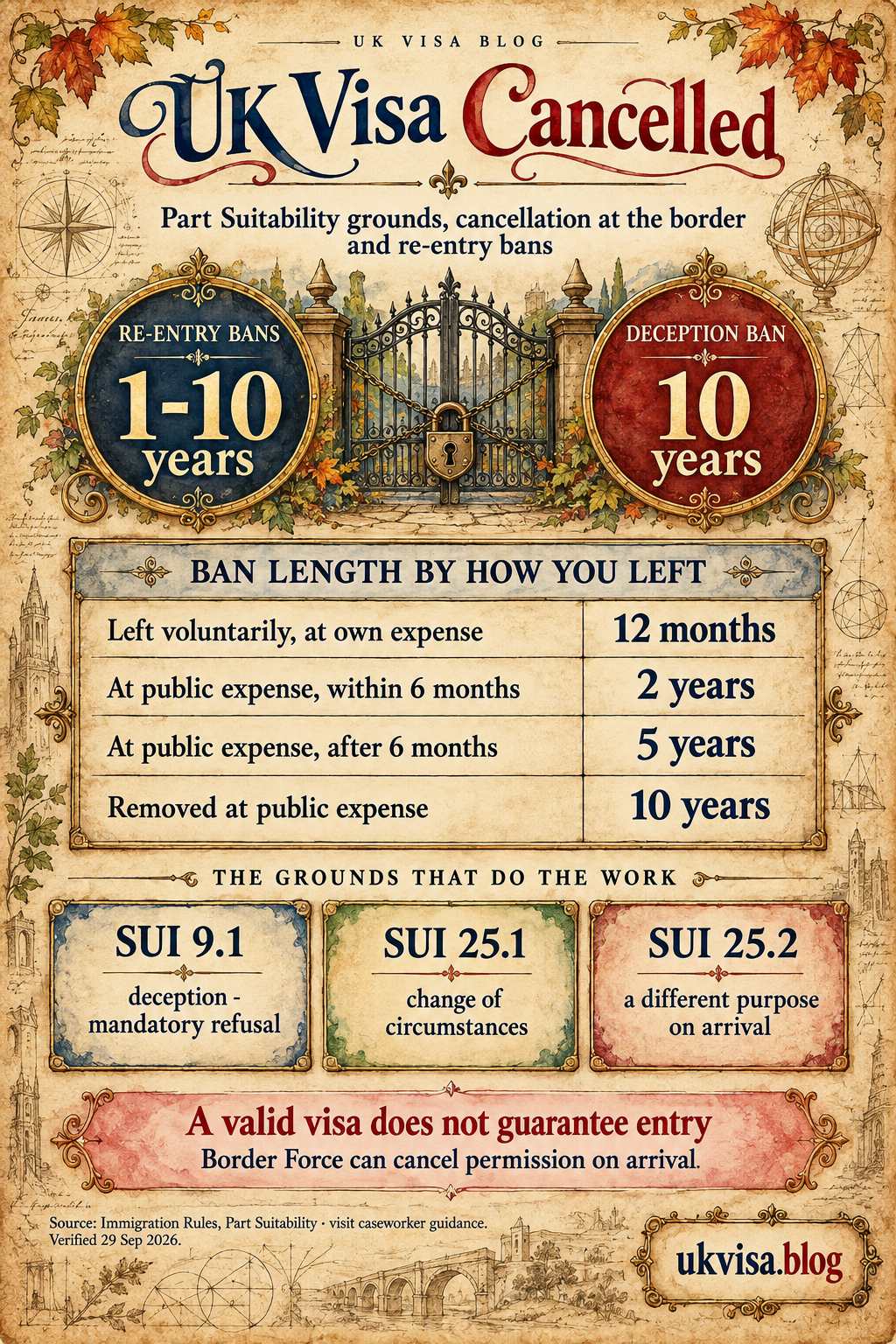
Some grounds require cancellation — a personal exclusion direction under SUI 2.2, a sentence of twelve months or more under SUI 5.2, deception in the application under SUI 9.2. Others are discretionary: a change of circumstances under SUI 25.1, arriving for a different purpose under SUI 25.2, sham marriage under SUI 8.2. Re-entry bans run from one to ten years under SUI 12.1.
Where the Older Language Comes From
Practitioners and older guidance pages still refer to Part 9 grounds and to curtailment notices. The substance survived the renumbering: the same conduct produces the same outcome. But a letter citing an old paragraph number against a current decision is worth querying, because the ground relied on has to exist in the Rules as they stand.
How Part Suitability Is Structured
Part Suitability carries the grounds for refusing entry and for cancelling entry clearance or permission. Each ground appears in a numbered SUI paragraph, and the paragraph tells you whether the decision maker had a choice. Mandatory grounds use “must be cancelled”; discretionary grounds use “may be cancelled”.
That distinction drives everything that follows. Against a mandatory ground, arguing that the outcome is harsh gets nowhere — the argument has to be that the ground does not apply on the facts. Against a discretionary ground, the exercise of discretion itself is open to challenge.
The Grounds Themselves
Mandatory Grounds
- SUI 2.2: the Secretary of State has personally directed that the person be excluded from the UK.
- SUI 5.2: a custodial or suspended sentence of twelve months or more, a persistent offender showing disregard for the law, or an offence causing serious harm.
- SUI 9.1: deception used in the application — false representations, false documents or information, or non-disclosure of relevant facts. Mandatory refusal of entry clearance or permission.
Discretionary Grounds
- SUI 3.2: presence in the UK not conducive to the public good.
- SUI 5.5: a sentence of under twelve months, a non-custodial sentence or an out-of-court disposal.
- SUI 8.2: involvement in a sham marriage or civil partnership, judged on the balance of probabilities.
- SUI 9.2: deception in an application, allowing cancellation of permission extended under section 3C.
- SUI 10.1 and 10.2: false representations, documents or information by the applicant or a third party, whether or not to the applicant’s knowledge — refusal and cancellation respectively.
- SUI 14.2: failure without reasonable excuse to attend an interview, provide information or biometrics, or undergo a medical examination.
- SUI 19.2: a medical inspector advises that entry is undesirable.
- SUI 25.1: a change in circumstances since the grant such that the permission should be cancelled.
- SUI 25.2: arriving for a purpose different from the one the entry clearance specifies.
What Triggers Each in Practice
For visitors, SUI 25.1 and 25.2 do most of the work. Arriving with tools, a UK employment contract, or belongings suggesting relocation is a change of purpose. So is a travel pattern showing the UK has become the main home — our page on multiple-entry visas and what is actually assessed covers how that pattern is read.
For work and study routes, the common triggers are a sponsor losing its licence, employment ending, or a course being abandoned. For family routes, a relationship breaking down — see our page on relationship changes on a partner visa. In each case the duty to report the change usually sits with the sponsor.
A Genuine Visitor Refusal Is Not a Suitability Refusal
This distinction is worth holding on to. Visit caseworker guidance states that where an applicant is assessed as not meeting the genuine visitor requirements, that is distinct and separate from suitability under Part Suitability. A refusal for not being a genuine visitor is a failure to meet the eligibility rules, not a finding against your character.
The practical consequence is that such a refusal carries no SUI re-entry ban. It is recorded, it must be declared, and it makes the next application harder — but it is not the same animal as a deception finding, and it should not be treated as one when you reapply. Our page on refusal grounds separates the two.
When a UK Company Is Referred
Cancellation is not always only about the traveller. Where caseworkers have concerns that specific UK companies are sending visitors to their offices to undertake work or fill roles, and so circumventing the work routes, they must record it on the case system and refer the matter to the Sponsor Management team. A pattern of visitors arriving to do a UK company’s work therefore has consequences for the company as well.
Cancellation at the Border
Holding a valid visa gives no right of entry. A Border Force officer may cancel it on arrival, most often under the change-of-purpose or change-of-circumstances grounds. Refusals at the border are recorded against set codes: A1 for insufficient funds, A2 for not being satisfied you are a genuine visitor, A4 for unsatisfactory study arrangements, and E4 for lacking the required visa.
Where an officer has residual doubts about whether someone is a genuine visitor, guidance requires them to record full details of the stated intentions, particularly those given verbally. An account given at the desk that differs from the application is the discrepancy that appears in the decision — and in the file for every later application.
What to Do If It Happens
- Ask for the written notice: it states the ground relied on. You need the paragraph number.
- Do not sign anything you do not understand: ask for it to be read to you, or for an interpreter.
- Do not argue the merits: the officer has decided; the record is what matters now.
- Keep every document: the notice, boarding passes, and any interview record you are given.
- Leave voluntarily at your own expense if offered: the alternative carries a longer ban.
Re-Entry Bans Under SUI 12.1
Ban Length by How You Left
| Circumstances | Ban length |
|---|---|
| Voluntary departure at your own expense | 12 months |
| Voluntary departure at public expense, within 6 months of a removal notice | 2 years |
| Voluntary departure at public expense, after that 6-month period | 5 years |
| Departure as a condition of a criminal caution | 5 years |
| Removal at public expense | 10 years |
| Deception used in an application | 10 years |
Source: Immigration Rules, Part Suitability, paragraph SUI 12.1, checked 22 August 2026.
The pattern is consistent: the more the taxpayer pays for your departure, and the longer you leave it, the longer the ban. Leaving promptly at your own expense is the cheapest option in every sense. Our pages on re-entry bans and the 10-year deception ban cover how each is applied.
The Fourteen-Day Exception Under SUI 13.1
SUI 13.1(a) provides that an applicant will not be treated as an overstayer where the application was made within fourteen days of the previous permission expiring and there is good cause, beyond their control, for the late submission. Further limbs cover applications made within fourteen days following a previous refusal, and defined pandemic-era periods.
Two limits worth stating plainly. It is not a fortnight of free time — good cause beyond your control is a condition, not a formality. And it protects the application, not your status: you are still without permission during those days, with the consequences that follow for work and renting.
Where Compassionate Circumstances Are Considered
Guidance provides a route for cases that fail the rules but should not fail outright. Where an applicant does not meet the visitor rules but there are compassionate and compelling circumstances, the caseworker must refer the case for consideration of leave outside the rules. That referral goes to the Referred Casework Unit on a form that must state the justification, include comprehensive evidence and, where relevant, a full medical report.
Two features make this narrow. The referral requires an Entry Clearance Manager’s authority on the form, and the threshold is genuinely exceptional — a dying relative, an urgent treatment need, a child’s welfare. It is not a general appeal against a strict decision, and it cannot be requested as of right. But where the facts are exceptional, the evidence has to be in front of the caseworker for the referral to be made at all, which means putting it in with the application rather than waiting for a refusal.
Challenging a Cancellation
The route depends on the decision. Administrative review is available for some in-country decisions but not for visit refusals. Judicial review challenges the lawfulness of the decision rather than its merits, and is expensive and time-limited. Where human rights are engaged, an appeal may exist.
- Identify the paragraph: mandatory or discretionary changes what can be argued.
- Check the time limits: they are short, and missing one usually ends the option.
- Gather the evidence that answers the ground: not general character material.
- Take advice before reapplying: a fresh application made into an unresolved ban compounds the problem.
Our pages on reading a refusal or cancellation letter, judicial review (JR) and reapplying after refusal set out the practical steps. Where the underlying issue is an expired visit permission, see visit extensions.
Sources: Part Suitability of the Immigration Rules on GOV UK, the Home Office suitability and cancellation caseworker guidance, and the visit caseworker guidance version 17.0 published 25 February 2026. Figures verified 22 August 2026.
Frequently Asked
Cancellation Questions
What is the difference between cancellation and curtailment?
Timing and vocabulary rather than substance. The Rules speak of cancelling entry clearance or permission; curtailment is the older term for cutting short permission already granted. The SUI paragraph cited is what matters.
Can my visa be cancelled at the airport even though it is valid?
Yes. A visa permits travel; permission to enter is granted on arrival. Officers may cancel where circumstances or your purpose have changed from what the visa was issued for.
How long is the ban if I overstay and leave on my own?
Voluntary departure at your own expense carries a twelve-month ban under SUI 12.1. Departure at public expense carries two or five years depending on timing, and removal at public expense carries ten.
Does the fourteen-day rule give me two extra weeks?
No. SUI 13.1(a) prevents you being treated as an overstayer where the application is made within fourteen days and there is good cause beyond your control for the delay. You are still without permission in the meantime.
What happens if I used false information without realising?
SUI 9.1 requires refusal where the decision maker is satisfied deception was used. Where the false material came from a third party, SUI 10.1 applies and is discretionary — though it bites whether or not you knew. Take advice quickly: the deception ban runs for ten years.
Can a criminal conviction cancel my visa?
A sentence of twelve months or more is a mandatory ground under SUI 5.2. Shorter sentences and out-of-court disposals fall under SUI 5.5 and are discretionary.
My sponsor lost its licence. Will my permission be cancelled?
It is a change of circumstances under SUI 25.1. In practice a period is usually given to find a new sponsor or leave, but the outcome depends on the route and the notice you receive.
Can I appeal a cancellation?
Only where a right of appeal exists, generally on human rights grounds. Administrative review covers some in-country decisions but not visit refusals. Otherwise judicial review challenges lawfulness, not merits.
Should I reapply immediately?
Not before you know which ground was used and whether a ban applies. A fresh application made into an unresolved ban is refused and adds another negative decision to the record.
Does a cancelled visa show on future applications?
Yes. Immigration history is checked, and you must declare it. Declaring a cancellation you can explain is far less damaging than an omission that surfaces. Our application form guide covers the declaration.