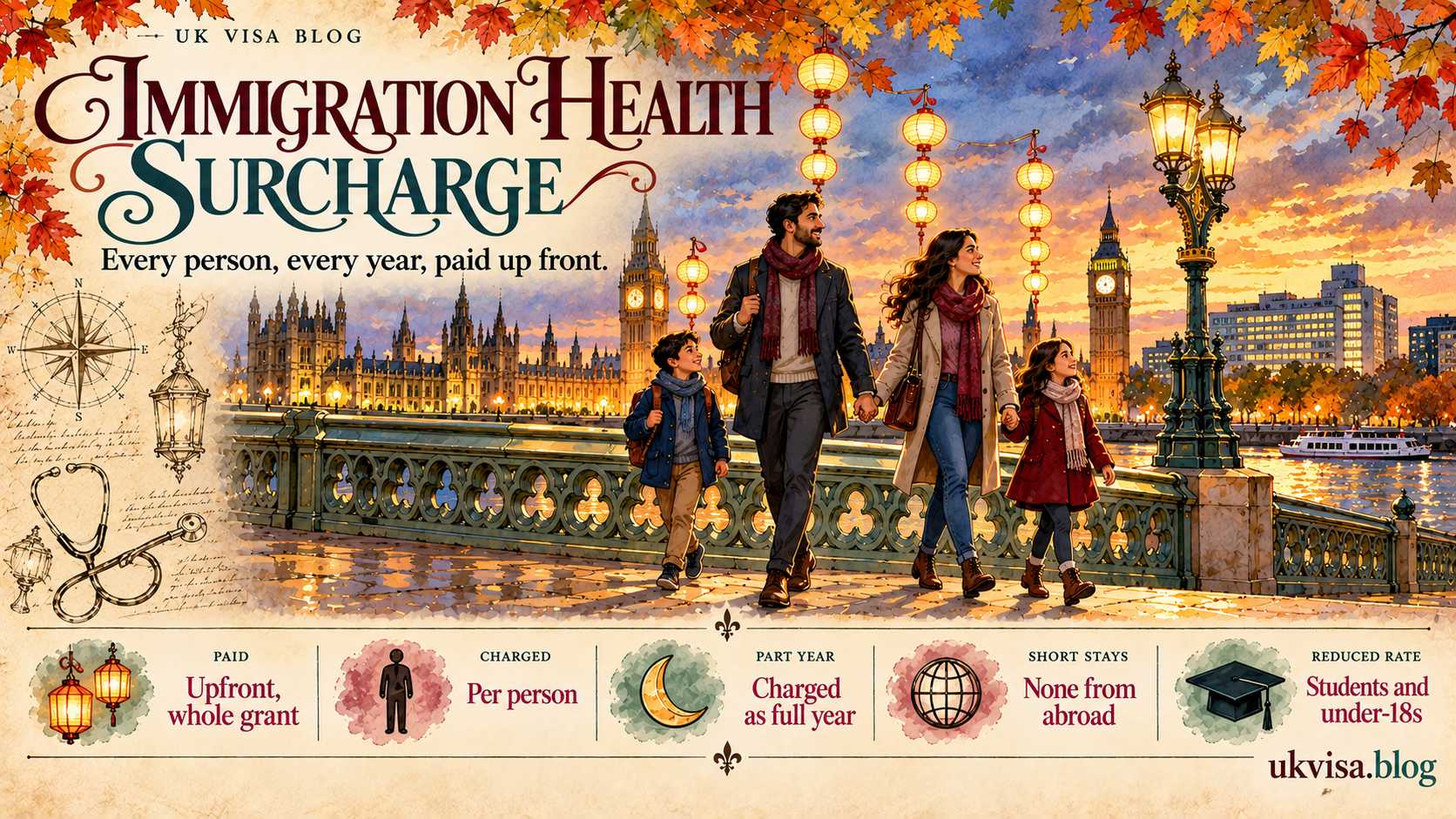
The Immigration Health Surcharge (IHS) is the mandatory NHS access fee paid upfront by most UK visa applicants staying longer than six months. From 6 February 2024 the standard rate is £1,035 per adult per year and £776 per year for students, Youth Mobility Scheme applicants, and under-18s — and these rates were unchanged in the 8 April 2026 fee schedule despite ongoing rumours about increases. This complete 2026 guide explains the IHS calculator rules, the route-by-route fee tables (Skilled Worker, Student, Spouse, Graduate, Ancestry, YMS, Dependant), full exemptions and fee waivers, what the surcharge actually covers on the NHS (and what it does not — prescriptions, dental, optical), how to pay and find your IHS reference number, when refunds apply, and a direct response to the widely-quoted £1,145 figure.
Source: Department of Health and Social Care; House of Commons Library briefing CBP-7274
The Immigration Health Surcharge rate is unchanged in 2026. Adults pay £1,035 per year of visa permission granted; students, Youth Mobility Scheme applicants, and applicants who are under 18 on the date of application pay £776 per year. Health and Care Worker visa holders and their dependants are fully exempt. The IHS is paid in full upfront — there is no instalment option, and private health insurance does not exempt anyone. Full refunds are automatic if a visa application is refused.
- What Is the Immigration Health Surcharge?
- IHS Rates and Fees 2026
- IHS Calculator: How to Work Out Your Total
- Who Needs to Pay the IHS?
- IHS Exemptions and Fee Waivers
- IHS Fees by Visa Type — Detailed Breakdown
- What Does the IHS Cover? Dental, Optical and Prescriptions
- How to Pay the IHS and Find Your Reference Number
- IHS Refunds — When and How
- The £1,145 IHS Figure Explained
- Frequently Asked Questions
Understanding the UK Immigration Health Surcharge in 2026
The Immigration Health Surcharge is the upfront NHS access fee paid as part of most UK visa applications for stays longer than six months. Introduced in April 2015 under section 38 of the Immigration Act 2014, the surcharge gives visa holders access to the National Health Service on the same basis as permanent UK residents. The most recent rate change took effect on 6 February 2024 — when the standard adult rate rose from £624 to £1,035 per year (a 66% increase) — and the rates were not increased in the 8 April 2026 Home Office fee schedule.
What Is the Immigration Health Surcharge?
The Immigration Health Surcharge (IHS) is a mandatory NHS access fee paid upfront by most non-UK nationals applying for a UK visa for more than six months, or for any length of stay if applying from inside the UK. The full surcharge for the entire visa duration must be paid before the application can be processed. IHS is the full form — "Immigration Health Surcharge". It is sometimes called the NHS surcharge, NHS visa fee, or healthcare surcharge, but all refer to the same charge.
The IHS is separate from the UK visa application fee schedule and is paid online during the visa application process. According to the House of Commons Library, the surcharge has raised more than £6.9 billion since its 2015 introduction, including £1.7 billion in the 2023/24 fiscal year alone. Receipts are forecast to rise further following the 66% rate increase in February 2024.
Immigration Health Surcharge Rates and Fees 2026
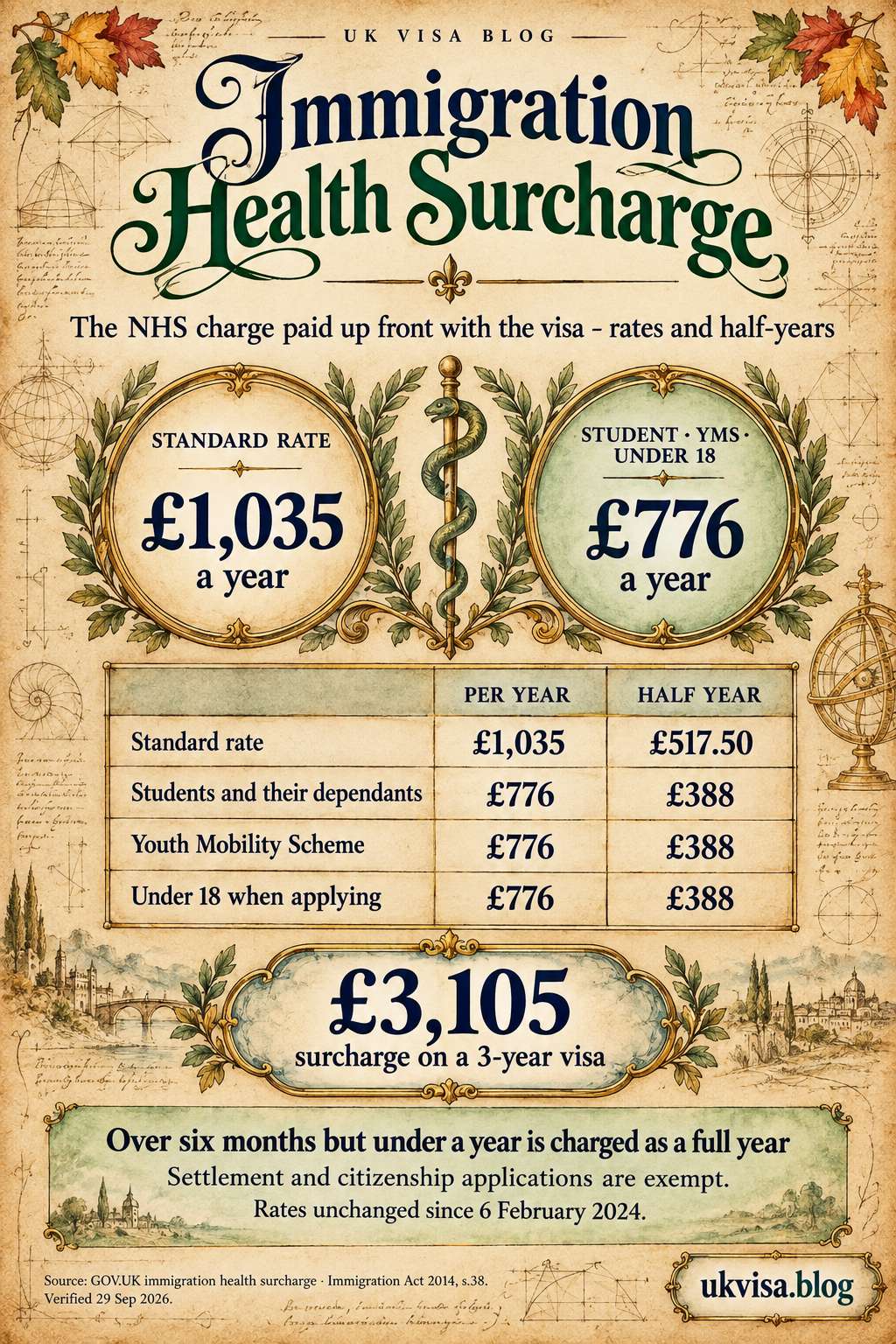
The current IHS rate is £1,035 per year for adult applicants and £776 per year for students, their dependants, Youth Mobility Scheme participants, and applicants under 18 at the date of application. These rates have been in force since 6 February 2024 and were unchanged in the 8 April 2026 fee schedule. The rate is multiplied by every full year of visa permission, with part-years rounded up to a full year if longer than six months or charged at the half-year rate if six months or less.
| Applicant Category | Annual Rate | 2-Year Total | 3-Year Total | 5-Year Total |
|---|---|---|---|---|
| Standard Rate (Most Adult Visas) | £1,035 | £2,070 | £3,105 | £5,175 |
| Students and Student Dependants | £776 | £1,552 | £2,328 | £3,880 |
| Youth Mobility Scheme | £776 | £1,552 | — | — |
| Under 18 on Application Date | £776 | £1,552 | £2,328 | £3,880 |
| Health and Care Worker Visa | Exempt | £0 | £0 | £0 |
Why the IHS Rate Is What It Is
The Department of Health and Social Care sets the IHS based on the estimated average per-capita cost of providing NHS services to migrants, calculated at approximately £1,036 per person per year in the most recent DHSC assessment. The current rate therefore broadly reflects DHSC's modelled cost of NHS use — a methodology that distinguishes IHS from the visa application fee itself, which is set by the Home Office to recover administrative costs of visa processing.
IHS Calculator: How to Work Out Your Total Surcharge
To calculate your IHS total, multiply your annual rate (£1,035 adult or £776 reduced) by the total number of full years of visa permission granted. For part-years over 6 months, round up to a full year. For part-years of 6 months or less, pay half the annual rate (£517.50 or £388). Use the official UKVI IHS calculator on gov.uk to verify your exact liability before paying.
UKVI Rounding Rules for Part-Year Visas
| Visa Period | How It Counts | Standard Rate Charge |
|---|---|---|
| Full year (12 months) | Full annual rate | £1,035 |
| Part-year over 6 months | Rounded up to full year | £1,035 |
| Part-year 6 months or less | Half-year rate applies | £517.50 |
| 30 months (2.5 years) | 2 full years + 6-month half-year | £2,587.50 |
| 33 months | 2 full years + 9 months (rounded up) | £3,105 |
Worked Examples — IHS Total Calculation
Skilled Worker, 3-year visa: 3 full years × £1,035 = £3,105. If switching from inside the UK, paid upfront alongside the in-country application fee.
Spouse visa, 33-month entry clearance: 2 full years + 9 months (over 6 months = rounded up) = 3 years × £1,035 = £3,105. Many applicants mistakenly assume 33 months attracts a 2.5-year charge — UKVI rounds the part-year up.
Spouse visa, 30-month FLR(M) extension: 2 full years + 6 months (exactly 6 = half-year rate) = (2 × £1,035) + £517.50 = £2,587.50. This is the standard FLR(M) spouse visa extension IHS cost.
Student, 3-year degree: 3 years + 4 months post-study Student permission + 1 month pre-course = approximately 3 years 5 months. Charged as 3 full years + 5-month half-year = (3 × £776) + £388 = £2,716. Students benefit from the reduced rate.
Graduate Route, 2-year post-study: 2 full years × £1,035 = £2,070. PhD holders qualify for 3 years, raising IHS to £3,105 on the Graduate (post-study work) visa.
Youth Mobility Scheme, 2-year visa: 2 full years × £776 (reduced YMS rate) = £1,552. Applicable for nationals of eligible YMS countries aged 18–30 (or 35 for some nationalities).
5-year Ancestry visa: 5 full years × £1,035 = £5,175. Paid upfront alongside the UK Ancestry settlement route application from outside the UK.
Who Needs to Pay the Immigration Health Surcharge?
You must pay the IHS if you apply for any UK visa lasting longer than 6 months from outside the UK, or for any in-country application regardless of length. This covers Skilled Worker, Student, Graduate, Spouse, Family, Ancestry, Innovator Founder, Global Talent, HPI, Scale-up Worker, YMS, Dependant, and most other long-stay routes. The full eligibility framework is set out at UKVI's official "Who Needs to Pay" guidance.
Visa Categories Requiring IHS Payment
| Visa Route | IHS Rate | Typical Visa Length |
|---|---|---|
| Skilled Worker sponsorship route | £1,035 / year | Up to 5 years |
| UK Student route applications | £776 / year | Course length + buffer |
| Graduate (post-study work) | £1,035 / year | 2 years (3 for PhD) |
| Spouse and partner route | £1,035 / year | 33 months initial |
| Fiancé(e) and proposed civil partner visa | £1,035 / year | 6 months |
| UK Ancestry route | £1,035 / year | 5 years |
| Global Talent endorsement route | £1,035 / year | Up to 5 years |
| Innovator Founder settlement route | £1,035 / year | 3 years initial |
| HPI route for top-university graduates | £1,035 / year | 2 years (3 for PhD) |
| Scale-up Worker visa | £1,035 / year | 2 years initial |
| Youth Mobility Scheme | £776 / year | 2 years |
| UK dependant visa requirements | Same as main applicant | Matches sponsor |
IHS Exemptions and Fee Waivers 2026
Health and Care Worker visa holders and their dependants are fully exempt from IHS. Other automatic exemptions cover Standard Visitor applicants (stays up to 6 months from outside the UK), ILR settlement applicants, EU Settlement Scheme applicants, asylum seekers, victims of human trafficking, diplomats, NATO personnel, and children in local authority care. Applicants on the ten-year family or human rights route may apply for an IHS fee waiver based on financial hardship.
Full Exemptions — No IHS Payable
| Exempt Category | Why Exempt |
|---|---|
| Health and Care Worker route | Recognition of NHS contribution |
| Dependants of Health and Care Workers | Follows main applicant exemption |
| UK Standard Visitor route applications | Visit visas under 6 months (entry clearance) |
| ILR / Settlement applicants | Settlement is permanent — no surcharge |
| Asylum and humanitarian protection | Protected persons |
| Victims of human trafficking | Modern slavery framework |
| EU Settlement Scheme applicants | Pre-Settled and Settled Status |
| Diplomatic exemptions | Diplomats and family members |
| NATO personnel | Including relevant civilian employees |
| Children in local authority care | Looked-after children under 18 |
| Hong Kong BN(O) — fee waiver eligibility | Means-tested via Hong Kong BN(O) settlement pathway |
IHS Fee Waivers for Financial Hardship
Applicants on the ten-year human rights and family life route, or certain other family routes where the applicant would otherwise face destitution, may apply for an IHS fee waiver. The fee waiver application must be submitted before the main visa application, supported by detailed evidence of income, housing costs, and any dependent children. UKVI assesses whether paying the surcharge would render the applicant destitute or expose a child to undue hardship — the test is stringent and the success rate is much lower than the application fee waiver alone.
IHS Fees by Visa Type — Complete 2026 Breakdown
A 3-year Skilled Worker visa attracts £3,105 IHS per person. A 33-month spouse visa from outside the UK is £3,105 (UKVI rounds the 9-month part-year up to a full year). A 3-year undergraduate Student visa with pre- and post-course buffer is approximately £2,716. A 2-year Graduate visa is £2,070. A 5-year Ancestry visa is £5,175. Child dependants under 18 always pay the reduced £776 rate.
IHS for the Skilled Worker Route
Skilled Worker visa applicants and their adult dependants pay the standard IHS rate. The surcharge is calculated on the visa length granted, not the duration of the employment contract — so a Certificate of Sponsorship issued for 3 years and a visa granted for 3 years and 1 month would attract IHS for 4 years (because the 1-month part-year rounds up to a full year is incorrect — only over-6-month part-years round up; 1 month attracts the half-year rate of £517.50).
| Skilled Worker Visa Length | Main Applicant IHS | Adult Dependant | Child Dependant |
|---|---|---|---|
| 2 years | £2,070 | £2,070 | £1,552 |
| 3 years | £3,105 | £3,105 | £2,328 |
| 4 years | £4,140 | £4,140 | £3,104 |
| 5 years | £5,175 | £5,175 | £3,880 |
Combined with the increased Skilled Worker application fees in the 2026 UK work visa fee schedule, a 3-year Skilled Worker visa now costs approximately £3,924 total (£819 visa fee + £3,105 IHS) for a single applicant from outside the UK.
IHS for the UK Student Route
Students benefit from the reduced £776 annual rate. UKVI grants Student visa permission for the full course plus a small buffer — typically 1 month before course start (for arrival) and 2 to 4 months after course end (for post-study time before switching to the Graduate route or departure). The total IHS therefore exceeds the course length.
| Course Length | Typical Visa Permission | Student IHS Total |
|---|---|---|
| 1 year (Master's) | ~1 year 5 months | £1,164 (1 year + half-year) |
| 2 years | ~2 years 5 months | £1,940 (2 years + half-year) |
| 3 years (Undergraduate) | ~3 years 5 months | £2,716 (3 years + half-year) |
| 4 years | ~4 years 5 months | £3,492 (4 years + half-year) |
| Foundation + 3 years | ~4 years 5 months | £3,492 |
IHS for the Spouse and Partner Route
Applicants on the spouse and partner route pay the standard adult rate. The five-year route to ILR requires the surcharge to be paid twice — once at entry clearance for 33 months, once at FLR(M) extension for a further 30 months. Settlement (SET(M)) itself is IHS-exempt.
| Spouse Visa Stage | Visa Length | IHS Total |
|---|---|---|
| Initial entry clearance from outside UK | 33 months | £3,105 |
| FLR(M) extension inside UK | 30 months | £2,587.50 |
| SET(M) ILR settlement | Permanent | £0 (exempt) |
| 5-year route total IHS | Two visa stages | £5,692.50 |
| 10-year human rights route total IHS | Four 30-month stages | £10,350 |
The five-year IHS commitment must be planned alongside the visa application fees and the £29,000 income threshold under spouse visa financial requirements. The combined application fee plus IHS for a 33-month entry clearance from 8 April 2026 is £5,169 (£2,064 visa fee + £3,105 IHS) per main applicant.
IHS for Other Routes
| Route | Standard Length | IHS Total |
|---|---|---|
| Graduate (post-study work) | 2 years | £2,070 |
| Graduate — PhD holders | 3 years | £3,105 |
| UK Ancestry | 5 years | £5,175 |
| Youth Mobility Scheme | 2 years | £1,552 (reduced rate) |
| Global Talent | Up to 5 years | Up to £5,175 |
| HPI — 2-year | 2 years | £2,070 |
| HPI — PhD 3-year | 3 years | £3,105 |
| Innovator Founder | 3 years initial | £3,105 |
| Scale-up Worker — initial | 2 years | £2,070 |
| Fiancé(e) visa | 6 months | £517.50 |
What Does the Immigration Health Surcharge Cover?
After paying the IHS you have full NHS access on the same basis as UK residents — GP services, hospital treatment (inpatient and outpatient), A&E and emergency care, maternity services, and mental health services are all included. The IHS does not cover NHS prescription charges (£9.90 per item in England, free in Scotland/Wales/Northern Ireland), NHS dental treatment (Band 1 £26.80, Band 2 £73.50, Band 3 £319.10 in England from April 2026), routine eye tests, glasses, or non-essential travel vaccinations. Coverage is for treatment costs, not patient charges.
Services Covered by the IHS
| NHS Service | IHS Coverage |
|---|---|
| GP services | Free registration and consultations |
| Hospital treatment (inpatient and outpatient) | Fully covered |
| A&E and emergency care | Fully covered |
| Maternity services | Antenatal, delivery, postnatal — fully covered |
| Mental health services | NHS mental health treatment fully covered |
| Treatment for pre-existing conditions | Covered (unlike most private insurance) |
| Routine vaccinations | Childhood schedule and public-health vaccinations covered |
Does IHS Cover Dental Treatment?
No — NHS dental charges apply. IHS gives access to NHS dental services but does not waive the patient charges. From April 2026 the standard NHS dental bands in England are: Band 1 £26.80 (examination, X-rays, polish), Band 2 £73.50 (fillings, extractions, root canal), and Band 3 £319.10 (crowns, dentures, bridges). Dental treatment is free for those under 18, full-time students under 19, pregnant women, mothers in the 12 months after birth, and patients on qualifying low-income benefits. NHS dentistry availability in many areas is limited regardless of IHS status.
Does IHS Cover Eye Tests, Glasses, and Optical?
No — standard optical charges apply. NHS-funded sight tests and optical vouchers are available only to specific groups: children under 16, students under 19 in full-time education, people aged 60 or over, those with diabetes or glaucoma, those on qualifying benefits, and those issued an NHS HC2 certificate. Most working-age IHS payers pay privately for eye tests (typically £20–£30) and the full cost of glasses or contact lenses.
Does IHS Cover Prescriptions?
No — England charges £9.90 per item. NHS prescription charges in England are £9.90 per item from April 2024 and have been frozen at this rate for 2025/26 and 2026/27. Prescriptions are free in Scotland, Wales, and Northern Ireland for all residents regardless of IHS status. England-resident IHS payers who take multiple regular medications often benefit from an NHS Prescription Prepayment Certificate (3 months £32.05; 12 months £114.50; HRT £19.80/year).
How to Pay the Immigration Health Surcharge and Find Your Reference Number
The IHS is paid online during the UK visa application. After completing the online application at gov.uk, you are redirected to the IHS payment portal where the system auto-calculates your total based on visa length. Pay by credit or debit card and you receive a unique IHS reference number (format IHS followed by 9 digits, e.g. IHS123456789). This number links your IHS payment to your visa application and confirms NHS coverage upon visa grant.
Step-by-Step IHS Payment Process
- Step 1: Complete the online UK visa application at gov.uk and submit
- Step 2: The system automatically redirects you to the IHS payment portal
- Step 3: The portal calculates your IHS total from the visa length entered in the application
- Step 4: Pay the full amount by credit or debit card (no instalment option)
- Step 5: You receive your unique IHS reference number on payment confirmation
- Step 6: The IHS reference is automatically linked to your visa application — keep a copy for your records
How to Find Your IHS Reference Number
- IHS payment confirmation email: Sent immediately after your card payment goes through
- IHS payment portal account: Log in at UKVI's IHS portal to retrieve historic payments
- Visa application account: Visible alongside your GWF/VAF reference
- Card statement reference: May appear on the card statement line for the IHS charge
What If You Do Not Pay Within the Deadline?
If you do not complete IHS payment or pay an insufficient amount, UKVI will send an email asking you to pay within a set window — typically 10 working days for applications outside the UK or 7 working days for applications inside the UK. Failure to pay within the deadline results in automatic refusal of the visa application. Recovery requires submitting a fresh application and paying both the application fee and IHS again.
Immigration Health Surcharge Refunds 2026
You are entitled to a full automatic IHS refund if your visa application is refused, withdrawn before decision, or successfully overturned at administrative review. Partial refunds may apply if UKVI grants you a shorter visa than the period you paid IHS for, or in some cases of switching routes with overlap. Refunds are issued to the original payment card. Refunds following a visa refusal cannot be processed until 14 calendar days after the refusal date. The standard automatic refund window is 6 weeks.
Full IHS Refunds — When Available
| Refund Trigger | Process | Refund Amount |
|---|---|---|
| Visa application refused | Automatic — to original card | Full |
| Application withdrawn before decision | Automatic — within 6 weeks | Full |
| Refusal overturned at administrative review | Automatic — once review concluded | Original IHS retained for granted visa |
| EU students with valid EHIC/GHIC | Manual claim required | Full |
Partial IHS Refunds
- Granted shorter visa than paid for: UKVI grants a shorter period than the IHS covered — automatic part-refund
- Switching visa categories with overlapping IHS: Apply to recover the overlap period
- Bereavement-related early departure: Apply through the Home Office in limited cases
- Specific compassionate grounds: Discretionary review by UKVI
If Your Refund Is Delayed
Automatic refunds following a visa refusal can only be processed after 14 calendar days have elapsed since the refusal decision date. If you have not received your refund within 3 months of when it was due, contact UKVI through the IHS portal to investigate. Refunds are returned to the original payment card — if that card has been cancelled, you will be required to provide alternative payment details.
The £1,145 IHS Figure Explained
The £1,145 figure that circulates widely in immigration coverage refers to a previously proposed or projected IHS rate that did not take effect. As of May 2026, the actual IHS rate remains £1,035 per adult per year — the rate set on 6 February 2024. The 8 April 2026 Home Office fee schedule increased most visa application fees by approximately 6–7% but left the IHS itself unchanged. No legislation or formal Home Office announcement has set an IHS rate of £1,145.
Search interest in "the immigration health surcharge will climb to £1,145 per adult per year" reflects coverage of earlier proposals, projections, or sector commentary that did not become rule changes. Applicants planning their budget should use the confirmed current rates: £1,035 standard, £776 reduced. Any future increase requires Department of Health and Social Care approval and an updated statutory instrument — none of which has been laid before Parliament for an April or May 2026 implementation.
When the IHS Last Changed
| Date | Standard Rate | Reduced Rate |
|---|---|---|
| April 2015 (introduction) | £200/year | £150/year (students/YMS) |
| January 2019 | £400/year | £300/year |
| October 2020 | £624/year | £470/year |
| 6 February 2024 | £1,035/year (+66%) | £776/year (+65%) |
| 8 April 2026 (current) | £1,035/year (unchanged) | £776/year (unchanged) |
For the most up-to-date Home Office position on IHS rates and the wider fee landscape, applicants should always check the official how much you pay guidance before submitting any application. Past rate changes have generally been announced 4–6 weeks in advance through written ministerial statements.
- Confirm your visa type and length to calculate exact IHS owed
- Determine if you fall under any full exemption (Health and Care Worker, ILR, asylum, EUSS)
- Apply for fee waiver before main visa application if on ten-year route and unable to pay
- Budget IHS + visa application fee + any priority service charge as one upfront cost
- Have a working credit/debit card with sufficient credit limit for full upfront payment
- Save the IHS reference number (IHS followed by 9 digits) and confirmation email
- If applying with dependants, count each person separately — including children at the reduced £776 rate
- Remember IHS does not waive NHS prescription, dental, or optical charges
- IHS is mandatory for most visas longer than 6 months — paid upfront, no instalments
- Standard rate £1,035 per adult per year; reduced £776 for students, YMS, and under-18s
- Rates unchanged since 6 February 2024 — including the 8 April 2026 fee schedule
- Part-years over 6 months round up to a full year; part-years of 6 months or less = half-year rate
- Health and Care Worker visa holders and their dependants are fully exempt
- Standard Visitor entry clearance (under 6 months), ILR, EUSS, asylum are all exempt
- Private health insurance does NOT exempt anyone from IHS
- Full refund automatic if visa application refused — to original card, within 6 weeks (14-day minimum wait)
- IHS covers NHS treatment but NOT prescriptions (£9.90 in England), NHS dental, or optical charges
- The widely-quoted £1,145 figure is NOT the current rate — it refers to a proposal that did not take effect
Frequently Asked Questions About the IHS
The Immigration Health Surcharge is £1,035 per year for most adult visa applicants and £776 per year for students, their dependants, Youth Mobility Scheme participants, and applicants under 18 on the date of application. These rates have been in force since 6 February 2024 and were not changed in the 8 April 2026 Home Office fee schedule. The total IHS payable is the annual rate multiplied by the number of full years of visa permission, with part-years over 6 months rounded up to a full year and part-years of 6 months or less charged at the half-year rate.
IHS stands for Immigration Health Surcharge. It is the upfront NHS access fee paid by most non-UK nationals applying for a UK visa longer than 6 months, or for any in-country application regardless of length. The IHS is also commonly called the NHS surcharge, NHS visa fee, UK healthcare surcharge, or UK immigration health charge — all refer to the same statutory fee under section 38 of the Immigration Act 2014.
For a Skilled Worker visa, the IHS is £1,035 per year of visa permission for adult applicants and their adult dependants. A 3-year Skilled Worker visa is £3,105 per person; a 5-year visa is £5,175. Child dependants under 18 pay the reduced £776 per year (£2,328 for 3 years; £3,880 for 5 years). The IHS is paid upfront alongside the visa application fee — for a 3-year visa from outside the UK from 8 April 2026, the combined fee plus IHS is approximately £3,924 (£819 application fee + £3,105 IHS).
Students pay the reduced rate of £776 per year. The IHS is calculated on the total visa length granted, which is usually the course duration plus a buffer (1 month before start, 2–4 months after end). For a 1-year Master's, the total IHS is around £1,164. For a 3-year undergraduate degree the total is approximately £2,716. Student dependants pay the same reduced £776 per year. Use the official UKVI IHS calculator at gov.uk before paying to verify the exact figure based on your course dates.
For a 33-month spouse visa (entry clearance from outside the UK), IHS is £3,105 — calculated as 2 full years plus a 9-month part-year that UKVI rounds up to a full year. For a 30-month FLR(M) spouse visa extension inside the UK, IHS is £2,587.50 — calculated as 2 full years plus a 6-month half-year rate of £517.50. The five-year route to ILR total IHS is £5,692.50 across the two visa stages, with ILR (SET(M)) itself being IHS-exempt.
No. The IHS gives you NHS dental access on the same basis as a UK resident — but the standard NHS dental patient charges still apply. From April 2026 in England these are Band 1 £26.80 (examination, X-rays), Band 2 £73.50 (fillings, extractions, root canal), and Band 3 £319.10 (crowns, dentures). NHS dental treatment is free for under-18s, full-time students under 19, pregnant women, mothers in the 12 months after birth, and those on qualifying low-income benefits. NHS dentistry availability in many areas is limited regardless of IHS status, and many visa holders use private dental care.
No. NHS prescriptions in England cost £9.90 per item (frozen for 2026/27); prescriptions are free in Scotland, Wales, and Northern Ireland. Eye tests and glasses carry the standard private charges for working-age IHS payers unless they fall into an NHS-eligible group (under 16, students under 19, over 60, diabetic, glaucoma, or on qualifying benefits). The IHS covers NHS treatment delivery — not the patient charges that apply across all NHS users.
Full exemptions cover Health and Care Worker visa holders and their dependants, Standard Visitor visa applicants from outside the UK (under 6 months), ILR/settlement applicants, EU Settlement Scheme applicants, asylum seekers, victims of human trafficking, diplomats, NATO personnel, and children in local authority care. Applicants on the ten-year human rights or family life route may apply for an IHS fee waiver based on demonstrated financial hardship — this is a means-tested application submitted before the main visa application, not an automatic exemption.
Pay the IHS during the online UK visa application process at gov.uk. After completing the visa form you are automatically redirected to the IHS payment portal, which calculates your total based on the visa length entered. Pay the full amount by credit or debit card — no instalment option is available. You receive a unique IHS reference number (format "IHS" followed by 9 digits, e.g. IHS123456789) on payment confirmation. The reference number appears in your IHS confirmation email, in your IHS payment portal account, and alongside your GWF/VAF reference in the visa application account.
Yes, if your visa application is refused, withdrawn before decision, or successfully overturned at administrative review, you are entitled to a full automatic IHS refund. Refunds are issued to the original payment card and typically processed within 6 weeks of the refusal. Refunds following a refusal cannot be processed until 14 calendar days have elapsed since the refusal date. If you have not received the refund within 3 months of when it was due, contact UKVI through the IHS portal to investigate.
No. The current IHS rate remains £1,035 per adult per year and £776 for students, YMS applicants, and under-18s. The £1,145 figure that appears in search trends and some media coverage refers to a previously proposed or projected rate that did not take effect. The 8 April 2026 Home Office fee schedule did not change the IHS — only visa application fees were updated. Any future increase would require approval by the Department of Health and Social Care and a new statutory instrument, neither of which has been laid before Parliament for May 2026 implementation.
No. The Immigration Health Surcharge must be paid in full upfront when you submit your visa application. There is no instalment option, regardless of the total amount due. A five-year Skilled Worker visa applicant pays £5,175 IHS as a single payment alongside the visa application fee. Applicants who cannot afford the surcharge and qualify under the ten-year human rights or family route may apply for an IHS fee waiver — this is a separate evidenced application made before the main visa application.
Yes. Private health insurance does not exempt anyone from the Immigration Health Surcharge. The IHS is a statutory charge tied to visa eligibility — it is mandatory for all applicants in scope regardless of whether they hold private insurance or intend to use the NHS. Many corporate sponsors arrange private health insurance for their Skilled Worker employees, but the IHS is still payable on top of any such cover.
For full UK visa supporting documents guidance covering the evidence required alongside IHS payment, and for current decision timescales by route, see our UK visa processing time after biometrics guide. Applicants requiring faster decisions can use UK Priority and Super Priority services — Priority and IHS are charged separately, and both apply to the same application.