
The US visa interview is short, and almost nobody is exempt from it any more. Since 2 September 2025 nearly every applicant, including children and the elderly, must attend in person. The officer is deciding one thing: whether you have overcome the presumption of immigrant intent. This guide covers what is asked, why, and what sinks otherwise strong applications.
US Visas
US Visa Interview Preparation: What Officers Ask and Why
What the Interview Is Actually For
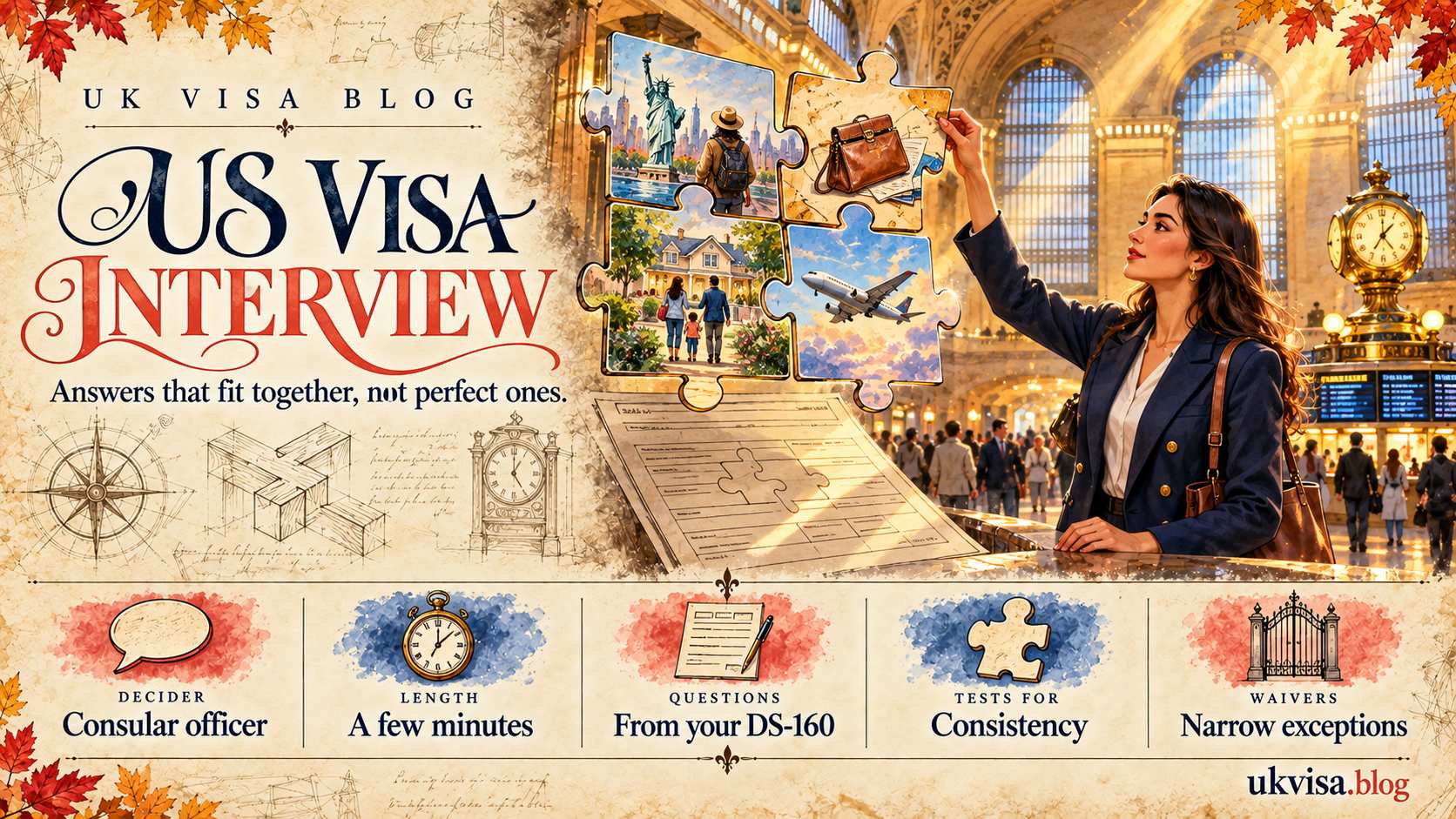
The consular officer must decide whether you qualify for the category you applied for and whether you have overcome the presumption that you intend to immigrate. Most interviews last a few minutes. Questions are drawn from your DS-160 and are designed to test consistency and plausibility, not knowledge. Since 2 September 2025 almost all applicants must be interviewed, with only a narrow list of exceptions.
Officers are not looking for perfect answers. They are looking for answers that fit together: a purpose of travel that matches your circumstances, funding that matches your means, and a plan that matches the time you can actually be away. An answer that contradicts the DS-160 is more damaging than an answer that is merely thin.
Who Still Qualifies for an Interview Waiver
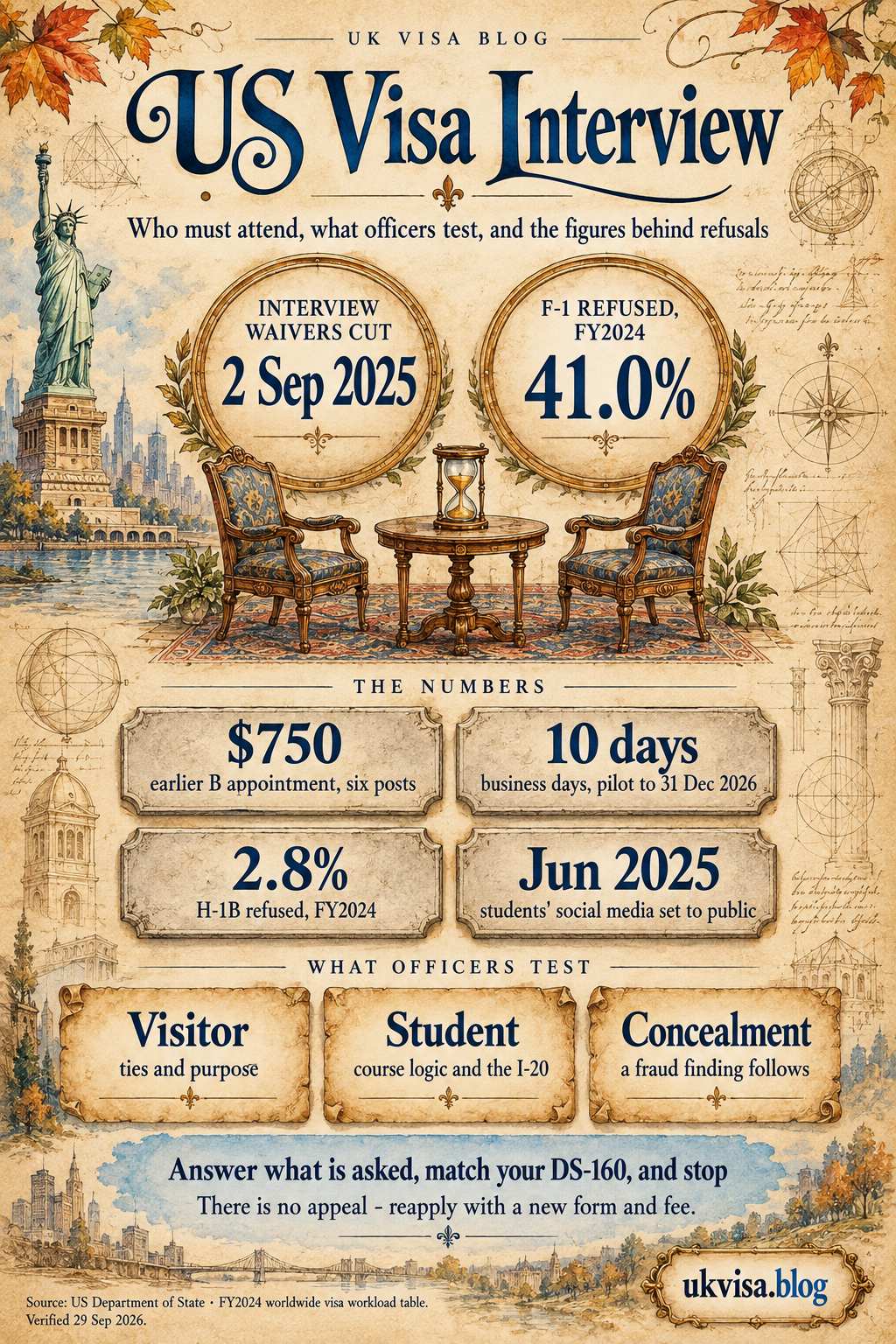
Under the policy effective 2 September 2025, waivers survive only for a short list: applicants in the A-1, A-2, C-3, G-1 to G-4, NATO-1 to NATO-6 and TECRO E-1 classifications, diplomatic and official-type applicants, and certain renewals. Age-based exemptions for applicants under 14 and over 79 have been removed entirely.
The Renewal Waiver and Its Conditions
B-1, B-2, B-1/B-2 and Border Crossing Card holders may still qualify when renewing within twelve months of expiry, provided the previous visa was issued for full validity and the applicant was at least eighteen when it was issued. The same applies to H-2A renewals. Every waiver applicant must also apply in their country of nationality or residence, have never been refused a visa, and have no apparent or potential ineligibility.
Paying for an Earlier Appointment
A pilot running from 18 August 2026 to 31 December 2026 lets B visa applicants pay $750 for an interview appointment within ten business days, subject to availability, at Mission Canada, Mission Mexico, Embassy Bogota, Embassy Guatemala City, Embassy San Jose and Embassy Tegucigalpa. The fee is separate from and additional to the visa application fee, is not refundable, and buys only an earlier appointment.
Visitor Visa Interviews
Visitor interviews are the shortest and the most heavily weighted toward ties. The officer is testing whether the trip described is the trip you will actually take, and whether your life at home gives you a reason to come back. Questions cluster around four themes.
The Four Themes Officers Return To
Purpose: what you will do, where, and for how long. Funding: who is paying, and how that is affordable on the income you have declared. Ties: your job, business, studies, property and dependants. History: previous US travel, previous refusals, and whether you left on time. A vague answer on any one of these invites more questions on the others.
Why a Long Trip Attracts Scrutiny
A six-month stay is permitted in principle, but an applicant in full-time employment who asks for six months has to explain how the job survives the absence. If the honest answer is that you are between roles, say so and explain what you are returning to. Concealing it usually produces exactly the outcome you were trying to avoid.
Student Visa Interviews
Student interviews are longer and more substantive because the officer must probe both academic credibility and funding. The category is also the hardest to win: the FY2024 worldwide workload table records 400,737 F-1 visas issued against 278,553 refused, a 41.0% refused share.
Course, School and Career Logic
Expect questions on why this course, why this institution, how you chose it, what you will do with the qualification and how it fits what you have already studied or done. An applicant who cannot name the department or explain why they turned down other offers is describing a plan they have not made. That is a credibility problem before it is an intent problem.
Funding Evidence and the Sponsor
The officer works from the figure on your I-20 and asks how it will be met. If a relative is paying, expect questions about their income, their occupation and their relationship to you. Funds that appeared in an account shortly before the application will be asked about, and an unconvincing answer here accounts for a large share of student refusals.
Social Media Must Be Public
Expanded screening has applied to F, M and J applicants since June 2025 and to H-1B applicants since December 2025, and from 30 March 2026 it covers a further list of classifications. Applicants in scope are instructed to set the privacy settings on all their social media profiles to “public” or “open” before applying. Leaving an account private does not refuse the case, but it can delay it past the start of term.
Work Visa Interviews
Petition-based interviews are different in kind. USCIS has already approved a petition establishing the role, the employer and the qualifications, so the consular officer is confirming identity and admissibility and testing whether the petition describes reality. Refusal rates reflect that: 2.8% for H-1B on FY2024 figures, 3.9% for L-1.
What Officers Test
Expect questions on your job title and duties, your employer, your salary, where you will physically work, and who supervises you. Where the work is at a client site, the officer will want to understand the arrangement, because the petitioning employer must genuinely control the work. Answers that do not match the petition are the main source of trouble.
Dual Intent Changes the Tone
H-1B and L-1 permit dual intent, so an applicant who has a pending immigrant petition is not penalised for saying so. That is a meaningful difference from the visitor and student categories, where the same disclosure is fatal. Answer questions about long-term plans honestly and according to the rules of the category you are in.
Fiancé(e) Visa Interviews
K visa interviews test the relationship itself. The application fee is $265, higher than the standard nonimmigrant rate, and the interview is correspondingly more detailed. The officer is establishing that the relationship is genuine, that the couple have met, and that the marriage is intended within the permitted period after entry.
The Shape of the Questioning
Questions cover how you met, how the relationship developed, how often you have seen each other in person, what your partner does, their family circumstances, and your wedding plans. Inconsistency between the two accounts matters more than any single answer. Bring evidence of the relationship’s history rather than relying on assertion.
Preparing Properly
Preparation is not rehearsal. The aim is to be able to answer plainly and consistently, with documents available if asked for. The checklist below reflects what officers actually work from.
- Your DS-160 confirmation: read your own form again before you attend, because every question comes from it and small errors read as inconsistencies.
- Appointment confirmation and passport: the passport must be valid for your intended stay and you will normally collect it back after biometrics.
- Category-specific evidence: the I-20 and funding proof for students, the petition receipt for work applicants, relationship evidence for K applicants.
- Your own numbers: your salary, your funding total and your trip dates, in figures you can state without checking.
- An honest account of any refusal: including a 221(g) later resolved, since every application asks and the record is already held.
The Mistakes That Cost Applications
Most avoidable refusals come from a small set of behaviours, none of which involve missing documents.
Rehearsed Answers and Volunteered Plans
A memorised answer sounds like a memorised answer, and it invites the officer to test it. Equally damaging is volunteering information the officer did not ask for, particularly about long-term hopes of living or working in the United States on a route that does not permit dual intent. Answer the question asked, accurately, and stop.
Concealment Is Worse Than the Fact
An old overstay, a refusal, or a period of unauthorised work is a problem you can usually address. Denying it creates a potential finding of fraud or misrepresentation under section 212(a)(6)(C)(i), which attaches to you rather than to the application and follows every future filing. The grounds of ineligibility are worth reading before you complete the form.
Treating the Interview as the Whole Case
The interview is short because most of the assessment is already on paper. If your DS-160, your funding and your ties do not support the trip, a good performance will not rescue it. Conversely, a nervous applicant with a coherent, documented case is not refused for being nervous. Officers interview hundreds of people a week and expect nerves.
Sources: US Department of State, interview waiver policy effective 2 September 2025; the expedited appointment pilot programme; the expanded screening and vetting announcement of 30 March 2026; and the visitor visa guidance. Category refusal volumes are from the FY2024 worldwide workload table, analysed in our review of the published refusal data.
Route requirements are covered in our B-1 and B-2 guide, costs in our fee breakdown, British charges in our Home Office fee guide and naturalisation costs in our N-400 cost guide. Figures verified 24 August 2026.
Frequently Asked
Questions about the US visa interview
Almost everyone. Since 2 September 2025 the State Department requires an in-person interview for nonimmigrant applicants including those under 14 and over 79, with exceptions only for certain diplomatic and official classifications and a narrow set of renewals. The previous age-based exemptions no longer exist.
Only within tight conditions. B-1, B-2, B-1/B-2 and Border Crossing Card renewals qualify within twelve months of expiry if the previous visa was issued for full validity and you were at least eighteen when it was issued. You must also apply in your country of nationality or residence, never have been refused, and have no apparent ineligibility.
Usually a few minutes for visitor applications, longer for student and fiancé(e) cases where the officer must probe funding or relationship history. The brevity is not a sign the case is going badly. Most of the assessment is already done from the DS-160 and supporting evidence before you reach the window.
At six posts only, and for B visas only. A pilot running from 18 August 2026 to 31 December 2026 offers an appointment within ten business days for $750 at Mission Canada, Mission Mexico, Embassy Bogota, Embassy Guatemala City, Embassy San Jose and Embassy Tegucigalpa. The fee is additional to the application fee and is not refundable.
No. The State Department is explicit that payment does not guarantee visa issuance or expedited processing and provides only an earlier appointment. If the case goes into administrative processing afterwards, the expedite fee does nothing to shorten it.
If you are in scope of the expanded screening, you are instructed to set the privacy settings on all your social media profiles to public or open. That covers F, M and J applicants, H-1B applicants and a list of other classifications. A private account is not a refusal ground but commonly causes delay.
Your DS-160 confirmation, appointment confirmation and passport, plus the evidence specific to your category: the I-20 and funding proof for students, the petition receipt for work applicants, relationship evidence for K applicants. Officers often ask for nothing, but being unable to produce a document when asked is avoidable.
Not unless you are asked, and not on a route without dual intent. Visitor, student and exchange categories are decided against the presumption of immigrant intent, so volunteering a long-term wish to settle undermines the application. H-1B and L-1 permit dual intent, so the same disclosure is not damaging there.
There is no appeal. You may reapply with a new form and a new fee, and a different officer will decide it. Reapplying with the same evidence rarely changes the result. If the refusal was under section 221(g), you have one year from the refusal date to supply the documents requested before you must start again.
No. Officers interview large numbers of people daily and expect applicants to be anxious. What matters is whether your answers are consistent with your form and with each other. A calm applicant whose account does not add up is in more difficulty than a nervous one whose case is coherent.