
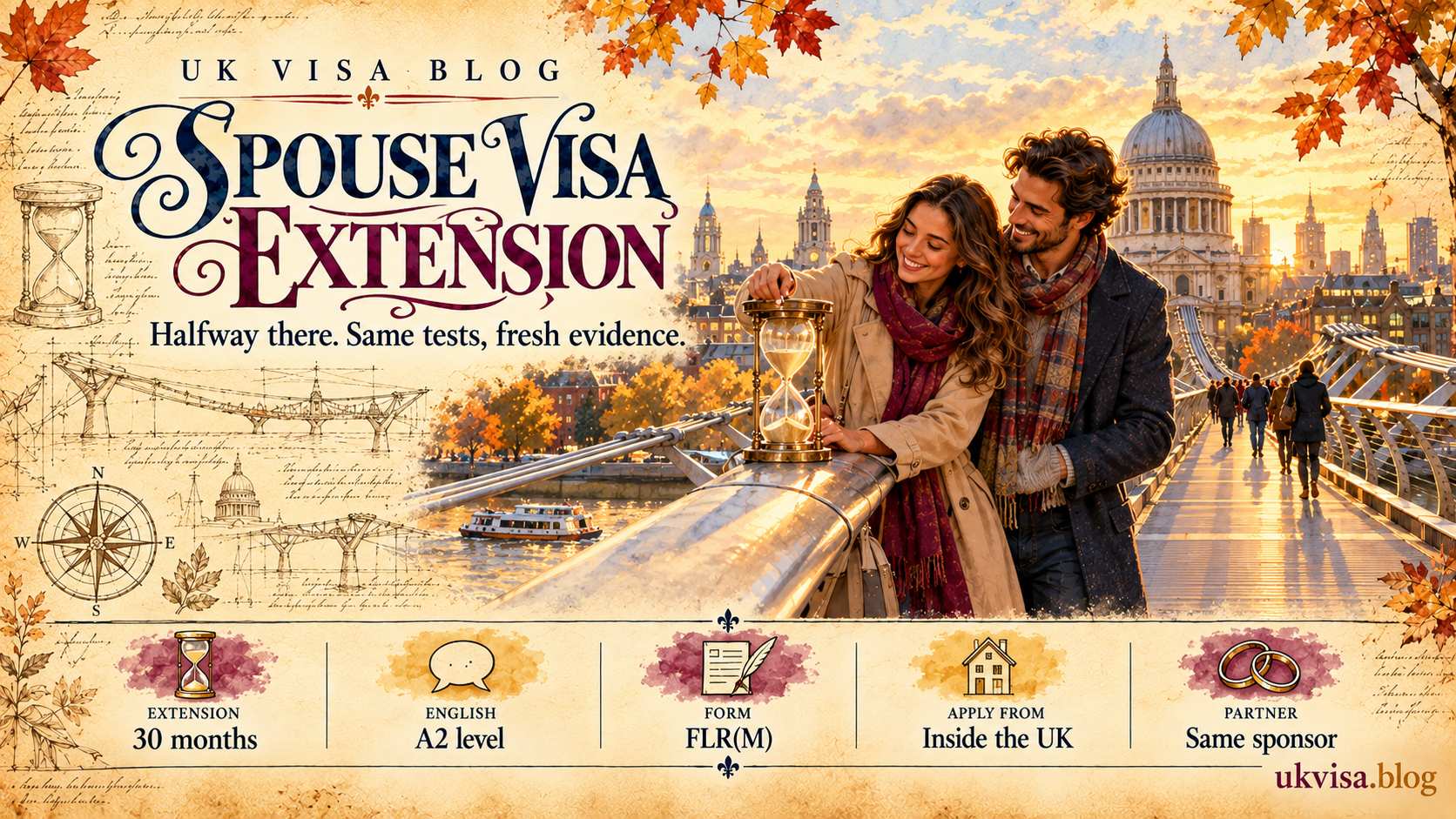
A spouse visa extension adds 30 months on form FLR(M) and costs £1,407 plus £2,587.50 of health surcharge. One thing gets easier — both partners’ incomes now count towards the £29,000. One rule is almost universally misreported, and it concerns when you are allowed to apply.
UK Family Visas
Spouse Visa Extension Requirements UK: Overview 2026
What Are the Spouse Visa Extension Requirements?
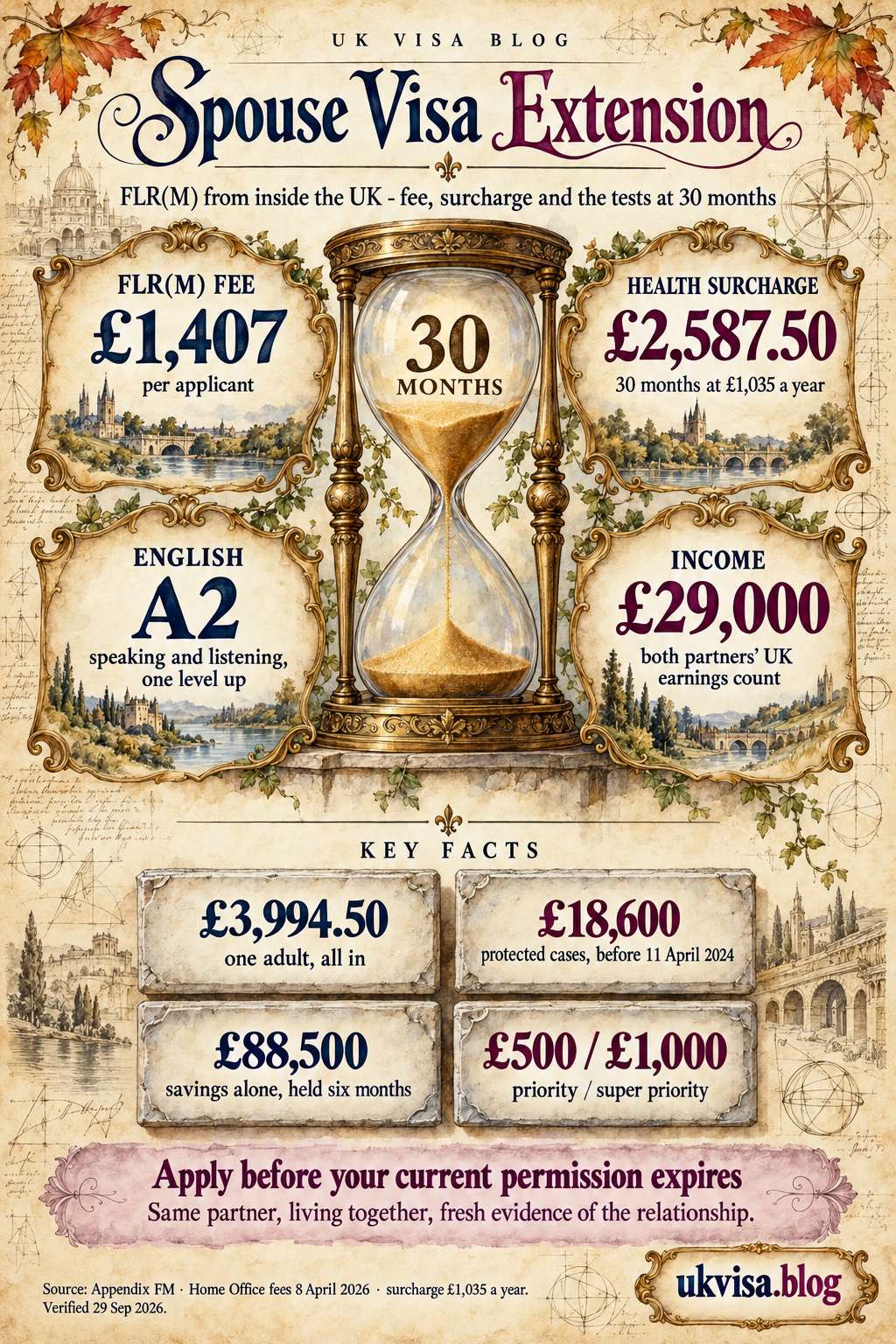
You must still be in a genuine and subsisting relationship with the same partner, meet the £29,000 financial requirement, pass English at A2, have adequate accommodation and clear the suitability rules. You apply on form FLR(M) from inside the UK before your current permission expires. From 8 April 2026 the fee is £1,407, plus £2,587.50 of Immigration Health Surcharge for the 30-month grant.
The tests are the same ones that carried the first UK Spouse visa application, applied to fresh evidence. The extension grants another 30 months, which with the initial 33 or 30 months brings you to the five-year qualifying period for settlement.
What You Must Show at Extension
| Requirement | At the extension stage |
|---|---|
| Relationship | Still married or in a civil partnership, still living together, with fresh evidence |
| Financial | £29,000, or £18,600 for protected pre-April 2024 cases, or £88,500 in savings |
| English | A2 speaking and listening, one level above the first application |
| Accommodation | Adequate and not overcrowded under the Housing Act 1985 |
| Sponsor | The same partner, still British, Irish, settled or with protection status |
| Suitability | No serious criminality, immigration breach or deportation order |
| Location | You must be physically in the UK — the extension cannot be made from abroad |
Source: Appendix FM; fee table of 8 April 2026; IHS at £1,035 a year.
Both Incomes Count Now
On an entry clearance application only the sponsor’s income is admissible. At extension the applicant’s UK earnings are added to it, because they have been living and working here on a visa that permits work. Two ordinary salaries clear £29,000 where one did not, and that single change resolves most extension anxiety.
Each partner’s income needs its own complete evidence — payslips, matching bank statements and an employer’s letter — under Category A or B. Full detail on the categories sits in our UK Spouse visa financial requirements guide.
When and How to Extend
Apply on the FLR(M) partner form online. The application must be made from inside the UK and before your current permission runs out. What is widely misstated is when the window opens.
The 28-Day Rule Is Not What Most Guides Say
GOV.UK is explicit: you can extend at any time before your current permission expires. There is no earliest date and no risk of refusal for applying too soon. The 28-day figure is about something else entirely — where you extend with the same family member, only up to 28 days of unused permission is carried over onto the new grant.
So applying three months early does not invalidate anything; it simply forfeits some of the time you already paid for. Applying with a few weeks left is usually the sensible balance between protecting the leave you hold and leaving room to answer a request for documents.
Apply while your permission is still valid and section 3C extends it automatically, with your work rights intact, until a decision is made. Miss the expiry date and you are an overstayer, exposed to removal and to a UK re-entry ban, with your continuous leave broken. Section 3C leave also ends if you leave the UK while the application is pending — do not travel until it is decided.
Five-Year Route and Ten-Year Route Compared
| Route | Extensions needed | Time to settlement |
|---|---|---|
| Five-year route | One FLR(M) | Five years |
| Ten-year route | Three FLR(M) applications | Ten years |
Source: Appendix FM and Appendix Settlement Family Life.
Applicants placed on the 10-year route to settlement — usually on Article 8 grounds where a requirement could not be met — can move across once they meet everything, but the five-year clock restarts from zero. Our exceptional circumstances guide covers how people end up there.
Settlement Is Still Five Years for Partners of British Citizens
The earned settlement consultation, which closed on 12 February 2026, expressly carves out people admitted as the partner, parent or child of a British citizen who have held that status throughout the qualifying period. They keep settlement at five years, and that treatment was not put out to consultation. No rules have yet been laid.
Extension Documents Checklist
The extension needs updated evidence rather than the original bundle resubmitted. Cohabitation across the last two and a half years is the part people underprepare, because it accumulates quietly and nobody keeps it deliberately.
- Identity: valid passports for both partners and your eVisa share code.
- Relationship: the marriage or civil partnership certificate.
- Cohabitation: joint statements, utility bills and council tax from several sources spread across the whole period.
- Financial: six months of payslips, employer letters on headed paper and matching bank statements — for each partner whose income is counted.
- English: an A2 SELT certificate, or evidence of an exemption.
- Accommodation: tenancy agreement with the landlord’s consent, mortgage statement or proof of ownership.
- Children: birth certificates, school letters and care arrangements where dependants are included.
Financial documents must be dated no earlier than 28 days before submission. The wider inventory sits in our spouse visa supporting documents guide, and housing standards in the accommodation guide.
Process and Fees from 8 April 2026
The application is completed online, paid for at submission, and finished with a biometrics appointment. Nothing is posted, and the permission itself arrives as a digital record rather than a card.
Extension Costs from 8 April 2026
| Charge | Amount | Notes |
|---|---|---|
| FLR(M) application | £1,407 | Per applicant; was £1,321 |
| Health surcharge, 30 months | £2,587.50 | Adult, at £1,035 a year |
| Health surcharge, child | £1,940 | At £776 a year |
| Standard total, one adult | £3,994.50 | Fee plus surcharge |
| Priority service | £500 | Target five working days, where offered |
| Super priority service | £1,000 | Target next working day |
Source: Home Office immigration and nationality fees, 8 April 2026.
Surcharge rates are unchanged despite the April fee rise. Costs across the whole route sit in our Home Office fees guide.
The Steps in Order
- Test first: sit the A2 SELT if you are not exempt and do not already hold a higher certificate.
- Gather evidence: relationship, cohabitation, income for both partners, accommodation.
- Complete FLR(M): online, while your current permission is still valid.
- Pay: £1,407 plus £2,587.50 of surcharge at the point of submission.
- Book biometrics: through Sopra Steria’s UKVCAS service.
- Upload documents: to the application, or take them to the appointment.
- Wait: around eight weeks as standard, protected throughout by section 3C leave.
- Receive the eVisa: in your UKVI account — biometric residence permits are no longer issued.
Processing Times
Standard decisions take about eight weeks from biometrics. Priority targets five working days and super priority the next working day. Self-employment, combined income categories and unusual evidence all slow cases down whichever service is bought — see our UK visa extension processing time guide.
English at the Extension Stage
A2 speaking and listening is required, from a UKVI-approved provider. If your first application was carried by a certificate at A2 or above, that same certificate works again — even expired — provided the provider has not withdrawn it. Only an A1-only history means a new test.
English Level by Stage
| Stage | Level | Also required |
|---|---|---|
| First application | A1 | — |
| FLR(M) extension | A2 | — |
| SET(M) settlement | B1, or B2 from 26 March 2027 | Life in the UK test |
| Naturalisation | B1 | Life in the UK test |
Source: Appendix FM; Appendix KoLL paragraph 2.2; HC 1691 of 5 March 2026.
Exemptions for nationality, age 65 or over, an English-taught degree and medical grounds all apply here as elsewhere — see our UK Spouse visa English requirement guide. Test fees vary by provider and country, so take the figure from the provider’s own booking page.
After the extension you approach the five-year mark and UK Spouse visa ILR, which needs B1 English and the Life in the UK test (KoLL) — start both during the extension period. If an application goes wrong, see our guides to the common reasons for spouse visa refusal and the refusal appeal process. Sources: the family visa extension pages on GOV.UK; Appendix FM of the Immigration Rules; and the earned settlement consultation document of 12 February 2026. Figures verified 22 August 2026.
Frequently Asked
Questions about the UK Spouse Visa Extension
A continuing genuine and subsisting relationship with the same partner, the £29,000 financial requirement — or £18,600 if protected from before 11 April 2024, or £88,500 in savings — A2 English, adequate accommodation, and no suitability problem. You apply on form FLR(M) from inside the UK before your current permission expires. Both partners’ incomes count at this stage.
At any time before your current permission expires. GOV.UK sets no earliest date, and an early application is not refused for being early. What the 28-day figure actually means is that when you extend with the same family member, only up to 28 days of unused permission is added to the new grant — so applying very early forfeits time you have already paid for.
From 8 April 2026, £1,407 for the FLR(M) application plus £2,587.50 of Immigration Health Surcharge for the 30-month grant — £3,994.50 in total for one adult. A dependent child pays £1,407 plus £1,940 of surcharge. Priority adds £500 and super priority £1,000 where those services are offered.
Yes, provided you applied before your permission expired. Section 3C extends your existing permission on the same conditions, including full work rights, until the application is decided. Do not leave the UK while it is pending: departure ends section 3C leave, and you would have to apply for entry clearance from abroad instead.
Only if your last certificate was at A1. A2 speaking and listening is required at the extension, and any earlier certificate at A2 or above satisfies it — even after its two-year validity has run out, provided the provider has not withdrawn the award. Exemptions for nationality, age 65 or over, an English-taught degree and medical grounds all still apply.
Yes, and it is the main advantage of applying from inside the UK. On the first application from abroad only the sponsor’s income counts. At extension the applicant’s UK earnings are added, because they hold permission to work. Each income needs its own full set of payslips, bank statements and employer letter under Category A or B.
About eight weeks from biometrics as standard. Priority targets five working days and super priority the next working day. Self-employed income, combined categories and any request for further evidence extend that regardless of the service purchased. Section 3C leave protects your status and your right to work for as long as it takes.
Both passports and your eVisa share code, the marriage certificate, cohabitation evidence spread across the whole period, six months of payslips and matching bank statements for each income counted, an employer letter, an A2 certificate or exemption proof, and accommodation evidence. Financial documents must be dated no earlier than 28 days before submission.
Yes. The earned settlement consultation that closed on 12 February 2026 expressly carves out people admitted as the partner, parent or child of a British citizen who have held that status throughout the qualifying period: they settle after five years as now, and that treatment was not put out to consultation. No implementing rules have been laid.