
A US visa costs more than the headline fee. The application fee is $185 for most categories, but students add a SEVIS charge, work routes add petition and employer fees, and Visa Waiver travellers pay a separate ESTA charge that rose on 1 January 2026. This guide sets out every published amount and who actually pays it.
US Visas
US Visa Fees for Visitors, Students and Workers
The Machine Readable Visa Application Fee
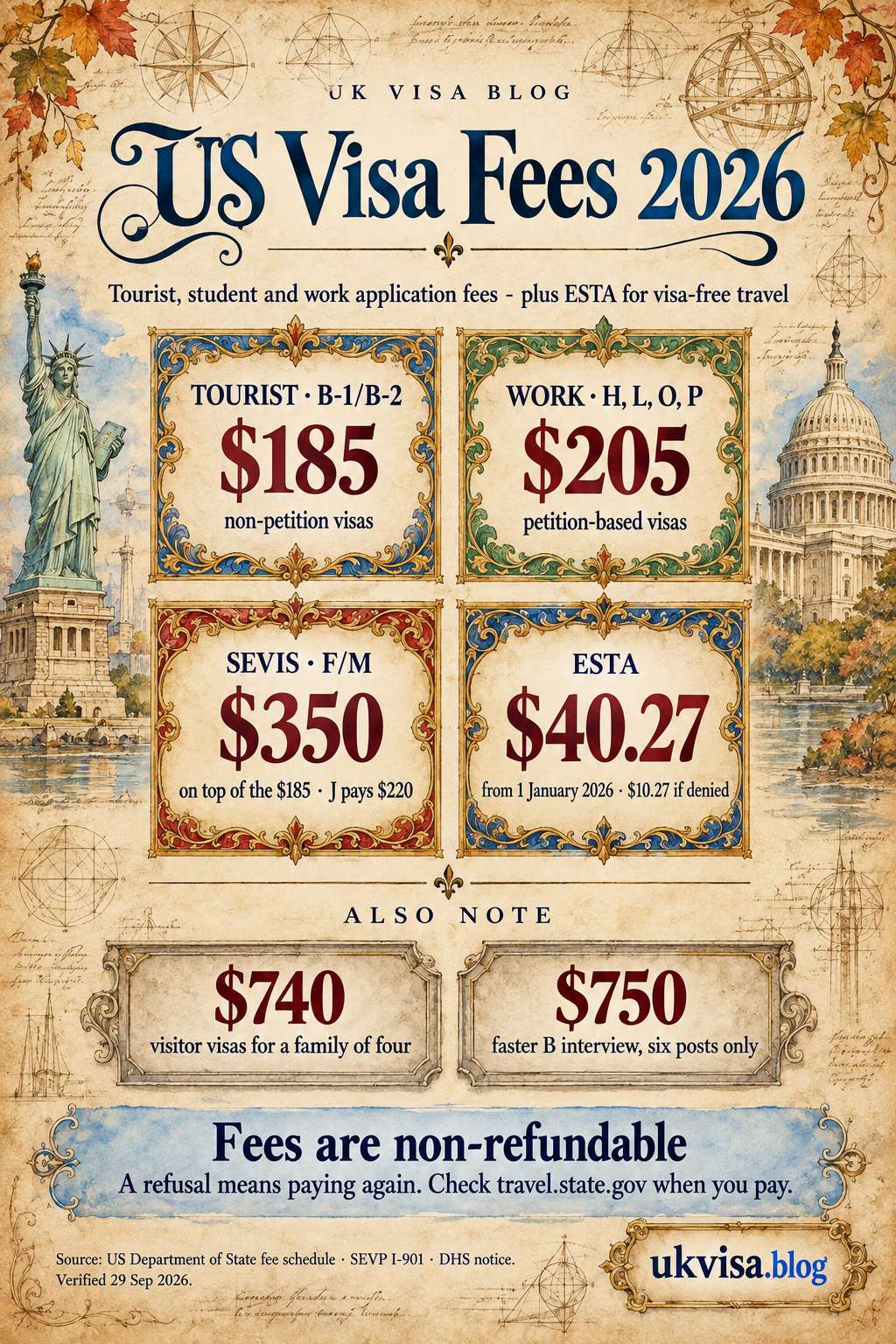
The application fee, often called the MRV fee, is $185 for non-petition-based categories including B, C-1, D, F, I, M and TN, and $205 for petition-based categories including H, L, O, P, Q and R. E visas cost $315 and K fiancé(e) visas $265. The fee is paid before booking the interview and is never refunded, whatever the outcome.
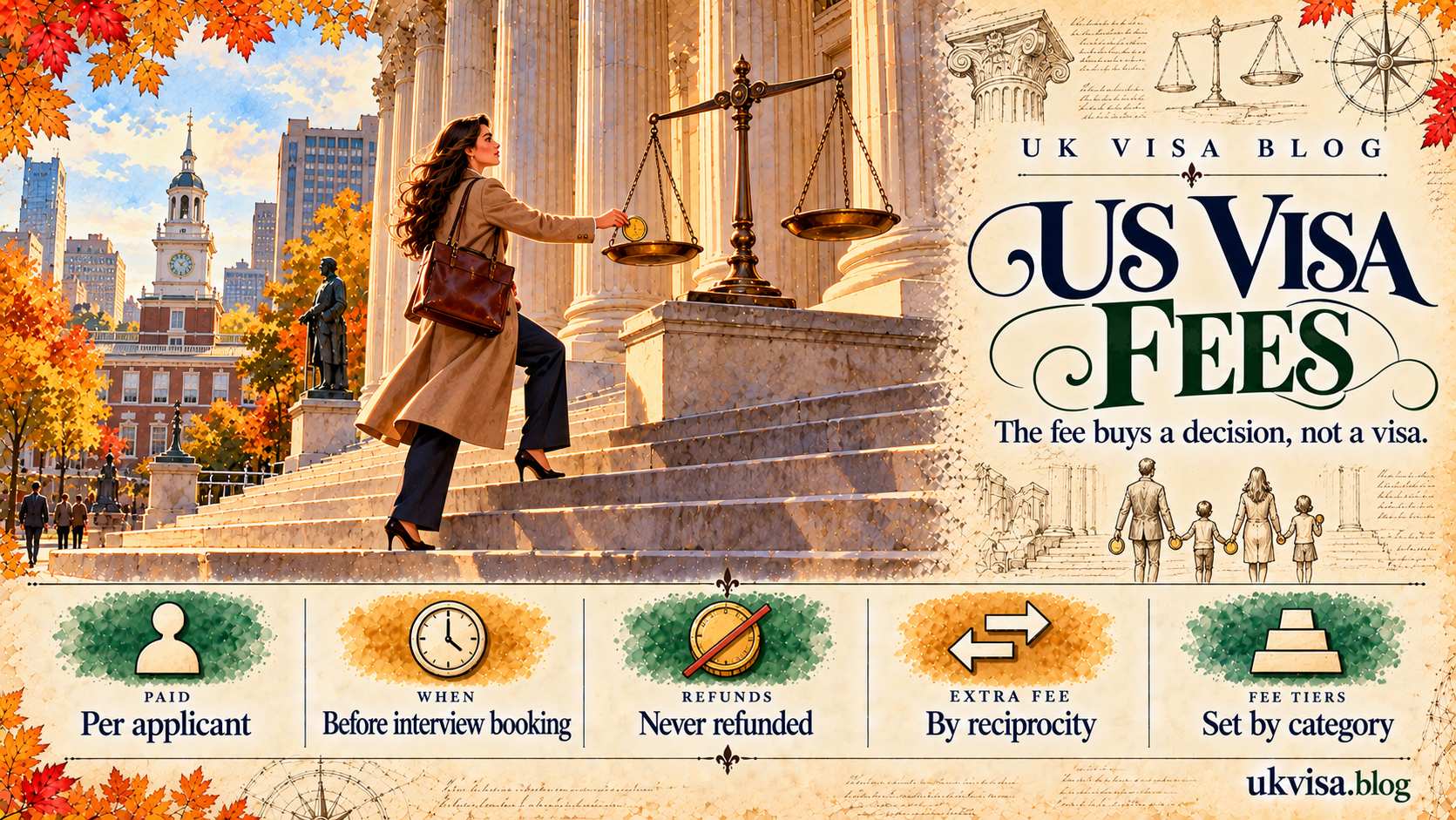
The fee buys adjudication, not a visa. The State Department describes it as “a non-refundable application processing fee”, and a refusal does not entitle you to any part of it back. Where an application is refused and you decide to try again, you pay it again, unless you are responding to a section 221(g) document request within the one-year window.
One Fee, One Applicant
The fee attaches to the person, not the trip. Every traveller needs their own application and their own payment, including infants and children, so a family of four applying for visitor visas pays $740 before anything else. Families frequently budget for one fee and are caught out at the point of booking interviews, which cannot be done until each payment has cleared.
Reciprocity and Issuance Fees
Some nationalities pay a further issuance fee once the visa is approved, set by reciprocity with the fees their own country charges US citizens. It varies by nationality and by visa class, and is separate from the application fee. Check the reciprocity table for your own country before budgeting, because for a few nationalities it is substantial.
Every Published Visa Fee
The consular fee schedule sets one price per category, worldwide. The table below covers the nonimmigrant and immigrant fees most applicants encounter.
Nonimmigrant Application Fees
| Category | Fee |
|---|---|
| Non-petition-based: B, C-1, D, F, I, M, TN/TD, S, T, U | $185 |
| Petition-based: H, L, O, P, Q, R | $205 |
| E treaty trader and treaty investor | $315 |
| K fiancé(e) and spouse | $265 |
| Border crossing card, age 15 and over | $185 |
| Border crossing card, under 15 | $15 |
Source: US Department of State, fees for visa services, travel.state.gov.
Immigrant Visa and Related Fees
| Item | Fee |
|---|---|
| Immediate relative and family preference application | $325 |
| Employment-based application | $345 |
| Other immigrant visa application | $205 |
| Diversity Visa application | $330 |
| Affidavit of support review | $120 |
| Immigrant petition, Form I-130 | $675 |
| Orphan petition, Forms I-600 and I-800 | $775 |
| Returning resident status | $180 |
| Transportation letter | $575 |
Source: US Department of State, fees for visa services, travel.state.gov.
Immigrant Applicants Pay at Both Ends
Family immigration carries two separate bills. The petition is filed with USCIS on Form I-130 at $675, and only then does consular processing begin, adding $325 for an immediate relative or family preference application and $120 for review of the affidavit of support. That is $1,120 in government charges before medical examinations, translations or travel.
The SEVIS Fee Students and Exchange Visitors Pay
Students and exchange visitors pay a separate I-901 SEVIS fee before the interview, in addition to the $185 application fee. It is $350 for F and M applicants and $220 for J applicants. Certain subsidised J categories pay $35, and government-sponsored exchange visitors pay nothing. The receipt is normally needed at the interview.
ESTA and Border Fees
Travellers who do not need a visa still pay. From 1 January 2026 the Department of Homeland Security adjusted a group of fees for inflation, using a 2.70% increase in the Consumer Price Index between July 2024 and July 2025.
Fees Payable Without a Visa, from 1 January 2026
| Item | Fee |
|---|---|
| ESTA travel authorisation | $40.27 |
| ESTA where the application is denied | $10.27 |
| EVUS enrolment | $30.75 |
| Form I-94 at a land border, including the $6 land border fee | $30 |
| Parole fee under Public Law 119-21 | $1,020 |
Source: Federal Register notice, Certain DHS Immigration Fees Required by HR-1: Fiscal Year 2026 Adjustments for Inflation.
Paying for an Earlier Interview
A pilot running from 18 August 2026 to 31 December 2026 offers B visa applicants an interview appointment within ten business days for $750, at Mission Canada, Mission Mexico, Embassy Bogota, Embassy Guatemala City, Embassy San Jose and Embassy Tegucigalpa. It is additional to the $185 fee, is forfeited if you cancel or fail to attend, and buys only the appointment.
The Visa Integrity Fee
A $250 visa integrity fee for nonimmigrant visas was created by the reconciliation legislation enacted as Public Law 119-21 in July 2025. It has been widely reported, and applicants budgeting for a US trip frequently ask whether they should now add it.
What Is Verifiable Today
The fee does not appear on the State Department’s published schedule of fees for visa services. The Department’s most recent consular fee rule, a temporary final rule effective 1 July 2026, creates the expedited appointment fee and does not mention a visa integrity fee at all. No collection start date has been published on travel.state.gov.
What That Means for Budgeting
Treat the $250 as a statutory provision awaiting implementation rather than a charge you will be asked for at the moment of applying. Check the consular fee schedule at the point of payment, because that page is the operative source, and any third-party fee calculator that already includes the charge is running ahead of the published position.
What British Applicants Actually Pay
Most British travellers never pay a visa fee. Visa Waiver Program nationals with an e-passport can travel for 90 days or less on an approved ESTA, so the total cost of a holiday trip is $40.27. The visa route becomes necessary only in specific circumstances.
When the Programme Is Closed to You
You cannot use an ESTA if you have ever been refused a US visa, or if you have travelled to certain listed countries since the applicable cut-off dates. In those cases the B-1/B-2 route and its $185 fee apply, along with an interview. Our guide to the visitor visa covers the process, and the grounds of refusal explain why a single old refusal has such lasting effect.
British Students and Workers
A British student pays $185 plus the $350 SEVIS fee. A British employee moving on an L-1 pays $205, with the employer meeting the petition and fraud prevention costs. Neither the expedited appointment pilot nor its $750 charge currently operates at any post in the United Kingdom.
The Extra Costs on Work Routes
Employment categories carry charges that fall on the employer rather than the applicant, and they dwarf the consular fee. They are worth knowing about because they shape whether a sponsor is willing to file at all.
Employer and Petition Charges
| Charge | Amount |
|---|---|
| L visa fraud prevention and detection fee | $500 |
| H-1B and L-1 employer fee for large petitioners | $4,500 |
| Proclamation payment on new H-1B petitions, currently not collected | $100,000 |
Sources: US Department of State fee schedule; USCIS H-1B FAQ, last updated 28 July 2026.
The H-1B Payment Is Currently Blocked by the Courts
The proclamation of 19 September 2025 required a one-time $100,000 payment with new H-1B petitions filed after 21 September 2025, including the 2026 lottery. It never applied to petitions filed before that date, to already approved petitions, to renewals, or to travel by existing visa holders.
On 8 June 2026 the US District Court for the District of Massachusetts vacated the guidance implementing it. The First Circuit refused to stay that order on 24 July 2026, and USCIS states it will comply while it considers next steps, adding that it still plans to collect the payment if the order is later lifted. Employers should confirm the position with USCIS before filing.
Exemptions, Reductions and Refunds
Genuine exemptions are narrow, and refunds are narrower still. The points below are the ones that come up most often.
- Subsidised J categories: pay $35 rather than $220 for the SEVIS fee, and government-sponsored exchange visitors pay nothing.
- Diplomatic and official applicants: A, G, NATO and related classifications are not charged the standard application fee.
- Children under 15 for border crossing cards: pay $15 rather than $185, where the parent qualifies.
- Military naturalisation: no fee is charged for applicants filing under sections 328 and 329 of the Immigration and Nationality Act.
- No refund on refusal: the application fee is non-refundable in every category, and a fresh application after a refusal means paying again.
Sources: US Department of State, fees for visa services; the temporary final rule on consular service fees effective 1 July 2026; the expedited appointment pilot; the I-901 SEVIS fee schedule; and the Federal Register notice on FY2026 DHS fee adjustments.
Refusal statistics are analysed in our review of the published data, interview practice in our preparation guide, British charges in our Home Office fee guide, and naturalisation costs in our N-400 cost guide. Figures verified 24 August 2026.
Frequently Asked
Questions about US visa fees
$185. That is the standard application fee for non-petition-based categories, which includes B-1 and B-2 visitor visas as well as F student, M vocational and C-1 transit visas. It is paid before the interview is booked and is not refunded if the application is refused.
No. The State Department describes the fee as a non-refundable application processing fee. If you reapply you pay it again. The single exception is a section 221(g) refusal, where you have one year from the refusal date to supply the requested documents without paying a new fee.
$40.27 from 1 January 2026, or $10.27 where the application is denied. The increase came from an annual inflation adjustment based on a 2.70% rise in the Consumer Price Index between July 2024 and July 2025. EVUS enrolment was set at $30.75 in the same notice.
It does not appear on the State Department’s published fee schedule, and the Department’s most recent consular fee rule does not mention it. The provision exists in Public Law 119-21 but no collection start date has been published. Check the official fee page at the point of payment rather than relying on third-party calculators.
The I-901 SEVIS fee, on top of the $185 application fee. It is $350 for F and M applicants and $220 for J exchange visitors, with $35 for certain subsidised J categories and nothing for government-sponsored visitors. Pay it before the interview and keep the receipt.
Because they are petition-based. The consular application fee for H, L, O, P, Q and R is $205 rather than $185. The larger costs sit with the employer: a $500 fraud prevention and detection fee on L petitions, and a $4,500 fee on certain large H-1B and L-1 petitioners.
Not at present. The guidance implementing the September 2025 proclamation was vacated by the District of Massachusetts on 8 June 2026, and the First Circuit refused to stay that ruling on 24 July 2026. USCIS says it is complying while it considers next steps, and that it still plans to collect if the order is lifted. Confirm with USCIS before filing.
Only for B visas at six posts, under a pilot running to 31 December 2026: Mission Canada, Mission Mexico, Embassy Bogota, Embassy Guatemala City, Embassy San Jose and Embassy Tegucigalpa. It buys an appointment within ten business days subject to availability, is additional to the $185 fee, and is forfeited if you cancel or do not attend.
An issuance fee charged to some nationalities after approval, set to mirror what their own country charges US citizens for an equivalent visa. It depends on nationality and visa class and is separate from the application fee. Check the reciprocity table for your country before budgeting, as amounts vary widely.
Diplomatic and official applicants in the A, G, NATO and related classifications are not charged. Elsewhere the exemptions are narrow: reduced SEVIS rates for certain J categories, a $15 border crossing card fee for children under 15, and no fee for military naturalisation applicants under sections 328 and 329.