
Free movement ended, and what replaced it for EU, EEA and Swiss citizens already here is the EU Settlement Scheme. Pre-settled status is now extended automatically before it expires, and many holders are converted to settled status without applying. Everything else — visiting, working, joining family — runs on the ordinary immigration system.

EU Citizens
EU Citizens’ Rights in the UK in 2026
What Changed, and For Whom
The distinction that matters is not nationality but timing. EU, EEA and Swiss citizens resident in the UK before the end of the transition period could protect their position through the EU Settlement Scheme. Everyone else is treated like any other national of a country outside the UK.
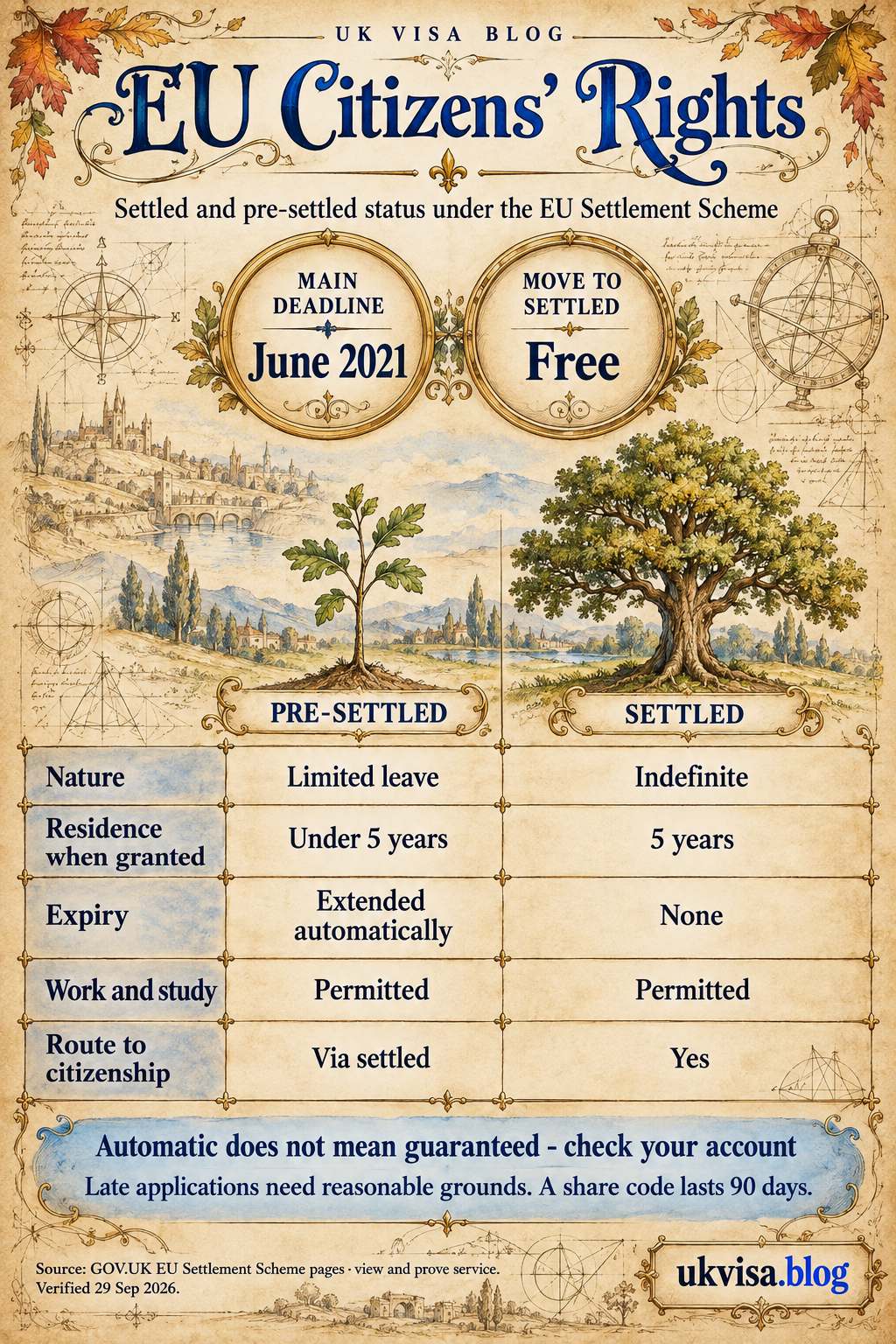
The main scheme deadline was 30 June 2021, though late applications remain possible in defined circumstances and joining family members have their own deadlines. Pre-settled status is extended automatically by five years before it expires, with email notification, and many holders are converted to settled status automatically. Applying to move from pre-settled to settled is free.
Who the Scheme Covers
- EU, Swiss, Norwegian, Icelandic and Liechtenstein citizens: resident before the deadline.
- Their family members: including those joining later, with their own deadlines.
- Family members of eligible people of Northern Ireland: under the specific provision for them.
- Late applicants: where reasonable grounds for the delay exist.
Free Movement and What Replaced It
Under free movement, an EU citizen’s right to live and work in the UK came from EU law directly and needed no permission from the Home Office. There was no application, no fee and no document, which is precisely why the transition was so administratively awkward: millions of people had a status that had never been recorded anywhere.
The Settlement Scheme converted that into UK immigration status, granted person by person. The rights are broadly preserved for those covered, but the mechanism is entirely different — status now exists because it was applied for and granted, and it can be lost in ways free movement rights could not.
The Northern Ireland Provision
There is a specific route for family members of eligible people of Northern Ireland, reflecting the position of those who may identify as Irish, British or both. It allows family members to apply on scheme terms rather than through the ordinary family rules, which is a materially different and cheaper application.
What the Scheme Gives You
Settled status is the scheme’s equivalent of indefinite leave to remain: the right to live, work and study without a time limit, access to public funds subject to the ordinary rules, and a route to citizenship. Pre-settled status is limited leave with the same day-to-day rights but an expiry date and a further step to take.
Settled and Pre-Settled Compared
The Two Statuses
| Feature | Pre-settled | Settled |
|---|---|---|
| Nature | Limited leave | Indefinite leave |
| Granted after | Less than 5 years’ residence | 5 years’ continuous residence |
| Expiry | Extended automatically before it expires | None |
| Work and study | Permitted | Permitted |
| Route to citizenship | Via settled status first | Yes, subject to the qualifying period |
| Cost of moving between them | Free | Not applicable |
Source: GOV.UK EU Settlement Scheme pages. Checked 22 August 2026.
Proving Your Status
Scheme status has always been digital — there was never a card. You prove it by generating a share code through the view and prove service, valid for 90 days, and the person checking also needs your date of birth. See our page on the eVisa and share codes.
Pre-Settled Status Now
The position has changed significantly for the better. Pre-settled status is now extended automatically by five years before it expires, and holders are notified by email. The Home Office also converts many holders to settled status automatically where the records show five years’ continuous residence.
Automatic extension and automatic conversion depend on the Home Office’s own data. Where it does not show what your circumstances actually are, nothing happens automatically and the responsibility to apply remains yours. Check your status through your account rather than assuming it has updated.
Applying to Move to Settled Status
You are usually eligible once you have lived in the UK for five years in a row, and the application is free. It is worth making rather than waiting for automatic conversion where the automatic route has not happened, because settled status removes the expiry date entirely and starts the clock towards citizenship.
The scheme has its own continuity rules rather than Appendix Continuous Residence, and they work differently — a single longer absence can be permitted for specified reasons. Do not apply the 180-day settlement test to scheme status; see our page on the absence limits for the contrast.
Evidence of Residence Is Worth Keeping
- Employment records: payslips, P60s and contracts across the period.
- Tax and benefits records: which the Home Office can often check automatically.
- Tenancy agreements or mortgage statements: covering the addresses you lived at.
- NHS registration: and other public service records.
- Study records: enrolment letters and course confirmations.
- Travel records: to establish that absences stayed within the scheme’s provisions.
Automatic conversion works from data the Home Office already holds, principally tax and benefits records. Where your five years included periods of self-employment, study, caring or time abroad, that data may not show a continuous picture — and that is exactly the situation in which nothing happens automatically and an application is needed.
Losing Scheme Status
Settled status under the scheme can lapse through absence, as indefinite leave can, and the scheme sets its own period. Pre-settled status has its own, shorter provisions. Anyone planning an extended period abroad should check the scheme’s rules before leaving rather than after returning, because the loss is discovered at the border.
Voting Rights
Voting entitlement for EU citizens in the UK depends on nationality and on the election, and it has been altered by legislation since Brexit rather than by the Settlement Scheme. Local election rights differ from parliamentary ones, and some nationalities are covered by bilateral agreements that others are not.
Check your own position with your local electoral registration officer rather than by nationality generalisation. Immigration status and electoral entitlement are separate questions, and holding settled status does not by itself determine which elections you can vote in.
Children Born in the UK
A child born in the UK to a parent with settled status is generally British at birth and needs a passport rather than an immigration application. A child born to a parent with pre-settled status is not, and needs their own scheme status — which is one of the commonest gaps families discover late.
Earned Settlement and the Scheme
The government consulted on an earned settlement model, and the consultation closed on 12 February 2026. Nothing has been laid in the Immigration Rules, so current arrangements apply until a statement of changes appears.
Scheme status derives from the withdrawal agreement rather than solely from domestic policy, which is a material difference from the position of people on ordinary immigration routes. Treat proposals as proposals, and check the rules rather than the commentary — see our page on settlement.
Late Applications
Applying after the deadline is possible where there are reasonable grounds for the delay. What counts is assessed case by case, and the categories that recur are children whose parents did not apply for them, people who lacked capacity or were in an abusive relationship, people who were seriously ill, and people who genuinely believed they did not need to apply — often those with long UK residence or another status.
The practical difficulty is evidencing both the residence and the reason for the delay years after the fact. Anyone in this position should assemble the residence evidence first and take advice on how the reasonable grounds are framed, because a poorly presented late application is harder to rescue than a delayed one.
Employers and Landlords
Because scheme status has always been digital, checks are made online rather than by inspecting a document. A share code plus your date of birth is what an employer or landlord needs, and there is no card to produce. Refusals of employment or tenancy for want of a physical document reflect unfamiliarity with the system rather than any gap in your status.
Where to Get Help
- Check your status in your account: rather than assuming an automatic update happened.
- Keep the registered email and phone current: automatic extension notifications go there.
- Generate a share code when asked to prove status: it lasts 90 days and can be reused.
- Keep evidence of residence: employment, tenancy, tax and NHS records covering the five years.
- Take advice on a late application: reasonable grounds are assessed case by case.
Family members joining a scheme holder use the family permit route — see our page on the EU Settlement Scheme family permit. Once you hold settled status, citizenship follows the ordinary rules; see our page on British citizenship requirements.
If You Are Not Covered by the Scheme
EU citizens arriving now use the ordinary system. Visiting is on an Electronic Travel Authorisation at £20 rather than a visa. Working means a sponsored route such as Skilled Worker. Country-specific guidance sits on our pages for France and Poland, and fees on our in-country fee page.
Sources: the GOV UK EU Settlement Scheme pages, the view and prove service and the published scheme statistics. Figures verified 22 August 2026.
Frequently Asked
EU Citizens’ Rights Questions
Can I still apply to the EU Settlement Scheme?
The main deadline was 30 June 2021, but late applications remain possible where there are reasonable grounds for the delay, and joining family members have their own deadlines.
Does pre-settled status expire?
It is now extended automatically by five years before it expires, with notification by email. Check your account rather than assuming the extension has been applied.
Will I be converted to settled status automatically?
Many holders are, where Home Office records show five years’ continuous residence. Where they do not, the responsibility to apply remains yours — and the application is free.
How do I prove my status?
By generating a share code through the view and prove service. It lasts 90 days and the person checking also needs your date of birth.
Does the 180-day absence rule apply to me?
No. The scheme has its own continuity provisions, structured differently, and a single longer absence can be permitted for specified reasons.
Is settled status the same as indefinite leave to remain?
Equivalent in effect, but granted under a separate scheme with its own rules and its own absence provisions.
Can I become British with settled status?
Yes, following the ordinary naturalisation rules — five years’ residence and twelve months holding settlement, or three years and no wait if married to a British citizen.
Can I vote?
It depends on your nationality and the election, and it has been changed by legislation rather than by the scheme. Check with your local electoral registration officer.
Can my family join me?
Through the EU Settlement Scheme family permit where they qualify, or through the ordinary family routes where they do not.
My employer wants to see a card. What do I show them?
There has never been a card for scheme status. Give them a share code and your date of birth; they check it online through the employer checking service.
What counts as reasonable grounds for a late application?
It is assessed case by case. Recurring categories include children whose parents did not apply, lack of capacity, abusive relationships, serious illness, and a genuine belief that no application was needed.
Can I lose settled status under the scheme?
Yes, through absence, on the scheme’s own terms rather than the ordinary settlement rules. Check the position before an extended period abroad rather than after returning.
What if I arrived after the transition period?
The scheme does not cover you. Visiting is on an Electronic Travel Authorisation and working requires a sponsored route like any other non-UK national.