
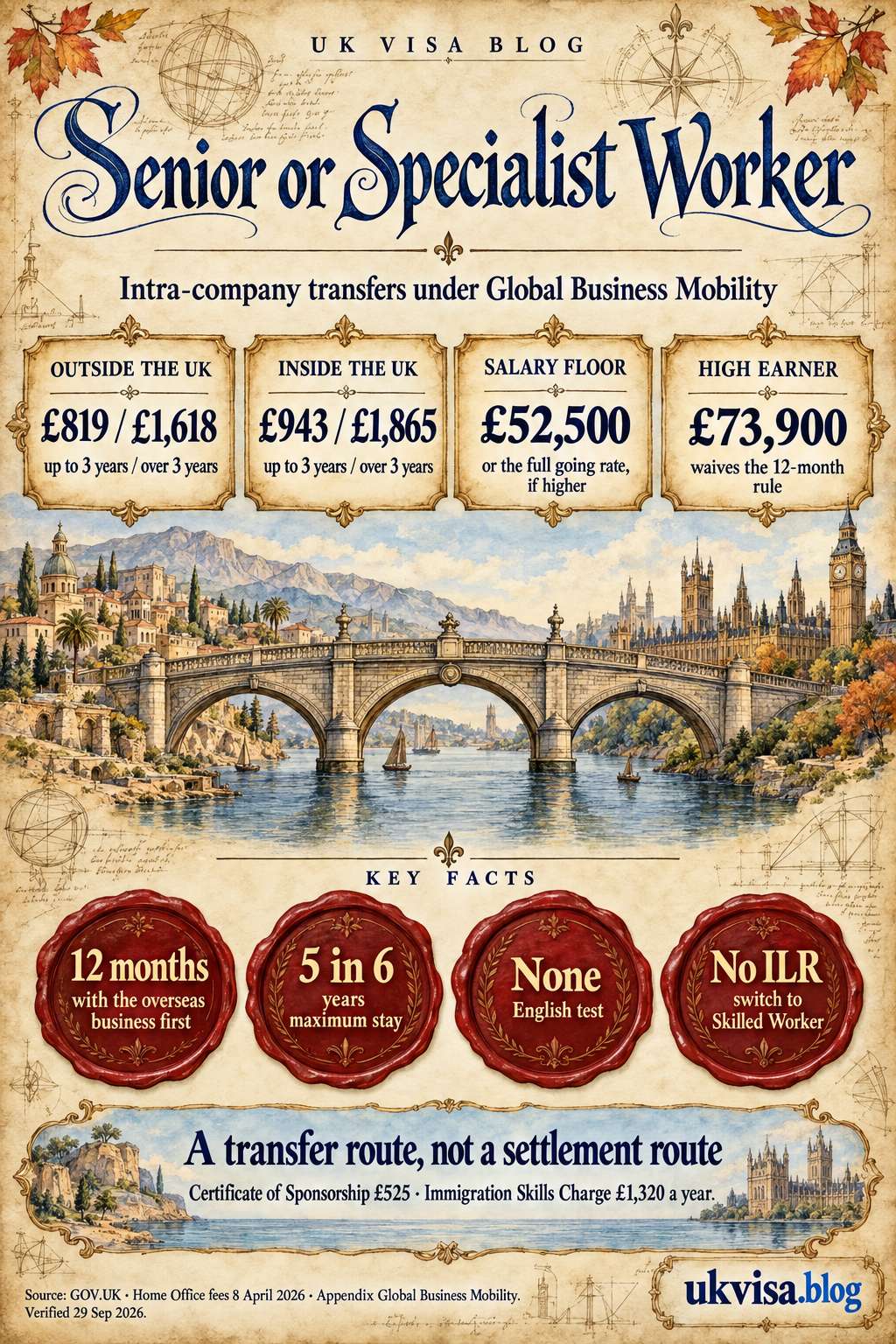
The Senior or Specialist Worker visa is the successor to the Intra-Company Transfer (ICT) visa — the route multinationals use to move senior managers and specialists into a linked UK entity. The salary floor is £52,500, or £73,900 to unlock high-earner privileges. Fees run £819 to £1,865 from 8 April 2026, stays are capped at 5 years in any 6 (9 in 10 for high earners), and the route never leads to settlement.

Global Business Mobility
Senior or Specialist Worker Visa UK 2026: Complete Guidance
What is the Senior or Specialist Worker Visa?
The Senior or Specialist Worker visa is the Global Business Mobility route for senior managers and specialist employees transferred from an overseas business to a linked UK entity. It needs sponsorship by a licensed UK sponsor, a salary of at least £52,500 (or the SOC 2020 going rate, whichever is higher), 12 months’ employment with the linked overseas business — waived at £73,900+ — and a job at RQF Level 6. No English test; no settlement pathway.
Most people still search for this route by its old names — “tier 2 ICT”, “intra-company transfer” — and the instinct is right: when the five-route Global Business Mobility framework launched on 11 April 2022, this route absorbed the ICT Long-Term Staff visa, and existing ICT licences converted automatically. The mechanics are unchanged in spirit: an established employee, an overseas employer, a UK entity linked to it by common ownership or control, and a temporary assignment between them.
Two Profiles, One Test
The route admits two profiles under one test. Senior managers hold high-level responsibility for the UK entity’s strategy, resources or significant decisions. Specialist workers carry advanced or proprietary knowledge of the sponsor’s products, processes or operations that the UK labour market cannot readily supply. The points assessment is identical for both; the sponsor’s choice of SOC 2020 occupation code on the Certificate of Sponsorship does the classifying.
It is also the odd one out in its own family: of the five GBM routes, only Senior or Specialist Worker triggers the Immigration Skills Charge — a fact that shapes the sponsor’s bill more than any other line item.
Five Years in Six: How the Cap Actually Works
Each grant runs for the Certificate of Sponsorship period plus 14 days, up to a ceiling of 5 years in any rolling 6-year period — or 9 years in any 10 for workers paid £73,900 or more. The count is cumulative across every GBM route and the old Intra-Company Transfer permissions before April 2022.
A widely repeated myth says GBM workers face a 12-month “cooling-off period” outside the UK. That rule died with Tier 2 ICT. Under the current caseworker guidance there is no cooling-off at all: the Home Office instead examines your immigration history backwards from each new Certificate of Sponsorship start date and refuses only if the rolling cap is already spent. A worker can leave, return, and reapply at any time — what matters is the arithmetic of the window, and old ICT time counts in it.
Senior or Specialist Worker Visa Eligibility 2026
Eligibility is scored: 60 mandatory points, 20 each for sponsorship, skill level and salary, and none of the three can be traded against another.
The 60-Point Test
| Points Category | Points | Test |
|---|---|---|
| Sponsorship | 20 | Valid Certificate of Sponsorship from a licensed Senior or Specialist Worker sponsor |
| Job at appropriate skill level | 20 | Role at RQF Level 6 (degree-equivalent) under an eligible SOC 2020 occupation code |
| Salary | 20 | At least £52,500 AND at least 100% of the SOC 2020 going rate for the occupation |
| Total required | 60 | All three categories are mandatory |
Source: Immigration Rules, Appendix Global Business Mobility routes; GOV.UK route pages and the 8 April 2026 fee table. Verified 22 August 2026.
Around the points sit the route’s supporting conditions:
- Age: 18 or over at the date of application.
- Overseas employment: 12 months’ continuous work with the overseas business linked to the UK sponsor — waived entirely for workers paid £73,900 or more.
- Linked-entity evidence: the corporate connection between overseas employer and UK sponsor (common ownership, common control or a qualifying joint venture) must stand up to scrutiny — share registers, group charts and audited accounts where requested.
- Genuine vacancy: the UK role must exist for business reasons, not to manufacture a visa.
- Maintenance: £1,270 held for 28 consecutive days — waived if the A-rated sponsor certifies maintenance, or if you have been in the UK on a valid visa for 12 months or more.
- TB certificate if applying from a listed country; documents not in English or Welsh need certified translation.
- No English test: the route has no language requirement at entry or extension — unlike Skilled Worker, which demands CEFR B2 from 8 January 2026.
Salary Threshold and Going Rate Rules
The general threshold rose from £48,500 to £52,500 on 22 July 2025 and holds for 2026. It works as a floor, not a target: every applicant must clear £52,500 and the going rate for their SOC 2020 occupation, whichever is higher. Going rates live in Appendix Skilled Occupations — the same tables that drive the Skilled Worker salary thresholds — and for most senior roles the going rate, not the floor, is the binding number.
The Two Thresholds and What They Unlock
| Salary Tier | Threshold | What It Unlocks |
|---|---|---|
| General threshold (since 22 July 2025) | £52,500 | Route minimum — paid alongside meeting the going rate |
| Going rate (occupation-specific) | 100% of SOC 2020 rate | Whichever is higher of £52,500 or the going rate applies |
| High earner threshold | £73,900 | Waives the 12-month overseas employment rule; extends maximum stay to 9 years in 10 |
Source: Immigration Rules, Appendix Global Business Mobility routes; GOV.UK route pages and the 8 April 2026 fee table. Verified 22 August 2026.
What Counts Toward the Threshold
Only guaranteed gross basic pay counts, capped at 48 working hours a week, plus a defined list of guaranteed allowances — London weighting, mobility premiums — paid throughout the UK assignment. Bonuses, overtime, shift premiums, employer pension contributions and most benefits in kind are excluded. Accommodation allowances count only up to 30% of total salary. And the SOC code must match what the worker will actually do: code-shopping for a lower going rate is the classic compliance failure the guidance tells caseworkers to hunt for.
Senior or Specialist Worker Visa Fees from 8 April 2026
The fee depends on two variables — where you apply and how long the Certificate of Sponsorship runs. All four tiers rose in the 8 April 2026 uplift; the full schedule sits in the Home Office fees table.
Application Fees at a Glance
| Application Type | CoS Duration | Fee from 8 April 2026 |
|---|---|---|
| Outside UK (entry clearance) | Up to 3 years | £819 |
| Outside UK (entry clearance) | More than 3 years | £1,618 |
| Inside UK (extension or switch) | Up to 3 years | £943 |
| Inside UK (extension or switch) | More than 3 years | £1,865 |
| Priority service | 5 working days | +£500 |
| Super Priority service | Next working day | +£1,000 |
Source: Home Office immigration and nationality fees, 8 April 2026.
On top of the fee sits the Immigration Health Surcharge at £1,035 per adult per year (£776 per child), paid upfront for the whole grant. A 3-year entry-clearance application therefore costs an adult £819 + £3,105 = £3,924 on day one; a 5-year grant carries £5,175 of IHS alone.
Sponsor Costs: Licence, CoS and Immigration Skills Charge
The sponsor’s side of the bill is heavier than the worker’s, and none of it can lawfully be recovered from the worker — clawing back the Immigration Skills Charge or CoS fee breaches sponsor duties and can invalidate the sponsorship. Senior or Specialist Worker is the only GBM route that pays the ISC at all: the Graduate Trainee, UK Expansion Worker, Service Supplier and Secondment Worker routes are all exempt.
What the Sponsor Pays
| Sponsor Cost | Small / Charitable Sponsor | Medium / Large Sponsor |
|---|---|---|
| Sponsor licence application (8 April 2026) | £611 | £1,682 |
| Certificate of Sponsorship | £525 | £525 |
| Immigration Skills Charge — first 12 months | £480 | £1,320 |
| Immigration Skills Charge — each further 6 months | £240 | £660 |
| 3-year ISC total | £1,440 | £3,960 |
| 5-year ISC total | £2,400 | £6,600 |
Source: Immigration Rules, Appendix Global Business Mobility routes; GOV.UK route pages and the 8 April 2026 fee table. Verified 22 August 2026.
The EU National ISC Exemption — Routinely Missed
One exemption softens that bill, and it hides in the sponsor guidance: no Immigration Skills Charge is due where the CoS was assigned on or after 1 January 2023, the worker is an EU national (or Latvian non-citizen passport holder) who normally works for the sponsor’s EU business, and the UK assignment is 36 months or shorter. It implements the UK-EU Trade and Cooperation Agreement’s intra-corporate transfer provisions — and on a 3-year large-sponsor assignment it saves £3,960. The mechanics sit in the Sponsor a GBM worker guidance.
Worked example, 3-year assignment at a medium/large sponsor: the worker pays £3,924 (fee plus IHS); the sponsor pays £4,485 (CoS plus ISC) — £8,409 of combined government charges before any priority service, dependant fees or the licence itself. Sponsor-side compliance obligations continue for the life of the assignment under the sponsor licence and SMS regime.
How to Apply for a Senior or Specialist Worker Visa
The application starts on the sponsor’s side — no Certificate of Sponsorship, no application. The CoS is valid for 3 months from assignment, and the worker can apply up to 3 months before its start date. The sequence:
- Step 1: the UK sponsor confirms its Senior or Specialist Worker licence is current and A-rated, pays the £525 CoS and any Immigration Skills Charge, and assigns the certificate carrying the job, SOC code and salary.
- Step 2: the worker completes the online application on GOV.UK and pays the fee for their tier plus the IHS.
- Step 3: identity — the UK Immigration: ID Check app for eligible passports, otherwise a biometric appointment at a visa application centre.
- Step 4: evidence upload — passport, maintenance (unless certified), TB certificate if applicable, certified translations for any non-English documents, and proof of the 12-month overseas employment if asked.
- Step 5: decision — usually 3 weeks outside the UK, up to 8 weeks in-country; processing timelines can be shortened with the priority services.
Switching Into the Route From Inside the UK
In-country switching is permitted from most routes — including from Skilled Worker where an intra-company structure fits better — but not from Visitor, Short-term Student, Parent of a Child Student, Seasonal Worker, Domestic Worker in a Private Household, or on immigration bail. The 12-month overseas employment rule still applies on a switch unless the £73,900 waiver is met.
Senior or Specialist Worker vs Skilled Worker — Key Differences
The two big sponsored routes look similar and end differently. Defaulting to Senior or Specialist Worker when there is no genuine overseas linked employer — or to Skilled Worker when the assignment is a classic group transfer — is the most common and most expensive route-selection error:
The Two Routes Compared
| Feature | Senior or Specialist Worker | Skilled Worker |
|---|---|---|
| General salary threshold 2026 | £52,500 | £41,700 |
| English language requirement | None | CEFR B2 from 8 January 2026 |
| Overseas employment | 12 months required (waived at £73,900+) | Not required |
| Sponsor type | UK entity linked to the overseas employer | Any licensed UK sponsor |
| Immigration Skills Charge | Yes — £1,320/year large sponsor | Yes — £1,320/year large sponsor |
| Maximum stay | 5 years in 6 (9 in 10 at £73,900+) | Indefinite (renewable) |
| Path to ILR | No — must switch routes | Yes — 5 years’ qualifying residence |
Source: Immigration Rules, Appendix Global Business Mobility routes; GOV.UK route pages and the 8 April 2026 fee table. Verified 22 August 2026.
Switching to Skilled Worker for the Settlement Pathway
No GBM time counts towards permanent settlement — a worker with 4 years on this route who switches to Skilled Worker starts the 5-year settlement clock at zero, making 9 years in the UK before ILR. Where long-term residence is the real goal, the strategic move is to switch early, not late.
The B2 English Sting on Switching
The switch carries a sting from 8 January 2026: Skilled Worker’s CEFR B2 English requirement applies to in-country switches, so a Senior or Specialist Worker who has never needed an English test must pass one — SELT, qualifying UK degree, or majority-English-country exemption — before the switch can be granted. Plan the test alongside the £41,700 salary check and the sponsor’s willingness to issue a Skilled Worker CoS, and the transition is administrative rather than dramatic.
Where an application is refused, the remedy is administrative review for caseworking error on the points, salary calculation or evidence. For the wider fee landscape across Skilled Worker, Health and Care and the other GBM routes, see the UK work visa fee comparison; the official entry point is the GOV.UK Senior or Specialist Worker overview. Figures verified 22 August 2026.
Frequently Asked
Questions about the Senior or Specialist Worker visa
Functionally yes. It replaced the Intra-Company Transfer (ICT) Long-Term Staff visa on 11 April 2022, and existing ICT licences converted automatically. The core mechanic — transferring an established employee from an overseas linked business to a UK group entity — is unchanged; what changed are the thresholds (£52,500 / £73,900 since 22 July 2025) and the rulebook, now Appendix Global Business Mobility.
Correct — the 12-month cooling-off rule belonged to Tier 2 ICT and did not survive into GBM. The current control is the rolling cap itself: caseworkers look backwards through your immigration history from each new CoS start date and refuse only if 5 years in the last 6 (or 9 in 10 for high earners) is already spent. Old ICT time counts in that arithmetic.
From 8 April 2026: £819 (outside UK, CoS up to 3 years), £1,618 (outside UK, over 3 years), £943 (inside UK, up to 3 years) or £1,865 (inside UK, over 3 years), plus £1,035 IHS per adult per year. The sponsor separately pays £525 per CoS and the Immigration Skills Charge — £1,320 a year for medium and large sponsors, £480 for small ones.
No. GBM time never counts toward the 5-year ILR qualifying period. The standard path is an in-country switch to Skilled Worker — meeting its £41,700 salary threshold and, from 8 January 2026, CEFR B2 English — after which the settlement clock starts from the switch date, not from arrival.
In the standard case yes — 12 continuous months with the overseas business linked to the UK sponsor. Workers paid £73,900 or more are exempt and can apply on salary alone. Annual leave and short business trips do not break continuity.
No — none at entry or extension, which is now one of the route’s sharpest advantages over Skilled Worker’s B2 requirement. English only becomes relevant if you later switch to Skilled Worker or apply for citizenship.
Yes — spouse or partner (including a 2-year durable unmarried partnership) and children under 18, each paying their own fee tier and IHS. Dependent partners can work in any role except as a professional sportsperson or coach, and dependants’ permission runs to the same end date as yours.
The Home Office curtails your permission, normally with a 60-day grace period to find a new sponsor and apply again, switch to another route you qualify for, or leave the UK. The clock runs from the curtailment notice — a new application must be submitted before it expires.