
A criminal record certificate is only required on some UK work applications, and the rule is narrower than most guides suggest: it applies to entry clearance applications in listed occupation codes, not to extensions or switches made inside the UK. Where it does apply, one certificate is rarely enough — the scope is every country you have lived in for long enough, over a ten-year window.
UK Work Visas
Criminal Record Certificate for a UK Visa 2026: Who Needs One and When
What the Requirement Is
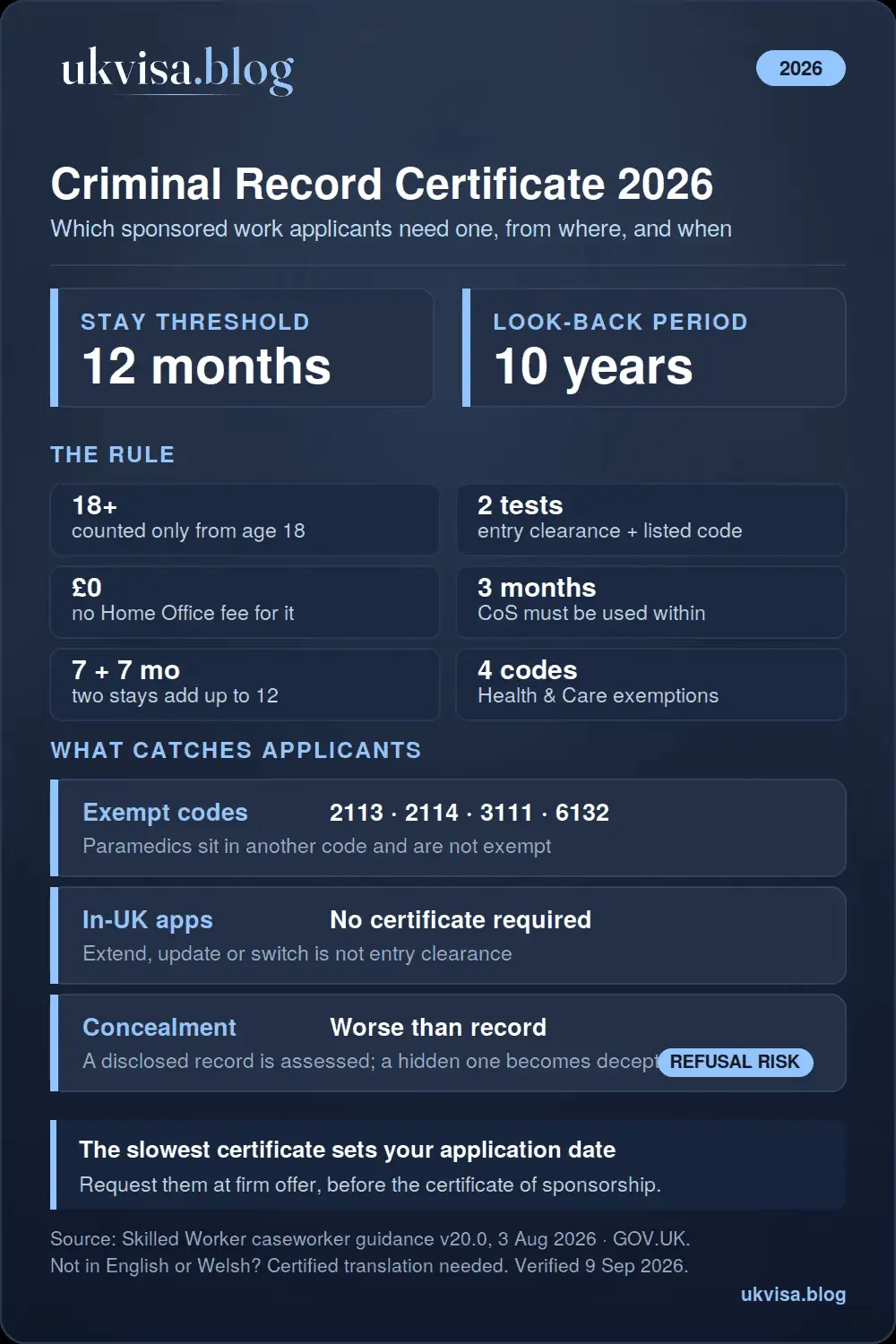
A criminal record certificate is a document from a national police authority confirming what, if anything, is held against you there. On sponsored work routes it is a mandatory requirement where the application is for entry clearance and the job sits in a listed occupation code. You need one for every country you were present in for 12 months or more, continuously or in total, in the 10 years before you apply, while aged 18 or over.
The certificate is not a Home Office document and there is no Home Office fee for it. You obtain it from the police or justice authority of each country concerned, and submit it with the application. Certificates not in English or Welsh need a certified translation alongside the original.
Who Actually Needs One
The caseworker guidance sets two conditions, and both must be met: the application is for entry clearance, and the applicant is sponsored in an occupation code listed in the rules. The practical effect is that the requirement follows roles working with people — health, care, education and related professions — rather than sponsored work generally.
Two consequences are worth stating plainly. An application made inside the UK to extend, update or switch does not attract the requirement, because it is not an entry clearance application. And an occupation code outside the list does not attract it either, however senior the role.
The Health and Care Exceptions
On the Health and Care Worker route, where the requirement otherwise bites hard, four codes are expressly excluded: 2113 biochemists and biomedical scientists, 2114 physical scientists, 3111 laboratory technicians and 6132 ambulance staff excluding paramedics. Paramedics themselves sit in a different code and are not excluded — a distinction that catches applicants who assume the ambulance service is treated as one thing.
Elsewhere the requirement attaches to the code your sponsor assigns, which is one more reason the coding decision matters — see how occupation codes are assessed and what the sponsor is responsible for. Unsponsored routes have their own position: The Global Talent route applicants working in relevant fields can be asked for certificates on the same logic.
Which Countries You Need Certificates From
This is where applications come apart. The requirement is not limited to your country of nationality or your current residence. The caseworker guidance requires a certificate for any country you were present in for 12 months or more — continuously or in total — during the 10 years before the date of application, while you were aged 18 or over.
The public page frames the scope by age: if you are under 28, a certificate from any country you stayed in for a total of 12 months or more since turning 18; if you are 28 or over, a certificate from any country you have stayed in over the last 10 years. The over-28 wording drops the 12-month qualifier and reads as though any stay counts, however brief. The caseworker guidance states one rule for everyone, with the 12-month threshold applying throughout. The guidance is what a caseworker applies, but where the two diverge, take advice before deciding a certificate is unnecessary — the cost of an unnecessary certificate is far lower than the cost of a refusal.
Add the periods up rather than looking only at single stays. Two separate seven-month postings to the same country inside the ten-year window reach 12 months in total, and the requirement is written to capture exactly that.
What the Certificate Has to Cover
A certificate is expected to come from the national authority responsible for criminal records in that country, and to cover the whole of your time there rather than a recent slice of it. Where a country issues more than one type of check, the one you need is the police certificate intended for immigration or emigration purposes, not an employer-facing disclosure aimed at a particular job.
Cost and Timing
Each authority sets its own fee and its own service standard, and both change. In the UK, ACRO Criminal Records Office issues police certificates and publishes current fees and processing times on its own site, usually with a standard and a faster option. Other countries range from a same-week online service to a multi-month consular process requiring fingerprints taken in person.
Plan backwards from the certificate, not forwards from the job offer. The slowest certificate sets your application date, and a sponsored certificate of sponsorship has to be used within three months of assignment — so a three-month police process in one country can waste it entirely. Buying a faster visa decision does not compensate for a certificate that has not arrived, and the wait afterwards is covered in our processing times guide.
Getting Certificates From Abroad
Requirements vary by country: some issue only to residents, some only through an embassy, some require an in-country agent, and some will not issue to former residents at all. Where a country genuinely cannot or will not provide one, say so in the application with evidence of what you tried, rather than leaving a gap. A silent omission looks like avoidance; a documented attempt looks like what it is.
Keep certificates current. Some authorities date-stamp validity and the Home Office expects a certificate that reflects the position now, so one obtained years ago for another purpose is unlikely to serve. Assemble them with the rest of the bundle described in our document checklist.
Order of Operations
Request certificates as soon as a job offer is firm, before the certificate of sponsorship is assigned rather than after. The assignment starts a three-month clock on the visa application, and it is the only part of the sequence your employer controls — so a conversation about timing at offer stage is worth more than any amount of chasing later.
If the Certificate Shows Something
A record on a certificate is not automatically fatal. It is assessed under the suitability provisions of the Immigration Rules, where the seriousness of the offence, the sentence and how long ago it happened all matter — the framework is set out in our general grounds for refusal guide.
What is close to fatal is concealment. Failing to disclose something that then appears on a certificate turns a suitability question into a credibility one, and deception findings carry consequences that outlast the application — see our guide to deception bans.
Disclosure with an explanation is almost always the better position, and it is worth taking advice before submitting where there is anything at all to disclose. Refusals on these grounds are among the harder ones to recover from, and challenging one is covered in our appeals guide.
Spent Convictions and Old Matters
Rehabilitation periods differ from country to country, so a matter treated as spent where it happened may still appear on that country\u2019s certificate. Read every certificate before you submit it rather than forwarding it unopened, and where an entry is unclear or looks wrong, resolve it with the issuing authority first. An unexplained entry the caseworker has to interpret alone is the worst version of the same fact.
Practical Points
- Check the trigger first: entry clearance plus a listed occupation code — inside-UK applications do not attract it.
- Map ten years of residence: list every country and add up time spent in each, counting only from age 18.
- Start with the slowest country: the certificate that takes longest sets your whole timetable.
- Translate what needs translating: anything not in English or Welsh needs a certified translation.
- Evidence any refusal to issue: if a country will not provide one, show what you asked for and when.
- Disclose anything disclosable: a record assessed on its merits is a far better position than a record discovered.
A certificate obtained late is the single most common reason an otherwise ready sponsored application sits unsubmitted. The certificate is one document among several — the route rules sit in our Skilled Worker guide, and good character surfaces again much later, at settlement and in the citizenship assessment, where the same history is looked at once more.
Sources: Home Office Skilled Worker caseworker guidance version 20.0, published 3 August 2026; GOV.UK criminal records checks for overseas applicants; and the Health and Care Worker route page on GOV.UK guidance. Figures verified 22 August 2026.
Frequently Asked
Questions about Criminal Record Certificates
Only if both conditions are met: your application is for entry clearance from outside the UK, and you are being sponsored in an occupation code listed in the rules. In practice that covers roles in health, care, education and related professions. Applications made inside the UK to extend, update or switch do not attract the requirement at all.
Every country you were present in for 12 months or more, continuously or in total, during the 10 years before the date of application, while aged 18 or over. Nationality is irrelevant — what counts is where you actually lived. Separate stays in the same country are added together, so two seven-month periods trigger the requirement.
The public page splits it into under 28 and 28 or over, and its wording for the older group drops the 12-month qualifier, reading as though any stay counts. The caseworker guidance states a single rule with the 12-month threshold throughout. Where the two diverge, take advice rather than assume — obtaining a certificate you did not need is cheaper than a refusal.
Four occupation codes: 2113 biochemists and biomedical scientists, 2114 physical scientists, 3111 laboratory technicians, and 6132 ambulance staff excluding paramedics. Paramedics sit in their own code and are not exempt, so an ambulance service role can fall on either side of the line depending on which code the sponsor assigns.
Each national authority sets its own fee and timescale, and both change — ACRO publishes current UK figures on its own site. There is no Home Office fee for the certificate itself. Timings vary from days to months, so start with the country likely to be slowest and work the rest of the application timetable around it.
Explain it in the application and evidence what you tried — the request, the date, and any response or refusal. Some authorities issue only to current residents or only through an embassy. A documented attempt is treated very differently from a silent gap, which reads as avoidance rather than impossibility.
Not automatically. It is assessed under the suitability provisions, where the offence, the sentence and how long ago it occurred all count. What is far more damaging is non-disclosure: something concealed and then revealed by a certificate becomes a credibility issue as well as a suitability one, with consequences that follow you well beyond the refused application.
Yes, if it is not in English or Welsh. A certified translation must be provided alongside the original document. Build the translation time into your plan — it is a common cause of late submissions, particularly where a certificate arrives close to the three-month expiry of a certificate of sponsorship.