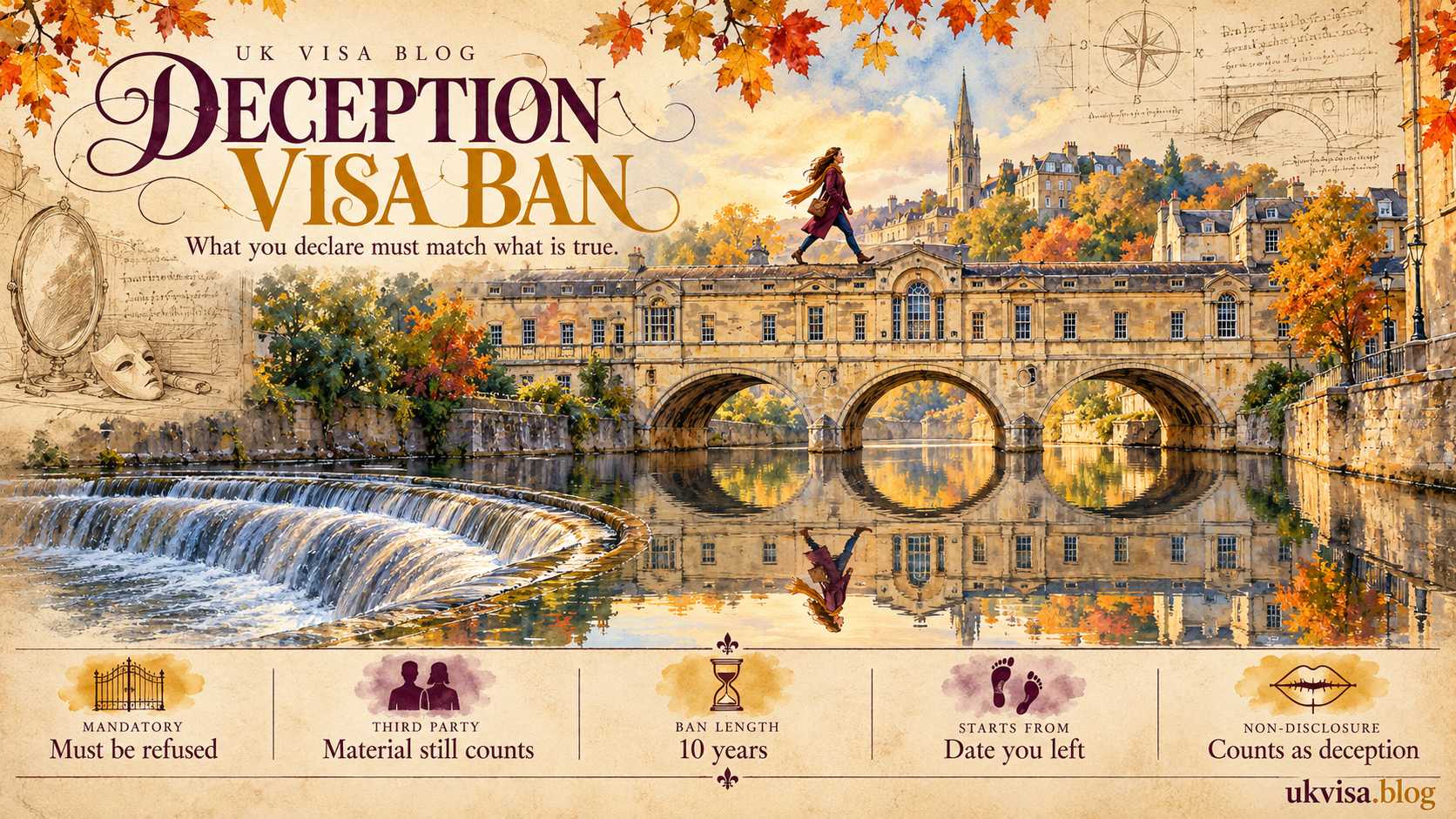
A UK deception ban is a 10-year mandatory refusal under paragraph 9.8.1 of Part 9 of the Immigration Rules (formerly paragraph 320(7A)) where an applicant uses false representations, false documents, or fails to disclose material facts in connection with a UK visa application. The 10-year deception ban applies regardless of whether the deception succeeded in obtaining leave. Re-entry bans (separate framework) range from 1 year (voluntary departure within 30 days of overstaying) to 10 years (removal after overstaying 90+ days). Deportation orders are indefinite. UKVI must provide concrete evidence — typically via Document Examination Report (DER) or Document Verification Report (DVR). The Balajigari case law requires UKVI to give applicants an opportunity to respond before refusal. This guide covers the 10-year deception ban, re-entry ban table, voluntary return, appeal routes, how to check UK ban status (SAR process), and 2026 policy context.
Source: Immigration Rules Part 9 — Grounds for Refusal (paragraphs 9.8.1 and 9.8.2); Balajigari & Others v Secretary of State for the Home Department [2019] EWCA Civ 673; UKVI deception caseworker guidance; Home Office Voluntary Returns Service framework; 10 February 2025 Nationality Caseworker Guidance update
The 10-year deception ban under paragraph 9.8.1 (formerly 320(7A)) remains the most severe immigration penalty short of deportation. Procedural fairness: the Court of Appeal in Balajigari [2019] EWCA Civ 673 requires UKVI to put deception allegations to the applicant before refusing, giving an opportunity to respond. 2026 policy context: from 10 February 2025 the Nationality Caseworker Guidance includes a near-blanket good character bar refusing naturalisation for anyone who entered the UK irregularly — separate from but parallel to the deception framework. HC 1691 (laid 5 March 2026) introduces a B2 English settlement standard from 26 March 2027 — applicants with deception findings face additional scrutiny under the strengthened settlement framework. Re-entry bans: range from 1 year (voluntary departure within 30 days of overstaying) to 10 years (removal after overstaying 90+ days). Deportation orders remain indefinite until revoked.
- Four Types of UK Visa Bans — Deception, Re-Entry, Deportation
- Deception Ban UK — 10-Year Mandatory Refusal Under Paragraph 9.8.1
- What Counts as Deception in UK Visa Applications
- Exceptions to the 10-Year Deception Ban (Paragraph 9.8.2)
- UK Re-Entry Ban — 1 to 10 Years for Overstaying or Removal
- Voluntary Return Service — Reducing Re-Entry Ban Length
- How to Check UK Ban Status (SAR Process)
- How to Appeal a UK Visa Ban — Four Routes
- Consequences of a UK Visa Ban
- Reapplying After a UK Visa Ban Expires
- Frequently Asked Questions
UK Deception Ban 2026 — 10 Years Under Paragraph 9.8.1, Re-Entry Bans, and Appeal Routes
A UK deception ban is a formal mandatory refusal imposed under paragraph 9.8.1 of Part 9 of the Immigration Rules. It is the most severe immigration penalty short of deportation. The 10-year ban applies where UKVI determines an applicant used false representations, false documents, or failed to disclose material facts — and applies regardless of whether the deception was successful in obtaining leave. The deception ban is separate from re-entry bans (which apply to overstaying or illegal entry). UKVI must provide concrete positive evidence of deception — not mere suspicion. Document Examination Reports (DER) and Document Verification Reports (DVR) must be detailed and substantiated. The Court of Appeal in Balajigari [2019] EWCA Civ 673 requires UKVI to put deception allegations to the applicant and give an opportunity to respond before refusing on this ground.
Four Types of UK Visa Bans — Deception, Re-Entry, Deportation
UK visa bans fall into four main categories. Deception ban: 10 years under paragraph 9.8.1 for false documents, false representations, or material non-disclosure. Re-entry ban (short): 1-2 years for voluntary departure after overstaying. Re-entry ban (long): 5-10 years for removal after overstaying 90+ days or illegal entry. Deportation order: indefinite until revoked, typically following criminal conviction or national security concerns. Each ban has different criteria, evidence requirements, appeal rights, and routes to removal. The Immigration Rules under Part 9 general refusal grounds set out the full framework. The 10-year deception ban under paragraph 9.8.1 is the strictest non-deportation penalty.
Four Types of UK Visa Bans — Comparison Table
| Type of Ban | Duration | Common Triggers | Immigration Rules |
|---|---|---|---|
| Deception Ban | 10 years (mandatory) | False documents, false representations, material non-disclosure, identity fraud, sham marriages | Paragraph 9.8.1 (formerly 320(7A)) |
| Re-Entry Ban (Short) | 1-2 years | Overstaying <90 days followed by voluntary departure | Paragraphs 9.8.2-9.8.7 (re-entry framework) |
| Re-Entry Ban (Long) | 5-10 years | Overstaying >90 days, removal, deportation, breach of UK immigration laws | Paragraphs 9.8.2-9.8.7 |
| Deportation Order | Indefinite until revoked | Criminal conviction (12+ months), conducive to public good, national security | Section 3(5) and 3(6) Immigration Act 1971 |
Old 320(7A) → New Paragraph 9.8.1 — Rule Change Context
Until October 2020, the 10-year mandatory deception ban was found in paragraph 320(7A) of the Immigration Rules. The Statement of Changes laid in September 2020 restructured Part 9 — the substantive content was renumbered to paragraph 9.8.1 (mandatory) and paragraph 9.8.2 (discretionary). The substantive rules and 10-year ban period are unchanged — only the paragraph numbering. Refusal letters now cite paragraph 9.8.1 rather than 320(7A). Older case law referring to 320(7A) — including Balajigari [2019] EWCA Civ 673 — remains good law under the renumbered paragraphs. Searches for "320 7a immigration rules appeal" or "paragraph 320(7A)" all relate to what is now paragraph 9.8.1.
Deception Ban UK — 10-Year Mandatory Refusal Under Paragraph 9.8.1
A UK deception ban is a 10-year mandatory refusal under paragraph 9.8.1 of the Immigration Rules. It applies when UKVI determines an applicant used false documents, made false representations, or failed to disclose material facts in connection with a visa application. The ban applies whether or not the deception succeeded in obtaining leave to enter or remain. The 10-year ban runs from the date of the refusal decision. The deception finding remains on the applicant's UKVI immigration record indefinitely — even after the 10-year ban expires, future applications face heightened scrutiny. UKVI must provide concrete evidence; Balajigari case law requires the applicant be given an opportunity to respond to allegations before refusal.
What Counts as Deception in UK Visa Applications
UKVI treats the following as deception triggering a 10-year ban under paragraph 9.8.1: (1) false documents — counterfeit, forged, or fraudulently obtained documents (educational certificates, employment letters, bank statements, payslips); (2) false representations — untrue statements made in interview or written form; (3) material non-disclosure — deliberately omitting relevant information (previous refusals, criminal convictions, immigration history, prior identities); (4) identity fraud — using someone else's identity or documents; (5) sham marriages — entering marriage primarily for immigration purposes. A typo, innocent error, or minor inconsistency does NOT constitute deception — UKVI must show dishonest intent, not just incorrect information.
Deception Triggers Under Paragraph 9.8.1
- False documents: Submitting counterfeit, forged, or fraudulently obtained documents — fake educational certificates, employment letters, bank statements, payslips, ETS / Pearson PTE certificates, ATAS letters
- False representations: Untrue statements made in interview, on the application form, or in written correspondence with UKVI
- Material non-disclosure: Deliberately omitting relevant facts such as previous UK visa refusals and decision notices, criminal convictions, prior immigration history, or previous identities used
- Identity fraud: Using someone else's identity, photograph, or biometrics; presenting another person's documents as your own
- Sham / marriages of convenience: Entering into marriage primarily for immigration purposes rather than a genuine subsisting relationship — investigated under Appendix FM and the marriage referral scheme
- Fraudulent English language test results: ETS / TOEIC results found fraudulent in 2014 investigations; Pearson PTE results found fraudulent at specific test centres
Exceptions to the 10-Year Deception Ban (Paragraph 9.8.2)
Paragraph 9.8.2 contains the discretionary refusal limb — covering cases where deception in less serious forms may be considered. Routes where the 10-year ban may be disapplied or considered in context: (1) family members under Appendix FM spouse visa — Article 8 ECHR rights may engage; (2) children under 18 — typically not held responsible for deception by adults; (3) third-party deception — where an agent or representative submitted false documents without the applicant's knowledge; (4) exceptional circumstances — compelling humanitarian reasons; (5) asylum / protection claims — separate framework under refugee law. Even where the mandatory 10-year ban does not apply, the deception finding will be considered under general suitability requirements in subsequent applications.
Exception Categories
- Family members under Appendix FM: Spouse / partner / parent applicants where Article 8 ECHR family life rights are engaged — the 10-year ban may be disapplied where refusal would cause unjustifiable harshness
- Children under 18: Minors are typically not held responsible for deception by adult guardians or agents acting on their behalf — burden on UKVI to show the minor's own complicity
- Third-party fraud (innocent applicant): Where an agent, representative, or family member submitted false documents without the applicant's knowledge or instruction — must be supported by evidence (police report, agent complaint, etc.)
- Exceptional circumstances: Compelling humanitarian reasons including serious medical conditions, danger of harm if refused, or extraordinary family circumstances
- Protection / asylum claims: The refugee framework operates separately — deception in identity documents to flee persecution is treated under the 1951 Refugee Convention, not paragraph 9.8.1
- Long residence Article 8 claims: Where private life or family life has developed during the 10-year period despite the original deception
UK Re-Entry Ban — 1 to 10 Years for Overstaying or Removal
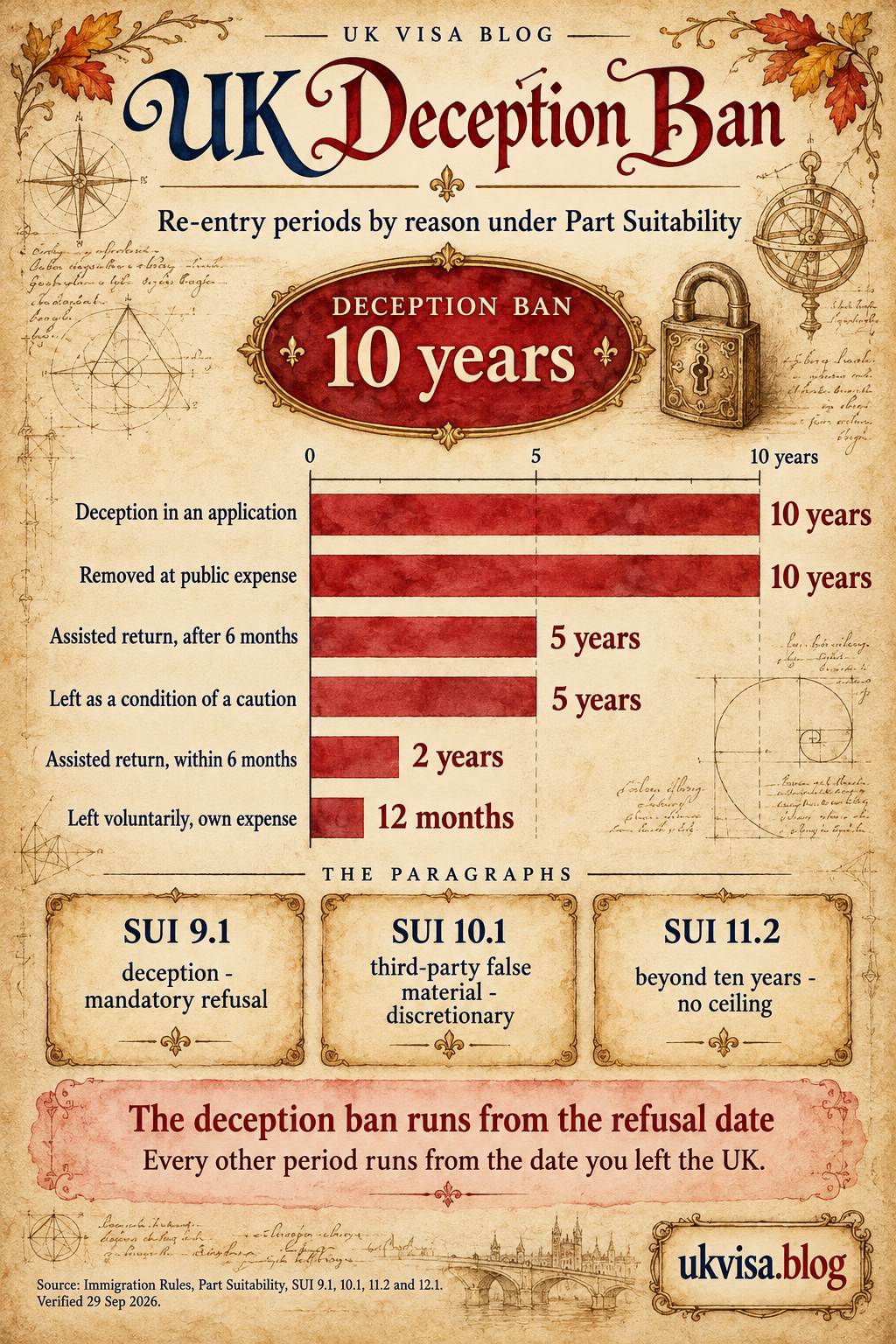
A UK re-entry ban is a separate framework from the deception ban. Re-entry bans apply where an applicant has overstayed their visa, entered the UK illegally, or been removed from the UK. Ban length depends on circumstances: 1 year for voluntary departure within 30 days of overstaying; 2 years for voluntary departure after 30+ days of overstaying; 5 years for removal after overstaying less than 6 months; 10 years for removal after overstaying 90+ days or significant immigration breaches. The ban starts on the date of departure (voluntary) or removal. Re-entry bans can run concurrently with deception bans — an applicant removed after a deception finding may face both simultaneously, with the longer period prevailing.
UK Re-Entry Ban Length by Circumstance
| Circumstance | Ban Length | Start Date |
|---|---|---|
| Voluntary departure within 30 days of overstaying | 1 year | Date of departure from UK |
| Voluntary departure more than 30 days after overstaying | 2 years | Date of departure from UK |
| Removal at public expense (overstay <6 months) | 5 years | Date of removal |
| Removal or enforced return (overstay 90+ days) | 10 years | Date of removal |
| Used deception in previous application (separate ban) | 10 years (paragraph 9.8.1) | Date of refusal decision |
| Deportation order | Indefinite until revoked | Date of deportation |
Voluntary Return Service — Reducing Re-Entry Ban Length
The Home Office Voluntary Returns Service (VRS) allows people without leave to remain in the UK to return to their home country voluntarily — significantly reducing future re-entry ban length. Voluntary departure within 30 days of overstaying triggers a 1-year re-entry ban (vs 5-10 years if removed). The service may also provide travel arrangements and limited reintegration support for eligible applicants. Voluntary return typically takes 4-12 weeks from application to departure. The 1-2 year ban runs from the date of departure. After the ban expires, applicants can reapply for UK visas — though the immigration history will be considered. Voluntary return is recorded on the UKVI immigration record and must be disclosed in future applications worldwide.
Voluntary Return Benefits vs Removal
| Departure Type | Re-Entry Ban | Cost to Applicant | Future Impact |
|---|---|---|---|
| Voluntary return within 30 days | 1 year | Free (Home Office covers travel) | Minimal future obstacle if reapplying after ban expires |
| Voluntary return after 30 days | 2 years | Free for VRS eligible | Moderate scrutiny on future applications |
| Enforced removal (<6 months) | 5 years | None (state-funded) | Significant adverse weight in future applications |
| Enforced removal (90+ days) | 10 years | None (state-funded) | Major adverse weight; difficult to overcome |
How to Check UK Ban Status (SAR Process)
To check if you have a UK visa ban, deception finding, or other immigration record, submit a Subject Access Request (SAR) to UKVI under the Data Protection Act 2018 / UK GDPR. The SAR is free and UKVI must respond within 1 month (extendable to 3 months for complex requests). The SAR will disclose the immigration record held about you including: previous refusals; deception findings under paragraph 9.8.1; re-entry ban status and duration; deportation orders; any conditional/cautioned departures; biometric records; and decision letters. SARs are made through the UKVI data protection team; identity verification is required. The SAR is the canonical way to confirm ban status before submitting any new UK visa application — particularly important if uncertain about historical decisions or where documents have been lost.
What a SAR Discloses About UK Ban Status
- Previous refusal decisions: All UKVI refusal letters and decision records held against your identity
- Deception findings: Whether paragraph 9.8.1 (or formerly 320(7A)) has been recorded — and the underlying evidence relied upon
- Re-entry ban duration: Start date, end date, and basis for any current re-entry ban
- Deportation orders: Whether a deportation order is in force and its scope
- Biometric records: Fingerprint and facial biometric matches across applications and identities
- Document Examination / Verification Reports: DER and DVR reports prepared during prior applications (may be partly redacted)
- Voluntary return records: Whether VRS was used; the date of departure; conditions attached
How to Appeal a UK Visa Ban — Four Routes
Four legal routes to challenge a UK visa ban. (1) First-tier Tribunal statutory appeal — only where the refusal engages human rights (typically Article 8 ECHR family life or Article 3 protection grounds); 14 days in-country / 28 days out-of-country deadline. (2) Administrative review — for caseworker errors in applying the Immigration Rules; 28-day deadline; fee £80 (refundable if successful). (3) Judicial review — for unlawful decision-making (procedural unfairness, irrationality, illegality); 3-month deadline; must follow Pre-Action Protocol first. (4) Fresh application — after ban expires, with completely accurate information and strong evidence. Appeals against deception findings often rely on Balajigari procedural fairness — where UKVI failed to give the applicant a fair opportunity to respond to deception allegations before refusal.
Four Appeal Routes — Comparison
| Route | Deadline | Forum | Best For |
|---|---|---|---|
| First-tier Tribunal appeal | 14 days in-country / 28 days out-of-country | First-tier Tribunal (IAC) | Refusals engaging Article 8 ECHR family / Article 3 protection rights |
| Administrative review | 28 days from decision | UKVI internal review | Caseworker errors in applying the Immigration Rules; PBS refusals |
| Judicial review | Promptly + 3 months | Upper Tribunal (IAC) / Administrative Court | Procedural unfairness (e.g. Balajigari failure); irrationality; illegality |
| Fresh application | After ban expires | UKVI online application | Where ban evidence is strong; with new documentation and strengthened circumstances |
Grounds for Successfully Challenging a 10-Year Deception Ban
- Balajigari procedural failure: UKVI failed to put deception allegations to the applicant and allow response before refusal — strong judicial review ground
- Insufficient evidence: No proper DER or DVR; mere suspicion or minor inconsistency cited as deception
- Innocent mistake: Genuine error (typo, transcription mistake, misunderstanding) misclassified as intentional deception
- Third-party fraud: Agent or representative submitted false documents without applicant's knowledge — supported by police report or formal complaint
- Procedural errors in DER: Document Examination Report flawed (wrong methodology, lack of detail, expert qualification issues)
- Article 8 ECHR rights: Refusal disproportionately affects family life rights — particularly Appendix FM cases involving British or settled spouse / partner / children
Consequences of a UK Visa Ban
A UK visa ban — particularly a 10-year deception ban — has wide consequences beyond preventing UK travel. All future UK applications are refused during the ban period. Settlement (ILR) is blocked — qualifying periods may reset. Family unity: spouses, partners, and children may face years of separation. Employment: UK work visas refused; career progression damaged. Other countries: UK visa refusals must be disclosed on US, Canada, Australia, Schengen applications — and a deception finding (suggesting dishonesty) is particularly serious internationally. Naturalisation: from 10 February 2025, a near-blanket good character bar refuses citizenship for irregular entry — deception findings strengthen this barrier. Permanent record: the deception finding remains on the UKVI record indefinitely even after the 10-year ban expires.
Wider Consequences of a UK Visa Ban
- All UK applications refused: During the ban period, all UK visa categories (visit, work, study, family, settlement) are refused — no discretion
- ILR / settlement blocked: Qualifying periods for Indefinite Leave to Remain may reset; HC 1691 from 26 March 2027 strengthens this with B2 settlement English standard
- Family separation: Spouse, partner, and child applications affected — Article 8 ECHR may engage but does not automatically override the 10-year ban
- Employment impact: UK work visas (Skilled Worker, ICT, etc.) refused; career progression damaged; sponsorship licence implications for previous employers
- Naturalisation barrier: 10 February 2025 good character guidance creates a near-blanket bar on naturalisation for irregular entry; deception findings strengthen this
- Other countries affected: US, Canada, Australia, Schengen Area visa applications require disclosure of UK refusals; deception findings are particularly serious due to international information-sharing
- Permanent UKVI record: The deception finding remains on the record after the 10-year ban expires — future applications face permanent heightened scrutiny
Reapplying After a UK Visa Ban Expires
After a UK visa ban expires, you can submit a fresh application — but it will face heightened scrutiny. Confirm ban expiry date precisely through a Subject Access Request before reapplying. Full disclosure: declare the previous ban and refusal honestly — non-disclosure is itself a deception offence triggering a fresh 10-year ban. Address original concerns: explain what changed, provide verified authentic documentation, and demonstrate strong ties to the home country. Verify all documents: ensure no third-party agent submits unverified material. Consider professional advice: solicitor or OISC adviser can assess prospects before submission. The Court of Appeal in Balajigari emphasised that deception findings must be applied fairly — successful reapplication after a deception ban requires demonstrating genuine change and providing exceptionally strong evidence. See our refusal recovery and reapplication strategy guide.
- Confirm exact ban expiry date — via Subject Access Request to UKVI before reapplying
- Declare the previous ban honestly — non-disclosure is itself deception triggering a fresh 10-year ban
- Verify all supporting documents — educational certificates, employment letters, bank statements, financial evidence
- Use only authorised representatives — OISC-regulated or solicitor; avoid unregulated agents who may submit false documents on your behalf
- Strengthen evidence of ties to home country — property, family, employment, business — particularly for visit visa reapplications
- Address each refusal reason in the original ban — explain what changed and provide new evidence
- Consider Appendix FM exemption analysis — for spouse / partner / family applicants where Article 8 ECHR engages
- Allow longer processing time — deception-history applications face extended verification
- Keep originals of every document — for any administrative review or judicial review if refused again
- UK deception ban: 10 years mandatory under paragraph 9.8.1 (formerly 320(7A))
- Triggers: false documents, false representations, material non-disclosure, identity fraud, sham marriages
- Applies regardless of whether the deception was successful in obtaining leave
- UKVI must provide concrete evidence (DER / DVR) — not mere suspicion or minor errors
- Balajigari [2019] EWCA Civ 673 requires UKVI to give applicants opportunity to respond before refusal
- Re-entry bans: 1 year (voluntary departure <30 days) to 10 years (removal after 90+ day overstay)
- Voluntary Return Service: free, 4-12 weeks; significantly reduces ban length vs enforced removal
- Check ban status via Subject Access Request (SAR) to UKVI — free, 1 month response
- Four appeal routes: First-tier Tribunal appeal (Article 8), administrative review, judicial review, fresh application after ban
- 10 February 2025: near-blanket good character bar on naturalisation for irregular entry strengthens deception barrier
- HC 1691 from 26 March 2027: B2 settlement English standard adds further scrutiny
- Deception finding remains on UKVI immigration record indefinitely — even after 10-year ban expires
- Reapplying after ban: full disclosure mandatory; non-disclosure triggers fresh 10-year ban
Frequently Asked Questions About UK Deception Bans
A UK deception ban is a 10-year mandatory refusal imposed under paragraph 9.8.1 of Part 9 of the Immigration Rules (formerly paragraph 320(7A)). It applies when UKVI determines an applicant has used false representations, false documents, or failed to disclose material facts in connection with a UK visa application. The ban applies regardless of whether the deception was successful in obtaining leave. The 10-year period runs from the date of the refusal decision. UKVI must provide clear positive evidence — typically a Document Examination Report (DER) or Document Verification Report (DVR) — and must give the applicant an opportunity to respond before refusing (the Balajigari requirement).
UK visa ban lengths vary by type. Deception bans under paragraph 9.8.1 are 10 years mandatory. Re-entry bans range from 1 year (voluntary departure within 30 days of overstaying) to 2 years (voluntary departure after 30+ days), 5 years (removal after overstaying less than 6 months), or 10 years (removal after overstaying 90+ days or major immigration breaches). Deportation orders are indefinite until revoked. The deception ban starts from the date of the refusal decision; re-entry bans start from the date of departure or removal. Deception and re-entry bans can run concurrently — the longer period prevails.
Yes — voluntary departure from the UK triggers a much shorter re-entry ban than enforced removal. Voluntary departure within 30 days of overstaying triggers a 1-year re-entry ban (vs 5-10 years if removed). Voluntary departure after 30+ days of overstaying triggers a 2-year ban. The ban runs from the date of departure. After the ban expires, you can apply for a UK visa — though the previous immigration history will be considered, and you must declare the voluntary return honestly in any future application. The Home Office Voluntary Returns Service offers free travel assistance and is the standard route for voluntary departure.
Yes — you can challenge a 10-year deception ban through several legal routes. (1) First-tier Tribunal statutory appeal if the refusal engages human rights (Article 8 ECHR family life or Article 3 protection grounds); deadline 14 days in-country / 28 days out-of-country. (2) Administrative review for caseworker errors in applying the Immigration Rules; 28-day deadline. (3) Judicial review for procedural unfairness (e.g. Balajigari failure to give opportunity to respond), irrationality, or illegality; promptly and within 3 months. (4) Fresh application after the ban expires. The most common successful ground is Balajigari procedural unfairness — where UKVI failed to give the applicant a fair opportunity to respond to deception allegations before refusal.
Submit a Subject Access Request (SAR) to UKVI under the Data Protection Act 2018 / UK GDPR. The SAR is free and UKVI must respond within 1 month (extendable to 3 months for complex requests). The SAR will disclose your immigration record including previous refusals, deception findings under paragraph 9.8.1, re-entry ban status and duration, deportation orders, biometric records, and decision letters. SAR is the canonical way to confirm ban status before submitting any new UK visa application — particularly where there is uncertainty about historical decisions, lost documents, or where the applicant was unaware a deception finding was recorded.
A 10-year deception ban can potentially be removed through successful judicial review (proving Balajigari procedural unfairness, insufficient DER / DVR evidence, or unlawful decision-making), successful First-tier Tribunal appeal (where Article 8 ECHR family life engages and refusal would be disproportionate), or by establishing you fall within an exemption category (Appendix FM family member with strong Article 8 claim, child under 18, third-party fraud where you were unaware). Outside these routes, you must wait until the ban expires. Even after the ban expires, the deception finding remains on the UKVI record — fresh applications face heightened scrutiny indefinitely.
Yes — a UK visa ban can affect applications to other countries. Visa application forms for the US, Canada, Australia, and the Schengen Area typically ask about previous visa refusals or deportations from any country. You must disclose the UK ban honestly; non-disclosure to another country's immigration authority is itself a deception offence in that country. A deception finding under paragraph 9.8.1 is particularly serious internationally because it suggests dishonesty — Five Eyes intelligence sharing (UK, US, Canada, Australia, NZ) means information about UK deception findings can be shared with other immigration authorities. Voluntary return / re-entry bans are less serious internationally than deception findings.
UKVI must provide clear, positive evidence of deception — not mere suspicion or minor errors. Standard evidence includes Document Examination Reports (DER) prepared by the National Document Fraud Unit showing why a specific document is forged or fraudulently obtained, and Document Verification Reports (DVR) recording the results of external verification with issuing bodies (universities, banks, employers). The Court of Appeal in Balajigari [2019] EWCA Civ 673 requires UKVI to put the deception allegations to the applicant before refusal and give an opportunity to respond. A typo, innocent error, transcription mistake, or minor inconsistency is NOT deception. If a refusal cites paragraph 9.8.1 but lacks detailed DER / DVR evidence, this may be grounds for administrative or judicial review.
Yes — after the 10-year deception ban expires, you can apply for a UK visa. However, the application faces heightened scrutiny. You must declare the previous ban honestly — non-disclosure is itself a deception offence under paragraph 9.8.1 triggering a fresh 10-year ban. The original deception finding remains on the UKVI immigration record indefinitely. To maximise prospects: confirm exact ban expiry via Subject Access Request; verify every document is authentic; address each original refusal reason with new evidence; demonstrate strong ties to the home country; use only OISC-regulated representatives or solicitors; consider seeking professional legal advice before submitting. From 10 February 2025, naturalisation faces a near-blanket good character bar for irregular entry — making citizenship particularly difficult post-deception.
For the formal rules, see Immigration Rules Part 9 — Grounds for Refusal (paragraphs 9.8.1 and 9.8.2). For the Subject Access Request framework, see UKVI Subject Access Request — personal data framework. For voluntary return, see the Home Office Voluntary Returns Service framework. For the underlying caseworker guidance on deception, see the general grounds for refusal caseworker guidance.