
Exceptional circumstances let the Home Office grant a family visa where the rules are not met but refusing would breach Article 8. The threshold is high, the grant is a ten-year route rather than five, and the guidance tells caseworkers to use the discretion sparingly.

UK Family Visas
Exceptional Compassionate Circumstances UK Visa: Overview
What Are Exceptional Circumstances?
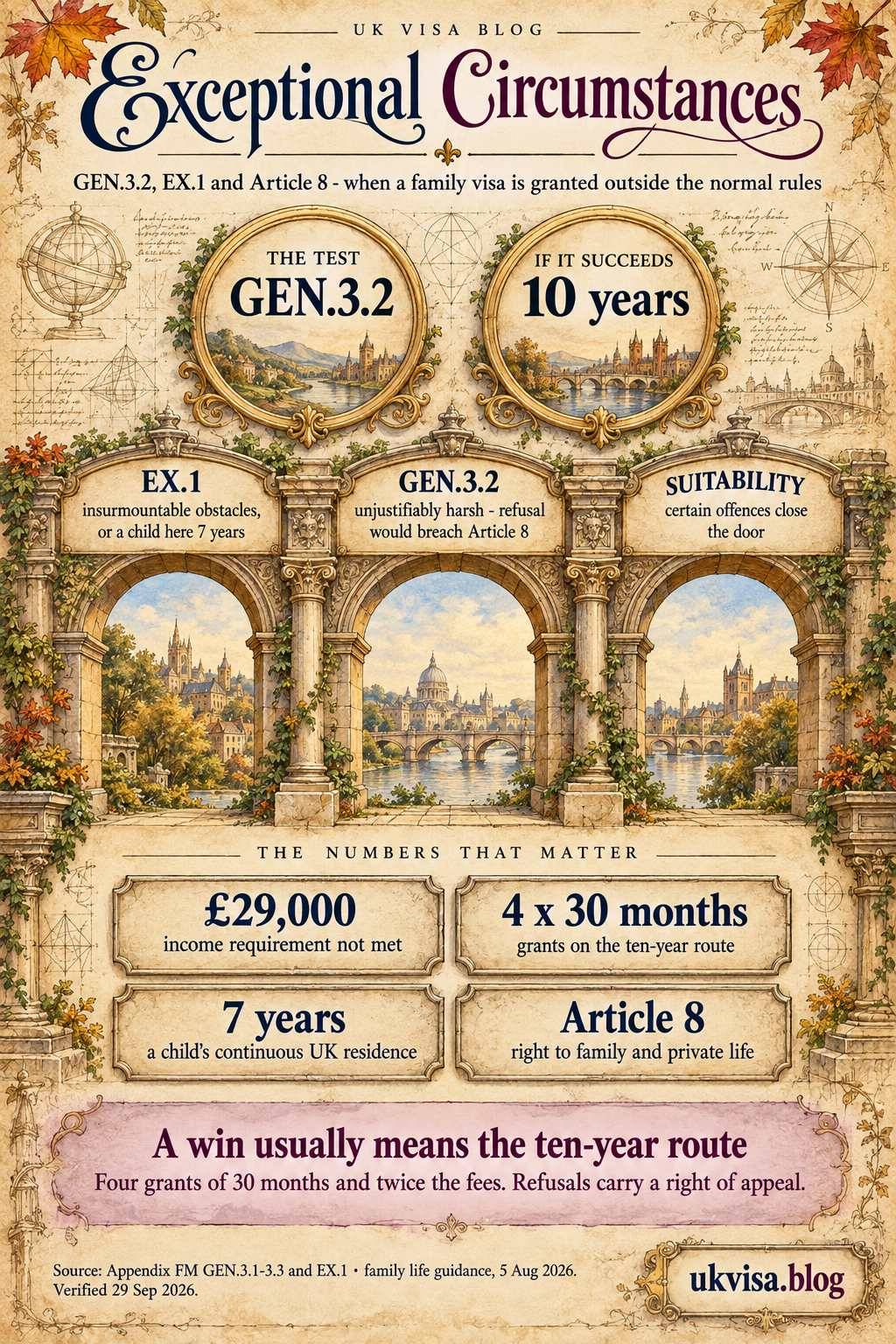
Circumstances in which refusing the application would result in unjustifiably harsh consequences, making refusal a breach of Article 8. That is the definition the Home Office guidance uses. It is not a synonym for difficult or unusual — every refused applicant suffers some hardship — and it requires consequences materially worse than a refusal ordinarily produces.
The provisions sit at paragraphs GEN.3.1 to GEN.3.3 of Appendix FM, and are applied through the Home Office guidance on family life as a partner or parent and exceptional circumstances, version 29.0 of 5 August 2026. They exist because rigid application of a threshold can produce an outcome the Article 8 human rights claims framework will not permit.
What Tends to Count
Severe medical need where treatment is unavailable abroad, or where the applicant cares for a seriously ill relative here. A child’s best interests, especially where the child’s whole life has been in the UK. Genuine risk of harm on return. Long residence with deep integration — see our guide to private life applications under Article 8. Separation whose consequences go well beyond the ordinary.
The Guidance Tells Caseworkers to Be Sparing
Version 29.0 is explicit that the discretion should be used sparingly, and only where the factors genuinely warrant a grant despite unmet requirements. It also directs that original documentary evidence carries more weight than assertion, and that where a document is missing the applicant must offer a reasonable alternative or a reasonable explanation.
Compelling Compassionate Grounds
The phrase describes the urgent end of the same spectrum: acute hardship, immediate risk, or a situation where basic dignity is at stake. Every compelling compassionate case is exceptional; not every exceptional case is urgent.
Two Framings of the Same Discretion
| Aspect | Exceptional circumstances | Compelling compassionate grounds |
|---|---|---|
| Focus | Unjustifiably harsh consequences | Urgent humanitarian need |
| Typical facts | Long residence, a child’s settled life, financial impossibility | Medical emergency, domestic abuse, risk of serious harm |
| Timescale | Variable | Usually immediate |
| Evidence emphasis | Impact and proportionality | Risk and vulnerability |
Source: Appendix FM GEN.3.1–GEN.3.3; family life and exceptional circumstances guidance version 29.0.
- Critical illness: the applicant or a UK relative with a life-threatening condition needing urgent care.
- Domestic abuse: victims who cannot safely return — see settlement under the domestic abuse provisions.
- Trafficking: victims requiring protection and support in the UK.
- A child at risk: where refusal of a parent’s application would expose the child to serious harm.
- End-of-life care: the need to be present with a dying family member.
How the Provisions Work Under Appendix FM
Two mechanisms operate. Paragraph EX.1 waives certain eligibility requirements in defined situations. GEN.3.1 to GEN.3.3 require the decision-maker to ask, before refusing, whether exceptional circumstances make refusal a breach of Article 8.
EX.1 and Insurmountable Obstacles
EX.1 applies where a partner faces insurmountable obstacles to family life continuing outside the UK, and where a parent’s child has lived here continuously for at least seven years immediately before the application and it would not be reasonable to expect them to leave. It is the most common gateway, and it operates inside the rules rather than outside them.
The guidance is candid that caseworkers begin from the position that it is ordinarily reasonable for a child to leave with their parents. Seven years’ residence is what displaces that starting point, so the case has to be built on what those years contain — schooling, language, medical care, friendships — not on the number.
Which Family Route Is in Play
| Route | Purpose | Central requirement |
|---|---|---|
| Spouse or partner | Join a partner in the UK | Relationship, £29,000, English |
| Fiancé(e) | Marry within six months | Genuine intention plus the financial requirement |
| Parent of a British child | Live with a British or settled child | Sole responsibility or access rights |
| Adult dependent relative | Long-term care needs | Care unavailable or unaffordable abroad |
Source: Appendix FM of the Immigration Rules.
What a Successful Claim Actually Produces
Not the five-year route. Where the £29,000 financial requirement cannot be met and exceptional circumstances carry the case, the grant is on the 10-year route to settlement: four grants of 30 months rather than two, and twice the fees.
The no-recourse-to-public-funds condition is mandatory on the five-year route. It is not on the ten-year route: version 29.0 directs caseworkers to consider whether to allow access to public funds where permission is granted on exceptional circumstances. Where the family genuinely cannot be maintained without it, ask expressly and evidence the need — it will not be volunteered.
Evidence That Carries an Exceptional Circumstances Claim
The threshold is high and the evidence has to be specific. Generic material about country conditions or general statements about hardship do not engage the test, because the question is always what happens to these people rather than what happens to people in this position.
- Medical: specialist reports with diagnosis, treatment plan, prognosis and care needs — not a GP letter confirming a condition exists.
- Financial: statements, payslips, tax returns and debt documents showing the position rather than describing it.
- Child welfare: school reports, social work or CAFCASS assessments, and where relevant a child psychologist’s report.
- Risk: police reports, country expert evidence and documentation of specific threats.
- Third parties: employers, clinicians, teachers and community figures speaking to what they have observed.
- Personal statement: a detailed account tying the documents to the consequences of refusal.
Why Claims Fail
Country reports with no link to the applicant. Medical letters that confirm a condition but not its consequences. No explanation of why family life must continue here rather than elsewhere. Nothing about the impact on the children. And no comparison at all — a claim that does not say why these circumstances are worse than the ordinary run of refusals has not engaged the test.
The wider pattern of refusal is covered in our guide to spouse visa refusal reasons, and evidence of the relationship itself in our guide to proving a genuine relationship.
Grants Outside the Immigration Rules
Where no route fits at all, the Home Office may grant leave outside the rules on compelling compassionate grounds. This is a last resort, considered once rule-based options are exhausted, and it produces leave with its own conditions rather than a standard visa.
What Leave Outside the Rules Gives You
Duration and conditions are set case by case, and such leave does not necessarily lead to settlement on any fixed timetable. It is protection rather than a route, which is why it is worth exhausting the routes first — including whether family life could be pursued from abroad by a British citizen returning to the UK.
Where Article 8 Reaches, and Where It Stops
Article 8 family life covers partners and the relationship between parents and minor children. It does not automatically extend to adult children and their parents, adult siblings, grandparents or wider relatives. Those relationships engage it only where dependency goes beyond normal emotional ties — the point on which most adult dependent relative arguments turn.
Suitability Can Close the Door Entirely
Since 11 November 2025 the common suitability provisions apply to the family and private life routes for the first time. Certain offences trigger mandatory refusal and a referral for deportation consideration, and no amount of compassionate evidence displaces that. Address criminal or immigration history openly rather than hoping it will be weighed in the balance.
Refusal, Appeal and Reapplication
An application raising Article 8 is a human rights claim, so refusal carries a right of appeal to the First-tier Tribunal. Our appeal options guide covers procedure, and our spouse visa refusal appeal guide covers the family-specific timeline.
Appeals do well in this territory when the tribunal has fresh evidence or when the Home Office weighed the Article 8 factors thinly. They do badly when the same material is simply re-argued. If reapplying instead, the fresh application must overcome both the original deficiency and the reasons the exceptional circumstances argument was rejected — our guide to reapplication strategy after refusal sets out how to judge it.
Sources: Appendix FM of the Immigration Rules, paragraphs GEN.3.1 to GEN.3.3 and EX.1; Home Office guidance on family life and exceptional circumstances, version 29.0 of 5 August 2026; and Part Suitability of the Immigration Rules. Figures verified 22 August 2026.
Frequently Asked
Questions about Exceptional Circumstances
Circumstances in which refusing the application would produce unjustifiably harsh consequences, making refusal a breach of Article 8. That is the definition the Home Office guidance itself uses. It is not a synonym for difficulty: every refused applicant experiences hardship, and the test asks for consequences materially worse than a refusal ordinarily brings.
They can, but the result is not the five-year route. Where £29,000 cannot be met and the Article 8 case succeeds, permission is normally granted on the ten-year route to settlement — four grants of 30 months instead of two. Simply being unable to reach the threshold is not exceptional; something further must make refusal disproportionate.
A paragraph in Appendix FM that waives certain eligibility requirements where a partner faces insurmountable obstacles to family life continuing outside the UK, or where a child has lived in the UK continuously for seven years and it would not be reasonable to expect them to leave. It works inside the rules and normally leads to the ten-year route.
Possibly. The no-recourse condition is mandatory on the five-year route but not on the ten-year one: the guidance directs caseworkers to consider whether to allow access to public funds where permission is granted on exceptional circumstances. Ask expressly and evidence why the family cannot otherwise be maintained — it is not offered automatically.
Specific and professional. Medical claims need specialist reports with diagnosis, treatment and prognosis rather than a GP letter confirming a condition. Child welfare claims need school, social work or CAFCASS assessments. Risk claims need police reports or country expert evidence. The guidance gives original documents more weight than assertion.
No. Family life under Article 8 covers partners and the relationship between parents and minor children. Adult children and their parents, adult siblings, grandparents and wider relatives are not automatically included: those relationships engage Article 8 only where dependency goes beyond normal emotional ties, which is a demanding test on the evidence.
A discretionary grant made where no route in the Immigration Rules fits but refusing would breach human rights obligations. It is a last resort with conditions set case by case, and it does not necessarily lead to settlement on a fixed timetable. Exhaust the rule-based routes first, because they offer far more certainty.
Yes. Since 11 November 2025 the common suitability provisions apply to the family and private life routes for the first time. Certain offences trigger mandatory refusal and a referral for deportation consideration, and compassionate evidence does not displace that. Disclose and address criminal or immigration history rather than leaving it to be discovered.
Yes, where the application raised Article 8, because that makes it a human rights claim and refusal of one carries a statutory appeal to the First-tier Tribunal. Appeals succeed most often where fresh evidence is produced or where the Home Office weighed the Article 8 factors thinly. Re-arguing the same material rarely changes the outcome.