
The UK fiancé visa buys six months to marry, costs £2,064 and carries no health surcharge. It also carries no work rights and no credit towards settlement — the five-year clock starts only when the spouse visa is granted, which makes the real journey nearer five and a half years.
UK Family Visas
UK Fiancé Visa Overview 2026
Fiancé Visa UK Requirements 2026
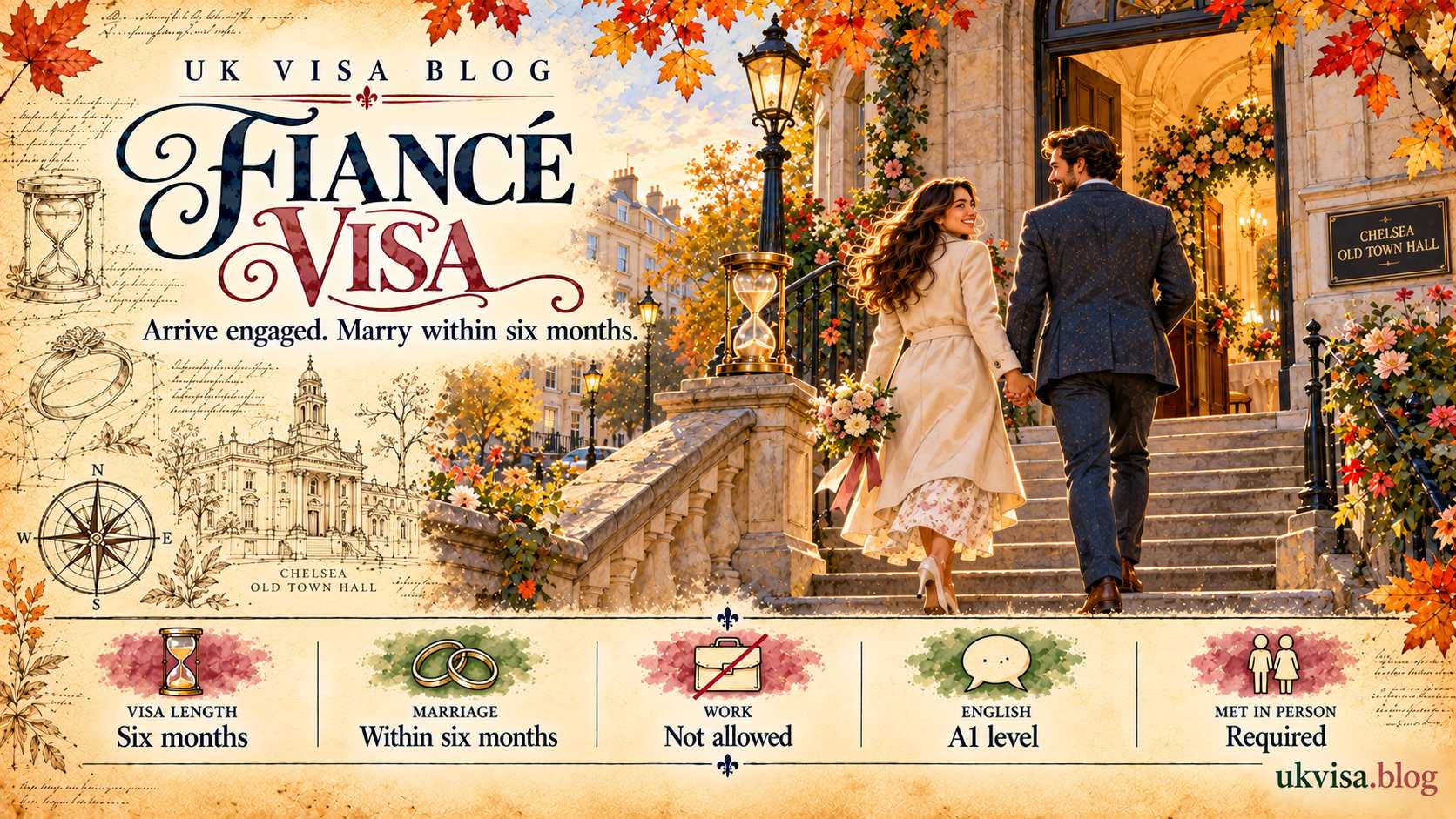
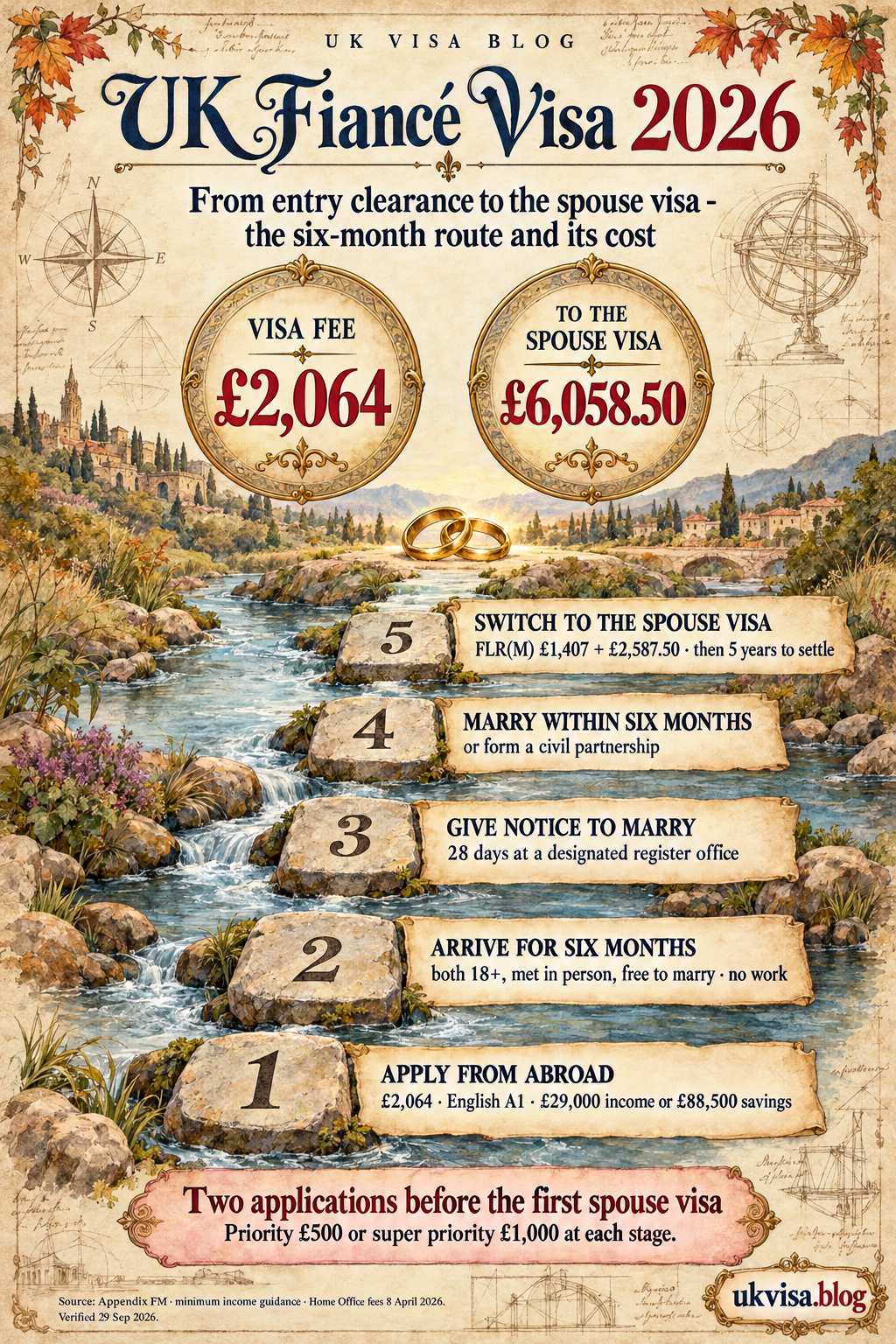
Both partners must be 18 or over, have met in person, be free to marry, and genuinely intend to marry or form a civil partnership within six months of arrival. The sponsor must meet the £29,000 financial requirement or hold £88,500 in savings, and you need A1 English and adequate accommodation. The visa costs £2,064, lasts six months, and does not permit work.
The route is officially the Fiancé(e) or Proposed Civil Partner visa, and it sits in Appendix FM alongside the spouse settlement route. The tests are the same ones the spouse route applies, with one addition — a credible plan to marry inside six months — and one subtraction, since no settlement clock runs.
What You Must Satisfy
| Requirement | Position in 2026 |
|---|---|
| Age | Both partners 18 or over |
| Relationship | Genuine and subsisting, and you must have met in person |
| Intention | To marry or form a civil partnership within six months |
| Sponsor income | £29,000 a year, or £88,500 in savings |
| English | A1 speaking and listening |
| Accommodation | Adequate and not statutorily overcrowded |
| Sponsor status | British or Irish citizen, settled person, or refugee or humanitarian protection status |
Source: Appendix FM of the Immigration Rules; fee table of 8 April 2026.
Where the Income Threshold Stands
£29,000 has applied since 11 April 2024. Announced increases to £34,500 and then £38,700 were paused, the Migration Advisory Committee reported in June 2025 without recommending a single figure, and nothing further has been laid. Our sponsor earnings test guide sets out how it is proved.
Proposed Civil Partners
The proposed civil partner route is the same visa under a different name, for couples forming a civil partnership rather than marrying. Requirements, fee and process are identical. Civil partnership in the UK is open to same-sex and opposite-sex couples alike.
Documents Required
The bundle overlaps heavily with the spouse application you will make six months later, so build it once and keep it. Our partner visa document checklist covers the evidential standard for each item.
- Passport: valid, with a blank page.
- Relationship evidence: photographs across the relationship, communication records, travel evidence, joint documents.
- Financial: six months of payslips, matching bank statements and an employer’s letter.
- Accommodation: tenancy agreement, mortgage statement or the property owner’s letter.
- English: an A1 SELT certificate or evidence of an exemption.
- Marriage plan: a venue booking, a notice of marriage appointment, or comparable concrete arrangements.
- TB certificate: where you have lived six months or more in a listed country.
The Marriage Plan Is the Distinctive Test
This is what separates a fiancé application from a spouse one. A stated intention is not enough — the caseworker is looking for arrangements that could realistically complete inside six months. A booked registry office appointment, a deposit paid, a date agreed with families all speak louder than a paragraph of intent.
Relationship evidence works the same way here as everywhere: official and verifiable documents carry the case, photographs and letters from friends support it. Our guide to a genuine relationship explains how caseworkers grade the tiers, and our partner credibility interview guide covers what happens if a case is referred.
How to Apply
The application is made online from outside the UK and cannot be switched into from within it. Complete the visa application form, pay, then attend a visa application centre for biometrics and document submission.
- Apply online: from outside the UK, on the family visa route.
- Pay: £2,064 from 8 April 2026; no health surcharge is due on a six-month grant.
- Book biometrics: at the visa application centre serving your country.
- Attend: with the passport and supporting documents.
- Wait: typically three to six weeks, or faster on a priority service where one is offered.
- Collect: the passport with the entry vignette, and travel within the dates printed on it.
Apply at least eight to ten weeks before any fixed wedding date. Processing times vary by post and season, and a delayed decision is far easier to absorb than a booked venue you cannot reach.
The Notice Period Eats Into the Six Months
Marriage in England and Wales requires notice at a register office, and since 2 March 2015 the standard notice period has been 28 days rather than the earlier 15. Where one partner is subject to immigration control, notice must be given at a designated register office and the couple must attend together.
If the Home Office refers the proposed marriage for investigation under the referral and investigation scheme, the notice period extends from 28 days to 70. That is two and a half months of a six-month visa gone before the ceremony can happen, which is why arrangements should be made in the first weeks after arrival rather than the last.
Switching to the Spouse Visa
Once married, apply on form FLR(M) from inside the UK before the six months run out — see our FLR(M) marriage form guide. The grant is 30 months, work rights begin at that point, and so does the qualifying period for settlement.
- Marriage certificate: the UK marriage or civil partnership certificate.
- Finances: the sponsor still meeting £29,000, evidenced afresh.
- Relationship: evidence that it continues.
- Accommodation: adequate housing for the couple.
- Timing: the application made before the fiancé permission expires.
Time on a fiancé visa does not count towards the five years for ILR. The clock starts when the spouse visa is granted, so the real distance from arrival to settlement is around five and a half years. You cannot work during those first six months either — employment rights arrive with the FLR(M) grant.
From there the route is the ordinary one: 30 months, an extension of another 30, then settlement. The A1 certificate used for the fiancé application also satisfies the first spouse application, and a higher pass carries further still.
Fees and Processing Time
The fiancé stage is cheaper than a spouse application only because no health surcharge falls due on six months. The saving is temporary — the surcharge arrives in full at the switch.
Cost from Fiancé Entry to Spouse Visa
| Charge | Amount | Stage |
|---|---|---|
| Fiancé or proposed civil partner visa | £2,064 | Entry clearance |
| Health surcharge | Not payable | Six-month grant |
| Priority service | £500 | Optional |
| Super priority service | £1,000 | Optional |
| FLR(M) switch | £1,407 | After marriage |
| Health surcharge, 30 months | £2,587.50 | After marriage |
| Total to the spouse visa grant | £6,058.50 | Standard service |
Source: Home Office immigration and nationality fees, 8 April 2026; IHS at £1,035 a year.
Full figures through to settlement sit in our Home Office settlement fees guide, and current rates should always be checked against the published fee table before paying.
Processing Times
Three to six weeks from biometrics is typical for a straightforward application. Priority targets five working days and super priority the next working day where those services operate. Complex financial evidence, requests for further documents and busy periods all extend the wait regardless of what was paid.
Refusal Risks and What Follows
Fiancé refusals share their causes with the spouse route — thin relationship evidence, financial evidence in the wrong form, credibility concerns — plus one of their own: a marriage plan that does not look achievable in six months. Our guide to reasons spouse visas get refused covers the shared ground.
Appeal or Reapply
A fiancé refusal is a refusal of a human rights claim, so an appeal to the First-tier Tribunal is available — see our partner visa appeal timeline guide. With human rights appeals averaging well over a year, a corrected fresh application is usually the faster route unless the caseworker misapplied the rules.
If the Marriage Cannot Go Ahead in Time
The route does not provide for extension as a matter of course, and running past the six months without a valid application makes you an overstayer. Where illness, bereavement or a cancelled ceremony makes the date impossible, take advice before the permission expires rather than after — the options narrow sharply once it has.
If the Relationship Breaks Down
Protections attached to the spouse route are not all available here. Settlement under the domestic abuse provisions requires permission as a partner, which a fiancé does not hold, so it becomes available only after the switch. Where circumstances are compelling but the rules cannot be met, the Article 8 compassionate grounds framework is the remaining avenue.
Sources: the partner and fiancé pages on GOV.UK; Appendix FM of the Immigration Rules; Home Office guidance on the minimum income requirement, version 13.0 of 11 November 2025; and the fee table of 8 April 2026. English levels follow our English requirement for fiancé visa guide. Figures verified 22 August 2026.
Frequently Asked
Questions about the UK Fiancé Visa
Entry clearance allowing the fiancé(e) or proposed civil partner of a British, Irish or settled person to come to the UK to marry within six months. It is granted for six months, carries no work rights, and must be switched to a spouse visa after the marriage. Time on it does not count towards settlement.
Both partners 18 or over, a genuine relationship in which you have met in person, a credible intention to marry within six months, a sponsor meeting the £29,000 financial requirement or holding £88,500 in savings, A1 English, and adequate accommodation. The sponsor must be a British or Irish citizen, settled, or hold refugee or humanitarian protection status.
£2,064 from 8 April 2026, up from £1,938, with no Immigration Health Surcharge because the grant is only six months. Priority services add £500 or £1,000 where offered. After the marriage the FLR(M) switch costs £1,407 plus £2,587.50 of surcharge, bringing the total from entry to the spouse visa grant to £6,058.50.
Not at the fiancé stage. The surcharge is not charged on permission of six months or less, so nothing is due on the initial application. It becomes payable at the switch, where a 30-month grant attracts £2,587.50 for an adult at the £1,035 annual rate. Budget for it from the outset rather than at the point of marriage.
No. The fiancé visa permits entry to marry and nothing more; there are no work rights and no recourse to public funds. Employment becomes possible only once the spouse visa is granted after the marriage, which is one reason the six-month period is best kept short rather than run to its limit.
Typically three to six weeks from the biometrics appointment. Priority targets five working days and super priority the next working day where those services operate at your visa application centre. Apply at least eight to ten weeks before any fixed wedding date, because delays are easier to absorb than a ceremony you cannot reach.
Apply on form FLR(M) from inside the UK before the fiancé permission expires, with the marriage certificate, fresh financial evidence, proof the relationship continues and accommodation evidence. The fee is £1,407 plus £2,587.50 of surcharge, and the grant is 30 months. You do not have to return home to make the application.
The route does not provide for extension in the ordinary course, and staying beyond six months without a valid application makes you an overstayer. Where illness, bereavement or a cancelled ceremony makes the timetable impossible, take advice before the permission expires — the available options narrow considerably once it has.
No. The five-year qualifying period for indefinite leave begins when the spouse visa is granted, not when you arrive on the fiancé visa. Allowing for the six months plus the switch, the realistic distance from arrival to settlement eligibility is about five and a half years rather than five.