
Where British citizens live abroad is measured differently by every source, and no single register exists. What is documented is the UK side: how many people leave, how many arrive, and what a returning British citizen has to do to bring a foreign partner or child with them. That last question is the one this site can answer.
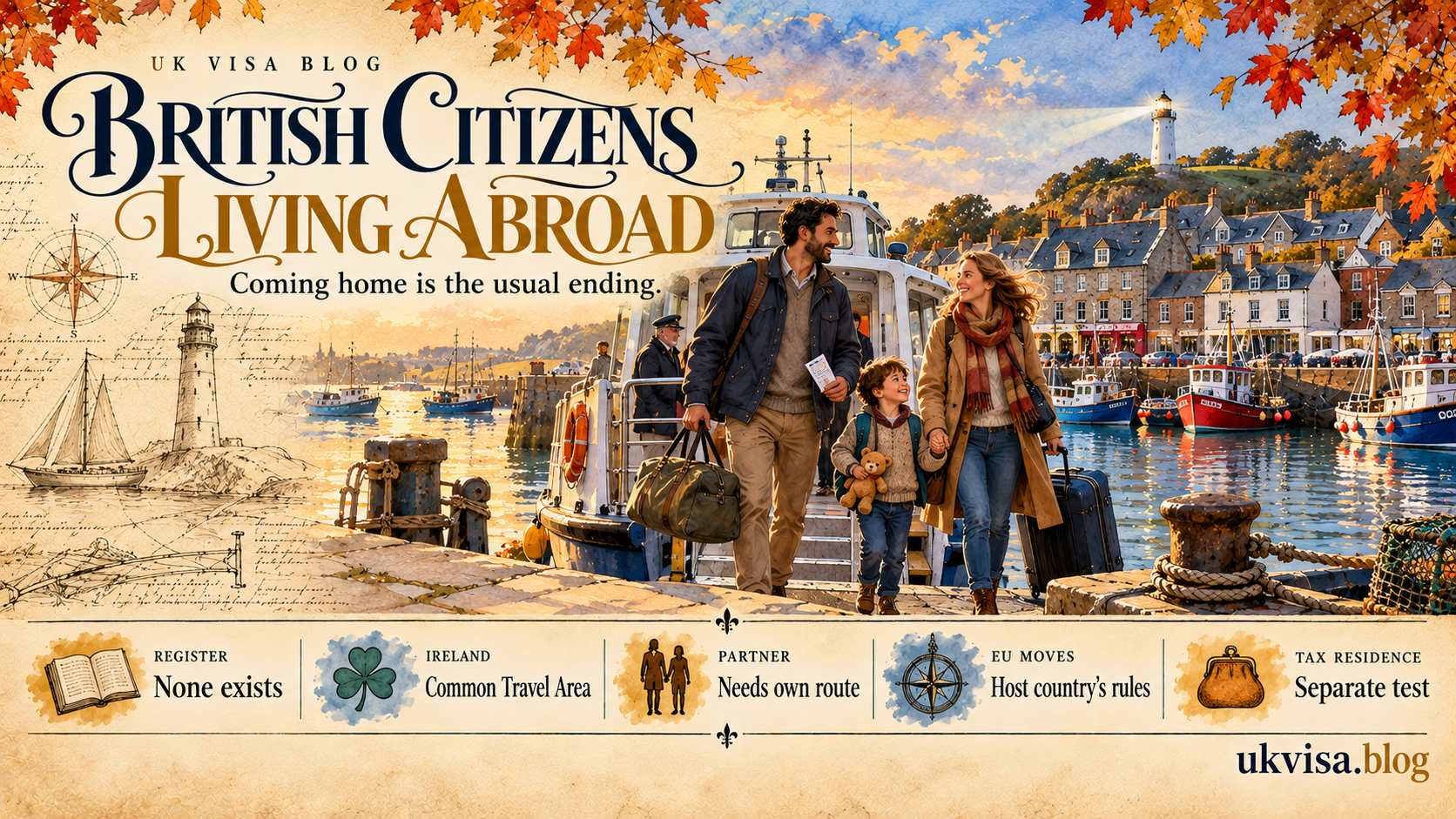
British Citizens Abroad
British Citizens Living Abroad, and Coming Back
How Many People Leave
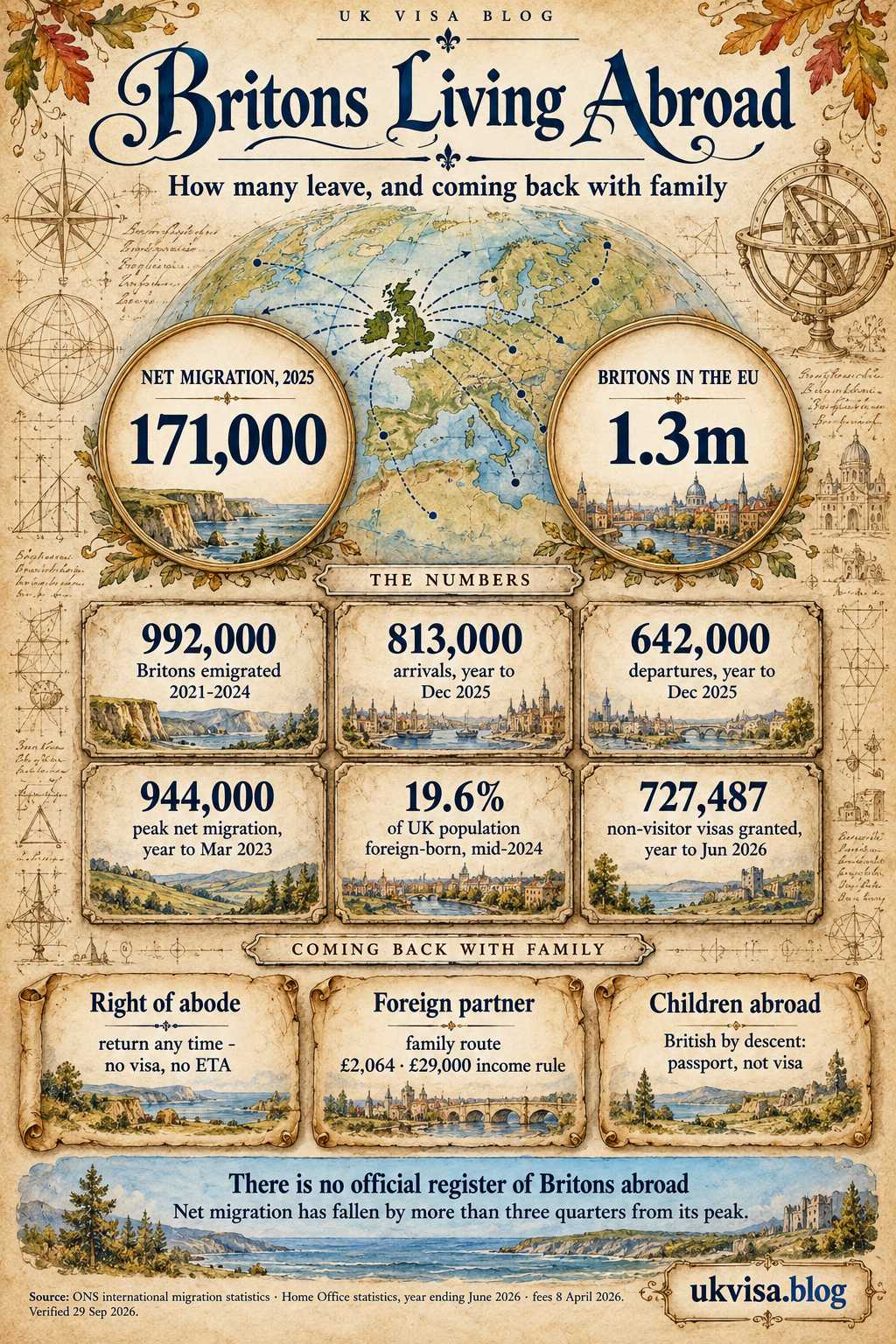
Emigration is measured by the Office for National Statistics as part of the net migration estimate rather than by any register of citizens abroad. Around 992,000 British nationals emigrated between 2021 and 2024 — roughly 679 a day — and about three quarters of them were under 35.
Net migration was around 171,000 in the year ending December 2025, from roughly 813,000 arrivals and 642,000 departures, down from a peak of about 944,000 in the year ending March 2023. Around 992,000 British nationals emigrated between 2021 and 2024, and roughly 1.3 million UK nationals live in the EU excluding Ireland. No official register of Britons abroad exists.
Country-level counts of Britons abroad come from different sources counting different things — consular registrations, host-country residence permits, census self-identification and estimates. They are not comparable with each other and rarely carry a date. Treat any single headline figure with caution, and check what it is actually counting.
Where They Go
The largest documented concentration is in the European Union: around 1.3 million UK nationals, excluding Ireland, where free movement between the two countries continues under the Common Travel Area rather than under EU law. Beyond that, the traditional destinations are the English-speaking countries.
What matters practically is not the count but the rules. Since the end of free movement, a British citizen moving to an EU state needs that country’s permission on that country’s terms, in the same way an EU citizen now needs UK permission. The reciprocity people remember no longer exists.
The Common Destinations
- The residence route: work, study, retirement or family, and whether you qualify.
- Income or savings thresholds: many retirement and non-lucrative routes set them.
- Healthcare: whether you can access the state system and what private cover costs.
- Tax residence: which is a separate test from immigration residence.
- Your partner’s position: a non-British partner may need their own route.
- The route back: what returning to the UK together would require.
Each destination’s requirements are a matter for that country’s law and change independently of anything the UK does. Check the current position with that country’s authorities rather than with a comparison article, and check it again close to the move.
Why People Move
The age profile tells the story better than any survey. With roughly three quarters of recent British emigrants under 35, the dominant drivers are work, study and relationships rather than retirement — which is the opposite of the popular picture of British emigration.
That matters for what comes next. Younger emigrants are far more likely to return, and far more likely to return with a partner or children acquired abroad. The UK immigration questions that follow are therefore not a niche concern but the normal end of the story.
Ireland Is the Exception
The Common Travel Area predates EU membership and survived leaving it. Irish citizens and British citizens continue to move, live and work between the two countries without immigration permission, which is why Ireland sits outside every count of Britons living “abroad” in the EU sense.
The Other Direction
Around 19.6% of the UK population was foreign-born as at mid-2024, roughly 13.1 million people. Net migration fell to around 171,000 in the year ending December 2025 from a peak of about 944,000 in the year ending March 2023 — a fall driven by both fewer arrivals and more departures.
On the visa side, 727,487 non-visitor and non-transit visas were granted in the year ending June 2026, 15% fewer than the previous year, with work and study visas accounting for almost all of the fall.
Returning With a Foreign Partner or Children
This is where British citizens abroad most often need UK immigration advice, and where the position surprises people. Being British gives you the right to return. It gives your foreign partner nothing automatically — they need a visa on the ordinary family route.
- The partner route: entry clearance at £2,064, plus the health surcharge at £1,035 a year.
- The financial requirement: £29,000 minimum income or the savings equivalent.
- English at A1: rising to A2 at extension and B1 at settlement.
- Accommodation: adequate and available, evidenced.
- Twelve weeks: the published waiting time for family applications from abroad.
- Children: British by descent in some cases, needing their own application in others.
The financial requirement is the obstacle that stops most returning families. A British citizen living abroad generally cannot rely on overseas earnings in the ordinary way, which is why so many return alone first and apply once UK employment is established. See our spouse route page and, where a child is British, our page on the Appendix FM parent route.
Children Born Abroad
Whether a child born outside the UK to a British parent is British at birth depends on how the parent holds their own citizenship — the distinction between citizenship otherwise than by descent and citizenship by descent. It is a technical question with a significant consequence, and it is one to establish rather than assume.
Where the child is British, they need a passport rather than a visa. Where they are not, registration may be available at £1,000, or they apply as a dependant. Getting this wrong in either direction is expensive: registering a child who is already British wastes the fee, and assuming a child is British when they are not surfaces at the first passport application.
The Fiancé Alternative
Couples who are not yet married sometimes assume they must marry abroad before returning. They do not: the fiancé route allows six months to marry in the UK and then a switch in country, which suits couples who want a UK wedding. It carries the same financial requirement, so it solves a logistical problem rather than a financial one.
The marriage visitor route is a different thing again — it permits marrying in the UK but requires you to leave afterwards, with no switching. Choosing between the two is a decision about where you intend to live, and it should be made before either application.
Timing a Return
- Establish UK employment first: which is usually what makes the financial requirement achievable.
- Assemble relationship evidence as you go: it cannot be created retrospectively.
- Get certificates translated early: certified translations need the translator’s confirmation, date, name, signature and contact details.
- Check each child’s nationality position: before assuming a visa is or is not needed.
- Allow twelve weeks: the published time for family applications from abroad.
Travelling on a British Passport
A British passport gives visa-free or visa-on-arrival access to a large number of countries for short visits, but requirements change and several major destinations have introduced pre-travel authorisations of their own — the mirror image of the UK’s Electronic Travel Authorisation.
Check the current position for each trip through the Foreign, Commonwealth and Development Office travel advice rather than from a list. Visa-free entry is also short-stay entry: it permits tourism, not residence, and it is not a route to living somewhere.
Visiting Before Moving
A foreign partner can visit the UK while a family application is being prepared, but the visit and the settlement intention have to be kept separate. A visitor must intend to leave at the end of the visit, and an application that reads as relocation by instalments is refused — and the refusal then sits on the record when the family application is made.
Where the partner is visa-free, an Electronic Travel Authorisation at £20 covers short trips. Where a visa is needed, a standard visit costs £135. Neither leads anywhere, and neither should be used as a substitute for the family route.
Practical Issues That Recur
- Losing UK settled status: a non-British partner’s indefinite leave lapses after two continuous years outside the UK.
- Absences and citizenship: a partner naturalising later needs 450 days or fewer across five years, and 90 or fewer in the final twelve months.
- Documents: marriage and birth certificates issued abroad need certified translations for UK applications.
- Evidence of the relationship: which is harder to assemble years later than as you go.
- Healthcare on return: the health surcharge is payable upfront for the whole period granted.
The recurring theme is that decisions made abroad have UK immigration consequences years later. A partner’s settled status lost through a long posting, or an absence record nobody kept, is discovered at the point of applying — see our pages on settlement and naturalisation rules.
Where a partner is an EU national, check whether they hold status under the EU Settlement Scheme before assuming the ordinary family route applies. Our pages on French and Spanish nationals, and on US nationals, cover the country-level position, and our page on the Skilled Worker route the work alternative.
Sources: ONS international migration statistics, the Migration Observatory overview of migrants in the UK, House of Commons Library research briefings, Home Office immigration system statistics for the year ending June 2026, and FCDO travel advice. Figures verified 5 September 2026.
Frequently Asked
British Citizens Abroad Questions
How many British citizens live abroad?
There is no official register. Around 1.3 million UK nationals live in the EU excluding Ireland, and roughly 992,000 British nationals emigrated between 2021 and 2024.
Who is leaving?
Mostly younger people — around three quarters of recent British emigrants were under 35, which is the opposite of the popular picture of retirement emigration.
Can I bring my foreign partner back to the UK?
Yes, but they need a visa on the family route: £2,064 entry clearance plus health surcharge, the £29,000 financial requirement, English at A1 and adequate accommodation.
Why is the financial requirement so difficult from abroad?
Because overseas earnings generally cannot be relied on in the ordinary way. Many returning families have the British partner return first and apply once UK employment is established.
Is my child born abroad British?
It depends whether your own citizenship is held otherwise than by descent or by descent. Establish it rather than assume it — the consequence is significant and the answer is technical.
Can my partner lose their settled status while we are abroad?
Yes. Indefinite leave to remain lapses after two continuous years outside the UK, with no notification. It is usually discovered at the border on return.
Does living abroad affect my own British citizenship?
No. British citizenship is not lost through absence. It is your non-British family members whose status is at risk.
Can I still live in the EU as a British citizen?
Only on that country’s terms, since free movement ended. Ireland is different, because the Common Travel Area operates independently of EU law.
How reliable are expat population figures?
Not very, taken individually. They come from consular registers, residence permits, censuses and estimates, count different things, and rarely carry a date.
Can my partner visit while we prepare the application?
Yes, but a visitor must intend to leave at the end of the visit. An application that reads as relocation by instalments is refused, and that refusal then sits on the record.
Should we marry abroad or in the UK?
Either works. The fiancé route allows six months to marry here and then a switch in country; the marriage visitor route permits the wedding but requires you to leave afterwards.
How long does a partner visa take from abroad?
Twelve weeks is the published waiting time for family applications made outside the UK, against three weeks for visit, study and work applications.