
Coming to the UK for private treatment is a Standard Visitor application with extra requirements attached. The application stands or falls on one document: a letter from the UK consultant setting out the condition, the cost, where treatment happens and how long it will take. Open-ended treatment is refused.
Medical Visits
Coming to the UK for Private Medical Treatment in 2026
How the Medical Visit Route Works
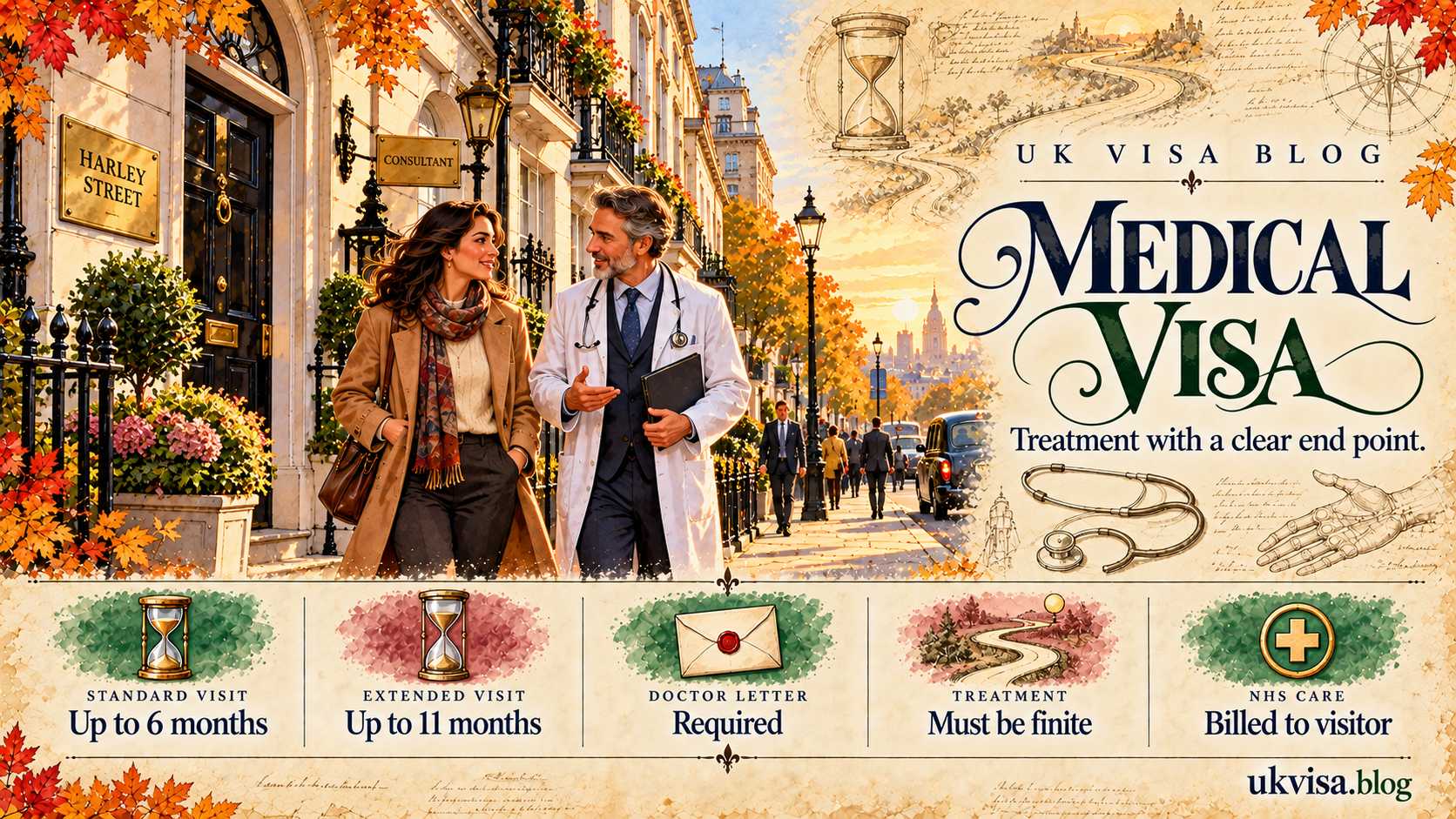
There is no standalone medical visa. You apply on the Standard Visitor route and declare private medical treatment as the purpose. Most patients are granted up to six months. Where the treatment genuinely requires longer, a separate application allows up to eleven months.
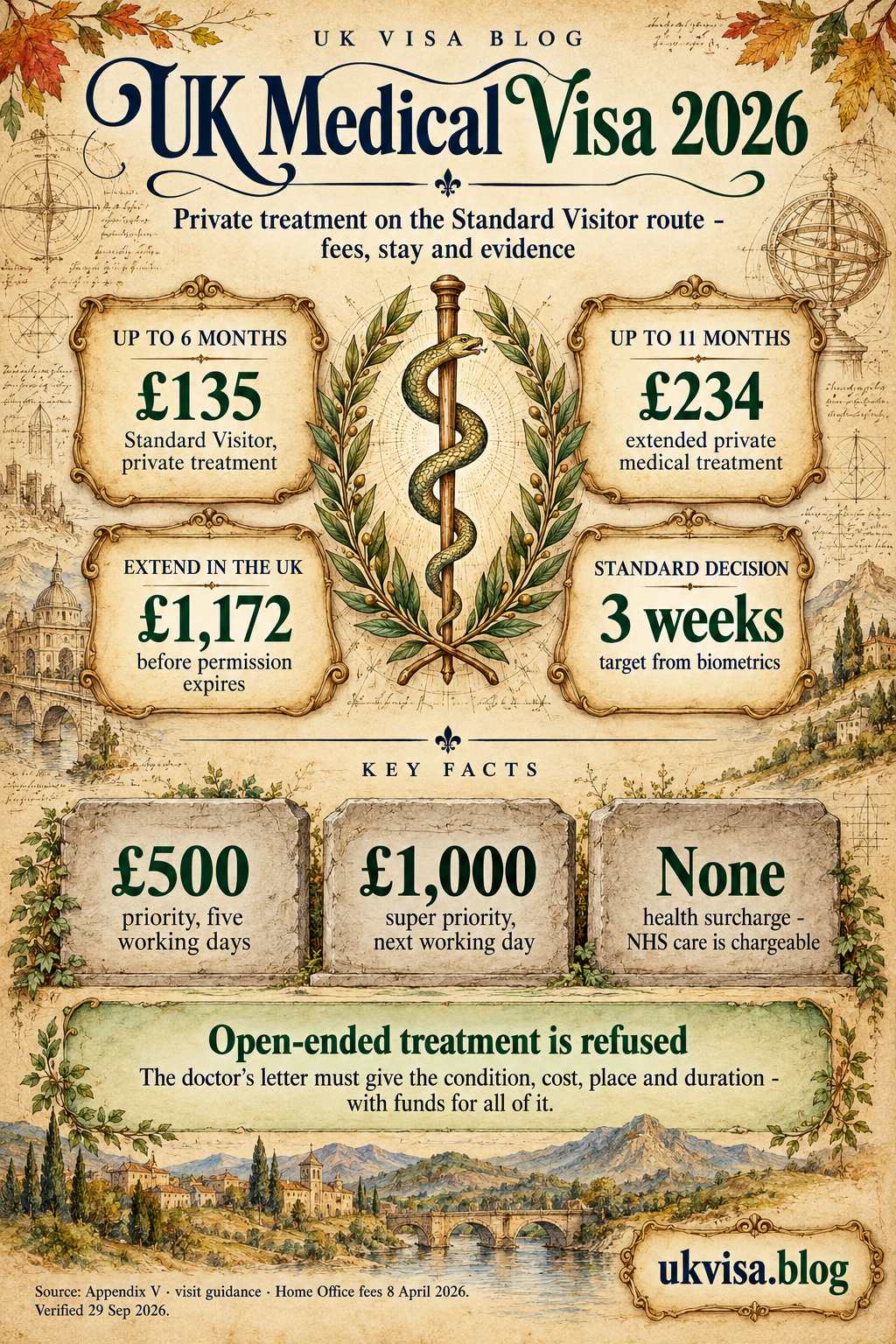
A six-month medical visit costs £135 from 8 April 2026; the extended visit for treatment running past six months costs £234 and allows up to eleven months. You need a letter from your UK doctor or consultant stating the condition, the likely cost, where treatment takes place and its likely duration, which must be finite. Visitors are billed for NHS treatment.
Guidance is clear that most patients seeking private treatment would be expected to stay six months or less. The eleven-month option exists for cases where the clinical evidence supports it, and the medical evidence must actually support the length requested rather than simply asking for the maximum.
This Is Not a Route for Medical Workers
The two are regularly confused. This route is for patients receiving treatment. The Health and Care Worker route is for doctors, nurses and care staff coming to work in the UK, requires a licensed sponsor and a certificate of sponsorship, and leads towards settlement. A patient cannot use it; a clinician cannot use the visit route to take up a post.
Separately, overseas doctors sitting the PLAB test or attending a clinical attachment do so as visitors, but under their own provisions with their own document requirements. That is a study and assessment activity, not medical treatment, and not employment.
What You Must Satisfy
- The standard visitor tests: genuine visit, intention to leave, no prohibited activity, no public funds.
- A named UK consultant or doctor: with a letter covering condition, cost, location and duration.
- Finite treatment: a defined end point. Open-ended treatment falls to be refused.
- Funds for everything: the treatment, the accommodation and all living costs for the whole stay.
- Private payment: the treatment must be paid for, unless a reciprocal healthcare agreement applies.
Funds Are Assessed Against the Full Cost
Sufficient funds here means all reasonable costs of the visit and the treatment, not a general living allowance. Where a third party is paying, that support must be declared, and the supporter must show they can fund their own household as well. Our page on sponsoring a visitor sets out how that is assessed.
Where Treatment Under an EU or Irish Agreement Fits
The UK holds reciprocal healthcare agreements with a number of countries. Planned treatment under the agreements with Ireland and the EU is treated as private medical treatment for visitor purposes, and the usual bar on coming specifically for treatment does not apply. You must carry an authorisation form from your own government naming the condition and the planned duration.
The Consultant’s Letter and Supporting Evidence
A caseworker with any doubt is expected to verify the letter. They may search the General Medical Council register, and where the consultant is not listed they must contact the hospital to confirm the consultant works there. They may also contact the consultant or hospital directly about the costs and arrangements.
What the Letter Must Contain
[Hospital or clinic letterhead]
[GMC registration number]
[Date]
To whom it may concern
Re: [Patient full name], date of birth [DOB], passport number [number]
Condition: [Patient] has been referred to me for [diagnosis or presenting condition]. I have reviewed [investigations or records provided] dated [date].
Proposed treatment: [describe the consultation, procedure or course of treatment].
Location: treatment will take place at [hospital or clinic full address].
Duration: I expect treatment to begin on or around [date] and to conclude by [date], a period of approximately [number] weeks, including [number] follow-up appointments.
Estimated cost: the total cost of consultation, treatment and follow-up is estimated at [amount], as itemised in the enclosed quotation.
I am content to be contacted to confirm these arrangements on [telephone] or [email].
Yours faithfully,
[Signature]
[Name, specialty, GMC number]
The duration stated must be finite. Where treatment is open ended, the application falls to be refused. Guidance names fertility treatment as an example of something that could run for years — for such cases the letter needs to define the specific cycle or course being undertaken on this visit, not the overall treatment journey.
Financial Evidence
- An itemised quotation: from the hospital or clinic, matching the consultant’s estimate.
- Six months of bank statements: showing the funds have been held, not recently deposited.
- Proof of accommodation: and of living costs for the whole period, which for an eleven-month stay is substantial.
- Sponsor evidence: where someone else pays, their letter, income evidence and statements.
- Ties abroad: employment, property or dependants confirming you will return.
GOV.UK lists documents that are less useful as evidence in visit applications, including hotel and flight bookings, personal photographs, travel insurance and credit card statements. Our supporting documents guide covers what to send instead.
Applying
Apply online through the visit route, selecting private medical treatment, then attend a visa application centre for biometrics. Our application form walkthrough covers the free-text fields, which here should name the condition in general terms, the consultant, the hospital and the expected dates.
Medical Referrals During the Process
Where an applicant has a communicable disease, the caseworker must refer them to a medical officer. At the border, anyone stating they are receiving or intend to receive medical treatment must be referred to the port medical inspector, and admission can be refused on that inspector’s advice. Carry the consultant’s letter in hand luggage, not the hold.
Escorts and Companions
This point catches families out. A relative, friend or nurse should not accompany a patient solely to act as an escort — there is no provision for it. They may apply in their own right if they qualify for another permitted activity, such as visiting family. They also cannot extend beyond six months, and any longer stay requires exceptional circumstances referred to a specialist casework unit.
Cost and Processing Time
Fees from 8 April 2026
| Application | Fee | Maximum stay |
|---|---|---|
| Standard Visitor, medical treatment | £135 | 6 months |
| Private medical treatment, extended | £234 | 11 months |
| Extension of stay in the UK | £1,172 | To complete permitted period |
| Priority service | £500 extra | Five working day target |
| Super priority service | £1,000 extra | Next working day target |
Source: Home Office visa fees table, checked 22 August 2026.
Standard decisions target around three weeks from biometrics. Where treatment is time-critical, priority services buy speed but not certainty — see our pages on priority processing, timelines after biometrics and delayed decisions. Full costs sit on our visitor fees guide.
Visitors do not pay the immigration health surcharge, which is why NHS treatment is chargeable to them — see our note on when the surcharge applies. Budget for the treatment quotation in full, and for anything unplanned.
Extending Treatment in the UK
You can apply from inside the UK to continue treatment, but the fee is £1,172 and the application must be made before your current permission expires. It is one of the few genuine extension cases on the visit route — our page on visit extensions and our FLR forms guide cover the mechanics.
The Transferable Funds Requirement
On an extension, where you rely on funds held abroad — your own or a third party’s — the caseworker must ask for proof that the money is actually transferable, because some countries operate strict exchange controls. Where a third party is funding, fresh confirmation of their willingness and ability to pay is required. Evidence from the original application is not carried over.
What You May and May Not Do
- Permitted: paid private treatment, consultations, follow-up appointments and convalescence.
- Permitted: planned treatment under a reciprocal agreement with an authorisation form.
- Prohibited: work, employment and access to public funds.
- Prohibited: free NHS treatment unless a statutory exemption applies — visitors are billed.
- Requires advice: participation in a clinical trial, which caseworkers must refer to policy.
Organ Donors
Donors apply under their own provisions and must evidence that they are a match or an identified potential donor for a named recipient in the UK. The relationship must be genetic or a close personal one — a spouse, partner or close friend. Relationships formed through social media appeals do not qualify, and the recipient must be lawfully in the UK.
Payment for organ donation is a criminal offence and suspected payment is referred to immigration enforcement. Where the recipient is treated on the NHS, a donor may be reimbursed for expenses directly attributable to donating, including travel and lost earnings, usually paid after treatment.
The Codes Used to Refuse Entry
Border Force records a refusal against a set code, and knowing them helps you read what went wrong. A1 is insufficient funds for the proposed visit. A2 is not satisfied the person is a genuine visitor. A4 covers unsatisfactory arrangements for proposed study. E4 is a lack of the required visa or entry clearance. For medical visitors, A1 and A2 are the ones that bite.
A1 usually reflects a treatment quotation the traveller cannot cover alongside accommodation and living costs. A2 usually reflects an account at the border that does not match the consultant’s letter — a different hospital, a longer stay, a vaguer condition. Rehearsing the paperwork before you fly is worth more than any additional document. Our page on refusal grounds and how to respond covers the aftermath, and our success rate page the wider picture.
Sources: the GOV UK medical treatment visit pages, Appendix V of the Immigration Rules, and the Home Office visit caseworker guidance version 17.0 published 25 February 2026. Figures verified 22 August 2026.
Frequently Asked
Medical Visit Questions
How much does a UK medical visit visa cost in 2026?
£135 for a stay of up to six months from 8 April 2026, or £234 for the extended application allowing up to eleven months. Extending inside the UK costs £1,172.
Can I get free NHS treatment as a visitor?
No, unless an exemption applies in law or you are covered by a reciprocal healthcare agreement. Visitors may be billed for NHS treatment received in the UK.
What must my doctor’s letter say?
Your condition, the likely costs, where the consultation or treatment will take place, and the likely duration of treatment. That duration must be finite.
Will the Home Office check my consultant?
They may. Caseworkers can search the General Medical Council register and, where a consultant does not appear, must contact the hospital to confirm they work there. They may also verify the costs directly.
Can I get an eleven-month visa for fertility treatment?
Only with medical evidence supporting that length, and only for a defined course. Treatment that could run for years is treated as open ended, which falls to be refused. Define the specific cycle this visit covers.
Can my husband come with me to care for me?
Not solely as an escort — there is no provision for that. He can apply in his own right if he qualifies for another permitted activity, such as visiting family, and he cannot extend beyond six months.
I already have a visit visa. Can I get treatment while I am here?
Nothing prevents private treatment arising during a visit. But if treatment is your main reason for coming, you must say so when applying or when seeking entry.
What happens at the border?
Anyone stating they are receiving or intend to receive medical treatment is referred to the port medical inspector, and admission can be refused on that advice. Carry your consultant’s letter and proof of funds with you.
Can I join a clinical trial on a visit visa?
Caseworkers receiving such applications are directed to seek policy advice, so treat it as a case requiring proper preparation and, realistically, professional advice before applying.
Can I donate an organ to someone in the UK?
Yes, with evidence you are a match or identified potential donor and that you have a genetic or close personal relationship with the recipient, who must be lawfully in the UK. Payment for donation is a criminal offence.