
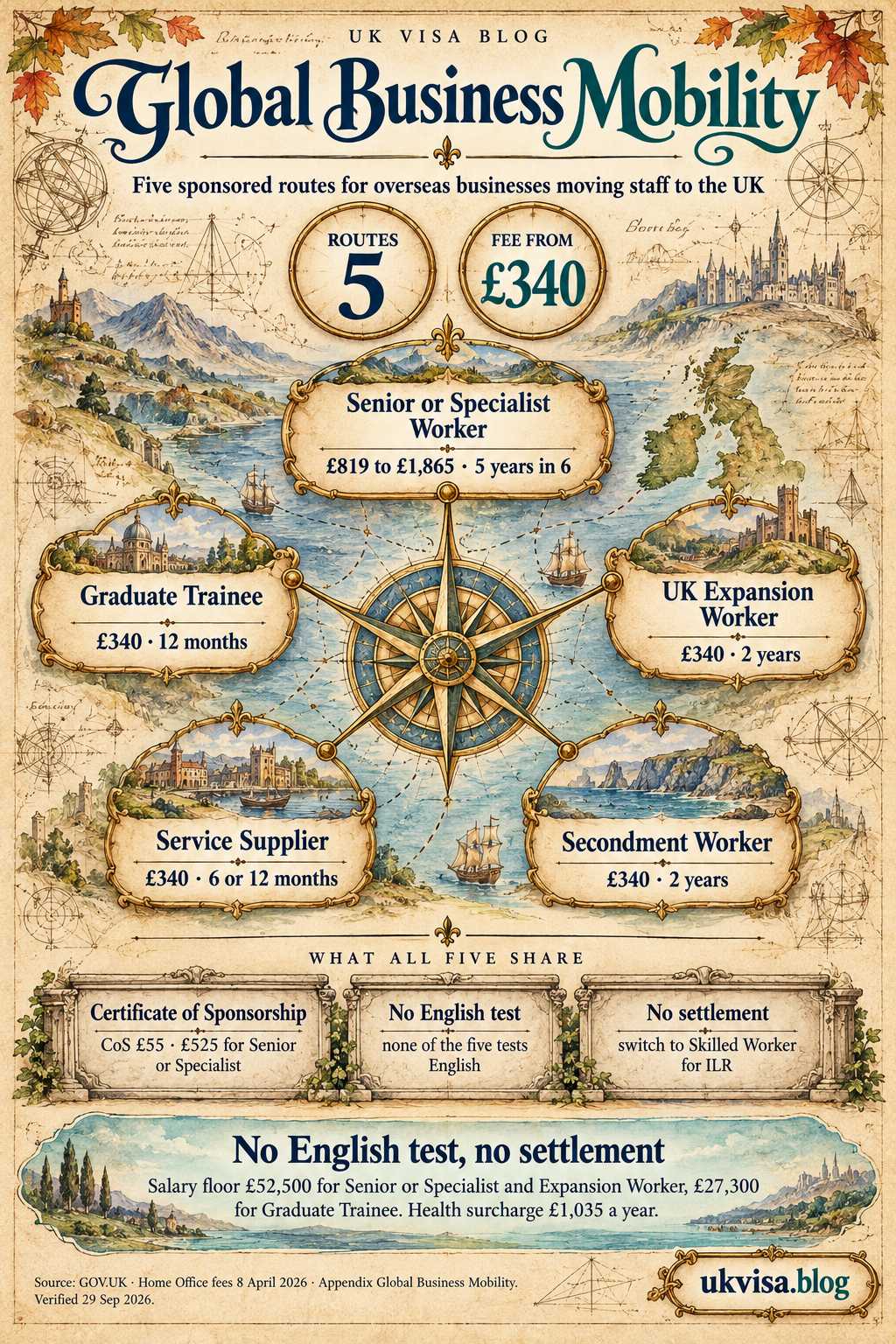
The Global Business Mobility visa is not one visa but five — the sponsored routes overseas employers use to deploy staff into a linked UK operation. The framework replaced the Intra-Company Transfer, Graduate Trainee, Sole Representative and Tier 5 agreement categories in April 2022. Thresholds run from £27,300 to £52,500, fees from £340 to £1,865, no route tests English — and none leads to settlement.

The GBM Framework
Global Business Mobility Visa UK 2026: Complete Guidance
What is the Global Business Mobility Visa?
Global Business Mobility (GBM) is a framework of five sponsored UK work routes for overseas businesses moving staff into linked UK operations: Senior or Specialist Worker, Graduate Trainee, UK Expansion Worker, Service Supplier and Secondment Worker. All five require a Certificate of Sponsorship, none tests English at any level, and none leads directly to Indefinite Leave to Remain — settlement requires switching to a route such as Skilled Worker.
The framework, launched on 11 April 2022 under Appendix Global Business Mobility of the Immigration Rules, consolidated a scattered set of predecessors — the Intra-Company Transfer and Intra-Company Graduate Trainee visas, the Sole Representative of an Overseas Business route, and parts of the T5 International Agreement category — into one system with a single logic: each route encodes a different business relationship between an overseas employer and a UK entity. Transfer within a group, a graduate rotation, a first UK branch, a trade-agreement service contract, a £50 million secondment — pick the relationship, and the route picks itself.
The bargain underneath all five is identical. The employer escapes the frictions of Skilled Worker — above all the English language requirement, which no GBM route imposes — and in exchange the deployment is strictly temporary: capped stays, cumulative counting across the whole family and its ICT predecessors, and not a single day credited towards settlement.
The 5 Global Business Mobility Routes Compared
Route selection is the decision that matters, because the Home Office assesses the application against the specific relationship evidenced on the Certificate of Sponsorship — and the wrong route is a refusal, not a technicality. The one-line tests:
The Five Routes at a Glance
| GBM Route | Business Relationship | Maximum Stay | Overseas Employment |
|---|---|---|---|
| Senior or Specialist Worker | Transfer within the same corporate group into a trading UK entity | 5 years in 6 (9 in 10 at £73,900+) | 12 months (waived at £73,900+) |
| Graduate Trainee | UK rotation of a group graduate training programme | 12 months, no extension | 3 months |
| UK Expansion Worker | Opening the group’s first UK branch — entity not yet trading | 2 years (12 + 12); 5 workers per licence | 12 months (waived at £73,900+, and for Japanese CEPA / Australian FTA nationals) |
| Service Supplier | Contracted services to a UK client under a UK trade agreement | 6 months; 12 under EU TCA, Swiss SMA, Australia FTA, CPTPP | 12 months’ employment or sector experience |
| Secondment Worker | Delivering a £50M+ contract between two unrelated businesses | 2 years (12 + 12) | 6 months (halved by HC 1691, 8 April 2026) |
Source: Immigration Rules, Appendix Global Business Mobility routes; GOV.UK route pages and the 8 April 2026 fee table. Verified 22 August 2026.
What 2026 Changed
2026 reshaped the family’s edges: Statement of Changes HC 1691 halved the Secondment Worker employment requirement to 6 months while leaving Expansion Worker at 12, and the UK-India CETA’s entry into force on 15 July 2026 added Indian nationals to the Service Supplier route for covered services, with a 1,800-place annual cap confined to chefs, classical musicians and yoga instructors.
The Points Arithmetic
All five decide applications on mandatory points. The three salaried routes — Senior or Specialist Worker, Graduate Trainee, Expansion Worker — require 60 points across sponsorship, skill level (RQF Level 6 under SOC 2020) and salary. Service Supplier and Secondment Worker require 40, because neither carries a general salary threshold — pay on those routes must simply comply with the National Minimum Wage and Working Time Regulations.
The Cumulative Cap — a Rolling Window, Not a Cooling-Off
Time on any GBM route — and on the pre-2022 ICT routes — counts towards one shared ceiling: 5 years’ permission in any rolling 6-year period, or 9 in 10 for Senior or Specialist Workers paid £73,900 or more. The old Tier 2 ICT “cooling-off period” did not survive into GBM: there is no mandatory 12 months outside the UK. Instead, caseworkers calculate backwards from each new Certificate of Sponsorship start date and refuse only where the window is already spent. A worker can leave and return at will; what matters is the arithmetic, and old ICT time is in it.
Global Business Mobility Salary Requirements 2026
The thresholds were set by the 22 July 2025 recalibration and hold for 2026 — the same reform that took Skilled Worker to £41,700. Every salaried GBM applicant must clear both their route’s floor and the going rate for their SOC 2020 occupation code, whichever is higher, with going rates published in Appendix Skilled Occupations:
Thresholds by Route
| Route | General Threshold 2026 | Going Rate Requirement |
|---|---|---|
| Senior or Specialist Worker | £52,500 | 100% of SOC 2020 going rate |
| UK Expansion Worker | £52,500 | 100% of SOC 2020 going rate |
| Graduate Trainee | £27,300 | 70% of SOC 2020 going rate |
| Service Supplier / Secondment Worker | No general threshold | National Minimum Wage compliance |
| High-earner level | £73,900 | Waives the 12-month rule; unlocks 9-in-10 stay (Senior or Specialist Worker only) |
Source: Appendix Global Business Mobility; Appendix Skilled Occupations, thresholds from 22 July 2025.
What counts is the standard sponsored-route calculation: guaranteed gross basic pay capped at 48 hours a week, plus contractually guaranteed allowances such as London weighting and mobility premiums. Bonuses, overtime, pension contributions and benefits in kind are excluded, and accommodation allowances count only within capped limits. The method mirrors the Skilled Worker salary rules at a different floor.
Clearing £52,500 is not enough on its own. If the occupation code’s going rate is £58,000, the worker must be paid £58,000 — and if a sponsor picks a code with a convenient lower rate that does not truly fit the role, UKVI refuses on the basis that the correct code carries a higher rate than the offered salary. Code selection against the RQF Level 6 occupation rules is where GBM applications are won and lost.
GBM Visa Fees from 8 April 2026
The 8 April 2026 uplift split the family cleanly in two: Senior or Specialist Worker pays by location and Certificate of Sponsorship length, while the four shorter routes share one flat fee:
Application Fees by Route
| Route & Application Type | Fee from 8 April 2026 |
|---|---|
| Senior or Specialist Worker — outside UK, CoS up to 3 years | £819 |
| Senior or Specialist Worker — outside UK, CoS over 3 years | £1,618 |
| Senior or Specialist Worker — inside UK, CoS up to 3 years | £943 |
| Senior or Specialist Worker — inside UK, CoS over 3 years | £1,865 |
| Graduate Trainee · UK Expansion Worker · Service Supplier · Secondment Worker | £340 flat |
Source: Home Office immigration and nationality fees, 8 April 2026.
Beyond the Application Fee
Beyond the application fee: the Immigration Health Surcharge at £1,035 per adult per year (£776 per child) paid upfront; £1,270 maintenance unless sponsor-certified; and the priority services at +£500 and +£1,000 where available.
What the Sponsor Pays
On the sponsor’s side, the Certificate of Sponsorship costs £525 for Senior or Specialist Worker but only £55 on the other four routes, the licence runs £611 (small or flat-fee categories) to £1,682 (medium and large Worker licences) — and the Immigration Skills Charge applies to Senior or Specialist Worker alone, at £1,320 a year for large sponsors and £480 for small ones. Graduate Trainee, Expansion Worker, Service Supplier and Secondment Worker are all ISC-exempt, which is often the decisive line in the sponsor’s budget. The full side-by-side across every sponsored route sits in the UK work visa fees comparison.
Sponsor Licence and Eligibility
Every route needs the UK entity licensed under the matching GBM category before any Certificate of Sponsorship can be assigned. ICT licences converted automatically to their GBM equivalents on 11 April 2022. Expansion Worker licences run on the provisional pathway — granted with a single CoS where the Authorising Officer is still overseas, upgraded to an A-rating once they arrive — and Secondment Worker sponsors must additionally register each £50M+ contract with the Home Office before sponsoring against it.
Where UKVI Digs
The linkage between overseas employer and UK sponsor is where UKVI digs: common ownership and control evidenced by share registers, group charts and audited accounts for the corporate routes; the registered contract or trade-agreement coverage for the contractual ones. Sponsor duties then run as they do across the whole sponsor licensing framework — record-keeping, reporting within 10 working days, right-to-work checks — with grants issuing as eVisas on the worker’s UKVI account, and decisions typically in 3 weeks abroad or 8 weeks in-country per the standard processing timelines.
- Certificate of Sponsorship reference, used within 3 months of assignment.
- Passport with at least one blank page; certified translations for any document not in English or Welsh.
- Overseas employment evidence — payslips, contract, employer letter — covering 12 months (Senior or Specialist Worker, Expansion Worker), 6 months (Secondment Worker) or 3 months (Graduate Trainee).
- Maintenance evidence: £1,270 held for 28 consecutive days, unless sponsor-certified or you have been in the UK on a valid visa for 12 months or more.
- TB test certificate where applying from a listed country.
- Route extras: Service Suppliers — nationality/residence evidence matching the trade agreement; Graduate Trainees — the training programme description; Secondment Workers — the registered contract reference on the CoS.
Does the Global Business Mobility Visa Lead to Settlement?
No — and this is the framework’s defining feature, not a footnote. Time on any GBM route counts towards the family’s maximum-stay caps and towards nothing else: a senior executive finishing year five on a Senior or Specialist Worker visa is precisely as far from ILR as on the day of arrival, and the same is true after nine high-earner years. GBM is engineered as circulation, not immigration — the rules assume the worker eventually goes home.
GBM vs Skilled Worker
| Feature | Global Business Mobility | Skilled Worker |
|---|---|---|
| Settlement (ILR) | No route, ever | After 5 qualifying years |
| English language | Not tested on any route | CEFR B2 from 8 January 2026 |
| Overseas employment | 3–12 months by route | Not required |
| Sponsor | UK entity linked to the overseas employer | Any licensed UK sponsor |
| General salary 2026 | £27,300–£52,500 by route | £41,700 |
| Maximum stay | 1–9 years by route | Indefinite, renewable |
Source: Immigration Rules, Appendix Global Business Mobility routes; GOV.UK route pages and the 8 April 2026 fee table. Verified 22 August 2026.
Switching from GBM to Skilled Worker
The standard escape from the temporariness is an in-country switch to the Skilled Worker route, available whenever every Skilled Worker requirement is met at the point of application: a CoS from a licensed Skilled Worker sponsor, £41,700 or the going rate, an eligible RQF Level 6 role — and, from 8 January 2026, CEFR B2 English, the test no GBM worker has ever had to sit. The 5-year settlement clock then starts from the switch date, with no credit for GBM time.
Switch Early — the Arithmetic Is Unforgiving
Every year on GBM adds a year to the total journey: four GBM years plus a switch means nine years in the UK before ILR. For workers genuinely intended to stay, the rational move is the switch at the end of year one or two — with the B2 English test booked during the GBM period, not discovered as a surprise at the end of it. Delay is the expensive option, and it compounds silently.
Skilled Worker is not the only door: Global Talent, Innovator Founder, the Health and Care stream, and the partner route for those who marry a British or settled person each lead to settlement on their own timelines. Where an application on any GBM route is refused, the remedy for caseworking error on points, salary or evidence is administrative review.
The legal framework sits in Appendix Global Business Mobility, with going rates in Appendix Skilled Occupations, fees in the Home Office fees table (8 April 2026), and sponsor-side rules in the Sponsor a Global Business Mobility worker guidance. Figures verified 22 August 2026.
Frequently Asked
Questions about the Global Business Mobility visa
Senior or Specialist Worker (group transfers into a trading UK entity), Graduate Trainee (UK rotations of a group graduate scheme), UK Expansion Worker (opening the first UK branch, pre-trading), Service Supplier (contracted services under a UK trade agreement) and Secondment Worker (delivering a £50M+ contract between unrelated businesses). Each encodes a different business relationship — the relationship picks the route.
Senior or Specialist Worker: £819 or £1,618 outside the UK and £943 or £1,865 inside, by CoS length. The other four routes: £340 flat. All pay the Immigration Health Surcharge at £1,035 per adult per year, and the sponsor pays £525 (Senior or Specialist Worker) or £55 (other routes) per Certificate of Sponsorship — plus the Immigration Skills Charge on Senior or Specialist Worker only.
No — that was Tier 2 ICT, and it died in April 2022. The control is now the rolling cap itself: 5 years’ permission in any 6-year window (9 in 10 for Senior or Specialist Workers on £73,900+), counted across all GBM routes and old ICT time, assessed backwards from each new CoS start date. Leave and return whenever you like; only the window arithmetic matters.
£52,500 for Senior or Specialist Worker and UK Expansion Worker; £27,300 (or 70% of the going rate) for Graduate Trainee — in each case the going rate applies where higher. Service Supplier and Secondment Worker have no general threshold at all: pay must comply with the National Minimum Wage and the role must still sit at RQF Level 6.
Two things, on different routes. On Senior or Specialist Worker it waives the 12-month overseas employment rule AND extends the maximum stay to 9 years in 10. On UK Expansion Worker it waives the 12-month rule only — the 2-year ceiling stays, with no high-earner extension. On the other three routes it does nothing.
No — on none of the five routes, at entry or extension. English enters only when leaving the framework: a switch to Skilled Worker requires CEFR B2 from 8 January 2026, and citizenship applications carry their own requirement. Workers planning a long UK future should sit the test during the GBM years, not after them.
Three things: the 8 April fee uplift (£340 flat on the four shorter routes; £819–£1,865 on Senior or Specialist Worker); HC 1691’s halving of the Secondment Worker overseas-employment rule to 6 months, with Expansion Worker kept at 12; and the UK-India CETA from 15 July, adding Indian nationals to the Service Supplier route with a 1,800-place annual cap limited to chefs, classical musicians and yoga instructors.
Yes, in-country, whenever the Skilled Worker requirements are met — sponsor, £41,700 or the going rate, eligible occupation, and B2 English. The 5-year ILR clock starts from the switch date with no credit for GBM time, which is why early switching is almost always the cheaper strategy for anyone intending to settle.
Yes — under the matching GBM category, before any CoS can be assigned. ICT licences converted automatically in April 2022. Expansion Worker licences start provisional (one CoS, self-assigned by the Authorising Officer, upgraded on arrival), and Secondment Worker sponsors must register each qualifying contract with the Home Office before sponsoring against it.