
Priority costs £500 and targets five working days. Super priority costs £1,000 and targets the end of the next working day. Both are charged per applicant, both buy queue position rather than a better decision, and neither is refunded when a case needs extra checks and drops back to standard handling.
Faster Decisions
UK Priority and Super Priority Visa Services in 2026
What You Are Buying
A place nearer the front of the queue. The caseworker applies exactly the same rules to exactly the same evidence, and reaches the same conclusion they would have reached in three weeks or eight. What changes is when they open the file.
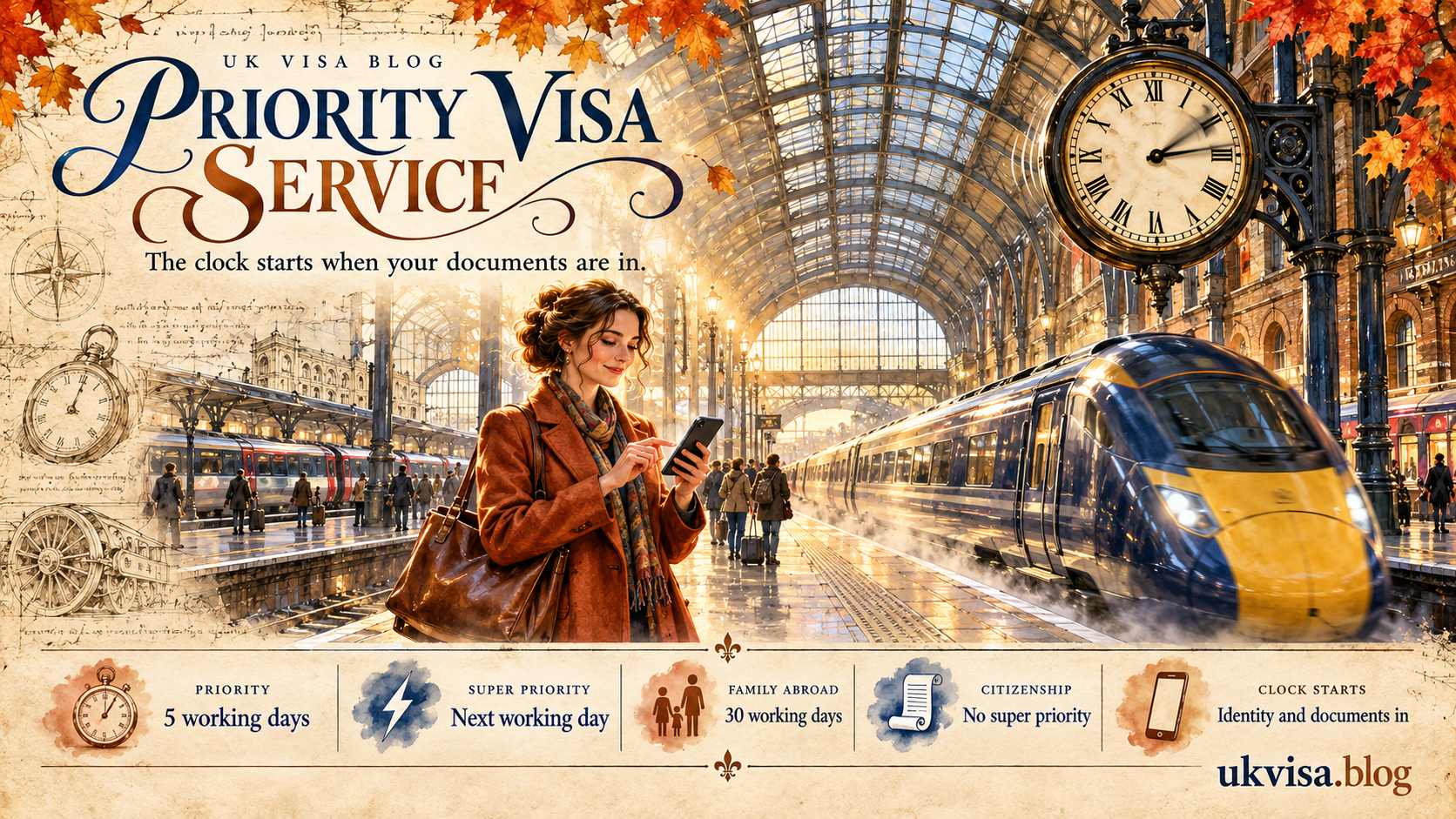
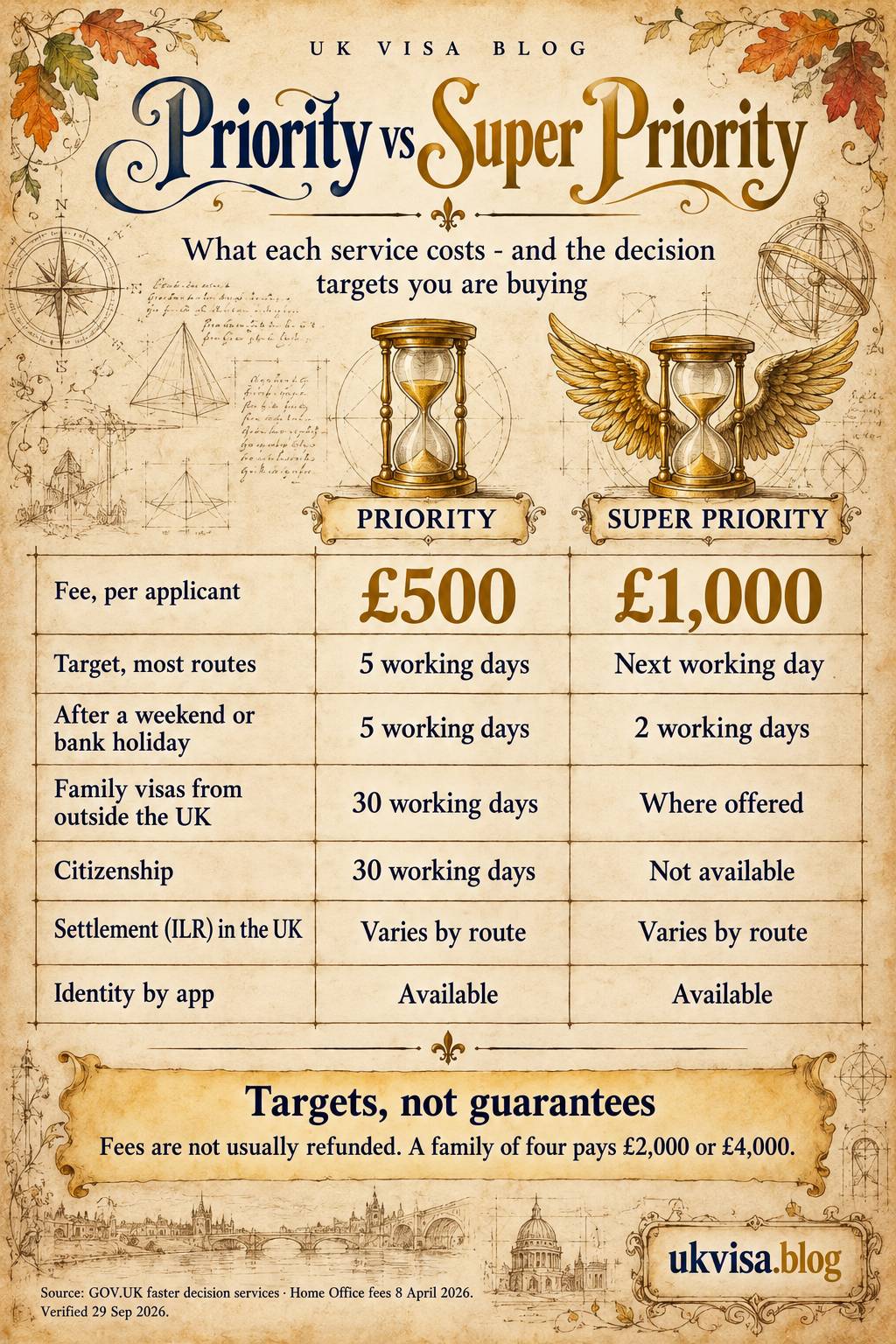
Priority is £500 per applicant and targets five working days for most visa and settlement applications, but 30 working days for family visas applied for from outside the UK and for citizenship. Super priority is £1,000 per applicant and targets the end of the next working day, or two working days where your appointment or document upload falls at a weekend or on a bank holiday. Super priority is not available for citizenship applications.
When the Clock Starts
Not when you pay. The target runs from the point your identity is proved and your documents are in — your appointment at a service point, or the moment you finish uploading through the UK Immigration ID Check app. Both routes carry the same targets, which matters because the app is often available sooner than an appointment.
Where an appointment or an upload falls at a weekend or on a bank holiday, the super priority target becomes two working days rather than one. Applicants booking a Friday evening upload and expecting a Saturday decision are the commonest disappointment on this service.
The Difference Between the Two
Priority and Super Priority Compared
| Feature | Priority | Super priority |
|---|---|---|
| Fee, per applicant | £500 | £1,000 |
| Target, most routes | 5 working days | End of the next working day |
| Target, weekend or bank holiday | 5 working days | 2 working days |
| Family visas from outside the UK | 30 working days | Not offered |
| Citizenship applications | 30 working days | Not available |
| Identity by app | Available | Available, same targets |
Source: GOV.UK faster decision guidance and the Home Office fee table, 8 April 2026. Checked 22 August 2026.
The choice is rarely close. Where super priority is offered on your route, the difference between one working day and five is worth £500 only when something concrete depends on it. Where nothing does, priority at £500 already removes most of the wait.
Settlement Applications
Faster decisions are available on settlement applications, and the eligible list is broad: long residence after ten continuous years, partner and parent routes, work, business and investment categories, the Innovator Founder route, UK Ancestry, former members of HM Forces, children under 18, and BN(O) applicants.
When ILR Priority Is Not Showing
The priority and super priority options are capacity-limited: they appear at the payment stage only when UKVI has slots, and they are withdrawn and restored without notice. If nothing shows for your ILR application, there is no official waiting list — the realistic choice is to submit at standard speed or check again before you submit. Third-party “fast track” offers do not move the Home Office queue.
That matters because settlement is otherwise one of the slower decisions, and because the fee already sits at £3,226 per person. Adding £1,000 each for a family of four doubles a bill that was already the largest of the immigration journey. See our pages on settlement, the ILR forms and settlement processing times.
Where the Service Point Route Is the Only One
Availability is not uniform. Some categories offer the next working day service only through a UKVCAS appointment rather than any other channel, and at least one route is excluded from UKVCAS appointments altogether. Check the position for your own route before paying, rather than assuming the headline service applies.
The Targets in Practice
- Most visa and settlement applications: five working days on priority.
- Family visas from outside the UK: 30 working days on priority.
- Citizenship: 30 working days on priority; super priority not available.
- Super priority, weekday: by the end of the next working day.
- Super priority, weekend or bank holiday: two working days.
- Standard, for comparison: three weeks from abroad on most routes, twelve for family, eight weeks in country.
These are targets rather than guarantees. Our page on processing time after biometrics sets out the standard published times against which to measure whether the spend is worth it.
The Fees
The fees are flat across routes: £500 for priority and £1,000 for super priority, per applicant, on top of the application fee and the health surcharge. They did not change in the 8 April 2026 fee schedule, while most application fees did.
- Visit: £135 plus £500 — see our page on the standard visitor route and on marriage visitors.
- Student: £558 plus £500 — see our student route page and short-term study.
- Skilled Worker: £819 or £1,618 plus £500 — see our Skilled Worker page and Health and Care Worker page.
- Partner, from abroad: £2,064 plus £500 for a 30 working day target.
- Settlement: £3,226 plus £500 or £1,000 per person.
- Graduate route: £937 plus the priority fee — see our Graduate route page.
Full application fees are on our pages covering entry clearance fees and in-country fees, and the surcharge on our page on the health surcharge.
Family Routes Are Different
This is the point most applicants get wrong. On a family visa applied for from outside the UK, £500 does not buy five working days. It buys a 30 working day target against a standard time of twelve weeks — a real saving, but not a fast track.
Paying £500 expecting a decision within a week, on an application where the priority target is 30 working days, is a common and expensive mistake. The fee is the same across routes; the target is not. Read what the service actually promises for your route before adding it.
In-country family applications behave differently again, with the next working day service available through a UKVCAS appointment. See our pages on the spouse route, spouse extensions and the financial requirement.
Which Routes Are Eligible
- Work: Skilled Worker, Health and Care Worker, the Global Business Mobility routes, Global Talent, High Potential Individual, International Sportsperson.
- Temporary work: Charity, Creative, Government Authorised Exchange, International Agreement and Religious Worker routes — see our temporary worker page.
- Study: Student and Child Student.
- Graduate: the post-study route.
- Hong Kong BN(O): see our BN(O) page.
- Family: eligible for the next working day service through a UKVCAS appointment.
Settlement categories are separately listed and broadly covered, including UK Ancestry and the Innovator Founder route, though some carry channel restrictions. The definitive list is the GOV UK eligibility page, which changes.
When the Spend Is Actually Justified
Three situations reliably repay it. A start date that cannot move and an employer who will not hold the role. A course with a fixed enrolment deadline. And a passport needed back for travel that is already booked and paid for. In each case the money buys a specific, priced outcome rather than peace of mind.
Against that, applying earlier is free. GOV.UK allows most entry clearance applications to be made up to three months before travel, and using that window achieves more than £500 spent to compress a late submission. Where the choice is between applying in good time and paying for speed, the first is cheaper and carries no risk of the case leaving the fast queue anyway.
One further point for families. Because the fee is per applicant, a household paying for super priority on a settlement round can add four figures to a bill that already runs to five. Paying for one applicant does not speed up the others, and linked applications are generally decided together, so partial purchases rarely achieve anything.
Add-Ons at the Visa Application Centre
Commercial partners running visa application centres sell services alongside the Home Office ones: document scanning, courier return, premium lounges, on-demand mobile visits, and form-checking. These are the centre’s products, not the Home Office’s, and none of them affects the decision or its speed.
Two are sometimes worth buying. Scanning, where you cannot upload documents yourself, and courier return where collecting the passport in person is impractical. The rest buy comfort. Nothing sold at a centre substitutes for the priority services described above, and no add-on improves an application’s prospects.
Availability Changes Without Notice
Both services are withdrawn from time to time in individual countries and on individual routes, usually during periods of high demand. A service offered when you researched the application may not be offered when you book the appointment, and there is no entitlement to it.
Check the position at your own visa application centre at the point of booking rather than relying on a general description. Where the service has been suspended, the only remaining lever is applying earlier, which is why timetables built entirely on a purchased target are fragile.
When It Goes Slowly Anyway
GOV.UK is explicit: a decision may take longer where the Home Office needs more information or has to verify details with another department, and in those circumstances you will not usually get your money back. The service was made available; the case left the fast queue for reasons of its own.
- Document verification: statements, employer letters or qualifications sent for checking.
- A request for further evidence: which pauses the case until answered.
- An interview: where credibility or the relationship is in question.
- Specialist consideration: character, history or complex issues.
- Inconsistencies: figures or dates that do not match across the bundle.
Almost all of those are avoidable at submission rather than afterwards, which is the real argument for spending on evidence before speed. Our pages on supporting documents, the application form and delays cover what tends to trigger a detour.
If the fast decision is a refusal, it is still a refusal. Our pages on refusal grounds, administrative review and what to do next set out the options — and none of them is quicker for having paid.
Sources: the GOV UK faster decision pages, the eligibility list for in-country applications and the GOV UK visa fees pages. Figures verified 22 August 2026.
Frequently Asked
Priority Service Questions
How much are the priority services?
£500 for priority and £1,000 for super priority, per applicant, on top of the application fee and health surcharge. Neither changed in the April 2026 fee schedule.
How fast is super priority?
By the end of the next working day where your appointment or document upload is on a weekday, and two working days where it falls at a weekend or on a bank holiday.
Can I use super priority with the ID Check app?
Yes, with the same targets. Using the app, the clock runs from when you finish uploading your documents rather than from an appointment.
Why is my family visa priority target 30 working days?
Because that is the published priority target for family visas applied for from outside the UK, and for citizenship applications. The five working day target applies to most other routes.
Can I pay for a faster citizenship decision?
Priority is available at a 30 working day target. Super priority cannot be used for citizenship applications at all.
Is priority available for settlement?
Yes, across a broad list including long residence, partner and parent routes, work and business categories, UK Ancestry, HM Forces, children under 18 and BN(O). Some carry channel restrictions.
Do I get a refund if the decision is late?
Usually not. GOV.UK states that where more information is needed or details must be verified with another department, the decision may take longer and you will not usually get your money back.
Does priority improve my chances of being granted?
No. The same rules are applied to the same evidence. A weak application decided quickly is refused quickly.
Does each family member have to pay?
Yes. Both services are charged per applicant, so a family of four paying for super priority adds £4,000.
Are the visa centre add-ons worth buying?
Scanning and courier return can be practical. Lounges and form-checking buy comfort and none of them affects the decision or its speed.