
The UK Graduate Trainee visa is the Global Business Mobility route for overseas employees on a structured graduate programme that includes a UK rotation. The salary floor is £27,300 — the lowest in the GBM family — the fee £340 from 8 April 2026, and the stay 12 months with no extension and no in-country switching in. Just 3 months’ overseas employment qualifies, but the route leads nowhere permanent.

Global Business Mobility
UK Graduate Trainee Visa 2026: GBM Sub-Route for Multinational Training Programmes
What is the Graduate Trainee Visa?
The Graduate Trainee visa lets an existing overseas employee of a multinational spend up to 12 months at the group’s UK entity as part of a structured graduate training programme leading to a senior management or specialist role. It needs 3 months’ prior employment with the linked overseas business, a Certificate of Sponsorship, a job at RQF Level 6, and a salary of at least £27,300 or 70% of the going rate. No English test; no extension; no settlement pathway.
Within the five-route Global Business Mobility framework, this is the junior seat — the successor to the Tier 2 ICT Graduate Trainee visa, carried over when the GBM family launched on 11 April 2022. Its purpose is narrow and specific: the UK leg of a multinational’s graduate scheme.
The Programme Is the Qualifying Object
The programme itself is the qualifying object — it must be a structured training programme leading to a senior management or specialist position, and the sponsor has to describe it on the Certificate of Sponsorship. An ordinary junior job at the UK office does not qualify; GOV.UK’s own guidance points anyone not on a genuine graduate programme towards Senior or Specialist Worker instead.
Everything about the route’s design follows from its trainee logic: the lowest salary floor in the GBM family, the shortest overseas-employment requirement, the shortest stay, and the hardest exit — because trainees are expected to rotate through, not settle in.
Eligibility Requirements
The requirements are the GBM standard set, scaled down to early-career level:
- Existing overseas employment: currently employed by a business linked to the UK sponsor by common ownership, control or joint venture.
- 3 months’ service: worked for that overseas business, outside the UK, for at least 3 months immediately before applying — the shortest tenure requirement in the GBM family.
- The programme: a structured graduate training programme leading to a senior management or specialist position, evidenced by the sponsor on the CoS.
- Certificate of Sponsorship: assigned within 3 months of the application; the application itself can be made up to 3 months before the start date.
- Eligible occupation: RQF Level 6 or above under SOC 2020.
- Salary: at least £27,300 or 70% of the going rate, whichever is higher — with some occupations requiring the full going rate.
- Maintenance: £1,270 held for 28 consecutive days — waived if the sponsor certifies maintenance (up to £1,270 for the first month) or you have been in the UK on a valid visa for 12 months or more.
- TB certificate if applying from a listed country; certified translations for non-English documents. No English language test at any stage.
Salary Requirements
The threshold rose from £25,410 to £27,300 on 22 July 2025, in the same recalibration that took Skilled Worker to £41,700 and the senior GBM routes to £52,500. The test is £27,300 or 70% of the going rate — the discount is the route’s defining concession, letting trainees be paid below the market rate their occupation code would otherwise demand, on the logic that they are learning the job rather than doing it at full capacity. For certain occupations, including health and education codes, the discount disappears and the full going rate applies.
What Counts Toward the Threshold
What counts is the standard GBM calculation: guaranteed basic gross pay up to 48 hours a week, plus contractually guaranteed allowances such as London weighting and mobility premiums. Bonuses, one-off payments, variable overtime and benefits in kind are all excluded — the guaranteed package alone must clear the floor.
Fees and Costs from 8 April 2026
The costs sit at the cheap end of the sponsored system, sharing the £340 fee tier with the other short-stay GBM routes:
The Full Cost Schedule
| Fee Component | Amount from 8 April 2026 | Notes |
|---|---|---|
| Application fee | £340 per person | Up from £319; same for dependants |
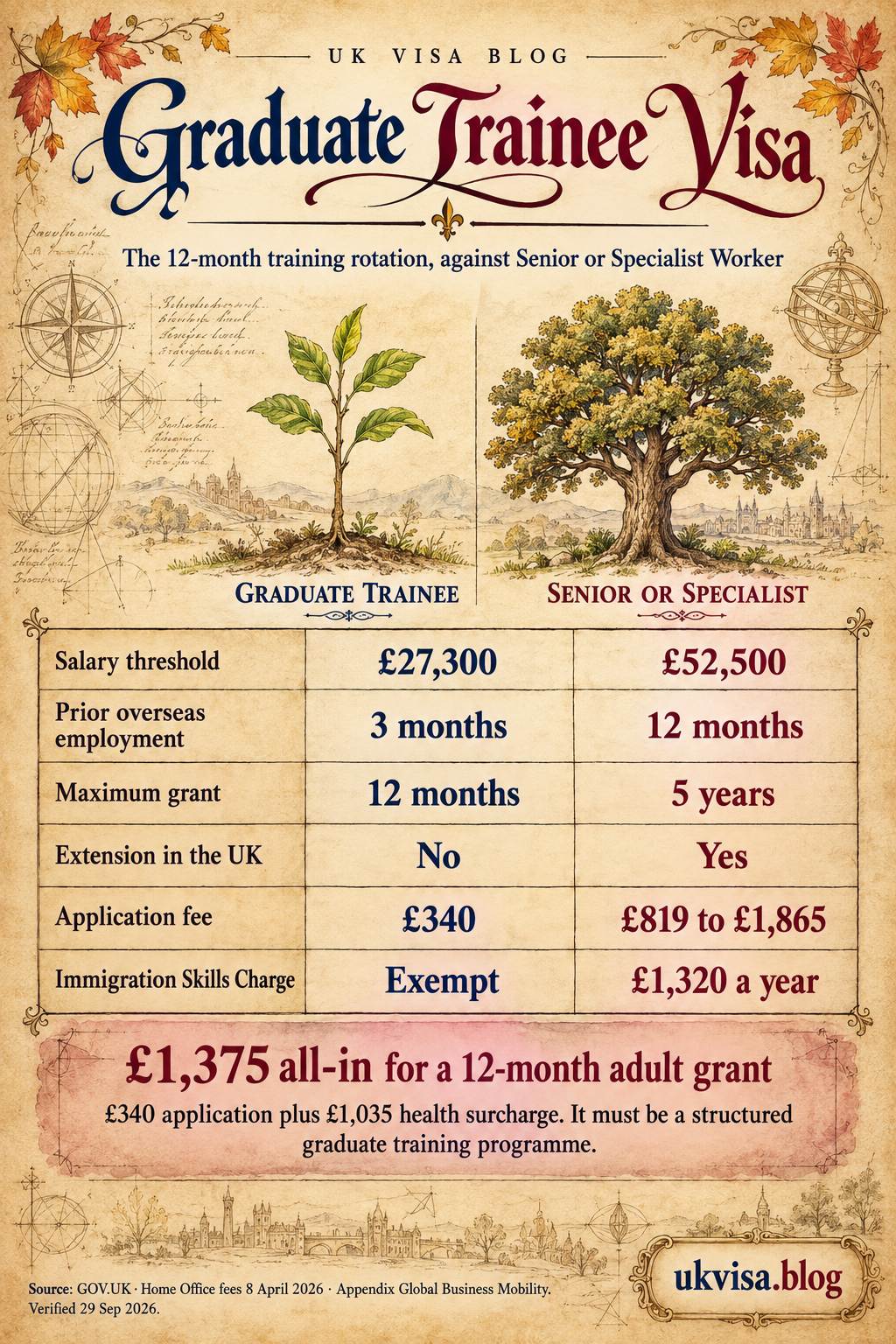
| Immigration Health Surcharge | £1,035/year adult · £776/year under-18 | Paid up front — £1,375 all-in for a 12-month adult grant |
| Personal maintenance | £1,270 | Plus £285 partner, £315 first child, £200 each further child; waived if sponsor certifies |
| Priority / super-priority service | +£500 / +£1,000 | Where available at the application location |
| Sponsor: Certificate of Sponsorship | £55 per worker | Against £525 on Worker routes |
| Immigration Skills Charge | £0 | Route is exempt — a £1,320/year saving versus Skilled Worker at a large sponsor |
Source: GOV.UK Graduate Trainee visa fee pages; Immigration and Nationality (Fees) Order uplift, 8 April 2026.
The ISC exemption is the sponsor’s quiet win: rotating a graduate through the UK on this route costs £55 in sponsorship charges, where the same year on Skilled Worker sponsorship would cost a large employer £525 plus £1,320 of Immigration Skills Charge. The wider landscape sits in the UK work visa fees comparison.
How to Apply
Applications are made online from outside the UK only, up to 3 months before the CoS start date, with decisions typically in 3 weeks. The sequence: the sponsor assigns the Certificate of Sponsorship carrying the role, salary and programme details; the worker applies on GOV.UK, pays £340 plus IHS, proves identity through the UK Immigration: ID Check app or a biometric appointment, and uploads the evidence — passport, CoS reference, payslips and contract covering the 3 months’ overseas employment, the training programme details, maintenance, and TB certificate if applicable. Successful grants issue as eVisas on the worker’s UKVI account.
The Rotation Clause: One Visa, Many Desks
Graduate schemes move people around — and the rules anticipate it. If the job changes as part of the graduate training programme, the worker does not apply again: the employer simply notifies UK Visas and Immigration. One visa covers the whole UK rotation, however many desks it spans, so long as each move stays inside the programme described on the Certificate of Sponsorship. Moves outside the programme are a different matter entirely and need a fresh application.
Bringing Your Partner and Children
Partners — spouse, civil partner, or unmarried partner in a 2-year durable relationship — and children under 18 apply as dependants through the standard UK dependant visa process, each paying £340 plus IHS at their rate. Maintenance stacks on the main applicant’s £1,270: £285 for a partner, £315 for the first child, £200 for each further child — a family of three needs £1,870 held for 28 days unless the sponsor certifies. Dependants can work in most jobs and study freely, and their permission ends with the main applicant’s.
Duration, Extension and the 5-in-6 Cap
The grant runs for the CoS period plus 14 days, up to 12 months — and there it stops. No in-country extension exists, and no one can switch into the route from inside the UK, both for the same structural reason: the 3-month overseas employment requirement must be satisfied immediately before each application, which is impossible from a desk in London. A further Graduate Trainee visa is allowed, but only from outside the UK, for a new programme.
The 5-in-6 Arithmetic
Every day on the route also counts towards the 5-years-in-any-6 cumulative cap shared across the whole GBM family and the old ICT routes. The arithmetic bites in both directions: a graduate year spent now is a year unavailable later on Senior or Specialist Worker, and a worker arriving with 4 years of prior GBM time has at most 1 year of trainee window left.
Graduate Trainee vs Senior or Specialist Worker
The two routes are siblings with a generation between them, and picking the wrong one is a routine cause of refusal:
The Two Routes Compared
| Requirement | Graduate Trainee | Senior or Specialist Worker |
|---|---|---|
| Salary threshold | £27,300 (or 70% of going rate) | £52,500 (or 100% of going rate) |
| Prior overseas employment | 3 months | 12 months (waived over £73,900) |
| Maximum grant | 12 months | 5 years |
| In-country extension | No | Yes |
| Application fee | £340 | £819–£1,865 by type |
| Immigration Skills Charge | Exempt | Applies |
| Programme requirement | Structured graduate training programme | None — substantive senior/specialist role |
| Settlement | No | No |
Source: Immigration Rules, Appendix Global Business Mobility routes; GOV.UK route pages and the 8 April 2026 fee table. Verified 22 August 2026.
Run in Sequence, Not in Competition
In practice HR teams run them in sequence: Graduate Trainee for the UK rotation inside a global graduate scheme, Senior or Specialist Worker for the substantive transfer years later, once the trainee has become the specialist the senior route expects — with the shared 5-in-6 cap quietly connecting the two.
What Happens After Your Visa Ends?
The route is built with a hard stop, so the exit should be planned before entry. The realistic onward paths:
- Skilled Worker: the settlement-leading switch, available in-country where the sponsor offers a qualifying role at £41,700 in an RQF Level 6 occupation — and, from 8 January 2026, with CEFR B2 English, which this route never tested.
- Senior or Specialist Worker: in-country switching is permitted, but the 12-month overseas employment requirement applies in full — UK trainee time does not count towards it.
- A further Graduate Trainee visa: from outside the UK, for a new programme, within the 5-in-6 cap.
- Independent routes: Global Talent, Innovator Founder, or family routes where circumstances fit.
Whichever door you choose, the settlement arithmetic underneath is identical:
No Graduate Trainee day counts towards the 5-year residence period for permanent settlement — the settlement clock starts only when a qualifying route is granted. A trainee who wants a UK future should treat the 12 months as an audition for a Skilled Worker offer, and start the English test and salary conversation with the sponsor well before the visa’s final quarter.
The official entry point is the GOV.UK Graduate Trainee visa overview; the legal framework sits in Appendix Global Business Mobility: Graduate Trainee, with going rates in Appendix Skilled Occupations and sponsor-side duties under the sponsor licensing framework. Figures verified 22 August 2026.
Frequently Asked
Questions about the Graduate Trainee visa
Because the eligibility rules require 3 months’ employment with the overseas business immediately before each application — a condition nobody inside the UK can satisfy. That single requirement structurally closes both doors: no in-country extension, no in-country switching in. The only repeat route is a fresh application from abroad for a new programme.
A defined graduate scheme leading to a senior management or specialist position in the group, described by the sponsor on the Certificate of Sponsorship — typically a programme prospectus with rotations, milestones and a destination role. An ordinary junior job at the UK office does not qualify; GOV.UK directs applicants without a genuine programme to the Senior or Specialist Worker route instead.
No — job changes that are part of the graduate training programme need no new application; the employer notifies UK Visas and Immigration. Only a move outside the programme requires a fresh visa. This is one of the route’s most useful and least-known features.
£27,300 per year (raised from £25,410 on 22 July 2025), or 70% of the SOC 2020 going rate for the occupation, whichever is higher — with certain occupations, including health and education codes, requiring the full going rate. Only guaranteed pay and guaranteed allowances count; bonuses and benefits in kind do not.
£340 application fee plus £1,035 IHS — £1,375 all-in for a 12-month adult grant. Dependants pay the same fee and their own IHS. The sponsor pays £55 per Certificate of Sponsorship and no Immigration Skills Charge, making this one of the cheapest sponsored deployments in the system.
No — none, like every GBM route. English enters the picture only on a later switch to Skilled Worker, which requires CEFR B2 from 8 January 2026 — worth planning during the trainee year rather than after it.
Yes — partner and children under 18, each paying £340 plus IHS (£1,035 adult, £776 child per year), with maintenance of £285/£315/£200 stacked on your £1,270 unless the sponsor certifies. Dependants can work in most jobs and study freely.
Every trainee day counts towards the 5-years-in-any-6 ceiling shared with Senior or Specialist Worker, Expansion Worker, Secondment Worker, Service Supplier and the old ICT routes. A year spent as a trainee is a year less available for a later senior transfer within the same rolling window — a real consideration in multi-year mobility planning.