
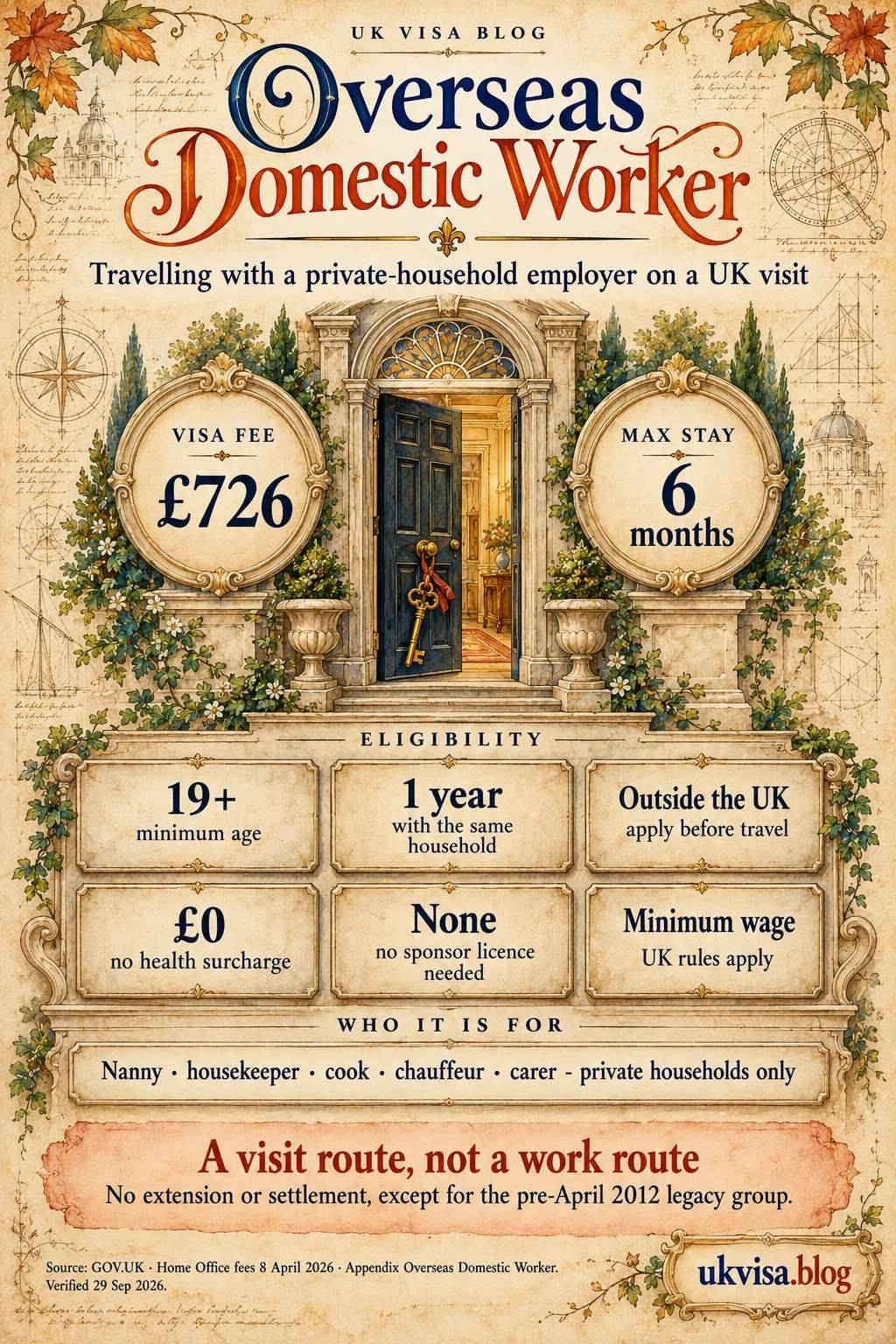
The Overseas Domestic Worker visa — officially the Domestic Worker in a Private Household visa — lets nannies, housekeepers, cooks, chauffeurs and carers accompany their existing private-household employer on a UK visit of up to 6 months. The fee is £726 from 8 April 2026, with no Immigration Health Surcharge. The route demands 12 months’ prior service, sets a hard 6-month ceiling, and — for anyone who applied after 5 April 2012 — offers no extension and no settlement.
UK Work Visas
Overseas Domestic Worker Visa UK 2026: Private Household Employment Route
What is the Overseas Domestic Worker Visa?
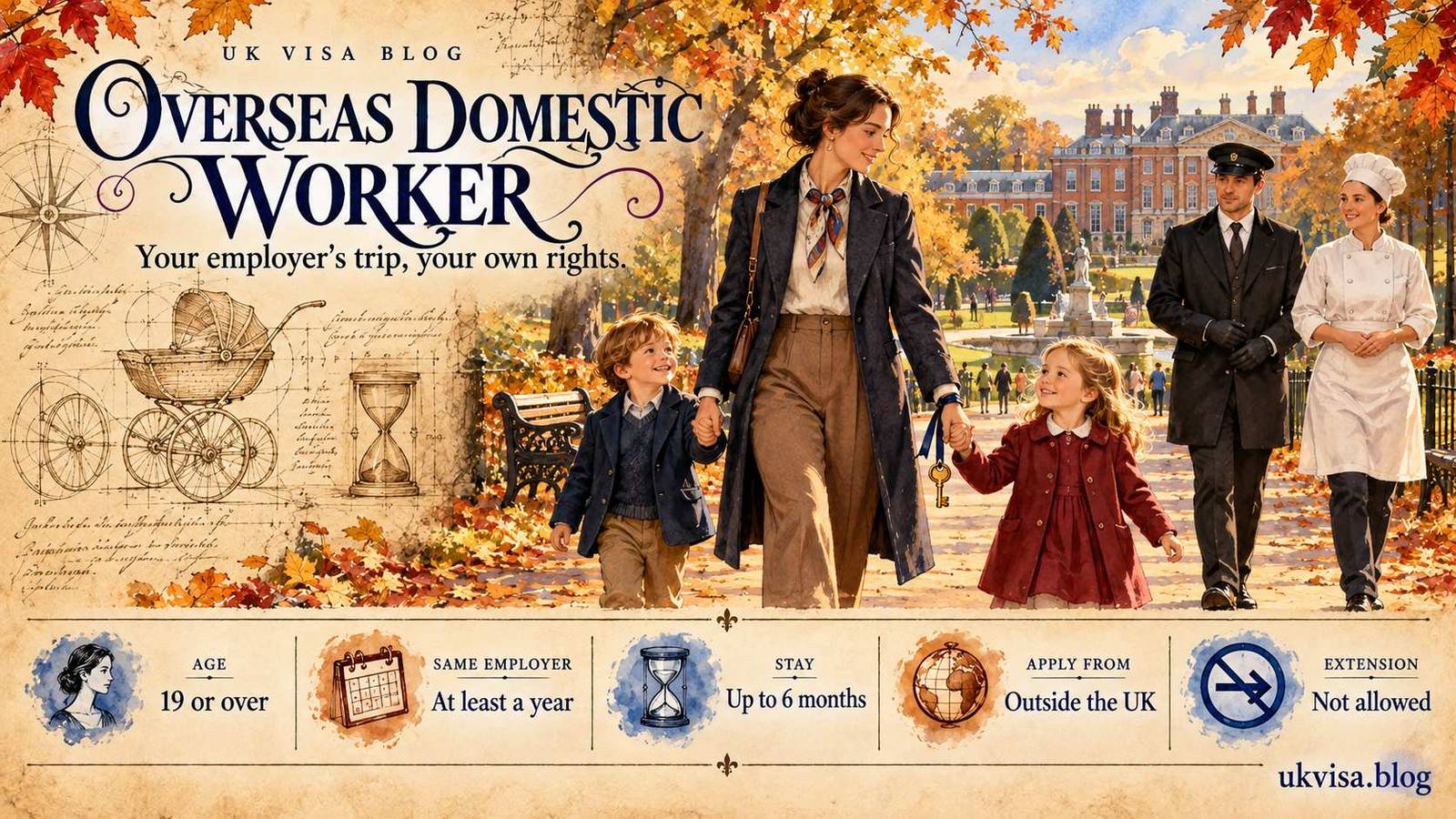
The Overseas Domestic Worker visa allows domestic staff — nannies, housekeepers, cleaners, cooks, chauffeurs and personal carers — to accompany their existing private-household employer on a UK visit for up to 6 months. The worker must be 19 or older, have worked for the same employer for at least a year, and apply from outside the UK. The fee is £726 from 8 April 2026, with no Immigration Health Surcharge. The stay cannot be extended, and the visa exists to continue an existing employment arrangement during UK travel — not to recruit staff into UK households.
The route is structurally unlike every other UK work visa. There is no sponsor licence, no Sponsorship Management System, no Certificate of Sponsorship — the entire framework runs on direct evidence of a genuine, established household employment relationship: a year of service, a signed Appendix Domestic Worker Statement, and proof that the employer is genuinely visiting the UK. Its rulebook sits in its own appendix of the Immigration Rules, Appendix Overseas Domestic Worker, consolidated in the 8 January 2026 rules update.
One Visa, Several Names
“Overseas Domestic Worker” is the Immigration Rules term; “Domestic Worker in a Private Household” is the application-form title; “ODW” is the practitioner shorthand. The casual search terms — nanny visa UK, maid visa UK, domestic helper visa UK — all describe this same route. There is no separate nanny visa, and understanding that early saves applicants from chasing a route that does not exist.
Who Qualifies — Domestic Roles Permitted
GOV.UK defines the population plainly: domestic workers in a private household, including cleaners, chauffeurs, cooks, nannies, and those providing personal care for the employer and their family. The dividing line is the household — the same duties performed for a company, hotel or agency fall outside the route entirely:
Role Eligibility at a Glance
| Domestic Role | Eligible? | Notes |
|---|---|---|
| Nanny | Yes | Childcare in the employer’s private household — not commercial childcare |
| Housekeeper / cleaner | Yes | Cleaning, laundry, household management in a private residence |
| Cook | Yes | Personal cook for the household — not restaurant or hospitality work |
| Chauffeur | Yes | Personal driver employed within the household |
| Personal carer | Yes | Care for the employer or a member of their family |
| Business or professional PA | No | Office and business duties fall outside the route |
| Cleaning-company or hotel staff | No | Commercial employment — not a private household |
| Private servant of a diplomat | No — different route | Uses the International Agreement private-servant sub-route |
Source: GOV.UK Overseas Domestic Worker visa overview; Appendix Overseas Domestic Worker.
Pre-2012 Legacy vs Current Route
One date splits every holder of this visa into two populations with very different rights: 5 April 2012. Workers who applied for a Domestic Worker in a Private Household visa on or before that date keep the old regime; everyone since lives under the restricted one. Same visa name, different futures.
What the Legacy Cohort Keeps
Pre-2012 workers can extend their stay 12 months at a time (£1,407 per application), change employer while their visa is valid, bring a partner and children under 18 as dependants, and — after 5 years’ continuous full-time domestic work in the UK — apply to settle for £3,226.
Settlement demands more than time served: no more than 180 days outside the UK in any 12 consecutive months, self-support without public funds throughout, English at CEFR B1 in all four skills (or a qualifying degree, or an exempt nationality), and the Life in the UK test. In-country decisions run on the 8-week standard, with the £1,000 super priority service where available — and travelling outside the Common Travel Area before the decision withdraws the application.
What 2015 Restored — and What It Didn’t
The 2012 reforms originally tied post-2012 workers to a single named employer, which the Home Office-commissioned Ewins Review identified as a structural exploitation risk: a worker suffering abuse could not lawfully walk out. The Modern Slavery Act 2015 era restored the right to change employer within the 6-month window. It did not restore extension or settlement — the current cohort’s ceiling stayed exactly where 2012 put it.
Who This Route Is NOT For
The commonest misunderstanding about this visa is that it lets UK families hire staff from abroad. It does not. The route exists solely to continue an existing overseas employment relationship during a visit — the worker arrives with the employer and leaves with the employer:
Matching the Scenario to the Route
| Scenario | Correct Route |
|---|---|
| Overseas employer visiting the UK with their existing domestic worker | Overseas Domestic Worker visa — this route |
| UK family recruiting a nanny or housekeeper from overseas | Skilled Worker — subject to the £41,700 threshold and occupation rules |
| Private servant accompanying a diplomat | International Agreement visa, private-servant sub-category |
| Employee of a cleaning company or hotel | Sponsored work routes — never ODW |
| Visitor wanting incidental household help in the UK | No route — engage UK-based domestic services |
Source: GOV.UK, Overseas Domestic Worker visa; Immigration Rules Appendix Overseas Domestic Worker in a Private Household. Verified 22 August 2026.
The UK Household Recruiting Trap
Families who discover the ODW route will not serve them usually look next at the Skilled Worker visa — and most stop there too. Sponsorship requires the household to hold a sponsor licence, pay the £41,700 general threshold or the going rate, place the job in an eligible occupation at RQF Level 6 — a bar most domestic roles fall below — and the worker must pass CEFR B2 English from 8 January 2026. For the great majority of private households, that combination is prohibitive by design.
Eligibility Requirements
Eligibility tests both sides of the relationship. The employer must be either a British citizen who usually lives outside the UK and does not intend to stay longer than 6 months, or a foreign citizen visiting the UK for no more than 6 months — and they must pay at least the National Minimum Wage. The worker’s side:
- Age: 19 or older at the date of application.
- 12 months’ service: employed by the current employer for at least one year before applying.
- Same household: working in the employer’s own household, or one they use regularly.
- Travelling together: accompanying the employer, their partner or their children to the UK.
- Full-time domestic work: intending to work as a full-time domestic worker in a UK household the employer will live in.
- Departure intention: planning to leave the UK at the end of the 6 months.
- Self-support: able to support yourself without public funds — evidenced by bank statements or payslips covering the last 6 months.
- Appendix Domestic Worker Statement: the terms-and-conditions statement signed by both worker and employer.
- Employer letter: confirming job title, length of service and permanent-employee status.
- Employment evidence: one document covering the same period — payslips or bank statements, tax or health-insurance confirmation, the employment contract, or a work visa or residence permit for the country of current employment.
- TB certificate if applying from a listed country; certified translations for any document not in English or Welsh. No English language test on this route.
The 25 February 2026 Statement Change
From 25 February 2026 the Home Office consolidated the previous two-document framework — a Statement of Written Terms and Conditions plus a separate Employer Statement — into the single Appendix Domestic Worker Statement, signed by both parties. Applications made since that date must use the combined format; the old paired documents no longer satisfy the requirement.
Fees and Costs from 8 April 2026
The bill is unusually short. Because the visa never exceeds 6 months, the Immigration Health Surcharge does not apply at all, and with no sponsorship framework there are no employer-side charges:
The Full Cost Schedule
| Fee Component | Amount from 8 April 2026 | Notes |
|---|---|---|
| Application fee | £726 | Up from £682; non-refundable |
| Immigration Health Surcharge | £0 | Visas of 6 months or less are exempt |
| Faster-decision services | +£500 / +£1,000 | Priority and super priority, where available at the application centre |
| Sponsor licence / Certificate of Sponsorship | None | The route has no sponsorship framework |
| Legacy cohort: extension | £1,407 | Pre-5 April 2012 applicants only, 12 months at a time |
| Legacy cohort: settlement | £3,226 | Pre-5 April 2012 applicants only, after 5 years |
Source: GOV.UK Overseas Domestic Worker visa pages; Home Office immigration and nationality fees, 8 April 2026.
How to Apply
Applications are made online from outside the UK only — there is no in-country application or switch into this route — up to 3 months before the planned travel date, with decisions typically in 3 weeks and faster-decision services available at many application centres:
- Step 1: assemble the 12-month employment evidence — payslips, bank records, contract — and the employer’s visit evidence.
- Step 2: complete and sign the Appendix Domestic Worker Statement, both worker and employer.
- Step 3: apply online on GOV.UK and pay the £726 fee, plus any priority uplift.
- Step 4: attend the biometric appointment at a visa application centre — fingerprints and photo, passport in hand; the nearest centre may be in another country.
- Step 5: decision — normally within 3 weeks; the grant issues as an eVisa linked to the worker’s UKVI account, and travel proceeds with the employer.
National Minimum Wage and Employment Rights
From the first hour worked in the UK, domestic workers hold full UK employment-law protection regardless of anything agreed in the home country. The employer must pay the agreed rate — at least the National Minimum Wage — must not force excessive hours, must give agreed holiday pay and proper notice, and cannot change the written employment conditions without the worker’s agreement. Breaches are enforceable through an employment tribunal or the civil courts:
Minimum Wage Rates from 1 April 2026
| Age Band | Hourly Rate |
|---|---|
| 21 and over (National Living Wage) | £12.71 |
| 18 to 20 | £10.85 |
Source: GOV.UK National Minimum Wage rates, verified 22 August 2026. Route applicants are 19 or older, so the 18–20 rate applies only to 19- and 20-year-old workers.
Underpaying the National Minimum Wage is unlawful whatever was agreed abroad, and an employer has no right to hold a worker’s passport. Free, confidential help exists: the Acas helpline for pay and employment rights, and the charity Kalayaan, which specialises in supporting migrant domestic workers. Where the situation involves control, threats or forced work, the modern slavery framework below provides an immigration route out — and contacting the police or another first responder organisation is the first step towards it.
Changing Employers Within the 6 Months
A worker on this visa may change employer — GOV.UK states it plainly — provided the new job is still as a domestic worker in a private household, and the stay still ends at the original 6-month deadline. No advance Home Office permission attaches to the change; the constraint is the scope of the work and the unmovable end date.
The right is a floor, not a feature: it exists so that a worker in a bad household is never trapped there by their immigration status. What it does not do is extend the visa, widen the permitted work, or create any path to staying on. The worker can also travel abroad and return to the UK within the visa’s validity to complete the stay.
Modern Slavery Extension Provisions
The one exception to the no-extension rule protects victims. A worker confirmed as a victim of modern slavery or human trafficking — through a positive conclusive grounds decision from the Single Competent Authority under the National Referral Mechanism — can apply to stay in the UK for up to 2 years as a Domestic Worker who is a Victim of Modern Slavery. The application is free, made on form FLR(IR).
The route is open to anyone who entered on an Overseas Domestic Worker visa, a Domestic Worker in a Private Household visa, or as a private servant in a diplomatic household under the International Agreement provisions.
The 28-Day Window
Timing is strict: the application must be made within 28 days of being notified of the positive conclusive grounds decision — or within 28 days of the outcome of another application that was outstanding when the decision arrived. A worker refused a different visa in that period gets a fresh 28 days from the refusal. The caseworker guidance (v6.0, November 2025) is trauma-aware: refusals need Grade 7 authorisation, and caseworkers verify circumstances with the Single Competent Authority rather than pressing the applicant.
What the 2-Year Permission Allows
The grant runs up to 2 years — reduced by any permission already held outside the rules after the NRM referral. The holder can work as a domestic worker in any private household, with no job offer needed before applying and full freedom to change employer; supplementary domestic work of up to 20 hours a week and voluntary work in any sector are also permitted. Dependants cannot apply, the route does not lead to settlement, and a refusal carries no appeal right — only administrative review.
No Extension, No Settlement Pathway
For the post-2012 cohort the route is closed-ended by design. The 6-month visa cannot be extended, cannot be switched into from inside the UK, and contributes nothing to the 5-year residence period for permanent settlement. A worker who wants a UK future needs a settlement-leading route on its own merits — for domestic occupations, a genuinely difficult ask.
The Re-Application Pattern Risk
Repeat visits are lawful — a worker can apply again from abroad for the same employer’s next trip. But GOV.UK is explicit that the worker must not live in the UK for long periods through frequent visits, and back-to-back applications read as de facto residence: short gaps between trips, more UK time than home time, an employer who has effectively relocated. Each application in such a pattern is easier to refuse than the last, and a refusal on genuineness grounds shadows every future UK application.
The official entry point is the GOV.UK Overseas Domestic Worker visa overview; the legal framework sits in Appendix Overseas Domestic Worker, with the signed-statement requirement in the supporting documents publication and victim provisions in the Domestic Workers who are Victims of Modern Slavery caseworker guidance (v6.0, 11 November 2025). Diplomatic-household private servants use the International Agreement route instead. Figures verified 22 August 2026.
Frequently Asked
Questions about the Overseas Domestic Worker visa
Domestic staff — nannies, housekeepers, cleaners, cooks, chauffeurs and personal carers — aged 19 or over who have worked for their current private-household employer for at least a year and are travelling to the UK with the employer, their partner or their children. The employer must be visiting the UK for no more than 6 months. Workers being recruited into a UK household for the first time do not qualify.
£726 from 8 April 2026, up from £682. No Immigration Health Surcharge applies, because visas of 6 months or less are exempt, and there are no sponsor-side fees. Priority (+£500) and super priority (+£1,000) decisions are available at many application centres.
Not for anyone who applied after 5 April 2012 — the 6-month stay is absolute, and the only exception is the modern slavery route, which grants confirmed victims up to 2 years. Workers who applied for a Domestic Worker in a Private Household visa on or before 5 April 2012 keep the legacy rights: 12-month extensions at £1,407 and settlement after 5 years.
Yes — to another domestic worker job in a private household, without advance Home Office permission, provided the stay still ends at the original 6-month deadline. The right was restored after the Ewins Review identified single-employer tying as an exploitation risk. It does not extend the visa or widen the permitted work.
At least the National Minimum Wage — £12.71 an hour for workers 21 and over, £10.85 for those aged 18 to 20, from 1 April 2026 — regardless of any agreement made in the home country. The employer must also honour holiday pay, notice periods and working-time limits, all enforceable through a UK employment tribunal.
No — the route has no dependant provision for the post-2012 cohort. Family members need their own visa, typically a Standard Visitor visa. Only the pre-5 April 2012 legacy cohort can include a partner and children under 18 on extension and settlement applications.
No. This is the route nannies use, and only where the family relationship already exists abroad. A UK family hiring a nanny from overseas faces the Skilled Worker framework instead — £41,700 salary, an eligible RQF Level 6 occupation and household sponsor licensing — which rules out most domestic arrangements in practice.
Not for the current cohort — no ODW day counts towards Indefinite Leave to Remain. The exception is historical: workers who applied on or before 5 April 2012 can settle after 5 years’ continuous domestic work, subject to the 180-day absence limit, CEFR B1 English and the Life in the UK test, at £3,226.
Seek help — the protections are real. Acas advises on pay and employment rights and Kalayaan offers specialist, confidential support for migrant domestic workers. Where there is control, threat or forced work, contact the police or another first responder organisation: a National Referral Mechanism referral leading to a positive conclusive grounds decision opens a free application, within 28 days, for up to 2 years’ further stay with full freedom to change employer.