
You cannot switch from a visitor visa to a work or family visa inside the UK. That is not a policy preference or a difficult application — it is a structural bar built into the visitor rules. What follows is what the prohibition actually says, what to do with a job offer, and which switches are permitted for people already here on other routes.
Switching
Switching From a Visit Visa, and the Switches That Do Work
Why a Visitor Cannot Switch
Appendix V requires a visitor not to intend to work in the UK, and defines work broadly: taking employment, doing work for a UK organisation or business, running a business as a self-employed person, a work placement or internship, direct selling to the public, and providing goods and services. Those are intentions assessed before you arrive.
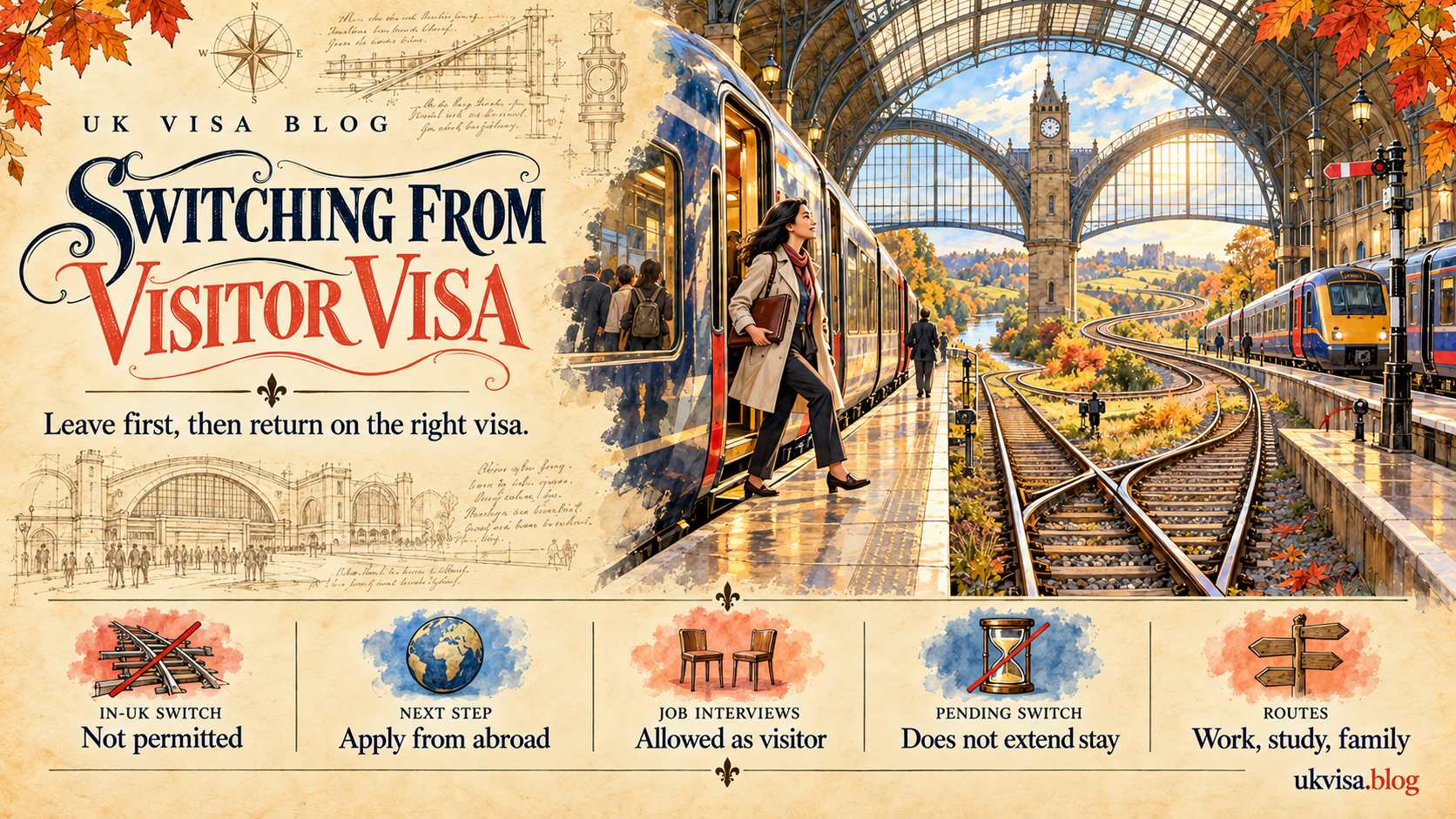
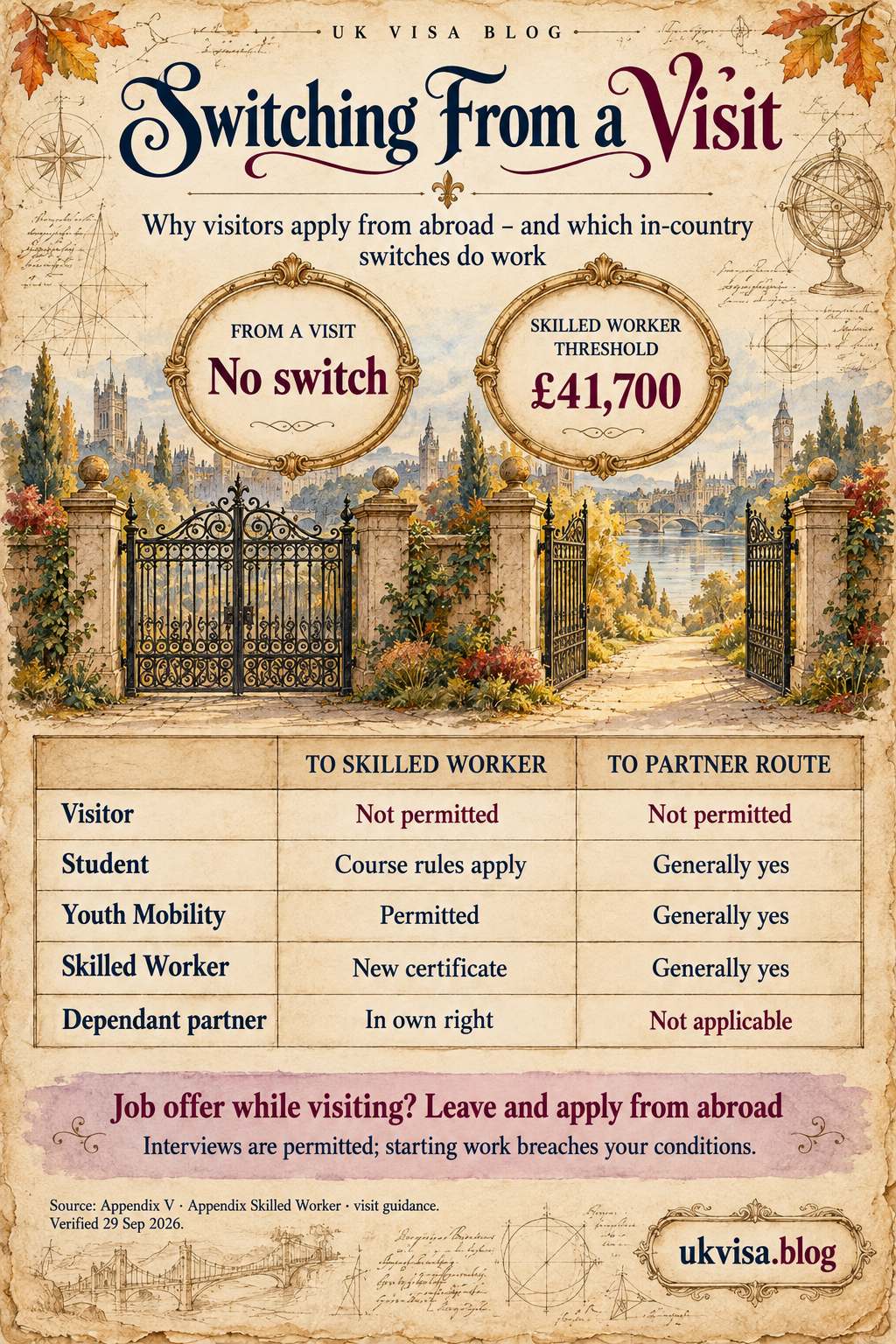
There is no switch from a visit visa to a work, study or family route inside the UK. You leave and apply for entry clearance from abroad. Attending job interviews as a visitor is permitted, but only on the footing that you will leave and obtain the correct visa before starting work. Applying to switch does not extend your permission.
What the Bar Looks Like in Practice
Two separate rules do the work. The visitor rules prohibit the intention to work. And the routes themselves — Skilled Worker, the family routes, the study routes — exclude visitors from their switching provisions. So even a perfect job offer with a licensed sponsor and a certificate of sponsorship cannot be used from inside the UK by someone here as a visitor.
The same logic reaches business visitors. Guidance confirms that coming for general discussions to secure funding for a project is permitted, but that visitors undertaking those activities cannot switch into the Innovator Founder route, in line with the wider switching principles of the points-based system.
Filling a Role Is the Line, Not the Job Title
Appendix V adds a second test. Even an activity on the permitted list fails where it amounts to employment, or to filling a role or providing short-term cover within a UK organisation. Where the visitor is already paid and employed outside the UK, they must remain so. That is the paragraph that catches an unpaid trial week, a favour for a relative’s business, and a secondment presented as a business trip.
Payment From a UK Source
Visitors must not be paid from a UK source, with narrow exceptions: reasonable travel and subsistence including fees for directors attending board meetings; certain drivers and seafarers; prize money; billing a UK client where your overseas employer is contracted to a UK company and most of the work is done overseas, at less than your salary; multinationals handling salary payments from the UK administratively; paid performances at permit-free festivals; and permitted paid engagements.
Remote Working Does Not Create a Route
You may work remotely for an overseas employer while visiting, as a secondary activity. But where a caseworker believes the viability of a long stay substantially depends on you supporting yourself through that remote work, the work is treated as the primary purpose of the visit and the application is refused. Visitors doing remote work as a secondary activity are expected to stay under a month; beyond ninety days, questions follow about the nature of the work.
None of that converts into permission to remain. Remote working is tolerated inside a visit; it is not a status, it accrues nothing towards settlement, and it cannot be extended into one by staying longer.
If You Receive a Job Offer While Visiting
Attending interviews is a permitted activity. The caseworker who granted your visa had to be satisfied that if you were successful you would leave the UK and seek the appropriate entry clearance before starting work. Acting on that is not a setback; it is the basis on which you were let in.
- Accept the offer: nothing stops you agreeing terms while here.
- Have the employer assign a certificate of sponsorship: they must hold a sponsor licence.
- Leave the UK before your permission expires: and before any start date.
- Apply for entry clearance from abroad: on the correct route, with the certificate.
- Start work only after the visa is granted: and after you re-enter.
Working while here as a visitor breaches your conditions and is a discretionary ground for cancelling permission. It also creates an immigration history that every future application must declare — and a sponsor who allows it risks its licence, since caseworkers must refer UK companies suspected of using visitors to fill roles to the Sponsor Management team.
Which Switches Are Permitted
Switching inside the UK is possible between many routes, just not from a visit. What follows applies to people already here with permission on a route that allows it. Our page on cancellation and the suitability rules covers what happens when a switch is attempted from the wrong position.
Switching Inside the UK
| Current permission | Switch to Skilled Worker | Switch to a partner route |
|---|---|---|
| Visitor | Not permitted | Not permitted |
| Student | Permitted, subject to course completion rules | Generally permitted |
| Youth Mobility | Permitted | Generally permitted |
| Skilled Worker | Change of employment, with a new certificate | Generally permitted |
| Dependant partner | Permitted, in your own right | Not applicable |
| Seasonal Worker | Not permitted | Not permitted |
Source: the route appendices of the Immigration Rules, checked 22 August 2026. Confirm your own route before applying.
Switching to Skilled Worker
The route requires a job with an approved sponsor, a certificate of sponsorship, an eligible occupation, and salary at or above both the applicable threshold and the going rate for the occupation code. The general threshold is £41,700 a year, with a lower threshold of £33,400 applying in defined circumstances — see our Skilled Worker page for the detail.
The Going Rate Catches People Out
Meeting the general threshold is not enough. Each occupation code carries its own going rate, and where that rate is higher than the threshold, the higher figure applies. A salary comfortably above £41,700 can still fail where the occupation’s going rate sits above it, so check the code before agreeing terms rather than after.
Common Pathways
- Graduating students: moving to sponsored employment, subject to the course completion rules.
- Youth Mobility holders: converting a temporary stay into sponsored work.
- Dependants: taking a sponsored role in their own right.
- Existing Skilled Workers: changing employer, which needs a new certificate before starting.
Between Partner and Work Routes
Both directions are generally possible for people already in the UK on a qualifying route, but each is a full application against that route’s requirements. Moving to a partner route means meeting the relationship, financial and accommodation requirements — see our spouse route page and our page on relationship changes on a partner visa.
Switching resets your settlement clock unless the routes count towards the same qualifying period. Someone three years into a five-year partner route who switches to Skilled Worker starts a new qualifying period — our page on permanent settlement sets out which routes count.
Youth Mobility to Skilled Worker
The most common planned switch. Youth Mobility gives a fixed period with no sponsor and no settlement, so people use it to find sponsored work and switch before it expires. Time on Youth Mobility does not count towards settlement, which makes the timing of the switch the whole point.
Start early. A sponsor licence check, a certificate assignment and a decision all take time, and the application has to be made before the existing permission expires. Missing that deadline turns a straightforward switch into an application from abroad.
Dependant to Main Applicant
A dependent partner can apply in their own right where they have a sponsored job meeting the requirements. It is worth doing where the relationship’s stability is uncertain, or where the main applicant’s route is ending, because permission held in your own name does not depend on someone else’s status continuing.
The application is assessed exactly as any other Skilled Worker application. Being in the UK already as a dependant helps with practicalities, not with the requirements — see our supporting documents guide and application form walkthrough.
Section 3C Leave and Timing
Where you make a valid application before your existing permission expires, section 3C of the Immigration Act 1971 continues that permission while the application is decided, and during any in-time appeal or administrative review. Your existing conditions continue — the same work rights, the same restrictions.
The protection depends on the application being valid and made in time. An application submitted after permission expires does not attract it, and a late or invalid application leaves you without status, whatever the merits of the underlying case.
Applying Late Is Not Simply a Delay
The suitability rules provide one narrow relief. An applicant is not treated as an overstayer where the application was made within fourteen days of the previous permission expiring and there is good cause, beyond their control, for the late submission. Good cause is a condition, not a formality, and the relief protects the application rather than your status in the intervening days.
Processing and Priority
In-country decisions vary by route and can take months at standard service. Priority and super priority options exist for many applications — see our pages on priority services and delayed decisions. Section 3C protects your status while you wait, but it does not let you start a job you are not yet permitted to do.
Sources: Appendix V of the Immigration Rules on GOV UK, the GOV UK switching pages, the Skilled Worker appendix, and the Home Office visit caseworker guidance version 17.0 published 25 February 2026. Figures verified 22 August 2026.
Frequently Asked
Switching Questions
Can I convert a visitor visa to a work visa?
No. Visitors cannot switch inside the UK. You leave and apply for entry clearance on the correct route from outside, however strong the job offer.
What should I do if I get a job offer while visiting?
Accept it, have the employer assign a certificate of sponsorship, leave before your permission expires, and apply from abroad. Start work only after the new visa is granted and you have re-entered.
Can I attend interviews on a visit visa?
Yes, that is a permitted activity. The caseworker had to be satisfied that if successful you would leave and obtain the correct entry clearance before starting work.
Can I switch from a visit visa to a spouse visa if I marry here?
No. Marrying in the UK on a marriage visitor visa does not create a right to stay. The spouse application is made from outside the UK.
What is the Skilled Worker salary threshold?
£41,700 a year generally, or the going rate for the occupation code if that is higher. A lower threshold of £33,400 applies in defined circumstances.
Can I raise investment as a visitor and then switch to Innovator Founder?
You can hold funding discussions as a visitor, but you cannot switch into that route from inside the UK. The application is made from abroad.
Does applying to switch extend my permission?
Only where the application is valid and made before your existing permission expires. Section 3C then continues your leave on the same conditions while the decision is pending.
Can a student switch to Skilled Worker before finishing the course?
Only within the course completion rules for that route. Check the specific position before applying — see our student route page.
Does switching reset my settlement clock?
Usually yes, unless both routes count towards the same qualifying period. Check before switching if settlement is the goal.
What happens if I work while on a visit visa?
It breaches your conditions and is a discretionary ground for cancelling permission. It also has to be declared on every later application, and can expose the UK company to sponsor licence action.