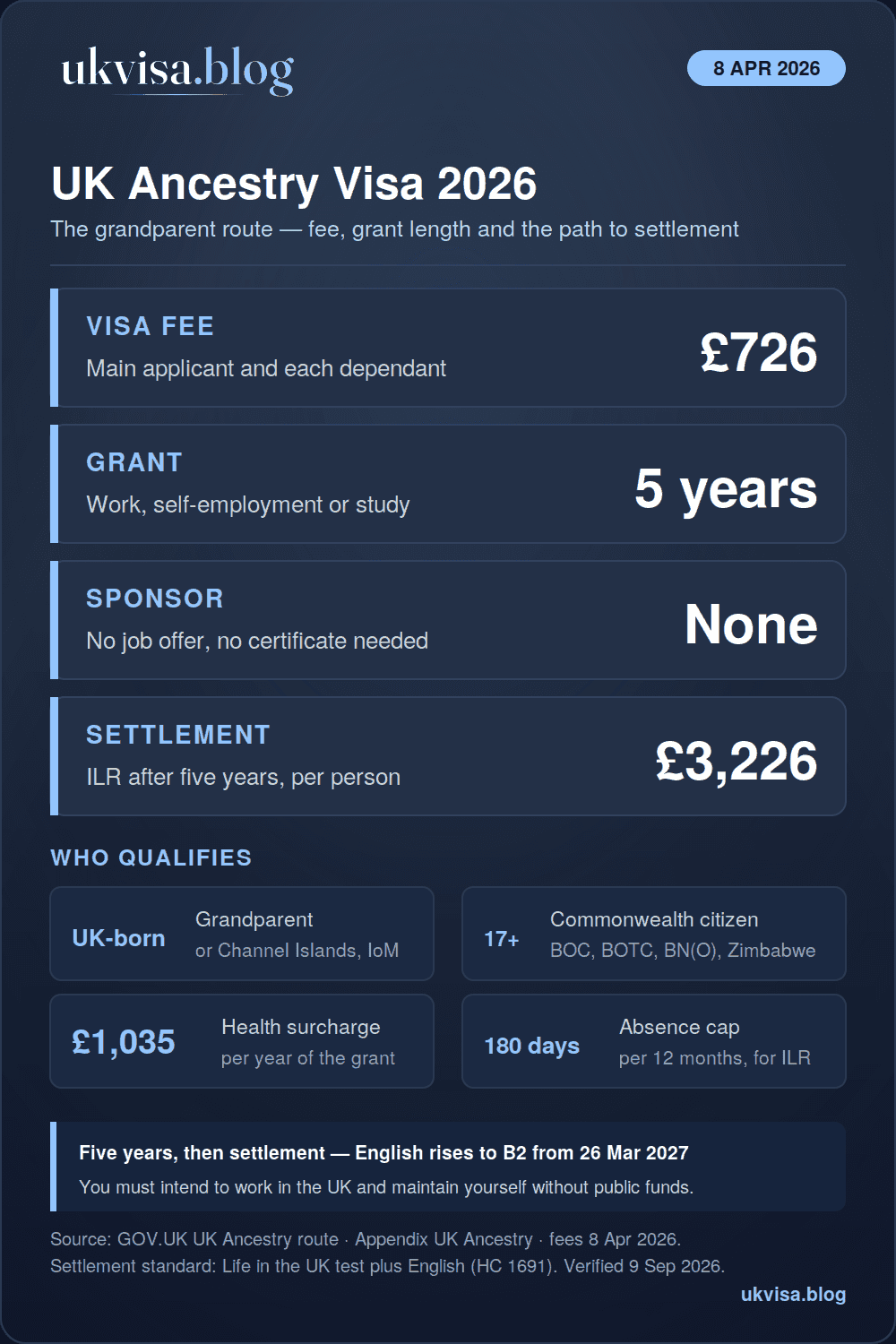
The UK Ancestry visa is one of the most generous routes the UK still operates — a five-year sponsored-free permission for Commonwealth citizens with a UK-born grandparent, leading directly to settlement after five years. From 8 April 2026, the application fee is £726 outside the UK and the in-country extension fee is £1,407, with a £3,226 SET(O) settlement application at the five-year mark. This 2026 guide covers eligibility under Appendix UK Ancestry, the grandparent rule and adoption nuances, every fee, the 180-day continuous residence rule for ILR, and how the route reaches British citizenship.
If you are a Commonwealth citizen aged 17 or over with at least one UK-born grandparent, the Ancestry route gives unrestricted work and study rights, allows self-employment, and leads to Indefinite Leave to Remain after five years and to British citizenship one year after ILR. No sponsorship, no English test at entry, no minimum salary. The full cost over five years is £726 application fee + £5,175 Immigration Health Surcharge = £5,901 for adults.
- What is the UK Ancestry Visa?
- Eligibility Requirements and the Grandparent Rule
- Documents Required for an Ancestry Visa
- How to Apply Step by Step
- UK Ancestry Visa Fees from 8 April 2026
- Renewal and Extension After Five Years
- Indefinite Leave to Remain via Ancestry
- Path to British Citizenship
- Frequently Asked Questions
UK Ancestry Visa 2026: Complete Guidance
The UK Ancestry visa — often searched as "ancestral visa", "grandparent visa", "heritage visa", or "patriality visa" — sits in Appendix UK Ancestry of the Immigration Rules. It is open only to Commonwealth citizens (plus a small set of British status holders and citizens of Zimbabwe), and the entire route hinges on proving an unbroken documentary chain from the applicant back to a UK-born grandparent. November 2025 government policy proposals on extending settlement to ten years explicitly preserve the Ancestry route's five-year ILR pathway, making this one of the most predictable settlement routes currently available.
What is the UK Ancestry Visa?
The UK Ancestry visa is a five-year UK immigration route for Commonwealth citizens aged 17 or over with at least one grandparent born in the UK, the Channel Islands, the Isle of Man, the Republic of Ireland before 31 March 1922, or on a British-registered ship or aircraft. Holders can work in any job, run a business, study, and bring dependants — and apply for settlement after five years of continuous residence.
What makes the route distinctive is the absence of conditions present in nearly every other UK work permission. There is no Certificate of Sponsorship, no Immigration Skills Charge, no salary threshold, no shortage-occupation list, no English language test at the entry-clearance stage, and no genuine-vacancy test for the employer. The Home Office assesses one historical fact (the grandparent's UK birth), one current status (Commonwealth citizenship), and one prospective requirement (intention and ability to work). Everything else is documentation.
Eligibility Requirements and the Grandparent Rule
You qualify if you are a Commonwealth citizen, British overseas citizen, British overseas territories citizen, British national (overseas), or citizen of Zimbabwe; aged 17 or over at intended arrival; have at least one grandparent born in the UK, Channel Islands, Isle of Man, pre-1922 Ireland, or on a British-registered ship or aircraft; can demonstrate ability and intention to work in the UK; and can maintain yourself without recourse to public funds.
The Five Eligibility Tests
- Nationality: Commonwealth citizen (the current list includes Australia, Canada, New Zealand, South Africa, India, Nigeria, Kenya, Jamaica, and many others), or British overseas citizen, British overseas territories citizen, British national (overseas), or citizen of Zimbabwe. Citizenship must be held on the date of application.
- Age: 17 or over at the date of intended arrival. Applicants under 18 need parental consent for travel and care arrangements.
- The grandparent connection: At least one grandparent born in the UK, the Channel Islands, the Isle of Man, the Republic of Ireland (before 31 March 1922), or — in qualifying circumstances — on a British-registered ship or aircraft. The connection can be through either parent and through legally recognised adoptions in the ancestry chain.
- Work intention and ability: Must demonstrate ability to work in the UK and intention to do so. Employment, self-employment, part-time, full-time and voluntary work all count. Past employment history, job offers, or registration with a UK recruitment agency are accepted as evidence.
- Maintenance: Must show ability to maintain and accommodate yourself (and any dependants) without recourse to public funds. There is no fixed financial figure — evidence under UKVI's caseworker guidance on UK Ancestry must be dated within 31 days of application, and credible third-party support (from a relative or friend) is accepted on this route.
The route does not accept great-grandparents or any earlier ancestor born in the UK or Islands. The connection must be exactly one generation up from your parent — i.e. your mother's or father's mother or father. Adoption is recognised on either generation: you can claim through a grandparent who was legally adopted by a UK-born person, and you can claim if you were adopted by a parent whose own parent was UK-born. Step-parents do not create a UK Ancestry route.
Nationality Edge Cases — Zimbabwe, Cyprus and Malta
Although Zimbabwe officially left the Commonwealth in December 2003, its citizens remain eligible for the UK Ancestry route — Zimbabwe stays on the Schedule 3 list in the British Nationality Act 1981 and UKVI continues to accept applications. Cypriot and Maltese applicants need additional handling at the caseworker stage because of their dual EU/Commonwealth status. Applicants holding both a Commonwealth and a non-Commonwealth citizenship can rely on the Commonwealth nationality.
Documents Required for an Ancestry Visa Application
The decisive part of every application is the documentary ancestry chain — three generations of birth certificates linking applicant → parent → UK-born grandparent. Photocopies and unofficial transcripts are insufficient; original long-form certificates from the General Register Office (or the equivalent in the grandparent's country of birth) are required. The full complete supporting documents checklist covers translation, certification, and document substitution rules.
| Document | What It Proves |
|---|---|
| Current passport | Commonwealth citizenship and identity |
| Grandparent's birth certificate | UK (or qualifying territory) place of birth |
| Parent's birth certificate | Links applicant's parent to the UK-born grandparent |
| Applicant's birth certificate | Completes the three-generation ancestry chain |
| Marriage / civil partnership certificates | Explains any surname changes across the chain |
| Adoption order(s) | Required where any ancestry link is by legally recognised adoption |
| Financial evidence | Bank statements or third-party support evidence dated within 31 days |
| Work-intention evidence | Job offer, business plan, CV, or registration with a UK recruitment agency |
| TB test certificate | Required when applying from a listed Appendix Tuberculosis country |
How to Apply for a UK Ancestry Visa
Initial applications must be made from outside the UK on the gov.uk specified form ("UK Ancestry, Right of Abode or Returning Residents visa"). The route does not accept switching from inside the UK — visitor, Student, Graduate or Skilled Worker holders inside Britain must leave and apply from overseas. The exception is people who previously held UK Ancestry permission and are returning: they can re-enter the route from inside the UK via the FLR(IR) form for permission to stay.
- Step 1: Assemble the documentary ancestry chain — three generations of original birth certificates plus any marriage and adoption evidence.
- Step 2: Complete the online application on gov.uk no earlier than 3 months before intended travel.
- Step 3: Pay the £726 application fee and the £5,175 Immigration Health Surcharge upfront (full five years).
- Step 4: Verify identity — UK Immigration: ID Check app for eligible Commonwealth passports, or biometric appointment at a Visa Application Centre.
- Step 5: Submit or upload supporting documents — passport, ancestry chain, financial evidence, work-intention evidence, and TB certificate where required.
- Step 6: Receive decision within 3 weeks for standard processing; priority service (5 working days for £500) is available at most centres.
UK Ancestry Visa Fees from 8 April 2026
All UK Ancestry application fees rose on 8 April 2026 as part of the Home Office's annual fee uplift — entry clearance from £637 to £726, in-country leave to remain from £1,321 to £1,407, and Indefinite Leave to Remain from £3,029 to £3,226. The full schedule is published in the Home Office immigration and nationality fees, 8 April 2026.
| Fee Item | Amount from 8 April 2026 | Stage |
|---|---|---|
| Entry clearance application | £726 | Initial 5-year visa, outside UK |
| Immigration Health Surcharge — adult | £5,175 | £1,035 × 5 years, paid upfront |
| Immigration Health Surcharge — under 18 | £3,880 | £776 × 5 years, paid upfront |
| Total adult cost (entry) | £5,901 | Application + IHS for 5 years |
| In-country extension (FLR(IR)) | £1,407 | Further 5 years if not ready for ILR |
| Settlement application (SET(O)) | £3,226 | Indefinite Leave to Remain — no IHS payable |
| Naturalisation as a British citizen | £1,709 | One year after ILR |
| Priority service | +£500 | 5 working day decision, subject to centre capacity |
| Super Priority service | +£1,000 | Next working day decision, where available |
Source: Home Office immigration and nationality fees, 8 April 2026.
The total upfront cost for an adult applicant moving to the UK on the Ancestry route for the first time is £726 + £5,175 = £5,901. Spouses, civil partners, unmarried partners (2+ year cohabitation) and children under 18 each pay the same £726 plus their own IHS. A wider side-by-side of how this compares to other UK visa routes sits in the complete UK visa fee schedule, and a settlement-focused breakdown in the Home Office settlement and citizenship fees guide.
Renewal and Extension After Five Years
Ancestry visa holders who are not yet ready to apply for settlement — typically because of excess absences from the UK during the first five years — can apply to extend for another five years using the FLR(IR) form. Extensions cost £1,407 in-country plus a fresh £5,175 IHS (£6,582 total) and are made from inside the UK. There is no cap on how many times the visa can be extended in five-year blocks, provided the applicant continues to be a Commonwealth citizen and meets the work and maintenance requirements.
An ILR application at year five costs £3,226 with no IHS payable; a five-year extension costs £6,582 (£1,407 + £5,175). Choosing extension over ILR is therefore almost always a function of not meeting the continuous-residence test rather than a financial preference. The full mechanics of the FLR extension form selection guide set out which FLR variant applies and when Section 3C leave automatically extends an in-country application during the wait.
While an FLR(IR) extension application is pending, travel outside the Common Travel Area (UK, Republic of Ireland, Channel Islands, Isle of Man) automatically withdraws the application — and the existing visa is treated as having ended on the date of departure. Schedule any planned travel either before submitting the FLR(IR) or after receiving the decision; do not leave the CTA while the application is being processed.
Indefinite Leave to Remain via the Ancestry Route
After five years of continuous residence on the Ancestry visa, you can apply for Indefinite Leave to Remain using SET(O). The application costs £3,226 with no Immigration Health Surcharge payable. You must show no more than 180 days outside the UK in any rolling 12-month period during the qualifying five years, pass the Life in the UK Test, meet the B1 English language requirement, and demonstrate continued work or self-employment intention.
Ancestry is one of the few UK immigration routes that leads to settlement after five years on Ancestry on its standard terms — no qualifying-period extension, no salary requirement, no sponsorship needed at the point of ILR. The November 2025 earned-settlement consultation, which proposed extending standard settlement to ten years for most routes, explicitly excluded UK Ancestry from that extension; the five-year clock remains the published settlement pathway.
ILR Requirements for Ancestry Holders
- Continuous residence: Five years in the UK with no more than 180 days outside the UK in any rolling 12-month period — see the 180-day absence rule for settlement for how the rolling window is calculated and the limited exceptions.
- Life in the UK Test: Pass at the standard 75% threshold — the Life in the UK Test booking and pass mark guide covers the booking, content, and retake procedure.
- English language: B1 CEFR proficiency in speaking and listening, or a degree taught in English, or nationality of a majority English-speaking country — full options in the B1 CEFR English proficiency level reference.
- Work test: Continued ability to work, self-employment, or active job-seeking throughout the qualifying period.
- Maintenance and accommodation: Continued ability to support yourself and any dependants without recourse to public funds.
- Suitability: No refusal under Part 9 grounds (criminal convictions, deception, immigration breaches).
The settlement application uses form SET(O) — the SET(O) settlement application form guide explains form selection across the wider ILR landscape. Standard processing for SET(O) is up to six months; priority service (£500) and Super Priority (£1,000) reduce this where available, with the full timeline in the ILR decision timeline guide.
Dependants Settle When the Main Applicant Settles
A distinctive feature of the Ancestry route is that dependent partners and children do not have to complete an independent qualifying period. Partners qualify for settlement at the same time as the main applicant — even where the partnership began part-way through the five years, and even where the dependant has spent significantly less than five years on the route. The Immigration Health Surcharge for a 5-year grant is paid separately for each dependant and works on the same per-year basis.
Path to British Citizenship
Twelve months after the grant of ILR (or immediately on ILR, if married to a British citizen), an Ancestry-route settled person can apply for section 6 naturalisation as a British citizen under the British Nationality Act 1981. The application fee is £1,709 from 8 April 2026 and the process — including the same Life in the UK and English language tests already passed at ILR — runs to roughly four months on standard processing. Total time from first arrival on the Ancestry visa to a British passport is approximately six years.
The combined five-year residence on Ancestry plus the one-year ILR holding period satisfies the section 6(1) "lived in the UK for at least five years before the application" and "no more than 450 days outside the UK in those five years" naturalisation residence tests in a single qualifying period. Most other settlement routes require five years on the route, one year on ILR, plus separate residence calculations — meaning the Ancestry-to-citizenship pipeline is among the cleanest under current rules.
- Five-year permission for Commonwealth citizens with at least one UK-born grandparent — initial fee £726 from 8 April 2026.
- Total upfront cost £5,901 for adults (application + 5-year IHS); £4,606 for under-18 dependants.
- The grandparent rule applies strictly — great-grandparents do not qualify. Adoptions in the chain are accepted if legally recognised.
- Unrestricted work and study rights — no sponsor, no salary threshold, no English language test at entry.
- Initial applications must be made from outside the UK. Extensions and settlement applications are made in-country.
- Direct ILR pathway after five years (SET(O) at £3,226 with no IHS payable) — preserved under the November 2025 earned-settlement consultation proposals.
- 180-day absence rule applies for the ILR qualifying period — rolling 12-month windows, not aggregate.
- British citizenship available one year after ILR; total path to a UK passport is approximately six years.
Where a UK Ancestry application has been refused, the available remedy depends on the ground of refusal. Administrative review is the standard route for caseworker error on the ancestry chain, financial evidence or work-intention assessment; the time limits and procedure sit inside the guide on how to challenge an Ancestry visa refusal. The post-biometrics decision wait is around 3 weeks for standard entry clearance and up to 8 weeks for in-country extensions. Official route information sits on the UK Ancestry visa overview page.
Eligible applicants are Commonwealth citizens, British overseas citizens, British overseas territories citizens, British nationals (overseas), or citizens of Zimbabwe aged 17 or over at intended arrival, with at least one grandparent born in the UK, the Channel Islands, the Isle of Man, the Republic of Ireland before 31 March 1922, or on a British-registered ship or aircraft. Applicants must be able and intending to work in the UK and able to support themselves without recourse to public funds.
From 8 April 2026, the application fee is £726 outside the UK plus the Immigration Health Surcharge at £1,035 per adult per year of leave (£776 per child) — £5,175 for a 5-year adult grant. The total adult upfront cost is therefore £5,901. The in-country FLR(IR) extension is £1,407 (plus £5,175 IHS), and the SET(O) Indefinite Leave to Remain application is £3,226 with no IHS payable.
Yes — directly. After five years of continuous residence on the Ancestry visa, the holder can apply for Indefinite Leave to Remain using SET(O). One year after ILR is granted, the holder can apply for naturalisation as a British citizen. Where the holder is married to a British citizen, the one-year holding period is waived and naturalisation can be applied for immediately on grant of ILR.
No. The grandparent rule is strictly one generation up from the parent. Great-grandparents and any earlier ancestors do not create eligibility for the Ancestry route, even if their UK birth is documented. If the closest UK-born ancestor is a great-grandparent, the alternative routes to consider are claims to British citizenship by descent (where applicable) or, separately, a sponsored UK work or family route.
Not for an initial grant. Initial Ancestry applications must be made from outside the UK on the gov.uk specified form. Visitors, students, graduates and other temporary visa holders inside the UK cannot switch into the Ancestry route from within the country and must leave to apply. The one exception is people who have previously held Ancestry permission and are now in the UK on another route — they can apply to return to the Ancestry route in-country using FLR(IR).
While the visa is live there is no statutory limit on travel — you can freely enter and leave the UK. However, if you plan to apply for ILR after five years, you must not exceed 180 days outside the UK in any rolling 12-month period during the qualifying five years. The window is rolling, not aggregate — a single 200-day absence in any 12-month period breaks the continuous residence and resets the qualifying clock for ILR purposes.
Yes. Spouses, civil partners, unmarried partners (2+ years' cohabitation), and children under 18 can apply as dependants. Each dependant pays the £726 application fee and their own Immigration Health Surcharge. Dependants receive the same length of leave as the main applicant and have full work and study rights. A notable advantage of the Ancestry route: dependants qualify for settlement when the main applicant qualifies, even if they have spent less than five years in the UK.
No — not at the entry-clearance stage. The initial five-year Ancestry visa has no English language requirement, which is one of the route's distinctive features. The English requirement applies later, at the Indefinite Leave to Remain stage, where applicants must demonstrate B1 CEFR proficiency in speaking and listening (or hold a qualifying degree taught in English, or be a national of a majority English-speaking country). The Life in the UK Test also applies at the ILR stage.
You can apply for a further five-year extension using FLR(IR) from inside the UK. The extension fee is £1,407 plus a fresh £5,175 IHS, total £6,582. There is no cap on how many times the visa can be extended in five-year blocks — provided you remain a Commonwealth citizen, continue to be able and intending to work, and continue to meet the maintenance requirement. ILR can then be applied for at any later five-year anniversary once the continuous residence test is finally met.
Standard processing is approximately 3 weeks (15 working days) for entry clearance from outside the UK, and up to 8 weeks for in-country FLR(IR) extensions. Priority service for £500 targets a decision in 5 working days where available, and Super Priority for £1,000 targets next-working-day decisions — both subject to centre capacity. SET(O) settlement applications take up to 6 months on standard processing.