
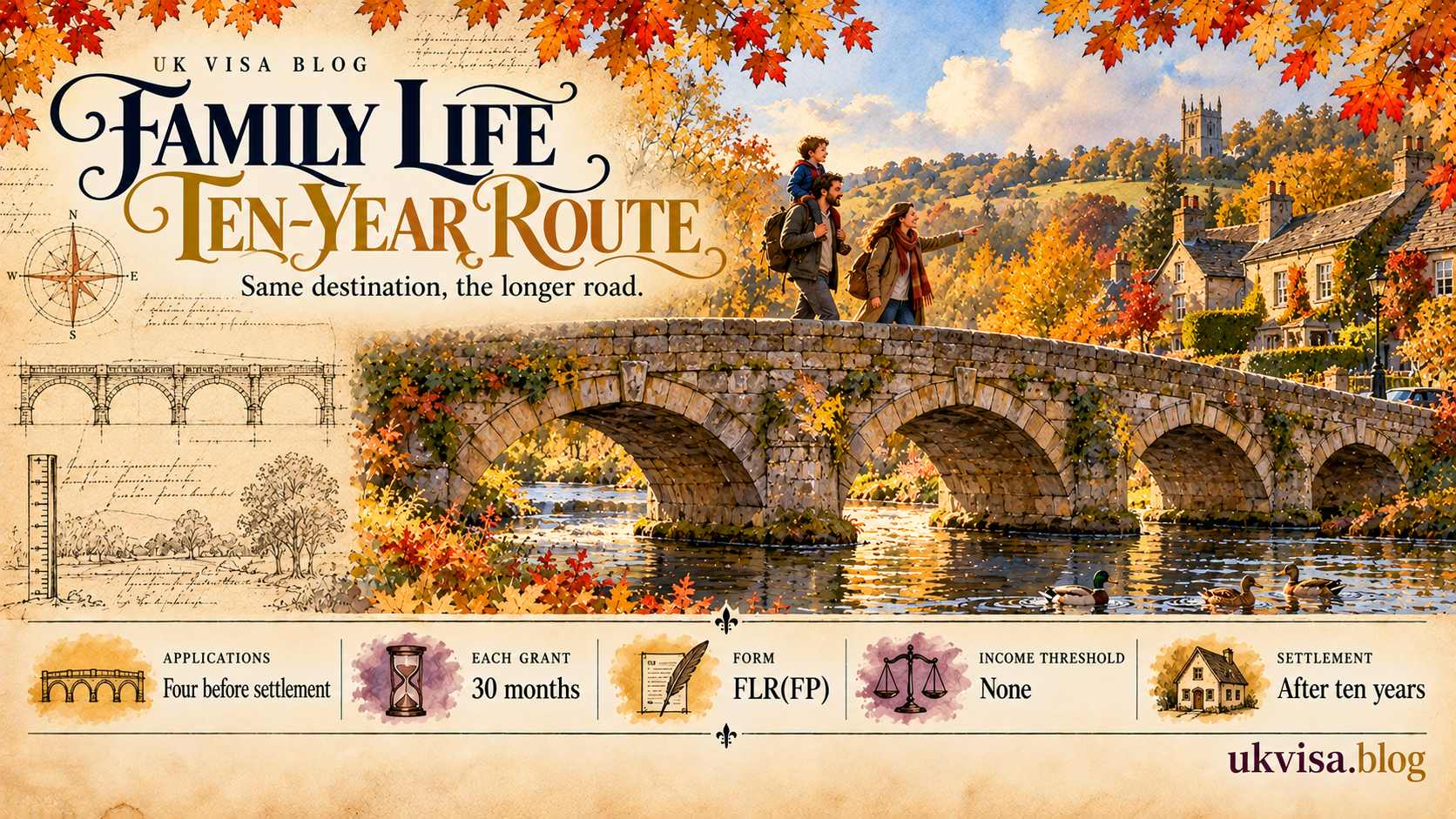
The family life 10-year route is what the Home Office grants when the relationship is real but the £29,000 threshold is out of reach. There is no minimum income on it. There are four applications instead of two, around £19,200 in fees, and ten years before settlement.
UK Family Visas
Understanding the Family Life 10 Year Route to Settlement in 2026
What Is the 10 Year Route to Settlement?
An Article 8 pathway for partners and parents who satisfy the relationship requirements but not the financial ones. Instead of two grants across five years, you make four applications on form FLR(FP) across ten years, each granting 30 months, before settlement. There is no minimum income threshold — only a requirement to maintain yourself without public funds.
It exists because refusing a genuine family relationship purely on income can breach Article 8. Rather than refuse, the Home Office grants limited permission on a longer route. It is distinct from the private life route, which rests on personal ties rather than a relationship, and from the standard five-year partner route.
You Do Not Choose This Route
Nobody applies for the ten-year route. It is what a decision-maker grants when the five-year requirements cannot be met but refusal would be disproportionate. The gateway is usually paragraph EX.1 of Appendix FM, and the practical consequence is a longer, more expensive road to the same destination.
Five-Year and Ten-Year Routes Compared
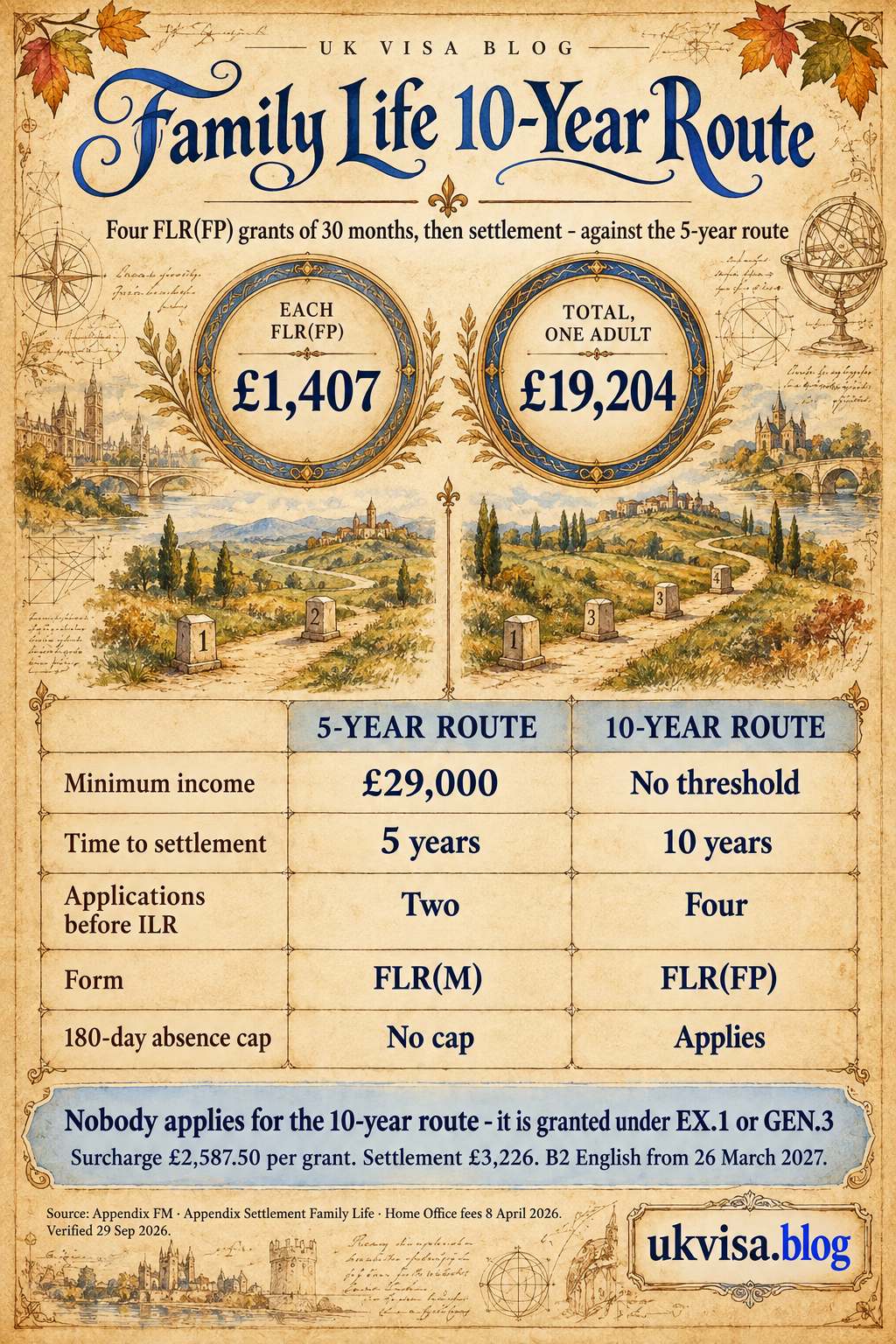
| Aspect | Five-year route | Ten-year route |
|---|---|---|
| Financial requirement | £29,000 minimum income | No threshold; self-sufficiency without public funds |
| Time to settlement | Five years | Ten years |
| Applications before settlement | Two | Four |
| Form | FLR(M) | FLR(FP) |
| Fee waiver | Limited | Available on destitution grounds |
| Approximate Home Office cost | About £12,400 | About £19,200 |
Source: Appendix FM; Appendix Settlement Family Life; fee table of 8 April 2026.
Where the Threshold and the Settlement Reforms Stand
£29,000 has applied since 11 April 2024; the announced rises to £34,500 and £38,700 were paused and nothing further has been laid. The earned-settlement consultation closed on 12 February 2026 and carves out people admitted as the partner, parent or child of a British citizen who held that status throughout their qualifying period — they keep five years.
Requirements on the 10 Year Route
Everything except the requirement that put you here still applies. The relationship must be genuine, the accommodation adequate, the English at the right level, and the suitability rules satisfied — which since 11 November 2025 means the common Part Suitability provisions, applied to the family routes for the first time.
- Relationship: a genuine and subsisting relationship with a partner, or a genuine parental relationship with a child.
- Sponsor: British or Irish citizen, settled person, or holder of refugee or humanitarian protection status.
- English: A1 at the first application, A2 at extension, B1 at settlement — see our English requirements guide.
- Maintenance: the family supported without recourse to public funds.
- Accommodation: adequate and not statutorily overcrowded.
- Immigration status: not in breach of the immigration laws, or a reasonable explanation for any overstaying.
Here the 180-Day Absence Rule Does Apply
This is a genuine difference from the five-year partner route. Settlement on the ten-year route falls under Appendix Settlement Family Life, which is covered by Appendix Continuous Residence — so no more than 180 days outside the UK in any rolling 12-month period, across the whole decade.
The permitted exceptions are narrow: humanitarian or environmental crisis work, travel disruption from natural disaster, conflict or pandemic, and compelling personal circumstances such as life-threatening illness or a close relative’s death. Settlement Family Life applicants also have absences for work, study or supporting family overseas allowed for. Our continuous residence guide covers the mechanics.
Public Funds Are Not Always Off Limits
The no-recourse condition is mandatory on the five-year route. On a ten-year grant made on exceptional circumstances it is not: the family life guidance, version 29.0 of 5 August 2026, directs caseworkers to consider whether to allow access to public funds. Where a family cannot otherwise be maintained, ask expressly and evidence the need.
Family Life as a Partner
Partners on this route prove exactly what partners on the five-year route prove about the relationship. What changes is the money: instead of £29,000 evidenced through the lettered categories, you show the household is supported without public funds.
- Relationship: marriage or civil partnership certificate, cohabitation records, joint accounts, correspondence and photographs across the relationship.
- Accommodation: tenancy agreement or mortgage statement, council tax, and the owner’s letter where you live in someone else’s property.
- Finances: bank statements, payslips and employment letters showing self-sufficiency, with no threshold to hit.
- English: a certificate at the level for the stage, or exemption evidence.
- Identity: your passport and eVisa, and the sponsor’s status evidence.
The absence of a threshold does not mean the absence of scrutiny. Self-sufficiency has to be demonstrated on documents, and an application that shows outgoings exceeding income without explanation invites the same refusal the threshold would have produced.
Family Life as a Parent
Parents reach this route where they have a genuine parental relationship with a British or settled child and it would not be reasonable to expect the child to leave. Our Parent of a British Child Visa guide covers the five-year version of the same relationship.
Parent Route Eligibility
| Requirement | Detail |
|---|---|
| Child’s status | British or Irish citizen, or settled in the UK, and under 18 |
| Relationship | Genuine and subsisting parental relationship |
| Responsibility | Sole responsibility, or access rights actually being exercised |
| Child’s position | Not reasonable to expect the child to leave the UK |
| English | A1, then A2 at extension, then B1 at settlement |
Source: Appendix FM; family life and exceptional circumstances guidance version 29.0.
The evidence that carries these applications is institutional: school reports addressed to you, correspondence with teachers, GP records showing your involvement, and records of financial support. Access arrangements should be documented rather than described.
Fees, Processing and Settlement
Four applications and four surcharge payments make this route roughly half as expensive again as the five-year one, spread over twice the time. For most families the fee waiver is what makes it survivable.
Costs from 8 April 2026
| Charge | Amount | Notes |
|---|---|---|
| FLR(FP) application | £1,407 | Per person, per grant; four needed |
| Health surcharge, adult | £2,587.50 | Per 30-month grant, at £1,035 a year |
| Health surcharge, child | £1,940 | Per 30-month grant, at £776 a year |
| Settlement | £3,226 | After ten years |
| Total for one adult | About £19,204 | Four grants plus settlement |
| Priority and super priority | £500 / £1,000 | Where offered |
Source: Home Office immigration and nationality fees, 8 April 2026.
FLR(FP) applicants who are destitute, or would be made destitute by paying, can have the fee and the health surcharge waived in whole or in part. It requires full evidence of income, savings, debts and essential expenditure. Request it as part of the application — an application refused for non-payment is not the same as one where a waiver was considered and declined.
Processing and Settlement
FLR(FP) decisions commonly take a few months from biometrics, and cases turning on a child’s best interests take longer because that assessment is substantive. Settlement applications take longer again. Check the published in-country waiting time for your route before assuming a timescale, and full costs in our Home Office fees guide.
- Residence: ten years on the route, within 180 days’ absence in any 12-month period.
- English: B1, rising to B2 for applications made on or after 26 March 2027.
- Knowledge: a pass in the KoLL test.
- Relationship: still genuine and subsisting, or the parental relationship still active.
- Suitability: the Part Suitability requirements met.
- Fee: £3,226 for ILR.
Refusal, EX.1 and Appeal
Refusals here overlap with the spouse visa refusal grounds: thin relationship evidence, suitability, or a failure to show the family can be maintained. The distinctive one is a case that never engaged EX.1 in the first place.
EX.1 Is the Gateway
Paragraph EX.1 allows permission where there are insurmountable obstacles to family life continuing outside the UK, or where a qualifying child has been here seven years and it would not be reasonable to expect them to leave. Our exceptional circumstances guide sets out how the test is applied.
Appeal Rights
A family life refusal is a refusal of a human rights claim, so an appeal to the First-tier Tribunal is normally available — 14 days from service of the decision in-country, 28 days from outside. Our guide to challenging an immigration decision covers the procedure and cost.
After Settlement
Settlement removes the time limit, the work restriction and the health surcharge. Naturalisation follows twelve months later on this route — the immediate route belongs to spouses of British citizens. See our naturalisation requirements guide.
Sources: Appendix Settlement Family Life and Appendix FM of the Immigration Rules; Appendix Continuous Residence; Home Office guidance on family life and exceptional circumstances, version 29.0 of 5 August 2026; and the fee table of 8 April 2026. The financial requirement figures are unchanged. Figures verified 22 August 2026.
Frequently Asked
Questions about the Family Life 10 Year Route
An Article 8 pathway for partners and parents who meet the relationship requirements but not the financial ones. Four grants of 30 months on form FLR(FP) run across ten years before settlement becomes available. There is no minimum income threshold; instead you must show the family is maintained without recourse to public funds.
You move onto the ten-year route when you can no longer meet the five-year requirements. Moving back is possible once you meet all of them again, but the five-year clock restarts from zero — time already served on the ten-year route does not carry across. That makes an early switch far more worthwhile than a late one.
There is no minimum income threshold and no £29,000 to prove. What you must show is that you can maintain yourself and any dependants without recourse to public funds — income or savings sufficient for the household’s actual costs. The absence of a threshold does not mean the absence of scrutiny, and the arithmetic still has to work on the documents.
About £19,204 for one adult from 8 April 2026: four FLR(FP) applications at £1,407, four health surcharge payments of £2,587.50 for each 30-month grant, and £3,226 for settlement. Children pay the same application fee with surcharge at £1,940 per grant. Fee waivers can remove much of this where destitution is evidenced.
Yes, and this is where it does apply. Settlement on the ten-year route falls under Appendix Settlement Family Life, which Appendix Continuous Residence governs — so no more than 180 days outside the UK in any rolling 12-month period. The five-year partner route under Appendix FM has no such cap, which is a frequent source of confusion.
Yes, without restriction — employment, self-employment or running a business, and you may study. The condition normally attached is no recourse to public funds, though on a ten-year grant made on exceptional circumstances the caseworker is directed to consider allowing access to public funds. Ask for it expressly if the family cannot otherwise be supported.
FLR(FP) applicants can have the application fee and the health surcharge waived in whole or in part where they are destitute or would be made destitute by paying. You must evidence income, savings, debts and essential expenditure in full. Waiver arrangements differ at the settlement stage, so check the position for the specific application before relying on one.
The provision in Appendix FM that permits a grant where there are insurmountable obstacles to family life continuing outside the UK, or where a qualifying child has lived in the UK for seven years and it would not be reasonable to expect them to leave. It is the usual gateway onto the ten-year route when the five-year requirements cannot be met.
You can live and work in the UK without restriction, access public funds, and stop paying the health surcharge. Naturalisation becomes available twelve months after settlement on this route, subject to residence, good character and knowledge requirements. Settlement lapses after more than two continuous years outside the UK.