
Every partner application turns on one question: is the relationship genuine and subsisting. Married couples prove it with a certificate and a shared life. Unmarried partners need two years of a relationship akin to marriage. Caseworkers grade the evidence in tiers, and a thick file of the wrong tier proves nothing at all.
UK Family Visas
UK Partner Relationship Visa Guidance 2026
What Is a Genuine and Subsisting Relationship?
Genuine means the relationship was not formed primarily to obtain a visa. Subsisting means it is still running and the couple intend to live together permanently in the UK. Both are tested on the balance of probabilities from the documents alone. Three relationship types qualify under Appendix FM: spouses, civil partners and unmarried partners of at least two years.
The requirement sits in the eligibility rules of Appendix FM and applies at every stage of the spouse settlement visa route — first application, extension and settlement. Note that the separate Appendix Relationship with Partner in the Immigration Rules governs partners on work, study and other routes; family applications are decided under Appendix FM’s own definitions.
How Caseworkers Actually Decide
The relationship caseworker guidance (version 7.0) grades evidence in three tiers. Strong evidence is official and independently verifiable: a joint tenancy, a mortgage, council tax records. Acceptable evidence is third-party but unverified — separate bills at the same address, insurance documents, student finance letters.
Weak evidence is everything generated by the couple or their circle: photographs, personal statements, letters from friends and family. Enough strong evidence decides the case by itself. Weak evidence never does, whatever its volume, which is why applications built on photographs and chat logs fail so consistently.
What the Assessment Covers
Caseworkers look at how the couple met and how the relationship developed, time actually spent together, the pattern of communication, financial interdependence, each partner’s knowledge of the other’s life and family, and concrete plans for living in the UK. Where a case is referred for a partner visa interview, the answers must match the paperwork and each other.
The guidance also tells caseworkers to allow for culture and country conditions — patriarchal documentation practices, stigma around same-sex relationships, religious rules against cohabitation. Where documents genuinely cannot exist, an explanation is to be weighed before refusal rather than after it.
Durable Relationship Requirements for Unmarried Partners
Unmarried partners must show at least two years in a relationship similar to marriage or civil partnership. Cohabitation is the usual proof, but it is not an absolute rule: couples may have lived apart for good reason — study, work postings, immigration constraints — provided the relationship itself was genuine throughout.
Evidence of Living Together
Documents do not have to be in both names. Separate bills covering the same address and the same months are accepted. The guidance expressly tells caseworkers not to demand several documents covering one period, so the aim is coverage across the full two years rather than depth in any single month.
The Conditions Behind the Two Years
Both partners must be 18 or over, must have met in person, must not be within the prohibited degrees of relationship under UK marriage law, and any previous marriage or durable relationship must have ended permanently. Step-siblings are outside the prohibited degrees; adoptive parents and children, grandparents, siblings, aunts, uncles, nieces and nephews are inside them.
Previous Relationships That Have Not Formally Ended
A previous relationship must be over, not necessarily dissolved on paper. Evidence is normally a death certificate, a final order or a dissolution order. An overseas divorce counts where it is valid under that country’s law and the parties had the required connection to it. Where no document survives, a later UK marriage is itself accepted as evidence the earlier relationship ended.
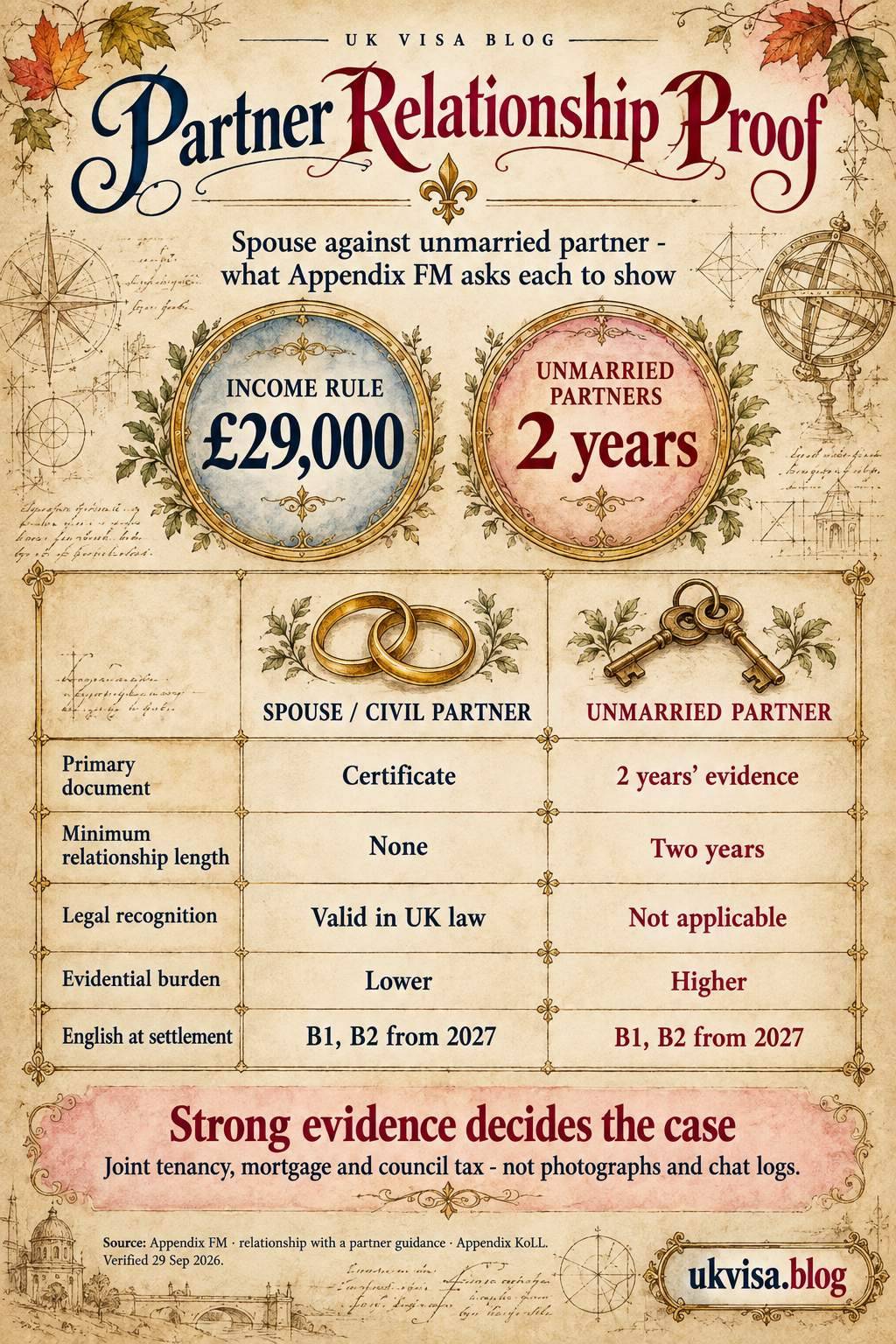
Spouse, Civil Partner and Unmarried Partner Compared
| Requirement | Spouse or civil partner | Unmarried partner |
|---|---|---|
| Primary document | Marriage or civil partnership certificate | Two years of relationship evidence |
| Minimum relationship length | None | Two years |
| Legal recognition | Must be valid under UK law | Not applicable |
| Evidential burden | Lower | Higher |
Source: Appendix FM; relationship caseworker guidance version 7.0.
Relationship Proof: Evidence and Documents
Build the file across categories rather than within one. A handful of strong documents from different parts of your life beats a hundred pages of the same thing. Our partner visa evidence checklist sets the relationship bundle alongside the Appendix FM-SE financial documents.
- Official certificates: marriage or civil partnership certificate, and birth certificates of any children.
- Shared address: joint tenancy or mortgage, council tax, utility bills covering the same months.
- Correspondence to both: bank statements, official letters and deliveries to one address.
- Communication: a representative sample of calls and messages showing continuity, not the whole archive.
- Travel and time together: flights, hotel bookings, passport stamps from visits.
- Financial ties: joint accounts, transfers between partners, policies naming both.
- Family and events: photographs with each other’s families, wedding or engagement invitations and bookings.
Where Evidence Goes Wrong
Photographs submitted alone. Hundreds of pages of chat logs in place of a selection. Third-party letters used to carry the whole case. Evidence that clusters in the weeks before the application and shows nothing of the years before it. Each of these is weak-tier material presented as if it were strong-tier, and volume does not convert one into the other.
Inconsistency does more damage than thinness. Dates that disagree between the form, the statements and the documents give a caseworker something concrete to refuse on. Our guide to why partner visas get refused works through the pattern.
Settlement Usually Needs No Fresh Relationship Evidence
A useful detail from the guidance: at the settlement stage caseworkers normally require no further relationship evidence, because the earlier grant already tested it. Fresh evidence is expected only where circumstances have materially changed since the last successful application — a separation and reconciliation, a long period living apart, a new address history.
UK Relationship Visa Requirements 2026
Proving the relationship is necessary but not sufficient. Four further requirements sit alongside it, and an application that satisfies the relationship test still fails if any one of them is unmet.
Requirements Beyond the Relationship
| Requirement | Position in 2026 |
|---|---|
| Sponsor income | £29,000 a year, or £88,500 in savings; £18,600 for protected pre-April 2024 cases |
| English | A1 first application, A2 at extension, B1 at settlement — B2 at settlement from 26 March 2027 |
| Accommodation | Adequate and not statutorily overcrowded |
| Sponsor status | British or Irish citizen, settled person, or refugee or humanitarian protection status |
| Age | Both partners 18 or over |
Source: Appendix FM; Appendix KoLL paragraph 2.2; fee table of 8 April 2026.
The sponsor income rule is where most applications are lost, and the A1 to B1 English requirement steps up at each stage. Housing standards are covered in our partner visa accommodation guide.
Where the Income Threshold Stands
The threshold has been £29,000 since 11 April 2024. Announced increases to £34,500 and then £38,700 were paused, the Migration Advisory Committee reported in June 2025 without recommending a single figure, and nothing has been laid since. Anyone quoting £38,700 as the current requirement is describing a plan that was abandoned.
Routes to Settlement
Applicants meeting every requirement reach permanent settlement by the 5-year route ILR. Those granted permission on Article 8 grounds because a requirement cannot be met take the 10-year route to settlement instead, with four grants of permission rather than two.
What Is Your Relationship to the Applicant?
This question appears on Home Office forms and asks the sponsor to state their connection to the person applying. The answer determines which rules are applied, so it must match the evidence exactly. An unmarried partner described as a spouse invites a refusal on a point that was never in dispute.
- Spouse: husband or wife, in a marriage recognised under UK law.
- Civil partner: in a registered civil partnership.
- Unmarried partner: a durable relationship of two years or more.
- Fiancé(e): engaged and intending to marry — the fiancé(e) route comes first, then a switch after the marriage.
Refusal Risks and Alternative Family Routes
Relationship-based refusals cluster around inconsistency, gaps in the two-year history for unmarried partners, and applications where one partner cannot describe the other’s basic circumstances. Where the partner route is closed, other parts of the family rules may still be open.
- Parent route: where there is a British or settled child and a genuine parental relationship, the parent visa applies instead of a partner application.
- Adult dependent relative: older parents or relatives needing long-term care may qualify under the rules for bringing dependent relatives, on a markedly stricter evidential standard.
- Exceptional circumstances: where the rules are not met but Article 8 is engaged, the compassionate grounds for family applications framework leads to the ten-year route.
If the Relationship Ends Because of Abuse
If your relationship breaks down because of domestic abuse while you hold permission as a partner, you can apply for indefinite leave under the domestic violence provisions rather than leaving the UK. Evidence from police, medical professionals, refuges or support organisations carries the application. Support is available before any application is made.
Sources: the partner route pages on GOV.UK; Appendix FM of the Immigration Rules; Appendix KoLL paragraph 2.2; and Home Office guidance, relationship with a partner, version 7.0 of 8 October 2024. Figures verified 22 August 2026.
Frequently Asked
Questions about Relationship with Partner Visa UK
Genuine means the relationship was not formed primarily to obtain immigration permission. Subsisting means it is still running and the couple intend to live together permanently in the UK. Caseworkers decide it on the balance of probabilities from documents alone, weighing evidence of a shared life, communication, financial ties and concrete plans, alongside each partner’s knowledge of the other.
A relationship similar to marriage or civil partnership lasting at least two years, for couples who are neither married nor civil partners. Living together is the usual proof but not an absolute requirement — periods apart for study, work or immigration reasons are accepted where the relationship remained genuine. Both partners must be 18 or over and free to marry.
The strongest are official and verifiable: a joint tenancy or mortgage, council tax records, joint accounts. Next come separate bills at the same address, insurance and similar third-party documents. Photographs, chat logs and letters from friends carry the least weight and cannot carry an application alone. Spread the evidence across the whole relationship, not one recent period.
No. That Appendix governs partners applying on work, study and other sponsored routes. Family applications by the partner of a British or settled person are decided under Appendix FM, which contains its own definition of partner and its own two-year rule for unmarried couples. Reading the wrong Appendix is a common source of confusion about what evidence is required.
Married couples and civil partners have no minimum cohabitation requirement — the certificate is the primary evidence. Unmarried partners need two years in a relationship akin to marriage, and while continuous cohabitation is the ordinary way of showing it, periods apart for good reason are accepted provided the relationship itself was genuine and subsisting throughout.
£29,000 gross annual income, or £88,500 in cash savings held for six unbroken months, or a permitted combination. Sponsors whose first partner application predates 11 April 2024 keep the £18,600 threshold with the same partner. The announced increases to £34,500 and £38,700 were paused and have not been implemented.
Yes. Relationships that began on dating apps or social media are routinely accepted. What matters is the progression from online contact to meeting in person, visits, and a settled commitment. Travel evidence, passport stamps and photographs from those meetings do far more for such an application than the volume of messages that preceded them.
Thirty-three months when granted as entry clearance from outside the UK, or thirty months when granted in-country. An extension adds a further thirty months. After five years on the partner route you can apply for indefinite leave to remain, provided you still meet the relationship, financial, English and accommodation requirements at that point.
From 26 March 2027. Appendix KoLL paragraph 2.2 sets B1 speaking and listening for settlement applications made before that date and B2 for applications made on or after it. The earlier steps are unchanged: A1 for the first application and A2 at extension. Anyone settling after March 2027 should plan the higher test well in advance.