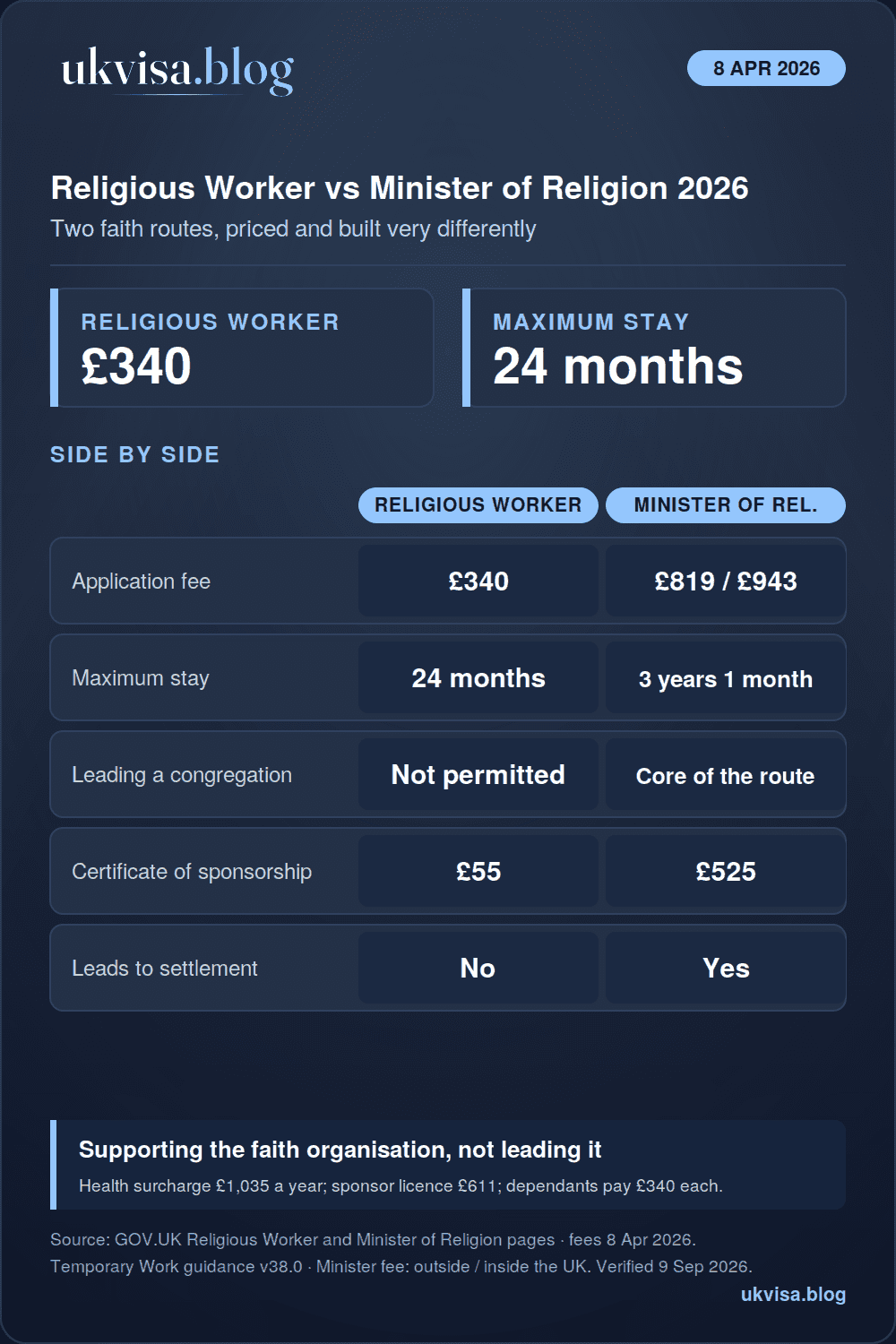
The Religious Worker visa — formally known as the Temporary Work — Religious Worker route, and still commonly called the T5 Religious Worker visa after the legacy Tier 5 nomenclature — is the UK's dedicated immigration route for non-pastoral religious workers, visiting religious workers, and members of religious orders. The route permits stays of up to 24 months for paid religious work performed in support of, but not in leadership of, UK faith communities. The fundamental distinction from the Minister of Religion route is functional: Religious Workers cannot be the primary celebrant leading a congregation in performing religious rites or preaching the essentials of the creed — those duties require the Minister of Religion route. From 8 April 2026, the application fee rose from £319 to £340, and the sponsor licence fee rose from £574 to £611 (Temporary Worker category, flat across all sponsor sizes), with no other substantive changes in 2026 affecting this route specifically.
The Religious Worker visa is the right route for three distinct profiles: non-pastoral religious workers (administrative, teaching, missionary support roles), visiting religious workers (overseas religious workers continuing the same religious work in the UK temporarily), and members of religious orders (monks, nuns, friars, sisters in monastic or contemplative communities). No English language test, no minimum salary threshold (National Minimum Wage compliance applies), no Immigration Skills Charge. The 12-month cooling-off period after the visa expires — also applying mutually with the Charity Worker visa — is the route's defining structural limit, designed to prevent permanent reliance on this temporary framework. The route does NOT lead to settlement; pastoral leadership roles requiring settlement should use the Minister of Religion route instead.
- What is the Religious Worker Visa?
- Three Eligible Profiles
- Pastoral vs Non-Pastoral — The Critical Line
- Religious Worker vs Minister of Religion
- Religious Worker vs Charity Worker
- Eligibility Requirements
- The 12-Month Cooling-Off Period
- Fees and Costs from 8 April 2026
- How to Apply
- What You Can and Cannot Do on This Visa
- Bringing Your Partner and Children
- Frequently Asked Questions
Religious Worker Visa UK 2026: Temporary Work Route, £340 Fee, 24-Month Maximum Stay
The Religious Worker visa sits within the broader UK Temporary Worker (T5) framework as one of six sub-routes: Religious Worker, Charity Worker, Government Authorised Exchange, International Agreement, Creative Worker, and Seasonal Worker. Across the family, the routes share the same structural features — short maximum stays, no English language requirements, no minimum salary thresholds, no Immigration Skills Charge, and no settlement pathways. The Religious Worker route is the largest of the six by application volume, serving UK churches, mosques, temples, gurdwaras, synagogues, monasteries, religious charities, and faith-based educational institutions across all major denominations and traditions.
What is the Religious Worker Visa?
The Religious Worker visa is the UK Temporary Work route for overseas nationals undertaking paid religious work for a UK religious organisation. It covers three distinct profiles: non-pastoral religious workers (administrative, teaching, missionary roles), visiting religious workers (continuing overseas religious work in the UK temporarily), and members of religious orders (monastic and contemplative communities). Maximum 24 months stay; application fee £340 from 8 April 2026; no English language test; no minimum salary; no Immigration Skills Charge; no settlement pathway. Sponsored by a UK religious organisation holding a Temporary Worker sponsor licence at £611 flat (from 8 April 2026).
Replaced the T5 (Tier 5) Religious Worker Visa in December 2020
The current Religious Worker visa replaced the older T5 (Tier 5) Religious Worker visa on 1 December 2020 as part of the wider Points Based Immigration System reforms following the end of EU free movement. The substantive immigration rules and policy intent remain the same — the change was primarily nomenclature, structural reorganisation under Appendix Temporary Work — Religious Worker, and the rebadging of the Tier 5 family as the unified Temporary Worker route. Many sponsors and applicants still use "T5 Religious Worker visa" or "Tier 5 Religious Worker visa" interchangeably with the current name. References across this guide treat the terms as equivalent.
Three Eligible Profiles
Appendix Temporary Work — Religious Worker recognises three distinct applicant profiles. Each has the same fee, processing time, and structural framework, but differs in the nature of religious work being undertaken and the relationship between the worker and the sponsor.
| Profile | Type of Religious Work | Typical Examples |
|---|---|---|
| Non-Pastoral Religious Worker | Paid religious work performed in support of UK faith activities, but NOT primary pastoral leadership | Religious teachers (not heads of school), administrative staff at religious charities, missionaries supporting local congregations, music ministers, retreat coordinators, faith-based community workers |
| Visiting Religious Worker | Continuation of overseas religious work temporarily in the UK; worker remains in ongoing employment with the overseas religious organisation | Visiting imams from overseas mosques during Ramadan; visiting Hindu priests for festival ceremonies; visiting Buddhist teachers on UK retreat tours; pulpit-swap clergy on short UK assignments |
| Member of a Religious Order | Membership of a monastic, contemplative, or apostolic religious community involving communal living under religious vows | Catholic monks/nuns joining UK monasteries; Buddhist monastics joining UK sanghas; Hindu sadhus/sadhvis joining UK ashrams; Orthodox monastics joining UK monasteries |
Members of religious orders living communally and bound by religious vows of poverty are exempt from the National Minimum Wage under section 44A of the National Minimum Wage Regulations 2015. Their "remuneration" is typically board and lodgings, contemplative life, and community membership rather than monetary wages. For visa purposes, this exemption is formally recognised — the sponsor confirms the NMW exemption on the Certificate of Sponsorship rather than evidencing monetary salary. Non-residential religious workers (the other two profiles) are NOT exempt and must receive at least the National Minimum Wage in cash or cash-equivalent (£12.71/hour from 1 April 2026).
Pastoral vs Non-Pastoral — The Critical Line
The critical distinction between the Religious Worker visa and the Minister of Religion visa is the worker's role in leading worship. Religious Workers can perform some pastoral support activities — providing spiritual counsel, supporting congregational activities, leading prayer in subsidiary capacity — but cannot be the primary celebrant leading the congregation in performing religious rites and rituals, preaching the essentials of the creed, or serving as the lead minister, priest, imam, rabbi, granthi, or equivalent. If your role IS primary pastoral leadership, the Minister of Religion route applies — and offers a settlement pathway that Religious Worker does not.
The line between Religious Worker and Minister of Religion is functional, not credential-based. A fully ordained minister can hold a Religious Worker visa if their UK role is non-pastoral (e.g. teaching at a seminary, administering a religious charity, music ministry). Conversely, a worker without formal ordination can hold a Minister of Religion visa if their actual UK role IS primary pastoral leadership (e.g. lay pastors in faith traditions that do not require ordination). The Home Office assesses the actual duties on the Certificate of Sponsorship, not the worker's titles or qualifications.
Where a UK religious organisation is unclear about which route applies — particularly for senior religious roles that combine teaching, administration, and some primary worship leadership — the Minister of Religion route is the safer choice. It offers a 5-year settlement pathway, no cooling-off period, and broader work permissions, at the cost of an English language test (CEFR B2) and a higher application fee. Selecting Religious Worker for a role that is, in substance, pastoral leadership exposes both the worker and sponsor to compliance risk and potential visa curtailment if the Home Office determines the role does not match the visa category.
Religious Worker vs Minister of Religion
| Feature | Religious Worker (T5) | Minister of Religion (T2) |
|---|---|---|
| Primary role | Non-pastoral religious work; visiting religious worker; religious order member | Primary pastoral leadership — lead minister, priest, imam, rabbi, granthi, monk teacher |
| Sponsor licence type | Temporary Worker (£611 flat from 8 April 2026) | Worker (£611 small / £1,682 large from 8 April 2026) |
| CoS fee | £55 per worker | £525 per worker |
| Application fee (from 8 April 2026) | £340 | £769 outside UK / £885 inside UK |
| English language test | None | CEFR B2 (IELTS 5.5+ or equivalent) |
| Minimum salary | None (NMW compliance; religious order members exempt) | None (NMW compliance only) |
| Immigration Skills Charge | Exempt | Exempt |
| Maximum initial grant | 24 months (or CoS time + 28 days) | 3 years (or CoS time + 14 days) |
| Maximum total stay | 24 months — cannot extend beyond | Indefinite — extension available; leads to settlement |
| Cooling-off period | 12 months (also applies to/from Charity Worker) | None |
| Settlement (ILR) | No — does not count toward 5-year ILR clock | Yes — 5 years' continuous residence leads to ILR |
| Secondary employment | Up to 20 hrs/week, same sector and level, or immigration salary list role | Up to 20 hrs/week, same sector and level, or immigration salary list role |
The headline trade-off is settlement vs flexibility. The Religious Worker route offers cheaper sponsor-side fees (£611 + £55 CoS vs £611/£1,682 + £525 CoS), no English language test, and faster sponsor licence approvals at the cost of a 24-month cap and no settlement. The T2 Minister of Religion route for pastoral leadership offers longer stays, no cooling-off, and a settlement pathway, at the cost of B2 English requirement, higher fees, and stricter sponsor licence framework.
Religious Worker vs Charity Worker
Religious organisations operating as registered charities sometimes face a choice between the Religious Worker route and the Charity Worker visa for voluntary charity sector roles. The decisive factor is whether the role is paid or unpaid. Paid religious work goes through Religious Worker. Unpaid volunteer work for a registered charity (which can include faith-based charities) goes through Charity Worker.
An important shared feature: the 12-month cooling-off period applies mutually between Religious Worker and Charity Worker visas. A worker who has held a Religious Worker visa cannot apply for a Charity Worker visa within 12 months of the Religious Worker visa expiring (unless outside the UK for the whole intervening period), and vice versa. This prevents serial use of the two routes to effectively extend stays beyond the temporary intent of either visa. Plan multi-stage UK religious deployments with this constraint in mind — particularly for missionary organisations rotating workers across paid and unpaid roles.
Eligibility Requirements
Be at least 18 years old; have a Certificate of Sponsorship reference number from a UK sponsor holding a valid Temporary Worker sponsor licence with Religious Worker sub-licence; demonstrate £1,270 in personal savings held for 28 consecutive days (waived if sponsor certifies maintenance OR if you have held a valid UK visa for 12+ months); have NOT been granted a Religious Worker or Charity Worker visa in the previous 12 months (unless outside UK for the entire period); meet TB test and criminal record certificate requirements where applicable. No English language test.
- Age: At least 18 years old on the date of application.
- Certificate of Sponsorship: Valid CoS reference number from a UK sponsor holding a Temporary Worker — Religious Worker sub-licence. CoS valid for 3 months from assignment date.
- Sponsor's compliance: Sponsor must be a Home Office-licensed religious organisation (church, mosque, temple, gurdwara, synagogue, monastery, religious charity, faith-based educational institution).
- Genuine intention: Genuine intention to undertake the sponsored role; Home Office may interview applicants to verify.
- Personal savings: £1,270 in personal savings, held for 28 consecutive days, ending within 31 days of the application date. Exemptions: (a) you have been in the UK with valid permission for 12+ months, OR (b) your sponsor certifies maintenance on the CoS.
- Cooling-off period: You have NOT been granted a Religious Worker visa OR a Charity Worker visa in the 12 months immediately before the application — unless you can demonstrate you were outside the UK for the entire 12-month period.
- Pay compliance: Where applicable, your sponsor confirms pay meets National Minimum Wage (currently £12.71/hour from 1 April 2026) and Working Time Regulations. Religious order members are exempt under Section 44A NMWR 2015.
- TB test certificate: Required if applying from a listed country with active TB screening obligations.
- Criminal record certificate: Required for any country lived in for 12+ months in the last 10 years where applicable to this route.
- NO English language test: The Religious Worker route does not require any Secure English Language Test or CEFR demonstration — a deliberate design feature reflecting the sector's typical multilingual character.
- Suitability: Must not fall for refusal under general grounds of the Immigration Rules.
The 12-Month Cooling-Off Period
After your Religious Worker visa ends, you cannot apply for another Religious Worker visa OR a Charity Worker visa for 12 months — unless you can demonstrate you were outside the UK for the entire 12-month period. This mutual cooling-off period also applies to anyone whose previous visa was Charity Worker: they cannot apply for Religious Worker or another Charity Worker visa for 12 months from the visa expiry date. The cooling-off period is the route's defining structural limit, designed to ensure temporary use rather than serial extensions across this volunteer/temporary religious framework.
The cooling-off period applies from the date of visa expiry, not from the date of departure from the UK. Workers planning sequential UK religious deployments should factor this into their multi-year planning — particularly for missionary organisations rotating workers across multiple short UK assignments.
| Cooling-Off Scenario | Outcome |
|---|---|
| Held Religious Worker visa expiring within 12 months | Cannot apply for Religious Worker OR Charity Worker; must wait 12 months OR demonstrate full 12 months outside UK |
| Held Charity Worker visa expiring within 12 months | Cannot apply for Religious Worker OR Charity Worker; same 12-month wait OR full overseas absence |
| Switching to Minister of Religion (T2) | NOT blocked by cooling-off; T2 has no cooling-off period and allows pathway switching |
| Switching to Skilled Worker | NOT blocked by cooling-off; Skilled Worker has independent eligibility framework (£41,700 salary + CEFR B2) |
| Spent 12 months outside UK after expiry | Cooling-off requirement satisfied; can reapply for either Religious Worker or Charity Worker |
| Other GBM, T5, or Worker route visas | Outside the cooling-off scope; Religious Worker / Charity Worker cooling-off is mutual only between those two routes |
Fees and Costs from 8 April 2026
Application fee £340 from 8 April 2026 (up from £319). Immigration Health Surcharge £1,035/year for adults (£776/year for under-18s), paid up front for the full grant period. For a 24-month single adult visa: total Home Office cost approximately £2,410 (£340 + £2,070 IHS). Sponsor pays £611 flat Temporary Worker sponsor licence and £55 per Certificate of Sponsorship. Immigration Skills Charge does NOT apply. Priority service +£500, super-priority +£1,000 (where available).
| Fee Component | Amount from 8 April 2026 | Notes |
|---|---|---|
| Visa application fee (initial and extension) | £340 per person | Up from £319; same fee inside or outside UK |
| Immigration Health Surcharge — adult | £1,035 per year | Pro-rated for visa duration; paid up front |
| Immigration Health Surcharge — under 18 | £776 per year | Discounted rate for dependent children |
| Personal maintenance | £1,270 | 28 consecutive days; waived if sponsor certifies OR 12+ months prior valid UK visa |
| Total Home Office charges (24-month visa, single adult) | £2,410 | £340 + £2,070 IHS |
| Priority service | +£500 | 5 working days target (where available) |
| Super-priority service | +£1,000 | Next working day target (where available) |
| Sponsor — Temporary Worker sponsor licence | £611 flat | Up from £574; applies regardless of sponsor size (small/medium/large/charitable) |
| Sponsor — CoS assignment | £55 per worker | Temporary Worker CoS rate |
| Sponsor — Immigration Skills Charge | £0 (exempt) | All T5 sub-routes are ISC-exempt |
Source: gov.uk Religious Worker visa fee schedule; Immigration and Nationality (Fees) Order amendments effective 8 April 2026.
For the wider sponsored route fee comparison across Skilled Worker, GBM and Temporary Worker families, see the UK work visa fees and ISC comparison guide.
How to Apply
Religious Worker visa applications are submitted online via the gov.uk Religious Worker visa portal. The standard route is outside-UK application, though in-country switching is permitted in limited circumstances. Applications can be submitted up to 3 months before the CoS start date, and successful applicants can enter the UK up to 14 days before the CoS start date.
- Step 1: Secure a job offer from a UK religious organisation holding a Temporary Worker — Religious Worker sponsor licence. If the organisation doesn't hold a licence, they can apply for one at £611 flat (8 April 2026 rate) before they can sponsor.
- Step 2: Sponsor assigns the Certificate of Sponsorship via the Sponsorship Management System (£55 fee). CoS is valid for 3 months.
- Step 3: Applicant completes the online visa application portal on gov.uk — typically 30–60 minutes.
- Step 4: Pay £340 visa fee and IHS (£1,035/year, pro-rated to grant period).
- Step 5: Verify identity — via the UK Immigration: ID Check app (eligible passports) or biometric appointment at a Visa Application Centre.
- Step 6: Upload the supporting documentation checklist — passport, CoS reference, financial evidence, TB and criminal record certificates where applicable.
- Step 7: Decision turnaround — 3 weeks standard (outside UK); 8 weeks standard (inside UK / extensions). Faster decisions via priority and super-priority visa services where available at the relevant Visa Application Centre.
- Step 8: Travel to the UK up to 14 days before CoS start date; begin the sponsored religious role.
What You Can and Cannot Do on This Visa
| Activity | Permitted? | Notes |
|---|---|---|
| Work for sponsor in the CoS-defined role | Yes | Primary activity; main purpose of the visa |
| Second job in same sector and level | Yes — up to 20 hours/week | Must be outside main role hours; same SOC 2020 code level |
| Second job on Immigration Salary List | Yes — up to 20 hours/week | Outside main role hours; from the official Skilled Worker Immigration Salary List |
| Study (most courses) | Yes | Some courses require Academic Technology Approval Scheme (ATAS) certificate |
| Bring partner and dependent children | Yes | Subject to dependant eligibility and additional fees |
| Switch into Religious Worker from another route in-country | Limited | In-country switching not permitted from most categories; typically must apply from outside UK |
| Switch out to Minister of Religion or Skilled Worker | Yes | Permitted in-country, subject to meeting target route requirements |
| Apply for settlement (ILR) | No | Time on Religious Worker does NOT count toward 5-year ILR clock |
| Access public funds | No | No recourse to public funds — applies throughout grant period |
| Lead a congregation in primary worship | No | Requires Minister of Religion route; doing so on Religious Worker risks curtailment |
If your sponsor's Temporary Worker licence is revoked or downgraded, OR if your sponsored employment ends for any reason, your visa may be curtailed. The Home Office will write to you and you'll typically have 60 calendar days from the date of curtailment notification to find a new sponsor on the same route, switch to a different visa category (excluding routes blocked by the 12-month cooling-off period), or leave the UK. Failure to act within this window may result in overstaying with significant consequences for future UK applications — see the common UK visa refusal reasons for the wider context.
Bringing Your Partner and Children
Religious Worker visa holders can bring eligible dependants to the UK — spouse, civil partner, unmarried partner (2+ years' cohabitation), and dependent children under 18. Each dependant submits a separate UK partner and dependant visa application.
| Dependant Type | Application Fee | IHS | Maintenance Requirement |
|---|---|---|---|
| Partner / spouse / civil partner / unmarried partner | £340 | £1,035/year | £285 in addition to main applicant's £1,270 |
| First dependent child | £340 | £776/year | £315 in addition |
| Each additional dependent child | £340 | £776/year | £200 in addition |
Dependants can work in any sector without restriction (including self-employment), can study without limitations, and can travel in and out of the UK freely during the visa period. Dependant permission aligns with the main applicant's grant end-date. Sponsor maintenance certification on the CoS extends to dependants where the sponsor explicitly opts in to certify the family's first-month costs.
After the Religious Worker Visa
The Religious Worker visa is structurally a temporary route — it does NOT count toward the 5-year continuous-residence period required for UK settlement (ILR). Workers wishing to remain in the UK long-term have three onward pathways:
- Switch to Minister of Religion (T2): The Religious Worker → Minister of Religion in-country switch is permitted where the worker now takes on primary pastoral leadership AND meets the Minister of Religion CEFR B2 English language requirement. The 5-year ILR clock starts from the Minister of Religion grant date.
- Switch to Skilled Worker: Where the worker's role can be redefined as a skilled occupation under SOC 2020 at RQF Level 3 or above with salary at or above £41,700 (the Skilled Worker baseline from 22 July 2025), in-country switching to Skilled Worker is permitted. Sponsor must hold a Worker sponsor licence (£611 small/charitable or £1,682 medium/large). Time on Skilled Worker counts toward the 5-year ILR clock.
- Leave UK for 12 months, then reapply: Workers can satisfy the 12-month cooling-off requirement by spending a full 12 months outside the UK, then reapplying for Religious Worker. This is the route's recurring-deployment model rather than a settlement pathway.
- Temporary Work — Religious Worker route (formerly T5 Religious Worker visa, replaced 1 December 2020) — for non-pastoral religious workers, visiting religious workers, and members of religious orders.
- Application fee £340 from 8 April 2026 (up from £319); £1,035/year IHS — total £2,410 for a 24-month single adult application.
- Maximum 24-month stay; cannot extend beyond this cap.
- 12-month cooling-off period after expiry — mutually with the Charity Worker route.
- No English language test; no minimum salary (NMW compliance; religious order members exempt under Section 44A NMWR 2015); no Immigration Skills Charge.
- Sponsor licence £611 flat (Temporary Worker category); CoS £55 per worker.
- For primary pastoral leadership, use the Minister of Religion route — settlement-leading at higher cost and B2 English requirement.
- For unpaid volunteer roles at registered religious charities, use the Charity Worker route — cooling-off applies mutually.
- Does NOT count toward 5-year ILR clock; settlement requires switching to a settlement-leading route.
For official guidance and to start the application, the authoritative entry point is the gov.uk Religious Worker visa overview. The legal framework sits in Appendix Temporary Work — Religious Worker. The fee uplifts (£319→£340 visa fee; £574→£611 sponsor licence) took effect on 8 April 2026 alongside Statement of Changes HC 1691 (5 March 2026). UK religious organisations seeking to sponsor workers should consult the Home Office's Sponsor a Minister of Religion or Religious Worker guidance — and the wider UK sponsor licensing framework guide covers the cross-route licensing obligations. The remaining T5 sub-routes — Charity Worker, Government Authorised Exchange route for approved schemes, International Agreement route for treaty-based work, and Creative Worker route for creative industries — provide alternative Temporary Worker pathways for different commercial and cultural scenarios.
The Religious Worker visa (formally Temporary Work — Religious Worker, formerly T5 Religious Worker visa) is the UK immigration route for overseas nationals undertaking paid religious work in a non-pastoral capacity, as visiting religious workers, or as members of religious orders. Maximum 24-month stay; sponsored by a UK religious organisation; no English language test; no minimum salary; no Immigration Skills Charge; no settlement pathway. Replaced the older Tier 5 framework on 1 December 2020.
From 8 April 2026 the application fee is £340 per person (up from £319). Immigration Health Surcharge is £1,035 per year for adults (£776 per year for under-18s), paid up front for the full grant period. Total worker-side cost for a 24-month visa: approximately £2,410 (£340 + £2,070 IHS). Sponsor pays £611 flat for the Temporary Worker sponsor licence (regardless of size), £55 per Certificate of Sponsorship, and is exempt from the Immigration Skills Charge.
No. The Religious Worker visa has NO English language requirement — applicants do not need to take IELTS, Trinity GESE, or any other Secure English Language Test. This is a deliberate design feature reflecting the multilingual character of UK religious communities and the fact that many religious workers operate primarily in scriptural languages (Arabic, Sanskrit, Pali, Hebrew, classical Latin, etc.) and overseas vernaculars. The Minister of Religion route, by contrast, requires CEFR B2 English (equivalent to IELTS 5.5 or higher).
The maximum stay is 24 months in total. The initial grant is the shorter of: (a) 24 months, OR (b) the period stated on the Certificate of Sponsorship plus 28 days. You can extend in-country only up to the 24-month cap — you cannot exceed it. After your visa expires, the 12-month cooling-off period prevents another Religious Worker or Charity Worker application unless you spend the full 12 months outside the UK. The cap is a defining structural limit and cannot be waived.
After your Religious Worker visa expires, you cannot apply for another Religious Worker visa OR a Charity Worker visa for 12 months — unless you can demonstrate you were outside the UK for the entire 12-month period. This mutual cooling-off applies in both directions between the two routes and is designed to prevent serial use of the temporary religious/charitable framework. Switching to Minister of Religion, Skilled Worker, or other settlement-leading routes is NOT blocked by this cooling-off.
No. Time on the Religious Worker visa does NOT count toward the 5-year continuous-residence period required for Indefinite Leave to Remain. The visa is fundamentally a temporary route. To pursue settlement, the worker must switch to a settlement-leading route — most commonly Minister of Religion (if primary pastoral leadership applies AND CEFR B2 English is met) or Skilled Worker (if salary £41,700+, RQF Level 3+ occupation, and CEFR B2 English). The 5-year ILR clock starts from the new visa grant date.
The decisive difference is the worker's role in primary worship leadership. Religious Workers cannot be the primary celebrant leading a congregation in performing religious rites, rituals, or preaching the essentials of the creed — those duties require the Minister of Religion route. Religious Worker permits 24 months maximum stay, no English test, no settlement; Minister of Religion permits 3 years initial grant with extensions, requires CEFR B2 English, and leads to settlement after 5 years. Sponsor licence and fees also differ — Religious Worker uses £611 flat Temporary Worker licence with £55 CoS; Minister of Religion uses Worker licence (£611 small / £1,682 large) with £525 CoS.
The Religious Worker visa is for PAID religious work; the Charity Worker visa is for UNPAID voluntary work for a UK registered charity (which can include faith-based charities). Religious Worker permits up to 24 months stay; Charity Worker permits up to 12 months. Both share the 12-month mutual cooling-off period — a worker cannot move between them, or repeat either, within a 12-month window after expiry (unless outside the UK for the whole period).
Yes. Spouses, civil partners, unmarried partners (2+ years' cohabitation), and dependent children under 18 can apply as dependants. Each dependant pays £340 visa fee plus £1,035/year IHS (£776 for under-18s). Maintenance: £285 partner, £315 first child, £200 each additional child — waived if sponsor certifies. Dependants can work in any sector without restriction (including self-employment) and study without limitations during the visa period.
Yes — many UK religious organisations hold Temporary Worker — Religious Worker sub-licences and can sponsor overseas workers. Sponsor licences cost £611 flat from 8 April 2026 regardless of organisation size (small, medium, large, or charitable status). For unpaid volunteer roles, organisations may also hold a Charity Worker sub-licence under the same Temporary Worker framework. For pastoral leadership roles, organisations need the Worker — Minister of Religion sub-licence instead (different licence framework). The Home Office publishes the public register of sponsors, listing every organisation currently licensed to sponsor each route.