
The Temporary Worker routes are the UK’s short-term sponsored categories: six of them, one flat £340 fee, and stays from six months to two years. They share a licence type, a financial requirement and a hard rule almost nobody mentions — you cannot switch into them from inside the UK, with a single narrow exception.

UK Work Visas
Temporary Worker Visas UK 2026: The Six Routes, Fees and Limits
What the Temporary Worker Routes Are
Six sponsored routes for short-term work: Charity Worker, Creative Worker, Religious Worker, Government Authorised Exchange, International Agreement and Seasonal Worker. Each needs a certificate of sponsorship from an employer holding a Temporary Worker licence. The application fee is £340 on every route, plus the health surcharge and £1,270 in savings unless your sponsor certifies maintenance. None of them leads to settlement.
They are not a lighter version of the main sponsored route. The sponsor obligations, the genuineness test and the employment-law checks all apply. What differs is duration, the absence of a salary threshold in most categories, and the fact that the permission is designed to end — with cooling-off periods on several routes to stop them being used back to back.
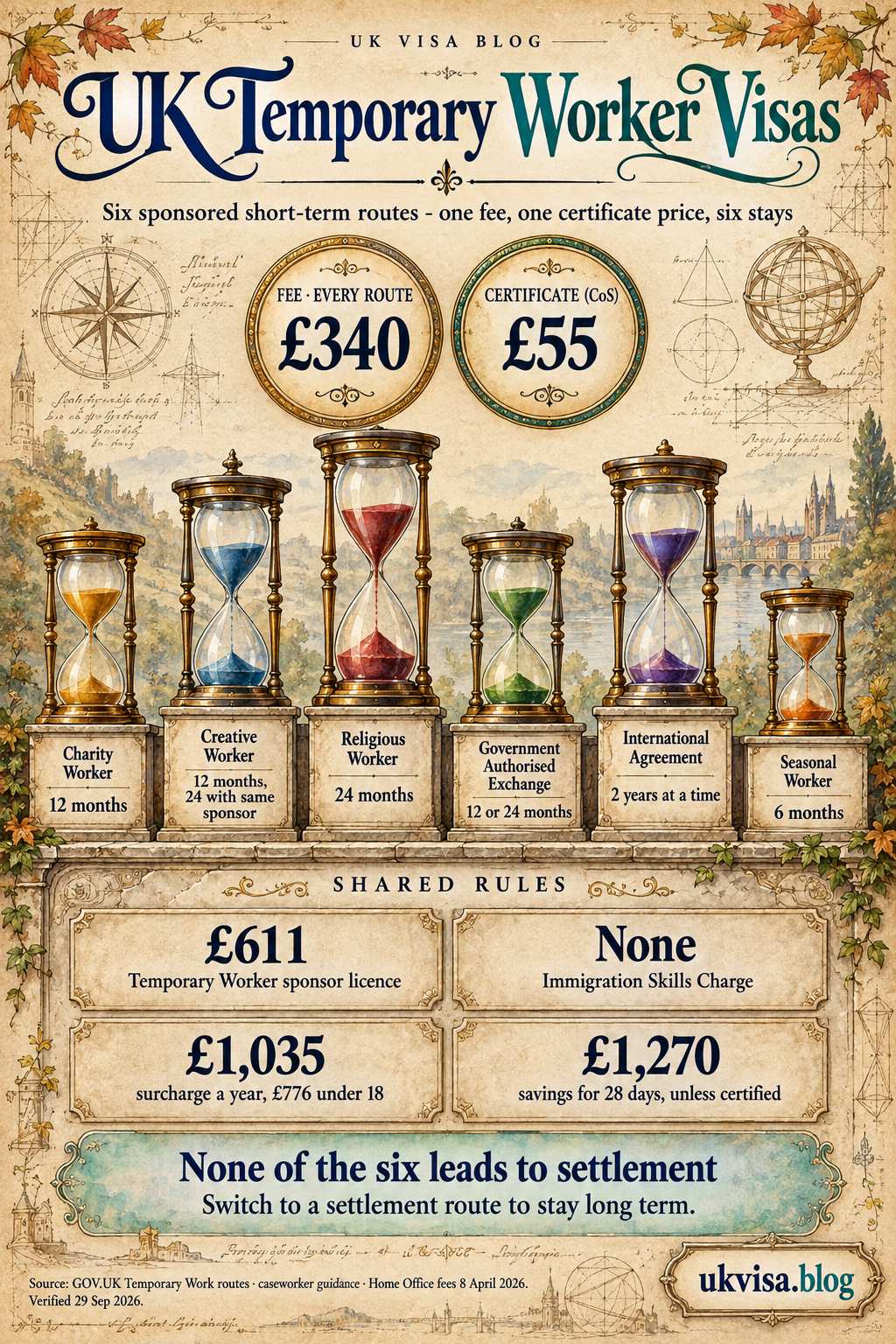
The Six Routes
Each route has its own appendix in the Immigration Rules and its own maximum stay. The differences matter more than the shared fee, because applying under the wrong one wastes the certificate as well as the money.
Temporary Worker Routes and Maximum Stays
| Route | Who it is for | Maximum stay |
|---|---|---|
| Charity Worker | Unpaid voluntary work for a charity | 12 months |
| Creative Worker | Entertainers, artists, models and their crew | 12 months |
| Religious Worker | Supporting religious work and members of religious orders | 24 months |
| Government Authorised Exchange | Approved work experience, training and research schemes | Depends on the scheme |
| International Agreement | Work covered by international law, including private servants in diplomatic households | 2 years at a time |
| Seasonal Worker | Horticulture, and poultry in a fixed autumn window | 6 months horticulture |
Source: GOV.UK Temporary Work route pages and Temporary Work caseworker guidance v38.0. Verified 22 August 2026.
Individual guides cover Charity Worker, Creative Worker visa, Religious Worker, Government Authorised Exchange, International Agreement and Seasonal Worker. Two neighbouring categories are often grouped with these but sit outside them: the Youth Mobility Scheme, which needs no sponsor, and the Global Business Mobility routes, which use the same Temporary Worker licence.
Where the Routes Draw Their Lines
Charity Worker is for genuinely unpaid work advancing the sponsor\u2019s charitable purpose: no payment or benefits in kind beyond reasonable expenses, which can include reasonable accommodation, and no filling of a permanent position even temporarily. Religious Worker covers supporting religious activity and members of religious orders — but not leading a congregation in rites, rituals or preaching, which belongs to the Minister of Religion route instead.
Government Authorised Exchange has the sharpest test of all: every role must be supernumerary, meaning it would not exist day to day if the applicant were not taking it. The guidance states plainly that the route cannot be used to facilitate the supply of labour, and salary arrangements out of line with the programme are treated as an indicator that the role is really a job.
What Every Route Requires
The shared requirements are sponsorship, money and suitability. There is no English language requirement on these routes and, in most of them, no salary threshold — but the job must still comply with the minimum wage and working time rules, and a breach refuses the application.
- Certificate of sponsorship: from a sponsor holding a Temporary Worker licence, valid and not withdrawn or already used.
- Genuineness: the caseworker must be satisfied the role and the arrangement are genuine.
- Money: £1,270 held for 28 consecutive days, unless your sponsor certifies maintenance on the certificate.
- Tuberculosis certificate: if you are applying from a listed country.
- Suitability: no ground of refusal under Part Suitability, including overstaying and immigration bail issues.
- Translations: documents not in English or Welsh need a certified translation.
The sponsor side runs on the same licensing system as the main route — see our sponsor duties guide — but with a cheaper licence and a £55 certificate instead of £525. Some roles also need a criminal record certificate.
The caseworker guidance states that applicants cannot normally switch into Temporary Work routes. There is one exception: someone holding, or last granted, permission as a Student can switch into Government Authorised Exchange — but only where they were sponsored by a higher education provider with a track record of compliance or by an overseas institution for a short-term study abroad programme, have completed a UK bachelor’s or postgraduate degree during that permission, and are sponsored for postgraduate professional training, work experience required for a professional qualification in the same field, or an internship of up to 12 months directly related to the degree. The role must not fill a permanent vacancy and the sponsor must not intend to employ them afterwards. Everyone else applies from outside the UK.
Certificates on the Creative Route
Creative Worker sponsorship is built for touring: sponsors can issue group certificates covering a company and cover multiple engagements or performances on one certificate, rather than a separate application for each date. Expenses handled through the certificate follow their own rules, so the paperwork is worth getting right before a tour is booked rather than after.
Fees
£340 per person on every route, the same for each dependant, plus the health surcharge at £1,035 a year for adults and £776 for under-18s. A twelve-month grant therefore costs about £1,375 for a single applicant. Employer costs are modest: a Temporary Worker licence is £611 regardless of organisation size, and each certificate is £55.
There is no Immigration Skills Charge on these routes — it applies only to Skilled Worker and Senior or Specialist Worker sponsorship. Comparisons across the whole work-visa landscape sit in our fee table.
International Agreement Is Two Different Things
The International Agreement route covers work brought within UK law by international agreements — employees of overseas governments and international organisations on one side, and private servants in diplomatic households on the other. The second group has its own protections, including specific national minimum wage treatment, and is assessed separately from the first even though both sit under the same appendix.
How to Apply
Apply online up to three months before the start date on your certificate, prove your identity, and submit your documents — the process is the one described in our application form guide. Decisions usually take about three weeks from outside the UK. What happens between biometrics and decision is covered in our processing guide, and a refusal on these routes is normally challenged through administrative review (AR) rather than appeal.
One route can be entered without a visa in narrow circumstances: a non-visa national coming as a Creative Worker for three months or less may seek entry under a concession at the border, provided all the eligibility criteria are met. Everyone else needs entry clearance before travelling.
Seasonal Work Is Narrower Than It Sounds
The horticulture definition is a closed list rather than a general idea of farming: protected and field vegetables, soft fruit, top fruit, vines and bines, mushrooms, bulbs and cut flowers, pot plants, hardy ornamental nursery stock, and tree and forest nurseries. Poultry production is separate and seasonal in its own right — and GOV.UK gives two different start dates for it, 2 October on the route page and 18 October in the employer sponsorship guidance, so confirm the date with the scheme operator before booking travel. Work outside those definitions is not seasonal work for these purposes, however agricultural it looks.
Cooling-Off Periods
Two cooling-off rules stop these routes running back to back. On the Charity Worker route, an entry clearance applicant must not have held permission as either a Religious Worker or a Charity Worker at any time in the 12 months before applying — unless they can show they were not in the UK at any point during those 12 months.
On the Seasonal Worker route the period is four months, on the same terms: no Seasonal Worker permission in the four months before the application, unless the applicant was outside the UK throughout. Both rules bite on the date of application, not on the date work starts, which is what catches returning workers planning consecutive seasons.
None of these routes counts towards settlement. Workers who want a long-term future in the UK have to convert into a route that does, usually Skilled Worker — and because switching in-country is barred, that conversion normally means applying from home.
Sources: GOV.UK Temporary Work route pages; the Immigration Rules appendices for each route; the employer sponsorship pages on GOV.UK; and the Home Office Temporary Work caseworker guidance version 38.0. Figures verified 22 August 2026.
Frequently Asked
Questions about Temporary Worker Visas
£340 per person on all six routes, whatever the length of the grant, plus the health surcharge at £1,035 a year for adults and £776 for children. Dependants pay the same fee again. Your sponsor pays £611 for the licence and £55 for each certificate of sponsorship, and no Immigration Skills Charge is due on these routes.
Normally no. The only exception is a Student switching into Government Authorised Exchange, and it is tightly drawn: the applicant must have completed a UK degree during that permission and be sponsored for professional training, required work experience in the same field, or an internship of up to 12 months related to the degree, in a role that is not a permanent vacancy.
No. Time on the Temporary Worker routes does not count towards indefinite leave to remain. They are designed to end, which is also why several carry cooling-off periods. Anyone planning a long-term future in the UK needs to move to a settlement route such as Skilled Worker, and because in-country switching is barred, that usually means applying from outside the UK.
On the Charity Worker route, you must not have held Charity Worker or Religious Worker permission in the 12 months before applying for entry clearance, unless you were outside the UK for all of those 12 months. On the Seasonal Worker route the equivalent period is four months. Both are measured to the date of application.
No. None of the six Temporary Worker routes has an English language requirement, which is one of the practical differences from the sponsored skilled routes. Documents you submit still have to be in English or Welsh, or accompanied by a certified translation, and interviews can still be conducted where a caseworker doubts the genuineness of the arrangement.
£1,270 held for 28 days in a row, unless your sponsor completes the maintenance certification on your certificate of sponsorship or you have been in the UK on a valid visa for at least 12 months. Dependants have to show their own funds separately, and the amounts are checked against the same 28-day rule.
Dependants are permitted on the Temporary Worker routes, each paying the £340 fee and their own health surcharge and showing their own funds. Because the permission is short and does not lead to settlement, families more often use these routes for one working member rather than relocating, particularly where the grant is six or twelve months.
Almost always. The exception is the Creative Worker concession: a non-visa national coming for three months or less can seek entry at the border without entry clearance, provided all the eligibility criteria are met. On every other route, and for visa nationals on the creative route, entry clearance must be obtained before travelling.