The UK Creative Worker visa (Temporary Work — Creative Worker, sometimes still searched as "T5 Creative and Sporting") is the dedicated immigration route for actors, dancers, musicians, film crew, theatre professionals and other creative practitioners working temporarily in the UK's creative industries. The "Sporting" half of the legacy T5 Creative and Sporting route split off in October 2021 into the standalone International Sportsperson visa — leaving the Creative Worker route as a focused entertainment-industry pathway. Two 2026 changes matter: from 8 April 2026 the application fee rose from £319 to £340 under Statement of Changes HC 1691, and the 22 July 2025 Skilled Worker salary recalibration (£41,700 baseline, RQF Level 6 minimum) pushed many creative roles out of Skilled Worker eligibility — making the Creative Worker visa the primary sponsored pathway for short-term international creative talent.
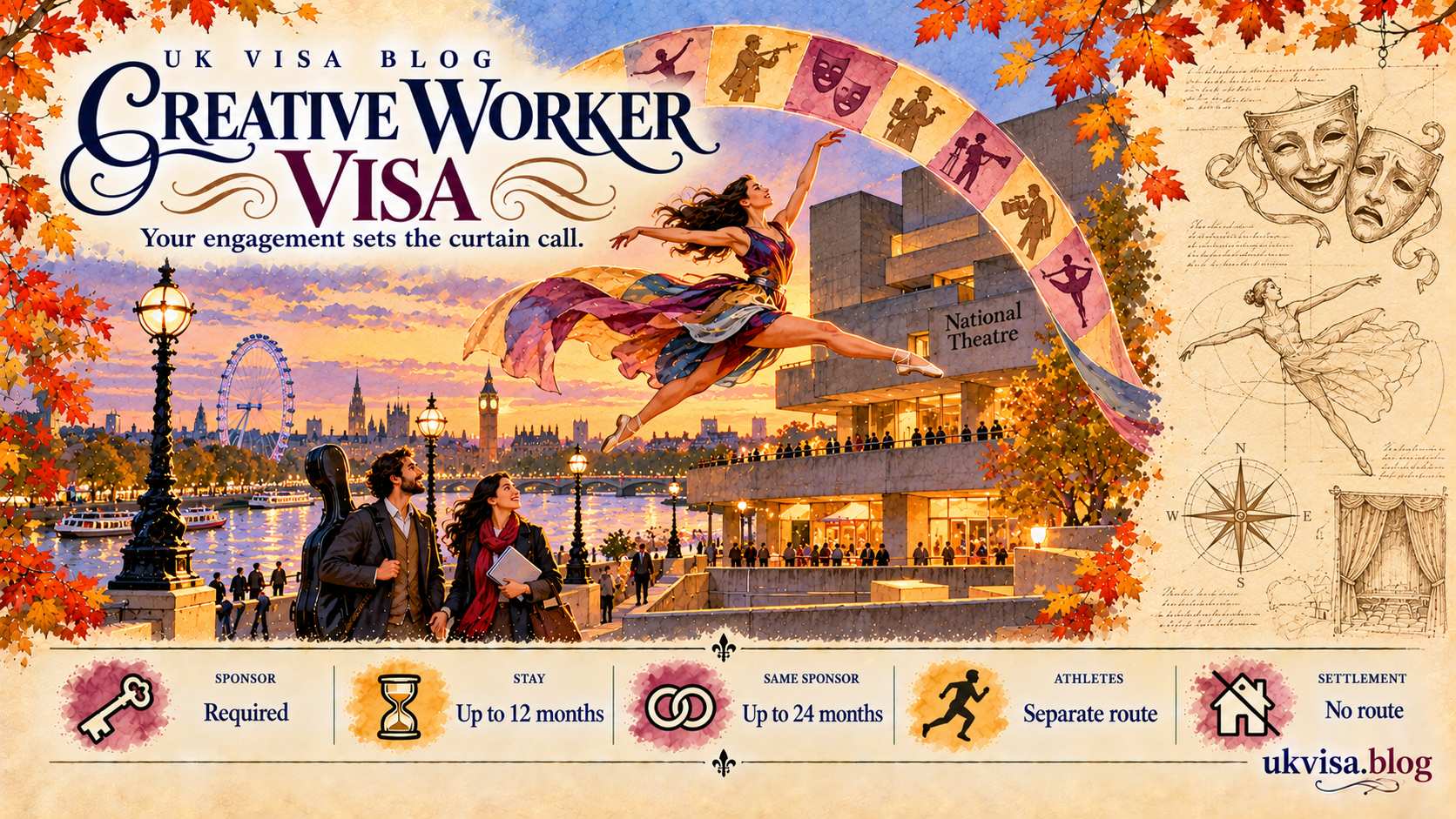
The default route for international creative talent on short-term UK engagements — actors in West End productions, touring musicians, festival performers, film crew on UK shoots, dancers in touring shows, circus artists and broadcast technicians. No English language test, no degree requirement, salary aligned to industry-agreed Code of Practice rates (Equity for performers, PACT for film/TV, BECTU for technical crew) — and models, musicians and circus performers are explicitly exempt from minimum salary requirements. The 3-month concession lets non-visa nationals enter for short engagements without applying for a full visa. Maximum stay 24 months with the same sponsor (12 months if changing sponsors). Does not lead to settlement.
- What is the UK Creative Worker Visa?
- Who Qualifies as a Creative Worker?
- Eligibility Requirements
- Codes of Practice: Equity, PACT and BECTU
- Fees and Costs from 8 April 2026
- How to Apply
- The 3-Month Concession
- Duration, Extension and Switching Sponsors
- What You Can and Cannot Do
- Bringing Your Partner and Children
- Frequently Asked Questions
UK Creative Worker Visa 2026: T5 Sub-Route for Artists, Entertainers and Film Crew
The Creative Worker visa sits within the broader T5 Temporary Worker visa parent route framework — the umbrella that covers seven distinct short-term work pathways including Seasonal Worker, Charity Worker, Religious Worker, Government Authorised Exchange, International Agreement, and Youth Mobility Scheme. Within that family, the Creative Worker route uniquely serves the creative industries through sponsor licences held by arts organisations, production companies, venues, festivals, broadcasters and creative agencies.
What is the UK Creative Worker Visa?
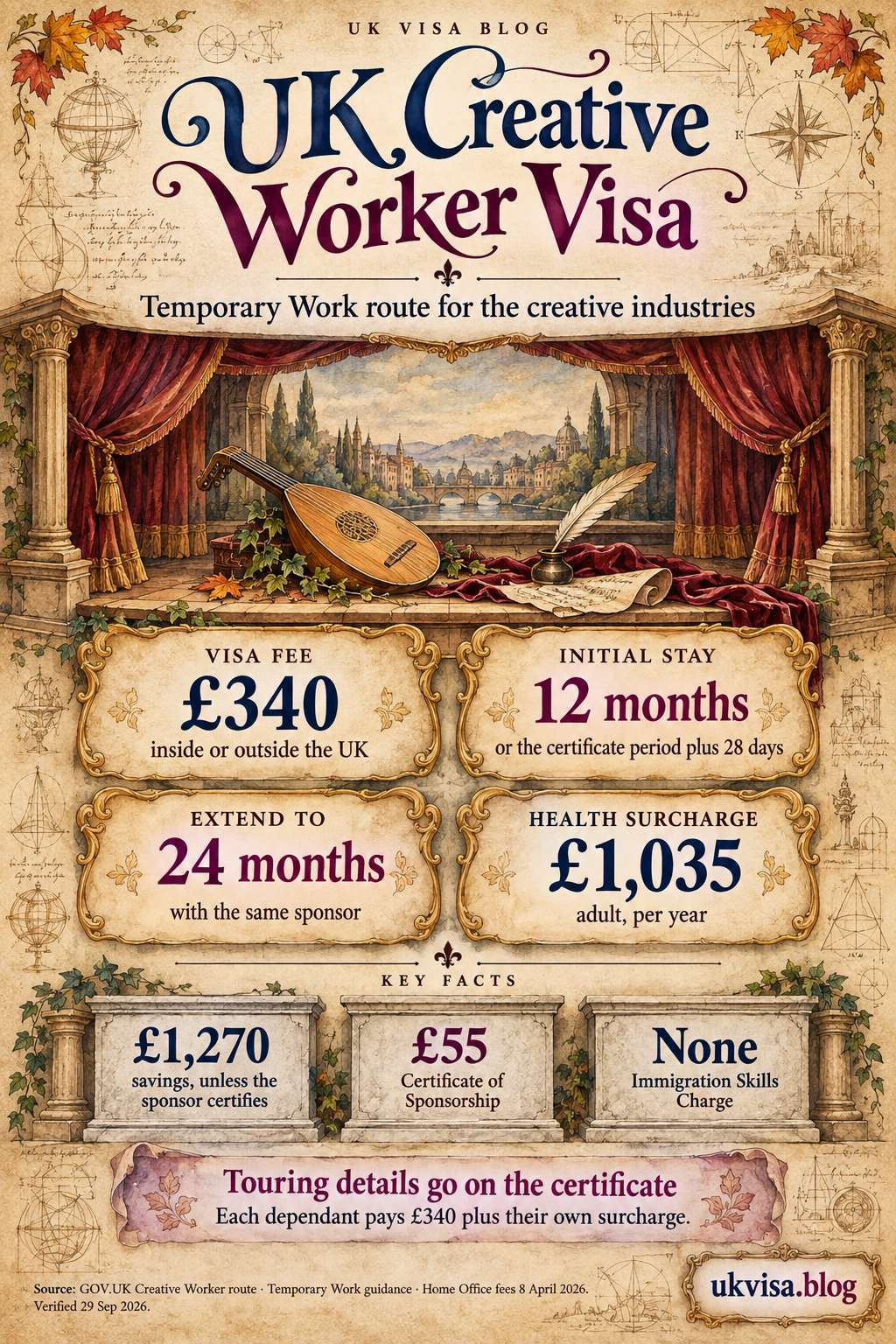
The UK Creative Worker visa permits international creative professionals to work temporarily in the UK for a licensed creative-sector sponsor. Eligibility requires a Certificate of Sponsorship, role compliance with the relevant industry Code of Practice (Equity, PACT or BECTU) — or exemption for models, musicians and circus performers — and £1,270 in personal savings held for 28 consecutive days. No English language test required. Initial grant up to 12 months; extension permitted to a 24-month maximum with the same sponsor.
This visa is exclusively for the creative industries. Elite athletes, sports coaches and sportspersons must apply for the International Sportsperson visa for elite athletes, which requires governing-body endorsement and — unlike Creative Worker — does lead to settlement after 5 years on the route. The sporting half of the former T5 Creative and Sporting route was split off in October 2021 to create the standalone Sportsperson route, recognising that elite sport and creative industries have fundamentally different sponsorship and settlement pathways.
Historical Context: From T5 Creative and Sporting to Creative Worker
Before the points-based system rebranding in December 2020, the route was called Tier 5 (Temporary Worker) Creative and Sporting visa. In December 2020 the "Tier" terminology was dropped — though the legacy term "T5" remains widely used in industry recruitment communications. In October 2021 the route split: sportspeople moved to the new International Sportsperson visa with its own endorsement framework and settlement pathway, while creative industry workers continued under the renamed Creative Worker route. The fundamentals of the creative half (industry Code of Practice salary standards, 12-month grant + extension, 24-month cap, dependant rights, no settlement) carried forward unchanged.
Who Qualifies as a Creative Worker?
The Creative Worker visa covers a broad cross-section of creative industry roles. The Home Office accepts any role that fits a recognised creative occupation and meets the relevant Code of Practice (or is in an exempt category). In practice, the most common visa categories sponsored on this route include:
- Performing artists: Actors, dancers, theatre performers, circus artists, comedians, drag artists, opera singers, choristers.
- Musicians: Orchestra members, session musicians, touring band members, solo artists, conductors, music directors.
- Film and television: Directors, producers, on-screen talent, presenters, presenters' essential support staff, production crew on specific UK shoots.
- Technical staff: Lighting designers, sound engineers, stage managers, broadcast technicians, costume designers, hair and make-up artists.
- Models: Fashion models, commercial models, artistic models (exempt from salary requirement).
- Essential support staff: Personal assistants, security, dressers, and other entourage members directly supporting the main creative worker.
The 22 July 2025 Skilled Worker recalibration raised the baseline salary threshold to £41,700 and restricted eligibility to RQF Level 6 (degree-level) occupations only. Many creative roles — particularly performers, freelance technicians and lower-paid entertainment positions — fell out of Skilled Worker sponsorship eligibility entirely. The Creative Worker visa is now the primary sponsored pathway for short-term international creative talent, since its industry-specific Code of Practice salary rates (rather than the £41,700 Skilled Worker floor) determine eligibility. Industry estimates suggest the change pushed materially more creative-sector sponsorship activity onto this route from late 2025 onward.
Eligibility Requirements
Valid Certificate of Sponsorship from a licensed UK creative-sector sponsor; role compliance with the relevant industry Code of Practice (Equity, PACT or BECTU) OR exemption (models, musicians, circus performers); £1,270 in personal savings held for 28 consecutive days OR sponsor maintenance certification; TB certificate if applying from a listed country. No English language test, no minimum age beyond standard adult applicant rules, no general qualification requirement. Switching INTO Creative Worker from inside the UK is generally not permitted.
- Certificate of Sponsorship: Valid CoS issued by a Home Office-licensed creative-sector sponsor within 3 months of the visa application.
- Genuine creative work: The role described on the CoS must relate to the work of the sponsor organisation — for example, a touring company sponsoring touring performers, a production company sponsoring crew on a specific UK shoot.
- Industry Code of Practice compliance: Where the role falls under Equity, PACT or BECTU's Code of Practice, the salary must meet the minimum rates set out by that body.
- Exempt categories: Models, musicians and circus performers are exempt from minimum salary requirements — but the sponsor must still demonstrate that the role is a genuine creative engagement.
- Financial maintenance: £1,270 in personal savings held for 28 consecutive days ending within 31 days of the application date, unless the sponsor certifies maintenance on the CoS.
- NO English language test: Creative Worker has no SELT or CEFR demonstration requirement.
- NO general qualification requirement: Unlike Skilled Worker (RQF Level 6 from 22 July 2025), Creative Worker has no academic skill-level threshold.
- TB test certificate: Required if applying from a listed country with TB screening obligations.
- Application source: Apply from outside the UK as standard. Switching INTO Creative Worker from inside the UK is generally not permitted — extensions within the same category are allowed.
- Suitability: Must not fall for refusal under general grounds of the Immigration Rules.
Codes of Practice: Equity, PACT and BECTU
The Creative Worker route operates on industry-negotiated Codes of Practice rather than the Home Office's standard going-rate system used for Skilled Worker. Three UK creative-industry trade unions and trade bodies set the minimum salary and working condition standards that sponsors must meet, with specific exemptions for low-pay sectors where Code of Practice rates would be impractical.
| Industry Body | Covers | Code of Practice Applies? |
|---|---|---|
| Equity | Actors, performers, dancers, singers, stage managers, creative practitioners in live performance | Yes — minimum rates apply |
| PACT (Producers Alliance for Cinema and Television) | Film and television production workers, independent producers, on-screen talent in commercial film/TV | Yes — minimum rates apply |
| BECTU (Broadcasting, Entertainment, Communications and Theatre Union) | Broadcasting technicians, cinema technical staff, theatre technical crew, broadcast engineers | Yes — minimum rates apply |
| Models | Fashion, commercial and artistic models | No — exempt from minimum salary |
| Musicians | All musicians regardless of genre or performance type | No — exempt from minimum salary |
| Circus performers | Circus artists and supporting performers | No — exempt from minimum salary |
Source: Appendix Temporary Work — Creative Worker; sponsor guidance for Creative Worker route.
"Unique Contribution" Route as an Alternative
Where the role does not fit a Code of Practice — for example, niche or non-union creative work — the sponsor can certify on the CoS that the worker makes a "unique contribution" to the UK creative sector. The unique contribution test typically requires the sponsor to demonstrate that the worker brings irreplaceable skills, international recognition, or specialist expertise unavailable in the UK labour market. The Home Office assesses unique contribution claims with closer scrutiny than Code of Practice cases, and sponsors should document the rationale carefully on the CoS.
Fees and Costs from 8 April 2026
From 8 April 2026 the application fee is £340 (up from £319 — the same uplift across the entire Temporary Worker family under Statement of Changes HC 1691). Immigration Health Surcharge is £1,035/year for adults (£776/year for under-18s), paid up front for the full grant period. Total Home Office cost for a 12-month visa: £1,375 for a single adult. The Immigration Skills Charge does NOT apply to the Creative Worker route — a £1,320/year (large sponsor) or £480/year (small sponsor) saving compared to Skilled Worker sponsorship.
| Fee Component | Amount from 8 April 2026 | Notes |
|---|---|---|
| Visa application fee | £340 per person | Up from £319; applies to main applicant and each dependant; same inside or outside UK |
| Immigration Health Surcharge — adult | £1,035 per year | Standard work-visa rate; paid up front for full grant period |
| Immigration Health Surcharge — under 18 | £776 per year | Discounted rate for dependent children |
| Personal maintenance | £1,270 | 28 consecutive days; waived if sponsor certifies maintenance |
| Total Home Office charges (12-month visa, single adult) | £1,375 | £340 + £1,035 IHS |
| Priority service uplift | +£500 | Targets decision within 5 working days (where available) |
| Super-priority service uplift | +£1,000 | Targets next working day decision (where available) |
| Sponsor — CoS assignment | £55 | Paid by employer, not worker; from 1 April 2025 sponsors cannot pass this cost to workers |
| Sponsor — Immigration Skills Charge | £0 (exempt) | Creative Worker route is ISC-exempt |
Source: gov.uk Creative Worker visa fee schedule; Statement of Changes HC 1691 (5 March 2026); Home Office sponsor guidance (April 2025 update on prohibited fee pass-through).
From 1 April 2025, sponsors are explicitly prohibited from passing the £55 Certificate of Sponsorship cost or any other sponsor-side fees to the worker. The full sponsor-side cost burden — CoS assignment, sponsor licence application or renewal, ongoing compliance audit costs — sits with the sponsoring organisation. Workers paying these costs (or being asked to reimburse the sponsor) can report this to the Home Office, and the sponsor's licence may be at risk. For the broader sponsored route fee context across Skilled Worker, GBM and Temporary Worker families, see the complete UK visa fees schedule.
How to Apply
Creative Worker visa applications are submitted online via the gov.uk Creative Worker visa apply portal from outside the UK (standard) or, where the worker is already in the UK on a route that permits switching, from inside the UK. Most successful applications are now granted as eVisas linked to the worker's UKVI account.
- Step 1: Sponsor assigns the Certificate of Sponsorship via the Sponsorship Management System, with role description, salary, Code of Practice alignment (or unique contribution rationale), engagement dates and venue locations.
- Step 2: Applicant completes the online online visa application portal on gov.uk — typically takes 30–60 minutes.
- Step 3: Pay the £340 visa fee and £1,035/year IHS by debit or credit card.
- Step 4: Verify identity — either via the UK Immigration: ID Check app (eligible passports) or by booking a biometric appointment at a Visa Application Centre.
- Step 5: Upload supporting documents — current passport, CoS reference, financial maintenance evidence (unless sponsor-certified), TB certificate if applicable, evidence of creative employment history where relevant.
- Step 6: Wait for decision — 3 weeks standard service from outside the UK; 8 weeks for in-country extensions.
- Step 7: Create a UKVI account, link the eVisa, and travel to the UK to start the engagement.
Stay Window: 14 Days Either Side of the CoS Period
The standard grant covers the period on the Certificate of Sponsorship plus 14 days either side — meaning the worker can enter the UK up to 14 days before the start date listed on the CoS and depart up to 14 days after the engagement end-date. For applicants with consecutive engagements covering a long run, the grant period covers the full run plus the 14-day buffers either end. The maximum grant per visa is 12 months regardless of CoS length — longer engagements require extension applications within the 24-month total cap.
The 3-Month Creative Worker Concession
Non-visa nationals (citizens of countries that don't normally need a visa to visit the UK) coming for a creative engagement of 3 months or less can use the Creative Worker concession instead of applying for a full visa. They still need a valid Certificate of Sponsorship, but they seek permission to enter at the UK border with the CoS reference rather than applying online from abroad in advance. The concession is non-extendable and does not permit in-country switching.
The 3-month concession is a major practical advantage of the Creative Worker route — particularly for short tours, festival appearances, single-shoot film work, gallery residencies, masterclasses and short theatre runs. Non-visa nationals include US, Canadian, Australian, New Zealand, EU/EEA, Swiss and many other commonly-recognised passport holders. Travellers using the concession must:
- Hold a valid Certificate of Sponsorship from a licensed creative-sector sponsor, just as for a full visa application.
- Be a non-visa national — the concession is not available to visa nationals, who must apply for the full visa from abroad.
- Have an engagement of 3 months or less total in the UK; the engagement period must be fully covered by the CoS.
- Present the CoS reference and supporting evidence (engagement letter, accommodation arrangements) to the Border Force officer on arrival.
- Hold an ETA where required from January 2024 onward — non-visa nationals from ETA-required countries need an Electronic Travel Authorisation in addition to using the concession.
The 3-month concession cannot be extended in-country — once the 3-month period ends, the worker must leave the UK. The worker also cannot switch to another visa category from within the UK if they entered using the concession; switching applications must be made from outside the UK. For longer engagements where extension or switching may be needed, apply for the full Creative Worker visa from abroad before travel rather than relying on the concession.
Duration, Extension and Switching Sponsors
Initial grant up to 12 months. Extension permitted in-country to a 24-month maximum with the SAME sponsor. If changing sponsors, the maximum total stay is 12 months across both sponsors combined. Switching INTO Creative Worker from inside the UK is generally NOT permitted — apply from outside the UK. The visa does NOT lead to Indefinite Leave to Remain; time on this route does not count toward the 5-year settlement qualifying period.
| Scenario | Maximum Stay | How It Works |
|---|---|---|
| Initial grant | Up to 12 months | Shorter of CoS period + 14 days either side OR 12 months |
| Extension with same sponsor | Up to 24 months total | Extension applied for in-country before original visa expires; same sponsor required |
| Extension with a new sponsor | Up to 12 months total (across both sponsors) | Changing sponsors caps the maximum at 12 months total, not 24 |
| 3-month concession (non-visa nationals) | 3 months maximum, non-extendable | Entered at UK border with CoS reference; cannot be extended or switched in-country |
| After 24-month cap reached | Must leave UK | Re-entry possible by applying afresh from abroad after a cooling-off period |
Switching Out of Creative Worker
A Creative Worker can switch to another visa category from within the UK if eligible — most commonly the Skilled Worker route for permanent creative roles (where the role meets the £41,700 Skilled Worker baseline from 22 July 2025 and the Skilled Worker £41,700 salary threshold at RQF Level 6), or the Global Talent visa for endorsed creative leaders for those with proven exceptional talent or promise in the arts and culture endorsement track (endorsed by Arts Council England). Time spent on the Creative Worker route does not count toward the 5-year ILR qualifying period on the new route — the settlement clock starts from the new visa grant date.
What You Can and Cannot Do
Permitted Activities
- Work for your sponsor in the role described on the Certificate of Sponsorship.
- Supplementary work (up to 20 hours per week) in the same sector and at the same level as the main role — for example, a sponsored theatre actor taking session voice-over work — OR work in a job on the Skilled Worker Immigration Salary List up to 20 hours per week.
- Study alongside the main creative work (for some courses an Academic Technology Approval Scheme certificate may be required).
- Bring dependants: Partner and children with full UK work rights for the dependant period.
- Travel freely in and out of the UK during the visa validity, for example for international tour stops.
- Voluntary work for registered charities or statutory bodies, unpaid and incidental to the main role.
Restrictions
- Cannot get public funds: No access to most welfare benefits or State Pension.
- Cannot start your own business: The visa is for sponsored creative work, not self-employed enterprise (Innovator Founder, sole trader or Global Talent routes serve those purposes).
- Cannot work outside the sponsored role or supplementary 20-hour permission: Additional roles must fit the supplementary work rules (same level/sector or ISL job).
- Cannot extend beyond 24 months: After the 24-month cap with the same sponsor, the worker must leave the UK.
- Cannot apply for settlement: Time on this route does not count toward ILR.
- Cannot generally switch INTO this route from inside the UK: Initial applications must be made from outside the UK.
Bringing Your Partner and Children
Creative Worker visa holders can bring eligible dependants to the UK — spouse, civil partner, unmarried partner (2+ years' cohabitation), and dependent children under 18. Each dependant submits a separate partner and children dependant visa application and pays the same fee structure as the main applicant.
Dependant Financial Requirements
- Partner: Additional £285 in savings held for 28 consecutive days.
- First child: Additional £315 in savings.
- Each additional child: Additional £200 in savings.
- Same fees: Each dependant pays the £340 visa fee and Immigration Health Surcharge per year (£1,035/year adult, £776/year under-18).
- Aligned grant end-date: Dependant permission aligns with the main applicant's grant end-date.
- Full work rights: Dependants can work in any sector without restriction — they are not limited to the creative industries.
- Part of the T5 Temporary Worker family — replaced the legacy T5 Creative and Sporting route when sportspeople split off to the International Sportsperson visa in October 2021.
- Application fee £340 from 8 April 2026 (up from £319) plus £1,035/year IHS — total £1,375 for a 12-month single adult application.
- Salary aligned to industry Codes of Practice — Equity (performers), PACT (film/TV), BECTU (technical crew); models, musicians and circus performers are exempt from minimum salary.
- Maximum stay 24 months with the same sponsor; 12 months total if changing sponsors.
- 3-month concession lets non-visa nationals enter at the border with a CoS for short engagements — non-extendable, no in-country switching.
- Up to 20 hours/week supplementary work permitted (same sector + same level OR Immigration Salary List job).
- NO English language test, NO degree requirement, NO Immigration Skills Charge.
- Does NOT lead to Indefinite Leave to Remain — switch to Skilled Worker or Global Talent for settlement pathway.
- 22 July 2025 Skilled Worker recalibration (£41,700, RQF Level 6) made Creative Worker the primary sponsored route for short-term international creative talent.
- From 1 April 2025, sponsors cannot pass CoS fee or sponsor-side costs to workers.
For official guidance, the authoritative entry point is the gov.uk Creative Worker visa overview. The 3-month route details sit on the gov.uk Creative Worker concession page. The legal framework sits in Appendix Temporary Work: Creative Worker. The 2026 fee uplift was set out in Statement of Changes HC 1691 (5 March 2026). For sponsor-side licensing requirements applicable to all Temporary Worker routes including Creative Worker, see the Home Office sponsor licence framework guide.
The UK Creative Worker visa is a Temporary Worker route under Appendix Temporary Work — Creative Worker for performers, entertainers, musicians, film and television crew, theatre staff and other creative industry professionals working temporarily in the UK. Sponsorship is via a licensed creative-sector sponsor — arts organisation, production company, festival, broadcaster, venue or creative agency. Maximum stay 24 months with the same sponsor (12 months if changing sponsors). The route replaced the legacy T5 Creative and Sporting visa when sportspeople moved to the standalone International Sportsperson route in October 2021.
From 8 April 2026 the application fee is £340 per person (up from £319 — the same uplift across the entire Temporary Worker family under Statement of Changes HC 1691). The Immigration Health Surcharge is £1,035 per year for adults (£776 for under-18s), paid up front for the full grant period. Total for a 12-month visa: £1,375 per adult applicant. Each dependant pays the same fee structure. Priority service adds £500 (5 working days) and super-priority adds £1,000 (next working day) where available.
Equity covers performers, actors, dancers, singers and stage managers in live performance. PACT (Producers Alliance for Cinema and Television) covers film and TV production workers and independent producers. BECTU (Broadcasting, Entertainment, Communications and Theatre Union) covers broadcasting technicians, cinema technical staff and theatre technical crew. The sponsor must demonstrate on the Certificate of Sponsorship that the worker's salary meets the relevant body's Code of Practice minimum rates. Models, musicians and circus performers are explicitly exempt from minimum salary requirements but must still hold a valid CoS for genuine creative work.
Yes — non-visa nationals (citizens of countries that don't normally need a visa to visit the UK) coming for a creative engagement of 3 months or less can use the Creative Worker concession instead of applying for a full visa. The worker still needs a valid Certificate of Sponsorship from a licensed sponsor, but seeks permission to enter at the UK border with the CoS reference. The concession is non-extendable and does not permit in-country switching to another visa category. ETA-required nationals must also hold a valid ETA from January 2024 onward.
The initial visa is granted for up to 12 months (the shorter of the CoS period + 14 days either side OR 12 months). Extension is permitted in-country to a maximum total of 24 months with the SAME sponsor. If changing sponsors, the maximum total stay is 12 months across both sponsors combined — not 24. The 3-month concession route is non-extendable. After reaching the 24-month cap with the same sponsor, the worker must leave the UK and apply afresh from abroad after a cooling-off period if returning.
Yes. Spouses, civil partners, unmarried partners (2+ years' cohabitation) and dependent children under 18 can apply as dependants. Each dependant submits a separate application and pays £340 visa fee plus £1,035/year IHS (£776/year for under-18s). Maintenance requirements: £285 partner, £315 first child, £200 each additional child — waived if the sponsor certifies maintenance on the CoS. Dependants have full UK work rights and can work in any sector without restriction, unlike the main applicant who is limited to the sponsored creative role plus 20 hours/week supplementary work.
No. Unlike the Skilled Worker route (which requires CEFR B2 from 8 January 2026), the Creative Worker visa has NO English language requirement. The route recognises that creative work often transcends language barriers — opera singers, musicians, dancers, models and many film crew roles do not require fluent English. Applicants do not need to take IELTS, Trinity GESE or any other Secure English Language Test, and there is no waiver framework to navigate.
Yes — but with strict consequences. The worker must obtain a new Certificate of Sponsorship from the new sponsor and apply for a new visa before starting work for them. Crucially, changing sponsors caps the maximum total stay at 12 months across both sponsors combined, NOT the 24-month maximum that applies when staying with the same sponsor. For extensions with the same sponsor, in-country application is permitted while the original visa is still valid; for sponsor changes, the new visa must be granted before the worker can lawfully start the new engagement.
The Creative Worker visa is the direct successor to the creative half of the T5 Creative and Sporting route. In October 2021 the sporting half was separated into the standalone International Sportsperson visa (which does lead to settlement after 5 years on the route with the right endorsement). The Creative Worker visa now focuses exclusively on creative professionals — performers, musicians, actors, film crew, theatre staff, models, circus performers — with no settlement pathway. Athletes, sports coaches and sportspeople must apply for the International Sportsperson visa instead.
No. Time on the Creative Worker visa does NOT count toward the 5-year continuous-residence period required for Indefinite Leave to Remain. The route is fundamentally designed for short-term engagements rather than long-term migration. For settlement pathway via the creative industries, the most common routes are the Skilled Worker visa (for permanent creative roles meeting the £41,700 threshold and RQF Level 6) and the Global Talent visa via Arts Council England endorsement (for those with proven exceptional talent or promise in the arts and culture endorsement track).