
The Government Authorised Exchange visa is for work experience, training, research, fellowships and language programmes run through an approved scheme. It costs £340 and lasts 12 or 24 months depending on what you are doing. Its defining rule is one nobody advertises: every role must be supernumerary — it must not exist unless you are there to do it.

UK Work Visas
Government Authorised Exchange Visa UK 2026: Schemes, Limits and Costs
What the Route Is
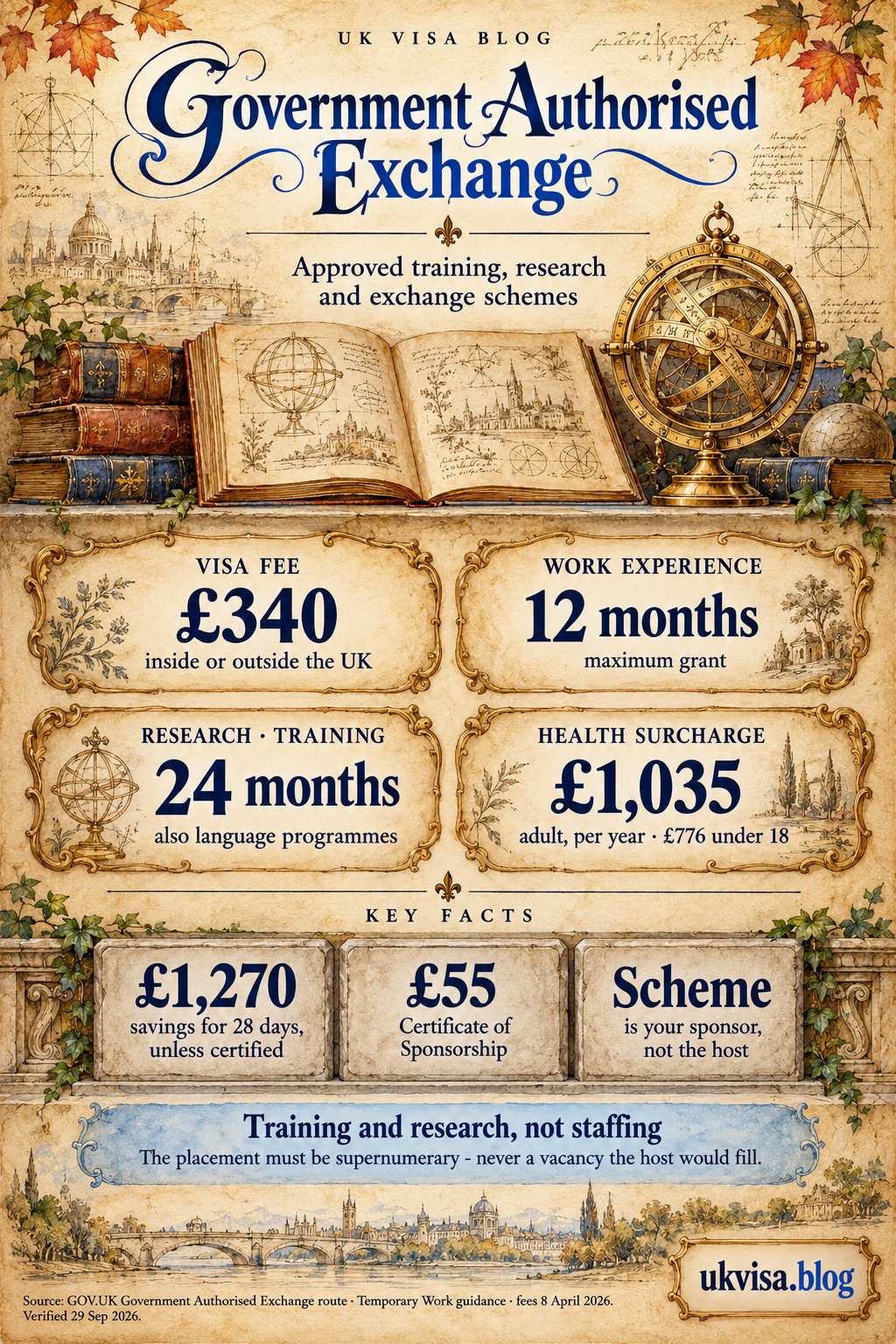
A sponsored route in the Temporary Worker routes for coming to the UK for a short period to do work experience, training, an Overseas Government Language Programme, research or a fellowship, through an approved government authorised exchange scheme. The fee is £340, the same inside or outside the UK. Permission runs to 12 months for work experience and 24 months for research, training or a language programme.
Your work, training or research in the UK must relate to the work of your sponsor organisation. That is the same relational test as the other temporary routes, and it is why the route cannot be used simply to place someone with a willing employer for a year.
Approved Schemes
You cannot use this route freehand. The scheme itself must appear in the Immigration Rules appendix listing government authorised exchange schemes, and your sponsor must be running or participating in one. Schemes cover a wide field — research fellowships, professional training, structured internships, language assistant programmes — but each has its own terms, and yours is set by the scheme rather than by negotiation with the sponsor.
Some bilateral arrangements sit outside this route entirely. The India Young Professionals Scheme, for example, is its own unsponsored category rather than an exchange scheme, and mixing the two up wastes an application.
Who Can Sponsor You
Three types of organisation can sponsor on this route: an organisation running an approved exchange scheme, a higher education institution where you are a sponsored researcher, visiting academic or examiner, or a government department or agency. Sponsors running schemes are often described as overarching bodies, because they hold the licence and place participants with host organisations.
You apply with a reference number from your sponsor — either the number on a certificate of sponsorship or a sponsorship reference number, depending on how the scheme is run.
The caseworker guidance states plainly that this route cannot be used to facilitate the supply of labour. Every sponsored role must be supernumerary — a role additional to the regular, required or standard number of staff at the organisation, which does not fill a permanent position or ongoing vacancy even temporarily. The test the guidance applies is simple: if the applicant were not taking up the role, it would not exist on a day-to-day basis. Salary arrangements that exceed what would normally be expected for the programme are named as an indicator that the placement is really a job — which means paying a participant like an employee can itself defeat the application.
Why the Supernumerary Rule Exists
The route was designed to move people between organisations for training and research, not to staff them. Without the rule it would be the cheapest sponsored labour available: no salary threshold, no skill level, no skills charge and a £55 certificate. The supernumerary condition is what keeps the price from becoming the point, and it is the first thing tested when a placement looks like a post.
Eligibility
- Approved scheme: the programme must be a listed government authorised exchange scheme.
- Sponsorship reference: from a scheme operator, higher education institution or government body.
- Supernumerary role: additional to normal staffing, not filling a vacancy.
- Money: £1,270 held for 28 consecutive days, unless exempt — including where you have been in the UK on a valid visa for at least 12 months.
- ATAS: a valid Academic Technology Approval Scheme certificate where the research falls in a sensitive subject.
- Scholarship consent: written consent where a government or international agency funded your fees and living costs in the last 12 months.
Placements, Hosts and Overarching Sponsors
On many schemes the licence holder is not the organisation you will physically work in. An overarching sponsor places participants with hosts, and remains responsible for them throughout. That structure is permitted, but it does not soften the supernumerary test: the host placement still has to be additional to normal staffing, and the sponsor is answerable for it on a compliance visit.
How Long You Can Stay
Twelve months if you are doing work experience. Twenty-four months if you are doing research, training or an Overseas Government Language Programme. Which applies is determined by the scheme and by what you are actually doing, not by preference — and a work-experience placement cannot be relabelled as training to reach the longer period.
Fees
£340 per person, identical inside and outside the UK, plus the health surcharge at £1,035 a year for adults and £776 for under-18s. Each dependant pays the same again, and there is no Immigration Skills Charge on this route. Cross-route comparisons are in our fee table.
Money and the 28-Day Rule
The financial requirement is £1,270 held for 28 days in a row, with the usual exemptions: twelve months in the UK on a valid visa, or the sponsor certifying maintenance. Where a scholarship or international agency has covered your fees and living costs in the previous twelve months, you also need that body\u2019s written consent to the application.
How to Apply
Apply online up to three months before your start date, with your sponsorship reference number to hand — the process is covered in our application form guide. Decisions usually take about three weeks from outside the UK. Where ATAS applies, obtain the certificate before applying rather than alongside, because the application cannot be granted without it.
Research Fellowships and Visiting Academics
Higher education institutions sponsor sponsored researchers, visiting academics and examiners directly rather than through a scheme operator, which makes this the standard route for a funded fellowship or a sabbatical placement at a UK university. The 24-month period covers most such arrangements, and ATAS applies to sensitive subjects in the ordinary way.
What You Can and Cannot Do
You do the work, training or research described by your sponsor. Study is permitted, with an Academic Technology Approval Scheme certificate for some courses. You cannot claim public funds, and you cannot use the route to hold down what is in substance a permanent job. Roles that pay like ordinary employment belong on the Skilled Worker route instead, where salary thresholds apply and the position may be permanent.
Partners and Children
A partner and children can apply as dependants if eligible, each paying £340 and their own health surcharge and showing their own funds — unless you have all been in the UK on valid visas for at least 12 months, which removes the evidence requirement. The mechanics are in our dependant visa guide.
The One Switching Exception
Temporary Work routes generally cannot be switched into from inside the UK. This route is the sole exception, and it is narrowly drawn. A Student can switch in if they were sponsored by a higher education provider with a track record of compliance, or by an overseas institution for a short-term study abroad programme; completed a UK bachelor’s or postgraduate degree during that permission; and are now sponsored for postgraduate professional training, work experience required for a professional qualification in the same field, or an internship of up to 12 months directly related to the degree.
Two further conditions apply: the role must not fill a permanent vacancy, and the sponsor must not intend to employ the person once the training ends. Everyone else applies from outside the UK.
This route does not lead to settlement, so researchers building a UK career often move on to the Global Talent route. Neighbouring routes are Charity Worker, Religious Worker, International Agreement and the Creative Worker route.
Sources: GOV.UK Government Authorised Exchange route page on GOV.UK; Appendix Government Authorised Exchange Schemes; and the Home Office Temporary Work caseworker guidance version 38.0. Figures verified 22 August 2026.
Frequently Asked
Questions about the Government Authorised Exchange Visa
Twelve months for work experience, or 24 months for research, training or an Overseas Government Language Programme. The period is set by the scheme and by what you are actually doing. A work-experience placement cannot be presented as training in order to reach the longer period, and the scheme’s own terms govern what you can be sponsored for.
The role must be additional to the regular, required or standard number of staff and must not fill a permanent position or ongoing vacancy, even temporarily. The guidance puts it as a test: if you were not taking the role, it would not exist day to day. Pay out of line with the programme is treated as an indicator that the placement is really a job.
An organisation running an approved exchange scheme, a higher education institution where you are a sponsored researcher, visiting academic or examiner, or a government department or agency. You apply using a reference number from that sponsor — either the number on a certificate of sponsorship or a sponsorship reference number, depending on the scheme.
Only as a Student, and only on strict terms: you must have completed a UK bachelor’s or postgraduate degree during that permission, and be sponsored for postgraduate professional training, work experience required for a professional qualification in the same field, or an internship of up to 12 months related to your degree. The role must not fill a permanent vacancy.
You do if your research falls within the Academic Technology Approval Scheme’s sensitive subject areas. Obtain it before you apply — the application cannot be granted without it, and the certificate takes time to issue. Some courses studied alongside the placement also require one, which is a separate check from the research itself.
£340 per person, the same inside or outside the UK, plus the health surcharge at £1,035 a year for adults and £776 for children. You also need £1,270 in savings held for 28 consecutive days, unless you have been in the UK on a valid visa for at least 12 months or your sponsor certifies maintenance.
Yes, if they are eligible. Each dependant pays the £340 fee and their own health surcharge, and each must show they can support themselves — unless you have all been in the UK with valid visas for at least 12 months, which removes the evidence requirement. Their permission ends when yours does.
No. Time on this route does not count towards indefinite leave to remain. Researchers and academics who want a longer future in the UK usually move to Global Talent, which runs on endorsement rather than sponsorship and does count towards settlement, or to Skilled Worker where a permanent salaried post is on offer.