
The Service Supplier visa is the Global Business Mobility (GBM) sub-route designed for overseas employees and self-employed professionals delivering contracted services to UK clients under a qualifying international trade agreement. Two material changes from 2026 redefine the route's commercial usefulness. First, the UK-India CETA enters into force on 15 July 2026, enhancing the route to honour UK commitments under the UK-India Comprehensive Economic and Trade Agreement (CETA): Indian contractual service suppliers and independent professionals will be able to use the route for 12-month engagements across an expanded list of service sectors, subject to the standard 12-month overseas-experience requirement. A separate collective quota of 1,800 places per year applies only to Indian traditional chefs de cuisine, classical musicians and yoga teachers. Second, the Immigration and Nationality (Fees) Order uplifts that took effect on 8 April 2026 raised the application fee from £319 to £340 — a 6.6% increase consistent across the GBM family. Combined, these changes modestly widen the route — most visibly for India-sourced IT, consulting and engineering services — though its core continues to rest on the EU TCA, the CPTPP and the UK's other trade agreements.
The Service Supplier route serves two profiles under a qualifying UK trade agreement: contractual service suppliers (employees of overseas businesses delivering services to UK clients) and independent professionals (self-employed practitioners with UK service contracts). The route is route-of-choice for sectors such as IT consulting, engineering services, accounting, legal advisory, R&D and creative industries where the UK client wants project-based delivery rather than permanent intra-corporate transfer. Maximum stay 6 months under most trade agreements; 12 months under the UK-EU Trade and Cooperation Agreement (TCA) and the UK-India CETA. From 15 July 2026, the route opens to qualifying Indian nationals across an expanded list of service sectors, with 12-month stays subject to the standard 12-month overseas-experience requirement; a separate 1,800-person annual quota applies only to Indian chefs de cuisine, classical musicians and yoga teachers. No English language test, no salary threshold, no Immigration Skills Charge. No settlement pathway.

- What is the Service Supplier Visa?
- Contractual Service Suppliers vs Independent Professionals
- Trade Agreements Covering the Service Supplier Route
- UK-India CETA Enhancement (15 July 2026)
- Eligibility Requirements
- Fees and Costs from 8 April 2026
- How to Apply
- Duration of Stay by Trade Agreement
- Service Supplier vs Other GBM Routes
- Bringing Your Partner and Children
- Frequently Asked Questions
Service Supplier Visa UK 2026: GBM Route Under International Trade Agreements
The Service Supplier visa is the niche category within the five-route Global Business Mobility framework dedicated to project-based service delivery under bilateral or multilateral trade agreements. Unlike the rest of the GBM family — which operates on the basis of corporate ownership and intra-group transfer — the Service Supplier route is built around a contractual service relationship between an overseas service provider and a UK client. The qualifying mechanism is the existence of a UK trade agreement covering the specific service being delivered.
What is the Service Supplier Visa?
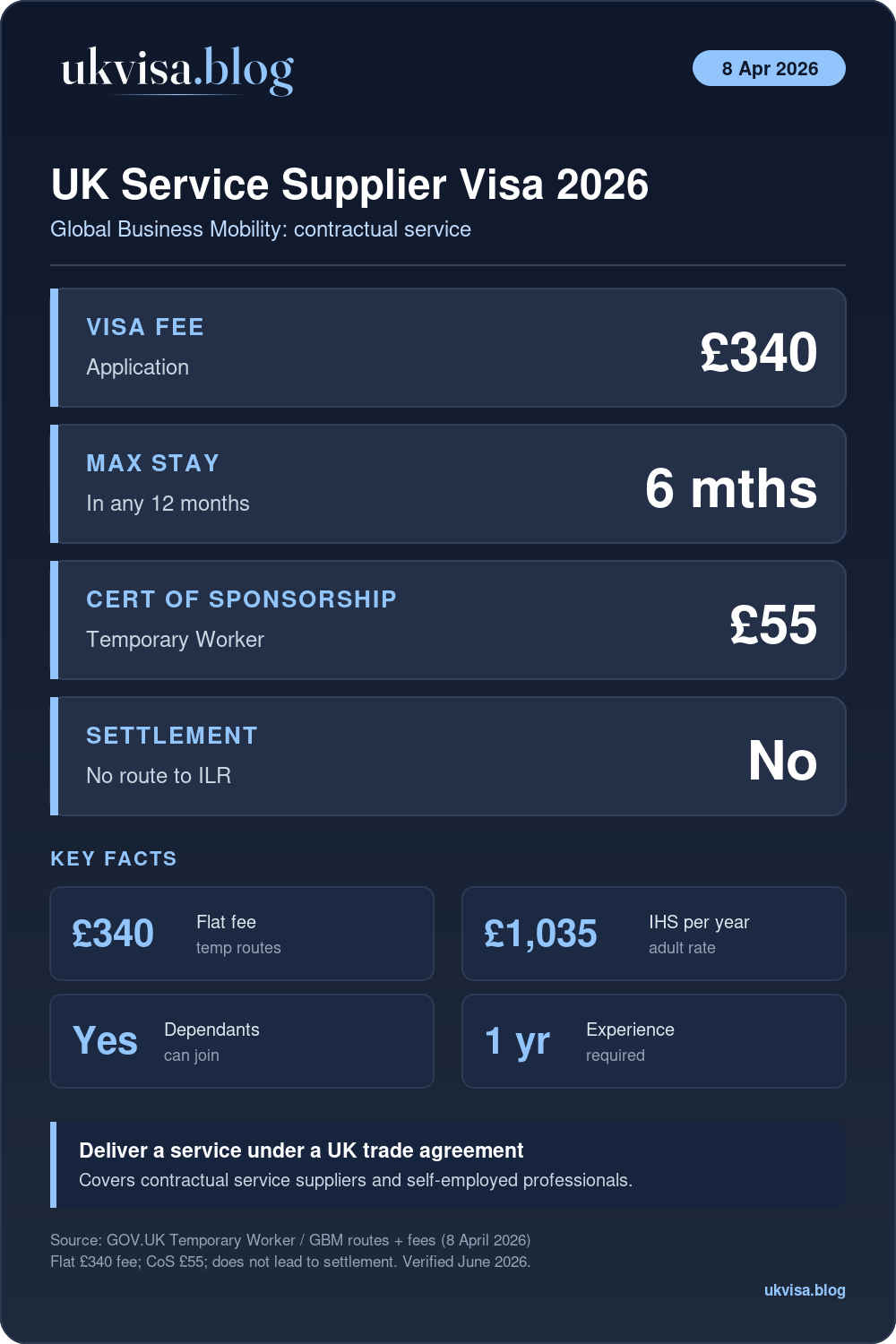
The Service Supplier visa permits two categories of overseas service providers to work temporarily in the UK: contractual service suppliers (employees of overseas businesses delivering contracted services to a UK client) and independent professionals (self-employed practitioners based overseas with a service contract for a UK client). Both must deliver services covered by a qualifying UK international trade agreement. Maximum 12 months under UK-EU TCA and UK-India CETA; 6 months under most other agreements. Application fee £340 (from 8 April 2026), £1,035/year IHS, no English test, no salary floor, no Immigration Skills Charge, no settlement pathway.
The Service Supplier route replaced the Tier 5 International Agreement provisions for contractual service suppliers and independent professionals when the GBM family launched on 11 April 2022. The architectural design is unusual: where other GBM routes operate within corporate group structures (Senior or Specialist Worker, UK Expansion Worker, Graduate Trainee, Secondment Worker), the Service Supplier route operates on a contractual basis between separate businesses. The fundamental qualifying mechanism is not corporate linkage but the existence of an applicable UK trade agreement covering both the service and the worker's nationality.
Why the Service Supplier Route Exists
UK international trade agreements typically include commitments on "Mode 4" service delivery — the temporary movement of natural persons across borders to deliver services. The Service Supplier visa is the immigration mechanism that operationalises these commitments. When the UK signs a trade agreement that includes Mode 4 commitments for contractual service suppliers and/or independent professionals, the Home Office adds the qualifying nationality and service categories to Appendix Global Business Mobility: Service Supplier. The most commercially important examples in 2026 are the UK-EU Trade and Cooperation Agreement (in force since 1 January 2021) and the UK-India Comprehensive Economic and Trade Agreement (enhanced Service Supplier provisions in force from 15 July 2026).
Contractual Service Suppliers vs Independent Professionals
The Service Supplier route covers two distinct applicant profiles with materially different evidential expectations:
| Feature | Contractual Service Supplier (Employee) | Independent Professional (Self-Employed) |
|---|---|---|
| Profile | Employee of an overseas service-providing business | Self-employed practitioner based overseas |
| Contracting party | Overseas employer holds contract with UK client | Practitioner personally holds contract with UK client |
| Prior experience required | 12 months' employment with the overseas business | 12 months' professional experience in the relevant sector |
| Skill level | RQF Level 6 (graduate level) OR degree + 3 years' sector experience | University degree (or equivalent) + any required professional qualifications |
| Certificate of Sponsorship | Assigned by overseas employer's UK partner / UK client | Assigned by the UK client directly |
| Eligible occupation list | Must be on the Service Supplier eligible occupations list | Must be on the Service Supplier eligible occupations list |
| National Minimum Wage compliance | Required (no salary floor, but NMW applies) | Required for the equivalent UK-paid component |
Independent Professional applicants must evidence both their self-employed status overseas (typically through tax registrations, professional licensing, business registration) and their continuing professional practice (client contracts, professional memberships, sector qualifications). The 12-month professional experience window must be demonstrably in the same sector as the UK service contract — not transferable across sectors. Practitioners with sector pivot histories will face additional Home Office scrutiny on the genuineness of the experience claim.
Trade Agreements Covering the Service Supplier Route
The Service Supplier route is available under several UK international trade agreements: the UK-EU Trade and Cooperation Agreement (TCA) for EU/EEA nationals; the UK-India Comprehensive Economic and Trade Agreement (CETA) for Indian nationals from 15 July 2026; the Comprehensive and Progressive Agreement for Trans-Pacific Partnership (CPTPP) for nationals of CPTPP member states from 15 December 2024; bilateral agreements with Switzerland, Singapore, Australia, Japan, Canada, Mexico, Vietnam, Norway, Iceland and others. The General Agreement on Trade in Services (GATS) under the WTO framework underpins several broader commitments. Specific service categories covered, qualifying nationalities, and maximum stay durations vary materially by agreement.
Major Trade Agreements and Maximum Stay Periods
The lead-in below summarises the trade agreement framework — full per-agreement maximum stays follow:
| Trade Agreement | Effective Date for Service Supplier | Max Stay |
|---|---|---|
| UK-EU Trade and Cooperation Agreement (TCA) | 1 January 2021 | 12 months |
| UK-India Comprehensive Economic and Trade Agreement (CETA) | 15 July 2026 | 12 months |
| Comprehensive and Progressive Agreement for Trans-Pacific Partnership (CPTPP) | 15 December 2024 (UK accession) | 12 months (Australia, Canada, Chile, Japan, Mexico, NZ, Peru, Singapore, Vietnam, Brunei, Malaysia) |
| UK-Switzerland Services Mobility Agreement | In force | 12 months |
| UK-Japan Comprehensive Economic Partnership Agreement (CEPA) | 1 January 2021 (post-Brexit version) | 12 months |
| UK-Singapore Free Trade Agreement | 11 February 2021 | 12 months |
| UK-Australia Free Trade Agreement | 31 May 2023 | 12 months |
| UK-Canada Trade Continuity Agreement | 1 April 2021 | 12 months |
| Most other bilateral / GATS-based agreements | Various | 6 months |
Source: Appendix Global Business Mobility: Service Supplier; UK trade agreement schedules of services commitments.
UK-India CETA Enhancement (15 July 2026)
The UK-India Comprehensive Economic and Trade Agreement (CETA) enters into force on 15 July 2026, enhancing the Service Supplier route to implement UK commitments under the UK-India Comprehensive Economic and Trade Agreement (CETA). The enhancement expands the eligible service sectors and locks in 12-month deployments for qualifying Indian contractual service suppliers and independent professionals. A separate collective quota of 1,800 places per calendar year applies only to Indian traditional chefs de cuisine, classical musicians and yoga teachers. Importantly, the standard requirement for 12 months' relevant overseas employment or professional experience continues to apply to qualifying CETA Indian nationals. Priority sectors include IT consulting, finance, engineering, R&D, and creative services. CETA-labelled applications target decision within 10 working days.
Three substantive changes for Indian nationals taking effect 15 July 2026: (1) maximum stay extended from 6 months to 12 months — bringing CETA parity with the UK-EU TCA cohort; (2) the list of eligible service sectors is expanded, widening the range of contracts Indian professionals can deliver — the standard 12-month overseas-experience requirement is unchanged; (3) priority processing commitment within 10 working days for CETA-labelled applications, against the standard 3-week processing time. The 1,800-place annual quota — which covers only Indian traditional chefs de cuisine, classical musicians and yoga teachers — operates on a calendar-year first-come-first-served basis (1 January to 31 December); the mainstream contractual-service-supplier and independent-professional categories are not capped.
CETA Priority Service Sectors
- IT and software services: Software development, systems integration, technology consulting, cloud architecture — the largest single sector under the CETA mobility chapter, reflecting India's services export strength.
- Financial and professional services: Investment advisory, actuarial services, audit support, regulatory consulting under reciprocal qualification recognition where applicable.
- Engineering services: Project engineering, technical consultancy, infrastructure delivery, energy sector specialisms.
- Research and development: Scientific research, technical research, applied innovation services — particularly in pharmaceuticals, fintech, biotechnology and advanced manufacturing.
- Creative and cultural services: Design services, advertising, media production, performing arts under specific service category commitments.
- Education and training services: Specialist training delivery, curriculum consulting, professional skills transfer (subject to sector-specific qualification recognition).
The 1,800-place annual quota under the UK-India CETA is a collective cap covering only three named occupations for Indian nationals: traditional chefs de cuisine, classical musicians and yoga teachers. It runs on a calendar-year basis (1 January to 31 December), first-come-first-served — once exhausted, further applications in those three occupations cannot be processed as Service Supplier under CETA until 1 January of the next year. The mainstream contractual-service-supplier and independent-professional categories are not subject to any numerical cap. All CETA applicants must still meet the standard requirement for 12 months' relevant overseas experience and hold an eligible-occupation role.
Eligibility Requirements
Be a national of a country whose trade agreement with the UK covers the specific service category; have a contract to provide qualifying services to a UK client; hold a valid Certificate of Sponsorship from the UK sponsor or client; meet 12 months' overseas employment (employees) or professional experience (self-employed); meet eligible occupation criteria (typically RQF Level 6 or equivalent); £1,270 personal savings held for 28 consecutive days (waived if sponsor certifies maintenance). National Minimum Wage applies but there is NO salary floor and NO English language test.
- Nationality match: National of a country with a qualifying UK trade agreement covering the specific service. Service category and nationality must align with the trade agreement's commitments.
- Service contract: Contractual service supplier applicants — overseas employer must hold a service contract with the UK client. Independent professional applicants — the practitioner must personally hold the service contract with the UK client.
- Certificate of Sponsorship: Valid CoS issued by the UK sponsor / UK client within 3 months of the visa application, referencing the qualifying trade agreement.
- Prior experience (standard): 12 months' continuous employment with the overseas service-providing business (employees) OR 12 months' professional experience in the same sector (self-employed).
- UK-India CETA (from 15 July 2026): the route's eligible service sectors are expanded for qualifying Indian nationals. The standard 12-month overseas-experience requirement still applies, and a separate 1,800-place annual quota covers only Indian chefs de cuisine, classical musicians and yoga teachers.
- Eligible occupation: Role must be on the GBM Service Supplier eligible occupations list under SOC 2020. Where the role is not directly listed, applicants may still qualify if they hold relevant degree-level qualifications plus 3+ years' sector experience.
- Financial maintenance: £1,270 in personal savings held for 28 consecutive days, ending within 31 days of the application date. Waived if the sponsor certifies maintenance on the CoS.
- National Minimum Wage: UK-paid component must equal or exceed the National Minimum Wage (£12.71/hour from 1 April 2026) — though there is no minimum annual salary threshold (unlike Senior or Specialist Worker's £52,500 floor).
- NO English language test: The Service Supplier route does not require any Secure English Language Test (SELT) or CEFR demonstration — unlike Skilled Worker (CEFR B2 from 8 January 2026).
- TB test certificate: Required if applying from a listed country with TB screening obligations.
- Criminal record certificate: Required for any country lived in for 12+ months in the last 10 years.
Fees and Costs from 8 April 2026
Application fee £340 from 8 April 2026 (up from £319 under the Immigration and Nationality (Fees) Order). Immigration Health Surcharge £1,035 per year (adult) or £776 per year (under 18), paid up front for the full grant period. Total Home Office cost for a 12-month single adult application: £1,375. Priority service adds £500; super-priority service adds £1,000 (where available). Sponsor pays £611 flat Temporary Worker sponsor licence and £55 per Certificate of Sponsorship. Immigration Skills Charge does NOT apply.
| Fee Component | Amount from 8 April 2026 | Notes |
|---|---|---|
| Visa application fee | £340 per person | Up from £319; uplift applies via Fees Order (not the UK-India CETA) |
| Visa extension fee | £340 per person | Same as initial application; subject to trade-agreement max stay |
| Immigration Health Surcharge — adult | £1,035 per year | Standard work-visa rate; pro-rated for visa duration |
| Immigration Health Surcharge — under 18 | £776 per year | Discounted rate for dependent children |
| Personal maintenance | £1,270 | 28 consecutive days; waived if sponsor certifies maintenance |
| Total Home Office charges (12-month visa, single adult) | £1,375 | £340 + £1,035 IHS |
| Priority service | +£500 | 5 working days target (where available) |
| Super-priority service | +£1,000 | Next working day target (where available) |
| CETA priority processing (Indian nationals) | No additional fee | 10 working day target under UK-India CETA mobility chapter |
| Sponsor — Temporary Worker sponsor licence | £611 flat | Up from £574; applies regardless of sponsor size (small/medium/large) |
| Sponsor — CoS assignment | £55 per worker | GBM Service Supplier CoS rate (vs £525 for Worker routes) |
| Sponsor — Immigration Skills Charge | £0 (exempt) | Service Supplier route is ISC-exempt |
Source: gov.uk Service Supplier visa fee schedule; Immigration and Nationality (Fees) Order amendments effective 8 April 2026.
For the wider sponsored route fee comparison across Skilled Worker, GBM and Temporary Worker families, see the UK work visa fees and ISC comparison guide. Indian nationals planning CETA-based deployments may also find the UK visa fees in Indian Rupees calculator useful for INR-denominated budgeting against current FX rates.
How to Apply
Service Supplier visa applications are submitted online via the gov.uk Service Supplier visa portal. The standard route is outside-UK application, though in-country switching from another route is permitted in some circumstances. Where the applicant is an EU/EEA/Swiss national, the UK ETA framework does not apply because the worker holds a visa.
- Step 1: UK client / sponsor confirms the service contract qualifies under a covered UK trade agreement and ensures the sponsor licence framework supports Service Supplier sponsorship (Temporary Worker licence, £611 flat).
- Step 2: Sponsor assigns the Certificate of Sponsorship (£55) via the Sponsorship Management System, identifying the trade agreement, service category, and (where applicable) the CETA quota slot for Indian nationals.
- Step 3: Applicant completes the online UK visa application portal on gov.uk — typically 30–60 minutes.
- Step 4: Pay £340 visa fee and £1,035/year IHS (pro-rated to grant period).
- Step 5: Verify identity — either via the UK Immigration: ID Check app (eligible passports) or biometric appointment at a Visa Application Centre.
- Step 6: Upload supporting documents — passport, CoS reference, evidence of overseas employment / self-employment, qualifications, service contract evidence, financial maintenance evidence, TB and criminal record certificates if applicable.
- Step 7: Decision turnaround — standard 3 weeks (outside UK) or 8 weeks (in-country switching); 10 working days for CETA-labelled Indian national applications under the bilateral commitment.
Duration of Stay by Trade Agreement
Maximum stay on the Service Supplier visa is set by the applicable trade agreement, not by the Immigration Rules generally. The grant period is the shorter of: (a) the maximum permitted under the qualifying trade agreement, OR (b) the period specified on the Certificate of Sponsorship plus 14 days.
| Trade Agreement Cohort | Maximum Stay | Extensions Permitted Within Agreement Limit? |
|---|---|---|
| UK-EU Trade and Cooperation Agreement | 12 months | Yes, within the 12-month cap |
| UK-India CETA (Indian nationals from 15 July 2026) | 12 months | Yes, within the 12-month cap and quota allowance |
| CPTPP cohort (10 member states from 15 December 2024) | 12 months | Yes, within the 12-month cap |
| UK-Japan CEPA, UK-Singapore FTA, UK-Australia FTA, UK-Canada TCA, UK-Switzerland Services | 12 months | Yes, within the 12-month cap |
| Most other bilateral and GATS-based agreements | 6 months | Yes, within the 6-month cap |
| Cumulative across all GBM routes (5-in-6 cap) | 5 years in any 6-year period | Time on Service Supplier counts against this cumulative cap |
If the UK service contract terminates before the visa expires, the UK sponsor must report the change to the Home Office within 10 working days under sponsor duties. The worker's visa may be curtailed, and the worker has 60 calendar days from the date sponsorship ends to either leave the UK, switch to a different visa category, or find a new sponsor under the same trade agreement. Failure to act within this window may result in overstaying, with significant consequences for future UK visa applications including potential re-entry bans of 1–10 years.
Service Supplier vs Other GBM Routes
The Service Supplier visa is the smallest and most specialised of the five GBM sub-routes by application volume, but the route's reach has expanded materially in 2026 following the UK-India CETA enhancement. Compared against the other four GBM categories, the qualifying mechanism is fundamentally different — the Service Supplier route is built around a contractual service relationship under a trade agreement, not corporate group structures.
| GBM Sub-Route | Qualifying Mechanism | Max Stay | Salary Floor |
|---|---|---|---|
| Service Supplier | UK trade agreement coverage | 6 or 12 months | None (NMW applies) |
| Secondment Worker | £50M+ high-value contract / investment | 2 years | None (NMW applies) |
| Senior or Specialist Worker | Intra-corporate transfer (UK trading) | 5 years (9 if salary ≥ £73,900) | £52,500 (from 22 July 2025) |
| UK Expansion Worker | Establishing new UK presence (pre-trading) | 2 years; 5-worker cap | £52,500 (from 22 July 2025) |
| Graduate Trainee | Intra-corporate structured graduate programme | 12 months | £27,300 (from 22 July 2025) |
Service Supplier vs Secondment Worker: Critical Differentiation
The two GBM routes most often confused are Service Supplier and Secondment Worker — both involve overseas-employed workers delivering services to UK clients. The qualifying mechanism is the decisive distinction. The Secondment Worker route under £50M+ contracts requires a single high-value contract or investment of at least £50 million between the overseas employer and the UK sponsor — and permits 2-year stays. The Service Supplier route requires service coverage under a qualifying UK trade agreement — and permits 6 or 12 months depending on the agreement. Where a multinational has both a CETA-qualifying Indian service delivery and a £50M-threshold UK investment project, Secondment Worker provides longer single-deployment stays but Service Supplier can accommodate more workers across the wider range of CETA-eligible service sectors in force from 15 July 2026.
Service Supplier vs Senior or Specialist Worker
The Senior or Specialist Worker route for established UK operations is the intra-corporate equivalent for overseas employees being temporarily redeployed to a UK group entity that is already trading. Where the underlying commercial arrangement is corporate group mobility (parent company sending UK subsidiary employees), Senior or Specialist Worker is the route. Where the arrangement is contractual service delivery between separate businesses under a trade agreement, Service Supplier is the route. The £52,500 salary floor under Senior or Specialist Worker (and the absent salary floor under Service Supplier) is a material commercial driver for choosing between the two routes.
Other GBM Routes
- UK Expansion Worker route for new UK branches: Pre-trading UK establishment phase — for overseas businesses that have NOT yet started trading in the UK. Capped at 5 sponsored workers per licence; maximum 2 years per worker.
- Graduate Trainee visa within structured programmes: Intra-corporate graduate-level training rotations — 12 months maximum, designed for early-career employees on structured leadership-track programmes.
Bringing Your Partner and Children
Service Supplier visa holders can bring eligible dependants — spouse, civil partner, unmarried partner (2-year durable relationship), and dependent children under 18. Each dependant submits a separate UK dependant visa application. Dependants can work in any sector without restriction during the visa period.
| Dependant | Application Fee | IHS | Additional Maintenance |
|---|---|---|---|
| Partner / spouse | £340 | £1,035/year | £285 (in addition to main applicant's £1,270) |
| First dependent child | £340 | £776/year | £315 |
| Each additional dependent child | £340 | £776/year | £200 |
Does the Service Supplier Visa Lead to ILR?
No. The Service Supplier route is fundamentally a temporary service-delivery visa, not a settlement-leading category. Time on Service Supplier does NOT count toward the 5-year continuous-residence period required for UK permanent residence (ILR). To pursue settlement, the worker must switch to a settlement-leading route — most commonly the Skilled Worker visa for permanent UK employment at the applicable Skilled Worker salary threshold from £41,700 — and the 5-year ILR clock starts from the new visa grant date. Switching from Service Supplier to Skilled Worker also requires meeting the Skilled Worker CEFR B2 English language requirement (from 8 January 2026), which is waived under Service Supplier but applies in full on Skilled Worker.
Indian nationals who enter on a Service Supplier visa under CETA can switch to Skilled Worker in-country at the end of their service contract, subject to meeting Skilled Worker eligibility (£41,700 salary, CEFR B2 English, RQF Level 6 occupation, full Home Office sponsor framework). Younger Indian professionals aged 18-30 may also be eligible for the separate India Young Professionals Scheme ballot — a non-sponsored 2-year work permission allocated by twice-yearly ballot.
- One of five Global Business Mobility sub-routes — distinguished by reliance on UK international trade agreements rather than corporate group structures.
- Application fee £340 from 8 April 2026 (up from £319 under the Immigration and Nationality (Fees) Order); £1,035/year IHS — total £1,375 for a 12-month single adult.
- UK-India CETA enhancement from 15 July 2026: expanded eligible service sectors and 12-month stays for qualifying Indian nationals (standard 12-month experience requirement unchanged), 10 working day priority processing, plus a separate 1,800-place annual quota for Indian chefs, classical musicians and yoga teachers.
- Two applicant profiles: Contractual Service Suppliers (overseas-employed) and Independent Professionals (self-employed overseas) — both require eligible occupation under SOC 2020 and trade-agreement coverage.
- Maximum stay: 12 months under UK-EU TCA, UK-India CETA, CPTPP, UK-Japan CEPA, UK-Singapore FTA, UK-Australia FTA, UK-Canada TCA, UK-Switzerland; 6 months under most other agreements.
- No English language test, no minimum salary (NMW applies), no Immigration Skills Charge.
- Standard 12-month overseas-employment / professional-experience requirement remains in force for non-CETA applicants.
- 5-in-6 cumulative cap applies across all GBM sub-routes (Service Supplier, Secondment Worker, Senior or Specialist Worker, UK Expansion Worker, Graduate Trainee).
- No direct settlement pathway — switch to Skilled Worker for the 5-year ILR clock.
For official guidance and to start the application, the authoritative entry point is the gov.uk Service Supplier visa overview. The legal framework sits in Appendix Global Business Mobility: Service Supplier. The CETA enhancement was set out in Statement of Changes HC 1691 (5 March 2026). The wider UK-India trade framework is set out in the UK-India Comprehensive Economic and Trade Agreement collection on gov.uk.
Frequently Asked Questions about Service Supplier Visa UK
The Service Supplier visa is the Global Business Mobility (GBM) sub-route for overseas employees (contractual service suppliers) and overseas-based self-employed professionals (independent professionals) delivering contracted services to UK clients under a qualifying UK international trade agreement. The route replaced the older Tier 5 International Agreement provisions on 11 April 2022. Maximum stay is 6 months under most trade agreements; 12 months under the UK-EU Trade and Cooperation Agreement, the UK-India CETA (from 15 July 2026), the CPTPP, and several bilateral agreements.
From 8 April 2026 the application fee is £340 per person (up from £319 under the Immigration and Nationality (Fees) Order). Immigration Health Surcharge is £1,035 per year for adults (£776 for under-18s), pro-rated for the visa duration. Total worker-side cost for a 12-month visa: £1,375 per adult. Sponsor pays £611 flat for the Temporary Worker sponsor licence (regardless of size), £55 per Certificate of Sponsorship, and is exempt from the Immigration Skills Charge.
The UK-India CETA enhances the Service Supplier route to implement UK commitments under the UK-India Comprehensive Economic and Trade Agreement. From 15 July 2026, qualifying Indian nationals can use the Service Supplier route for 12-month deployments across an expanded list of service sectors. A separate 1,800-place annual quota applies only to Indian chefs de cuisine, classical musicians and yoga teachers. The standard requirement for 12 months' relevant overseas experience continues to apply to qualifying CETA Indian nationals. CETA-labelled applications target decision within 10 working days against the standard 3-week processing time. Priority sectors include IT, finance, engineering, R&D, and creative services.
Both routes involve overseas-employed workers delivering services to a UK client, but the qualifying mechanism is decisive. The Service Supplier route requires the service to be covered by a qualifying UK international trade agreement (UK-EU TCA, UK-India CETA, CPTPP, etc.) and permits 6- or 12-month stays. The Secondment Worker route requires a single high-value contract or investment of at least £50 million between the overseas employer and the UK sponsor, and permits 2-year stays. Both routes are ISC-exempt, have no salary floor (NMW applies), and do not lead to settlement.
No. The Service Supplier visa has NO English language requirement — applicants do not need to take IELTS, Trinity GESE or any other Secure English Language Test, and there is no CEFR demonstration framework. This is a material differentiator from the Skilled Worker route (which requires CEFR B2 from 8 January 2026). The absence reflects the temporary, contract-based nature of Service Supplier deployments.
Generally no. The Service Supplier visa is granted for the specific service contract identified on the Certificate of Sponsorship. Any change of employer (for contractual service suppliers) or change of UK client (for independent professionals) requires an update to the visa via the gov.uk "Update your visa" framework. The substantive scope of work permitted is what is described on the CoS — additional contracts outside that scope are not authorised by the Service Supplier visa, even if technically delivered under the same trade agreement.
Maximum stay depends on the applicable trade agreement: 12 months under the UK-EU Trade and Cooperation Agreement, the UK-India CETA (from 15 July 2026), the CPTPP, the UK-Japan CEPA, the UK-Singapore FTA, the UK-Australia FTA, the UK-Canada TCA, and the UK-Switzerland Services Mobility Agreement. Most other bilateral and GATS-based agreements permit 6 months. The grant period is the shorter of the trade-agreement maximum OR the period on the Certificate of Sponsorship plus 14 days.
No. Time on the Service Supplier visa does NOT count toward the 5-year continuous-residence period required for Indefinite Leave to Remain. None of the five GBM sub-routes lead directly to settlement. To pursue settlement, the worker must switch to a settlement-leading route — most commonly Skilled Worker — and the 5-year ILR clock starts from the new visa grant date. Switching to Skilled Worker requires meeting the £41,700 salary threshold and CEFR B2 English language requirement.
Yes. Spouses, civil partners, unmarried partners (2-year durable relationship), and dependent children under 18 can apply as dependants. Each dependant pays £340 visa fee plus £1,035/year IHS (£776 for under-18s). Maintenance: £285 partner, £315 first child, £200 each additional child (waived if sponsor certifies). Dependants can work in any sector without restriction and study without limitations during the visa period — they are not limited to the trade-agreement-covered sectors that bind the main applicant.
Yes. Time spent on the Service Supplier visa counts toward the cumulative 5-years-in-any-6-year-period cap that applies across all GBM sub-routes (Service Supplier, Senior or Specialist Worker, UK Expansion Worker, Secondment Worker, Graduate Trainee) and the former Intra-Company Graduate Trainee / Intra-Company Transfer routes. This means repeated short Service Supplier deployments over a 6-year window may cumulatively block further GBM grants until the rolling window resets.